
Several years ago, in a post I’ve lost track of, a worship leader told of being approached by an older woman at church who felt the musicians should not use drums on the older, traditional hymns. He told her she didn’t have a right to impose her preferences on others.
He didn’t seem to realize that he was imposing his preferences on her.
In similar articles I’ve read since then, that seems to be the running theme–the person with more conservative music standards who voices a concern, is written off as old, out of touch, domineering, or, worst of all, a legalist.
It’s true, a lot of people want to keep things the same way they have always been “just because” that’s what they know and feel comfortable with. But a lot of people are not operating from that point of view. They’ve been taught that certain kinds of music are right and wrong. And whether they’re correct or not, their consciences have been trained in a certain way.
I’ve read that the Bible contains over 500 references to music. But it doesn’t say much about styles. It tells how music can help people emotionally, physically, and spiritually, as it did when young David played for King Saul. But when Joshua and Moses came down from the mountain with the ten commandments in Exodus 32, Joshua thought he heard noise like war in the camp. Moses said, no, it’s not war: it’s singing. Considering the people were involved in idol worship with the golden calf, and the chapter says earlier “the people sat down to eat and drink and rose up to play,” the sound was likely that of the wrong kind of revelry. So there is an indication of certain kinds of music going with certain kinds of behaviors.
The Bible tells us, “So, whether you eat or drink, or whatever you do, do all to the glory of God” (1 Corinthians 10:31) and “Do not love the world or the things in the world. If anyone loves the world, the love of the Father is not in him. For all that is in the world—the desires of the flesh and the desires of the eyes and pride of life—is not from the Father but is from the world” (1 John 2:15-16). There is a kind of music that appeals to the flesh–not just lyrics, but music. But exactly where are the lines between what’s worldly and what’s not? That takes some discernment. And some of it falls within the Romans 14 areas of differing convictions.
How much of our convictions about music are due to the culture we grew up with, to our consciences, or to the Holy Spirit’s leading? That’s what many of us wrestle with.
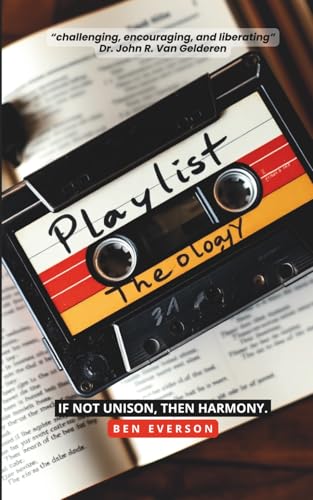
I recently came across Ben Everson’s book, Playlist Theology. He’s a “musical evangelist” from a conservative background who has given much thought to these issues. His book explores many of these questions in a careful, thoughtful, gracious way. He has the musical knowledge, experience, and vocabulary to discuss aspects of music in detail. He explores what Scripture says about music and how we can apply it.
I read one review of this book that brushed it off as saying music is amoral. That is not what Ben is saying. But he says certain aspects of music are not good or bad in themselves. The context and amount of their use can determine whether they are being used for good or bad purposes.
For instance, some people have a problem with syncopation. Ben explains what it is and names both classical music and some traditional old hymns that employ it.
Theologically, the mere presence of syncopation can’t be equated with sinfulness any more than dissonance in harmony can. Both are forms of tension that demand resolution. When tension resolves toward meaning, toward beauty, truth or praise, it becomes part of the art’s redemptive arc.
Where the moral question enters is what the tension serves. In worship, syncopation can mirror spiritual joy, spontaneity, or the exuberance of grace. . . In sensual contexts, the same rhythmic techniques can amplify bodily pleasure as an end in itself when all the other elements are bent toward lust (p. 118).
Some have trouble with the “beat” of rock music. All music has a “beat” It’s stronger in some kinds of music than others (like march music or children’s rhythmic songs). But a heavy rhythm can stir sensual feelings. (The main thing that made me throw out my rock albums as a teenager and new Christian was reading quotes from rock musicians themselves saying that their music–not just the words, but the music–was about sex and rebellion.) Ben suggests asking questions like whether the rhythm supports the melody or drives it, “What is this stirring in me? Is it leading my spirit or just exciting my body? Is it enhancing the message or overwhelming it?” (p. 142).
I have multiple quotes marked, but here are a few that stood out to me:
What’s taught in song is often remembered longer than what’s preached in a sermon (p. 34).
While the Bible doesn’t give us a list of forbidden styles, it does give us clear principles: music must glorify God, teach truth, be distinct from the world, stir the Spirit not the flesh, and flow from the heart (p. 36).
The same Bible that gives us freedom also gives us boundaries. The same God who created beauty also hates what distorts it. Discernment doesn’t mean endless openness; it means knowing where the lines actually are so we can hold them with integrity (p. 155).
I’ve realized over time that some of what I was taught about music, especially Christian music, as a young adult may have gone beyond what the Bible actually says. But I also didn’t think that meant “anything goes” now. Ben’s book was a great help to me in learning discernment about where problem areas in music are beyond “I know it when I hear it.”
I realize that for some of you, this whole conversation is totally foreign. You may have grown up with rock music and contemporary Christian music and never had a problem with it. Part of what I wrote at the beginning of this post was to try to help explain why that’s not true for everyone and hopefully encourage a little tenderness and understanding and less judgment on both sides.
____________
(To those who receive these posts via email: the last couple of times I’ve used the “quote” block in my blog posts, the quotes haven’t shown up in the email version. It was suggested to me that it might work better to use shorter quotes. I’ve done that here, so hopefully everything will come through. If it looks like something is missing, I invite you to click through to read the whole post.)
(Sharing with Between the Bookends)

