Aging with Grace

In Aging with Grace: Flourishing in an Anti-Aging Culture, Sharon Betters and Susan Hunt “want readers to ask, ‘What if aging, though challenging, is not a season of purposelessness, but rather an opportunity to discover our true identity in a way we couldn’t in the first half of life? What if we purposefully prepare for the afternoon of life while we are in the first half of life?'” (p. 18, Kindle version). The book is helpful for those already in their later years as well as those wanting to prepare for them adequately.

Susan writes, “The world tells us aging is our enemy, and we should fight it; the Bible says it’s our friend: ‘Wisdom is with the aged, and understanding in length of days'” (Job 12: 12)” (p. 27).

God promises the righteous “still bear fruit in old age; they are ever full of sap and green” (Psalm 92:14). Susan acknowledges that, with the physical problems that often accompany getting older, we don’t always feel fruitful, full of sap, and green. But “this promise of growth does not mock my physical reality; it transcends it” (p. 28).

The gospel imperative to “grow in the grace and knowledge of our Lord and Savior Jesus Christ” (2 Pet. 3: 18) does not have an age limit. The same grace that gives us new life in Christ empowers that life to develop, mature, and flourish. We never finish growing. There is always more grace to experience and more to know of Christ’s love. This growth is gradual. We don’t produce it, but as we trust and obey God’s word, we can anticipate it (p. 28).

Susan and Sharon alternate chapters. Some chapters delve into the Bible’s teaching about getting older, particularly Psalm 92 and 71. The chapters in-between take a closer look at some of the older women in the Bible: Anna, The “matriarchs of the exile,” Elizabeth, and Naomi.

Anna was the older widow who came up when Mary and Joseph brought baby Jesus to the temple in Luke 2. At first the elderly Simeon rejoiced that he had lived to see “the Lord’s Christ” and prophesied about Him. Part of that prophesy was to Mary, that “a sword will pierce through your own soul also” (Luke 2:35). I hadn’t thought about it this way before, and the Bible doesn’t specifically say that Anna spoke to Mary, but Sharon proposes that Anna’s coming right at that moment helped comfort Mary.

Simeon told Mary the hard reality that a sword would pierce her soul. Can you sense Mary holding her baby boy a little tighter, her throat constricting and tears welling up? This young mother needed a tangible touch of God’s tender love. At this intense moment we meet eighty-four-year-old Anna. God providentially met Mary’s need through an old woman who hoped in God. At exactly the right moment, Anna shows up (p. 48).

The exile Sharon refers to occurred after Israel had repeatedly rejected God and turned to idols. God had sent prophets and sometimes delivered his people into the hands of their enemies. But even if they repented for a while, they eventually turned away from God again. So God allowed Nebuchadnezzar to remove them from their land and take most of them to Babylon for 70 years. God tells the people as a whole in Jeremiah 29 to settle down, plant, build, marry, and pray for the land of their exile. The older people would have realized they would die in exile and never see their country again. Again, I don’t think the Bible specifically mentions the older women in this scenario, but Sharon posits what they might have done.

Though the elderly women might not be able to physically build houses, their status in the family gave them a key opportunity to influence the attitudes and stability of their households. They could be life-givers or life-takers. They could choose to joyfully embrace God’s call to cultivate a godly, peaceful community or they could choose bitterness, whining, and complaining, and so can we (p. 84).

A few of the other quotes that stood out to me:

There are many things we can no longer do as we age, but age does not keep us from fulfilling our purpose to glorify and enjoy God. An ever-growing knowledge of God’s undeserved love—his grace—changes our motivation: “The love of Christ controls us” (2 Cor. 5: 14)” (p. 39).

Repenting women who find rest in Jesus become life-giving women who flourish as gatherers. When our heart is Christ’s home, we can become homey places for troubled hearts to find refuge,” (p. 70).

The world equates flourishing with activity and productivity. A biblical perspective does not mean we do more; it means we become more like Christ. We mature in faith, hope, and love” (p. 98).

As counterintuitive as it sounds, flourishing is a slow and progressive death that brings abundant life. Our new heart has new desires. Even as our physical bodies grow old, God causes our new desires to flourish as they are fertilized by his word and Spirit, and we die to self-centered desires, dreams, and demands (p. 99).

As life slows down, we can become controlling and critical, or we can reflect on God’s sovereign love that chose and planted us in his house. The more we live in the light of the reality of his presence, the more we flourish as his Spirit fills us with sap to nurture and encourage others to flourish (p. 105).

One joy of aging is a stillness of soul that helps us see the small moments as sacred moments when we can reflect God’s glory to someone else (p. 145).

The plot of dirt where we die [to self] is also the place where we flourish (p. 146).

To me, flourishing means gratefully accepting the past and present trials God gives me, and looking for opportunities to use what I have learned to help others. . . Whatever situations we find ourselves in as we age, there are nuggets of gold in our past that we can pass on to others. God never wastes a trial, a grief, or a wilderness wandering. We flourish when we give to others the lessons God has taught us (p. 151).

Naomi did not know her ordinary little family would become an extraordinary link to the coming Messiah. In fact, she died without knowing how her seemingly insignificant life fit into God’s magnificent eternal tapestry (p. 154).

At the end of each chapter, the authors include testimonies from older women in various circumstances who share how they found God’s grace to flourish. 

I very much enjoyed this book and it’s encouragement that we can keep growing and flourishing at any age. I’m pretty sure I’ll be reading it again in years to come to keep reminding me of its truths.

Updated to add: I forgot to mention that I’ve been reading this book in conjunction with InstaEncouragements. They’ve been going through the book and summarizing chapters each Tuesday the last few weeks. The comments have been enlightening as well. This book was on my to-read list anyway, and when I saw they were going through it, I jumped in. Reading with a group helps reinforce what I learn plus draws out things I missed. So, if you read this book, you might want to check out those posts as well.

Be Compassionate (Luke 1-13)

In the gospel bearing his name, Luke, “having followed all things closely for some time past,” undertakes “to write an orderly account for you, most excellent Theophilus, that you may have certainty concerning the things you have been taught” (Luke 1:3-4).

Luke is a doctor and very detailed in his account. He is also a Gentile, and he emphasizes the availability of the gospel to everyone.

Luke begins before Jesus’ birth with the prediction of John the Baptist’s birth. Luke progresses the angel’s announcement to Mary that she would bear the long-awaited Messiah, the well-known Christmas story, Jesus’ ministry and teaching, death, burial, resurrection and ascension.

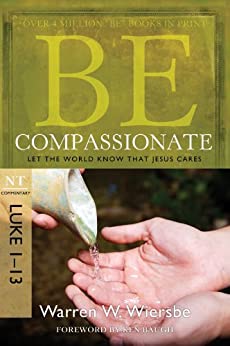
Because the book of Luke is so full, Warren Wiersbe divided up his commentary on Luke into two books. The first is Be Compassionate (Luke 1-13): Let the World Know Jesus Cares.

Wiersbe says Luke’s “key message is, ‘For the Son of man is come to seek and to save that which was lost’ (Luke 19: 10). He presents Jesus Christ as the compassionate Son of Man, who came to live among sinners, love them, help them, and die for them” (p. 16).

In the passage about Jesus’ temptation, Wiersbe says:

Satan questioned the Father’s love when he tempted Jesus to turn stones into bread. He questioned His hope when he offered Jesus the world’s kingdoms this side of the cross (see Heb. 12: 1–3). Satan questioned the Father’s faithfulness when he asked Jesus to jump from the temple and prove that the Father would keep His promise (Ps. 91: 11–12). Thus, the enemy attacked the three basic virtues of the Christian life—faith, hope, and love (p. 52).

I’ve often heard that this passage shows Satan tempting Jesus with “the lust of the flesh, and the lust of the eyes, and the pride of life” that 1 John 2:16 describes. I think that’s true as well as Wiersbe’s viewpoint.

In response to Jesus answering Satan’s temptation with Scripture, Wiersbe says:

Jesus balanced Scripture with Scripture to get the total expression of God’s will. If you isolate verses from their contexts, or passages from the total revelation of Scripture, you can prove almost anything from the Bible. Almost every false cult claims to be based on the teachings of the Bible (p. 53).

Some of the other quotes that stood out to me:

It was our Lord’s custom to attend public worship, a custom His followers should imitate today (Heb. 10: 24–25). He might have argued that the “religious system” was corrupt, or that He didn’t need the instruction, but instead, He made His way on the Sabbath to the place of prayer (p. 54).

Jesus was not teaching that poverty, hunger, persecution, and tears were blessings in themselves. If that were true, He would never have done all He did to alleviate the sufferings of others. Rather, Jesus was describing the inner attitudes we must have if we are to experience the blessedness of the Christian life (p. 80).

Life is built on character, and character is built on decisions. But decisions are based on values, and values must be accepted by faith (p. 81).

There is a difference between doubt and unbelief. Doubt is a matter of the mind: We cannot understand what God is doing or why He is doing it. Unbelief is a matter of the will: We refuse to believe God’s Word and obey what He tells us to do. “Doubt is not always a sign that a man is wrong,” said Oswald Chambers. “It may be a sign that he is thinking.” In John’s case, his inquiry was not born of willful unbelief, but of doubt nourished by physical and emotional strain (p. 93).

There are many people today who criticize the church for not “changing the world” and solving the economic, political, and social problems of society. What they forget is that God changes His world by changing individual people. History shows that the church has often led the way in humanitarian service and reform, but the church’s main job is to bring lost sinners to the Savior. Everything else is a by-product of that. Proclaiming the gospel must always be the church’s first priority (p. 94).

Power is the ability to accomplish a task, and authority is the right to do it, and Jesus gave both to His apostles (p. 117).

It is impossible to be wrong about Jesus and right with God (p. 121).

We must first say no to ourselves—not simply to pleasures or possessions, but to self—and then take up our cross and follow Christ daily. This means to be identified with Him in surrender, suffering, and sacrifice (p. 122).

[After the transfiguration] As wonderful as these experiences are, they are not the basis for a consistent Christian life. That can come only through the Word of God. Experiences come and go, but the Word remains. Our recollection of past experiences will fade, but God’s Word never changes. The farther we get from these events, the less impact they make on our lives. That was why the Father said, “Hear him!” and why Peter made this same emphasis on the Word in his report (2 Peter 1: 12–21). Our own personal “transfiguration” comes from inner renewal (Rom. 12: 1–2), and that comes from the Word (2 Cor. 3: 18) (pp. 125-126).

I appreciate Dr. Wiersbe’s insights and commentary on the Scriptures.

The Four Loves

In The Four Loves by C. S. Lewis, he says that when he contemplated writing about love, he thought there were two types: Need-Love and Gift-Love. Need-love is that of a child for its parents, who meet its needs and comfort when frightened. Gift-love is that of a man who works hard for the well-being of his family. Lewis was going to propose that the latter is more like God because He gives and needs nothing. Need-love, however, seemed totally selfish and not deserving of the name “love.”

But, he reasoned, no one thinks a child is selfish for looking to its parents for comfort or an adult selfish for wanting the companionship of friends. And man’s love to God is almost totally Need-love.

It would be a bold and silly creature that came before its Creator with the boast ‘I’m no beggar. I love you disinterestedly.’ Those who come nearest to a Gift-love for God will next moment, even at the very same moment, be beating their breasts with the publican and laying their indigence before the only real Giver. And God will have it so. He addresses our Need-love: ‘Come unto me all ye that travail and are heavy-laden,’ or, in the Old Testament, ‘Open your mouth wide and I will fill it’ (pp. 3-4).

Lewis also differentiates between Need-pleasures and Appreciation-pleasures. One quote stood out to me here because I see this in online discussions all the time.

We must be careful never to adopt prematurely a moral or evaluating attitude. The human mind is generally far more eager to praise and dispraise than to describe and define. It wants to make every distinction a distinction of value; hence those fatal critics who can never point out the differing quality of two poets without putting them in an order of preference as if they were candidates for a prize (pp. 14-15).

Next he writes a chapter titled “Likings and Loves for the Sub-Human”—about love of nature, home, family, country. There’s much to contemplate here, but I’ll just share this one quote from this chapter: “All natural affections, including this, can become rivals to spiritual love: but they can also be preparatory imitations of it, training (so to speak) of the spiritual muscles which Grace may later put to a higher service” (p. 30).

Then Lewis determined that there were four loves and dedicated a chapter each to each one.

First is Affection, or storge in the Greek (“two syllables and the g is ‘hard,'” p. 41). He describes Affection as “a warm comfortableness . . . satisfaction in being together . . . the least discriminating of loves” (p. 41). Affection is “the humblest love. It gives itself no airs” (p. 43). Affection can be in combination with the other loves or not.

Next comes friendship. You’d think that would be part of Affection. But Affection can be felt for pets and even people we don’t like very much. If I understand it rightly, it’s not as deep as friendship.

This chapter contains Lewis’ famous quote, “The typical expression of opening Friendship would be something like, ‘What? You too? I thought I was the only one'” (p. 82).

“To the Ancients, Friendship seemed the happiest and most fully human of all loves; the crown of life and the school of virtue. The modern world, in comparison, ignores it” (pp. 72-73). This book was published in 1960 and its elements were first shared in a series of radio talks. I don’t know if Lewis would say the same today. However, I am sure he would emphasize even more in our day that “It has actually become necessary in our time to rebut the theory that every firm and serious friendship is really homosexual” (p. 76).

Those who cannot conceive Friendship as a substantive love but only as a disguise or elaboration of Eros betray the fact that they have never had a Friend. The rest of us know that though we can have erotic love and friendship for the same person yet in some ways nothing is less like a Friendship than a love-affair. Lovers are always talking to one another about their love; Friends hardly ever about their Friendship. Lovers are normally face to face, absorbed in each other; Friends, side by side, absorbed in some common interest (p. 77).

Friendship is also not just between two people, though it can be. A group of friends enhances the friendship of each with the other. “In each of my friends there is something that only some other friend can fully bring out. By myself I am not large enough to call the whole man into activity; I want other lights than my own to show all his facets” (p. 77).

Friendship also has its good and bad sides. There is a certain exclusiveness to friendship–we can’t be as close to everyone as we are with our closest friends. But that can turn to snobbishness or cliqueishness. It can also form an “us against the world” attitude where we close off criticisms or efforts to point out problems or disagreements. Friendship must “invoke the divine protection if it is to remain sweet” (p. 111).

The third love, Eros, is what Lewis calls romantic love. I’ve always heard the Greek word eros meant sexual, physical love, but Lewis call that Venus. People can experience Eros and Venus together or just one or the other.

Sexual desire, without Eros, wants it, the thing in itself; Eros wants the Beloved. The thing is a sensory pleasure; that is, an event occurring within one’s own body. . .

Now Eros makes a man really want, not a woman, but one particular woman. In some mysterious but quite indisputable fashion the lover desires the Beloved herself, not the pleasure she can give (p. 120).

Eros, like Friendship, can have good and bad sides. Our fallen nature can corrupt any good thing.

The last of the four loves, according to Lewis, is Charity or agape in Biblical Greek. Lewis warns many times that our natural loves can act as rivals to the love of God. But he also warns that love of God does not erase or demean our naturals loves. Rather, His love infuses them to be what He created them to be.

Lewis gives an example from Augustine (which, in the providence of God, I just finished reading). Augustine had a dear friend, Nebridius, whose death plunged him into despair and desolation. “This is what comes, [Augustine] says, of giving one’s heart to anything but God” (p. 153). Therefore, he concludes we shouldn’t love other people so much. “If love is to be a blessing, not a misery, it must be for the only Beloved who will never pass away” (p. 153). Lewis responds:

Of course, this is excellent sense. . . I am a safety-first creature. Of all arguments against love none makes so strong an appeal to my nature as ‘Careful! This might lead you to suffering.’ To my nature, my temperament, yes. Not to my conscience. When I respond to that appeal I seem to myself to be a thousand miles away from Christ. If I am sure of anything I am sure that His teaching was never meant to confirm my congenital preference for safe investments and limited liabilities. I doubt whether there is anything in me that pleases Him less (p. 153-154).

To love at all is to be vulnerable. Love anything, and your heart will certainly be wrung and possibly be broken (p. 155).

The only place outside Heaven where you can be perfectly safe from all the dangers and perturbations of love is Hell. I believe that the most lawless and inordinate loves are less contrary to God’s will than a self-invited and self-protective lovelessness. It is like hiding the talent in a napkin and for much the same reason. . . Christ did not teach and suffer that we might become, even in the natural loves, more careful of our own happiness (p. 155).

We shall draw nearer to God, not by trying to avoid the sufferings inherent in all loves, but by accepting them and offering them to Him; throwing away all defensive armour. If our hearts need to be broken, and if He chooses this as the way in which they should break, so be it (pp. 155-156).

Lewis then goes on to a good discussion of what it means when God says He loved Jacob but hated Esau, or what God meant when He tells us we can’t be His disciples without hating mother, father, etc., which He tells us in other places to love. One helpful quote from this section:

To hate is to reject, to set one’s face against, to make no concession to, the Beloved when the Beloved utters, however sweetly and however pitiably, the suggestions of the Devil. A man, said Jesus, who tries to serve two masters, will ‘hate’ the one and ‘love’ the other. It is not, surely, mere feelings of aversion and liking that are here in question. He will adhere to, consent to, work for, the one and not for the other (p. 157).

But then we’re called to show this agape kind of love to others. And when we try, we quickly see it’s not in us naturally.

The invitation to turn our natural loves into Charity is never lacking. It is provided by those frictions and frustrations that meet us in all of them; unmistakable evidence that (natural) love is not going to be ‘enough’— . . . But in everyone, and of course in ourselves, there is that which requires forbearance, tolerance, forgiveness. The necessity of practising these virtues first sets us, forces us, upon the attempt to turn—more strictly, to let God turn—our love into Charity. These frets and rubs are beneficial (p. 173).

These can be raised with Him only if they have, in some degree and fashion, shared His death; if the natural element in them has submitted—year after year, or in some sudden agony—to transmutation (p. 174).

Even though this is an overly long review, I still feel I’ve only scratched the surface of the book. And even though I gleaned much from the book, I can already tell I’ll need to read it again some time.

I like to read whole chapters of this kind of fiction at a time so I can follow and hopefully retain the author’s thoughts all the way through. But with only six chapters in a 192-page book, the chapters are long. It wasn’t until the last chapter that I hit on the idea of taking it in much shorter bits and chewing on that for a while before moving on. I’ll have to try that through the whole book next time.

As always, Lewis has a way of stating and illustrating some things in a way to make them startlingly clear and convicting.

I’ll close with one last quote sharing the need for surrendering to God:

This pretence that we have anything of our own or could for one hour retain by our own strength any goodness that God may pour into us, has kept us from being happy. We have been like bathers who want to keep their feet—or one foot—or one toe—on the bottom, when to lose that foothold would be to surrender themselves to a glorious tumble in the surf. The consequences of parting with our last claim to intrinsic freedom, power, or worth, are real freedom, power, and worth, really ours just because God gives them and because we know them to be (in another sense) not ‘ours’ (pp. 167-168).

I’m counting this book for the Nonfiction Classic in the Back to the Classics Challenge.

The Confessions of St. Augustine

Augustine of Hippo wrote his Confessions partly as an autobiography, partly to express his views on doctrine.

Augustine was born in 354 and grew up in northern Africa. His mother, Monica, was a Christian, but his father was a pagan until close to his death. Augustine was sent to school to study rhetoric and eventually taught grammar and later rhetoric in Carthage, Milan, and Rome.

In the school he was sent to, boys bragged about their sexual exploits, even making up encounters so as to have something to tell. He began a relationship with a mistress that produced one son. He later agreed to forsake his mistress and marry, but the girl he was engaged to was too young. In the meantime, he took another mistress.

He was involved for many years in Manichaeism and astrology.

When Augustine first began to study the claims of Christianity, he was plagued by what the nature of God was, the origin of evil, and the seeming unconquerable hold his lust had on him.

Through reading, study, and conversations with others, he eventually he turned away from Manichaeism, disproved astrology, and came a satisfactory understanding of the nature of God and evil. It took a very long time, however, for him to be willing to give up his lust. He once famously prayed, “Grant me chastity and continence, but not yet.” He tells how this last stronghold was broken and how he came to believe in Christ for salvation and was baptized.

Confessions is written in thirteen books, the first nine autobiographical and the last four philosophical. He was only in his forties when he wrote it and lived until 76, so the book only covers the first half of his life. Wikipedia says Confessions is the “first Western Christian autobiography.” It’s written somewhat like the psalms, with Augustine’s history or thoughts on a subject followed by bursts of penitence or praise. In his introduction, the translator of this edition says:

One does not read far in the Confessions before he recognizes that the term “confess” has a double range of meaning. On the one hand, it obviously refers to the free acknowledgment, before God, of the truth one knows about oneself—and this obviously meant, for Augustine, the “confession of sins.” But, at the same time, and more importantly, confiteri means to acknowledge, to God, the truth one knows about God. To confess, then, is to praise and glorify God; it is an exercise in self-knowledge and true humility in the atmosphere of grace and reconciliation.

Augustine is considered one of the early church fathers. Though a Catholic, he is also claimed by many Protestants as well. Of course, the Reformation wouldn’t happen until the 1500s. But some of the seeds of Protestant thought are in Augustine’s writings, one being the doctrine of original sin.

Confessions was one of those “I probably ought to read that sometime” books. I put it off several times, thinking it would be hard to understand.

The words themselves weren’t hard to understand. The copy I read and listened to was originally translated by Albert C. Outler in 1955 and then included in this version in 2002, so perhaps the archaic language was modernized. But as Outler said in his introduction, “A succinct characterization of Augustine is impossible, not only because his thought is so extraordinarily complex and his expository method so incurably digressive, but also because throughout his entire career there were lively tensions and massive prejudices in his heart and head.” “Incurably digressive” was a good way to put it.

The dialogue and narrative testimony wasn’t hard to understand, either.

But what I found hard to follow were Augustine’s lengthy trains of thought: for example, over 16 Kindle pages pondering what was meant by “The earth was without form and void” in Genesis 1:2, 20 pages on what time is and how it is measured, similar long discourses on memory and many other subjects.

Also, I am not familiar with many of the schools of thought or warring doctrines and philosophies of the times. In fact, I am sorry to say that I know very little about the first millennium AD after the first century or so.

Augustine’s famous quote, “Thou hast made us for thyself and restless is our heart until it comes to rest in thee,” comes from the first page of his confessions. Some of my other favorite quotes:

Thou wast always by me, mercifully angry and flavoring all my unlawful pleasures with bitter discontent, in order that I might seek pleasures free from discontent. But where could I find such pleasure save in thee, O Lord—save in thee, who dost teach us by sorrow, who woundest us to heal us, and dost kill us that we may not die apart from thee.

I especially liked “mercifully angry” and “woundst us to heal us.”

I got a lot from his discussion of the will and struggles with food, especially that “What is sufficient for health is not enough for pleasure.”

He had a section on people with differing interpretations and Scripture and said, “In this discord of true opinions let Truth itself bring concord, and may our God have mercy on us all, that we may use the law rightly to the end of the commandment which is pure love.”

I enjoyed finding an incident I had heard, but did not know came from this book. Augustine’s mother, Monica, had prayed for him for years. She talked to a bishop who had had some of the same struggles as Augustine with the Manicheans. She wanted the bishop to speak to Augustine, but he felt Augustine was unteachable at the moment, and they should just pray for him for now. She cried and begged him, until he said, “It cannot be that the son of these tears should perish.”

There was another illustration I had heard but didn’t realize came from Augustine until I read it here. He tells of a friend, Alypius, who had “a passion for the gladiatorial shows,” but determined they were bad for him and he wouldn’t attend any more. One night he ran into some friends who, with “friendly violence . . . drew him, resisting and objecting vehemently, into the amphitheater” to watch. He determined to keep his eyes closed. But a cry from the audience caused him to open his eyes, and, “as soon as he saw the blood, he drank it in with a savage temper.” He became enamored once again with the violence of the games, receiving “a deeper wound in his soul than the victim.”

There was one famous illustration that I was looking forward to reading that was not in the book. The story is told that, after Augustine’s conversion, he ran into one of his mistresses on the street. He tried to avoid her, but she kept following and calling to him, “Augustine, it is I.” He was said to have answered, “Yes, but it is no longer I.” This article indicates this incident may not have ever happened. On the other hand, it may have come from some of Augustine’s writings that are not searchable online. At any rate, it’s not in his Confessions.

I am not Catholic and therefore couldn’t agree with his distinctly Catholic views. Probably my biggest disagreement is that, though he expressed faith and his life changed before his baptism, he equated salvation with baptism several times in the book. Also, he spends a lot of time near the end of the book interpreting creation allegorically–the firmament is supposed to mean the Bible, the spiritual gifts are supposedly meant by the sun, moon, and stars. etc. He goes into a great deal of explanation as to how he came to these conclusions. But personally, I think we have to be careful not to make something in the Bible symbolic that the Bible doesn’t convey as symbolic. He and his mother also put a lot of stock in visions and dreams, which I don’t.

So, I have mixed views about Augustine. But I am glad to finally have read this book.

I started out listening to the audiobook read by one of my favorite narrators, Simon Vance. I read parts in this 99-cent Kindle version, but didn’t find Augustine’s arguments any easier to follow. The last few pages, I read along while listening to the audiobook. That seemed to be the clearest way for me to gain the most from the book. If I ever read it again—which won’t be for a very long time to come—I’ll have to try it that way from the beginning.

I am counting this book for the Pre-1800 Classic for the Back to the Classics Challenge hosted by Karen at Books and Chocolate.

Have you ever read Augustine’s Confessions? What did you think?

Be Responsible (1 Kings)

Warren Wiersbe helps us glean understanding in Be Responsible (1 Kings): Being Good Stewards of God’s Gifts.

The book of 1 Kings begins with the death of David, Israel’s greatest king, and ends with the death of Ahab, one of Israel’s worst kings.

In-between those two kings, the temple was built, but then the kingdom of Israel split in two. The southern kingdom, Judah, was ruled by David’s line. The northern kingdom with the rest of the tribes was ruled by various people.

A few of the kings were good to some degree, but most were bad and led Israel in their besetting sin, idolatry.

God raised up prophets to warn the kings and the people about the danger they were in due to their disobedience. This book had Elijah’s famous showdown with the prophets of Baal and Elisha taking up Elijah’s mantle. But there were many unnamed prophets faithfully doing God’s will.

Here are some of the quotes that stood out to me from Wiersbe’s writing:

The two books of Kings record about four hundred years of the history of Israel and Judah, while the two books of Chronicles see the history of the united kingdom and then the kingdom of Judah from the priestly point of view. Besides recording history, these books teach theology, especially the faithfulness of God in keeping His covenant, the sovereignty of God in directing the destinies of all nations, and the holiness of God in opposing idolatry (p. 13).

Integrity is one of the vital foundations of society, but integrity involves taking responsibility and facing accountability. This includes leadership in the home and church as well as in the halls of academe and the political chambers. It’s one thing to make promises at the church altar or to take an oath of office, but it’s quite another to assume responsibility and act with courage and honesty and seek to please God (p. 11).

God took the consequences of David’s two worst sins—a piece of property and a son—and built a temple! “But where sin abounded, grace abounded much more” (Rom. 5: 20 NKJV). This isn’t an encouragement for us to sin, because David paid dearly for both of those transgressions, but it is an encouragement to us to go on serving God after we’ve repented and confessed our sins. Satan wants us to think that all is lost, but the God of all grace is still at work (1 Peter 5: 10) (p. 53).

“Because of our proneness to look at the bucket and forget the fountain,” wrote Watchman Nee, “God has frequently to change His means of supply to keep our eyes fixed on the source” (p. 160).

Responsibility means our response to His ability (p. 214).

I appreciate Dr. Wiersbe’s help in getting more from 1 Kings.

“Don’t Call Me Spry”

It’s a shock to the system when you realize someone thinks of you as “old.”

For me, it happened when a fast-food cashier rang up my order with a senior discount—and I was only 50.

For Win Couchman, it happened when she ran into an old friend who commented, “You’re so spry!” “Spry” was a “compliment reserved for exclusively for old people.”

As the shock of this well-meant statement brought Win to tears, she began to consider aging.

I am at the young end of old: junior-high old. Youth is gone and now, also, middle age. My life at sixty-four is rich, adventurous, blessed, and full of joy (p. 2).

I am not only wrinkling. I am growing. And while I am forgetting some things, I am learning much that is new. This season of my life is as fearsome and exciting as turning fourteen. Nobody told me it would be this way (p. 3).

She decided to investigate “what it means to grow old” from the Bible, culture, the examples of older people in her life (“Not everything I learned from Grandmother about aging was glamorous, but all of it was valuable” [p.84]). She wanted to “notice and enjoy the perks that come with old age” (p. 4).

The results of her study and contemplation is “Don’t Call Me Spry”: Creative Possibilities for Later Life.

Win noted, “The halves of my life each merit my attention. The tension between the material and spiritual aspects of reality are normal. The struggle is to keep a balance: to live in light of the unseen while resetting the washer from ‘permanent press’ to ‘delicate fabrics.’ In order to live for God’s glory and not lose heart, I have the perspective of the eternal as a gift” (p. 4).

In their fifties, Win and her husband, Bob, began to pray and consider what to do when he retired. For many years, they had hosted a ministry called Forever Family which combined hospitality, mentoring, counseling, and teaching. But they were sensing maybe the time had come to do something different.

Through a series of events and contacts, the door eventually opened for them to minister in a variety of other countries eight months out of the year. They enjoyed the novelty and the opportunities to minister, resulting in some never-to-be forgotten experiences.

But they also experienced stresses with travel and continual adjustments, and they handled them differently. She liked to talk things out when stressed or anxious; he withdrew and became quiet. I’m sure those tendencies were always a part of their personalities, but these new experiences brought them to the forefront and required them to meet each other half-way.

Bob’s retirement brought other stresses and adjustments, like sharing space that she had previously had to herself.

Then new stresses arose when Win developed a heart issue which brought not only their international travel to a close, but their full-time active ministry as well. She had to rethink what she could do within her new reality. “It grieved me to give up thinking I could do anything anyone even a generation or two younger than I can do” (p. 45).

It saddened me to give up the illusion that I could always push myself a bit more if I needed to, that pushing was the thing to do. I could no longer be casual about getting too tired. I was newly aware of another true separation between me and those who are younger (p. 46).

She tells how God led her to other types of ministry, mainly mentoring, prayer, being involved with her grandchildren. She still taught and spoke on a limited basis.

One of my favorite chapters is “The Downside,” dealing with some of the negative aspects of aging. “When you ask me how I am, sometimes it is a little hard to know how to answer” (p. 107).

But even though Win describes herself as a pessimist, overall the book is hopeful and positive. The Bible assures that God’s care and love and grace will always be with us. In addition:

As I have looked repeatedly into the mirror of these verses, I have not only been provided with new assurance of God’s caring for me, but I have a greatly enhanced concept of the possibility of lifelong usefulness (p. 136).

While searching for more information about Win, I came across this video of her.

I had not heard of Win before until I read a chapter by her in The Wonder Years: 40 Women over 40 on Aging, Faith, Beauty, and Strength compiled by Leslie Leyland Fields. I didn’t discover until recently that her chapter, “The Grace to Be Diminished,” originally came from a magazine here. Then I found her poignant article, “The Beds I Have Known,” about living separately from her husband of 72 years when she could no longer care for him. I saw somewhere that she had written this book, so I searched for it. It’s out of print, but I found a used copy in good condition for $5 at Amazon.

I am glad to have found and read it. It gave me much encouragement as I look ahead.

Be Encouraged: Wiersbe on 2 Corinthians

The church in Corinthians had lots of problems. 2 Corinthians is actually the fourth letter Paul wrote to the church at Corinth. His second letter to them is our 1 Corinthians. Some of Paul’s opponents had invaded the church and stirred up rebellion. A previous visit by Paul to deal with the issues had not gone well. Paul left and then sent by Titus a “severe” letter. He rejoiced that many in Corinth repented. So in this letter, Paul wanted to encourage those who had repented but warn those who had not.

He also had to defend his apostleship from various charges.

Plus, the Corinthians had promised some time before to send an offering for the poor in Jerusalem, but had not done so yet. Paul planned to pick up their donations to take along with what he had collected from other churches, so he encouraged them to give and give cheerfully. The offering would not only help meet material needs, but would help unite the Jewish and Gentile congregations.

Dr. Warren W. Wiersbe’s short commentary on 1 Corinthians is Be Encouraged (2 Corinthians): God Can Turn Your Trials Into Triumphs.

In the first chapter, Wiersbe writes:

One of the key words in this letter is comfort or encouragement. The Greek word means “called to one’s side to help.” The verb is used eighteen times in this letter, and the noun eleven times. In spite of all the trials he experienced, Paul was able (by the grace of God) to write a letter saturated with encouragement.

What was Paul’s secret of victory when he was experiencing pressures and trials? His secret was God. When you find yourself discouraged and ready to quit, get your attention off of yourself and focus it on God. Out of his own difficult experience, Paul tells us how we can find encouragement in God (p. 18).

Wiersbe also points out:

The words comfort or consolation (same root word in the Greek) are repeated ten times in 2 Corinthians 1: 1–11. We must not think of comfort in terms of “sympathy,” because sympathy can weaken us instead of strengthen us. God does not pat us on the head and give us a piece of candy or a toy to distract our attention from our troubles. No, He puts strength into our hearts so we can face our trials and triumph over them. Our English word comfort comes from two Latin words meaning “with strength.” The Greek word means “to come alongside and help.” It is the same word used for the Holy Spirit (“ the Comforter”) in John 14—16.

God can encourage us by His Word and through His Spirit, but sometimes He uses other believers to give us the encouragement we need (2 Cor. 2: 7–8; 7: 6–7) (p. 20).

Dr. Wiersbe also shares that “There are ten basic words for suffering in the Greek language, and Paul uses five of them in this letter” (p. 20).

I won’t go point by point through Corinthians–Wiersbe includes an outline as well as discussion. But some of the most well-known passages in this book of the Bible are these: God comforts us in all our affliction and we comfort others (1:2-7); when we behold God, we become more like Him (3:18), “we have this treasure in jars of clay, to show that the surpassing power belongs to God and not to us” (4:7-12), though outwardly we’re wasting away, inwardly we’re renewed day by day, and our “light momentary affliction” prepares for us “an eternal weight of glory beyond all comparison” (4:16-18), the ministry of reconciliation (5), Now is the day of salvation (6:2), we’re God’s temple and shouldn’t be yoked up with darkness (6:14-18), godly grief vs. worldly grief (7:5-12), grace giving (8:1-15), the cheerful giver, sowing and reaping (9:1-15), “God is able to make all grace abound to you, so that having all sufficiency in all things at all times, you may abound in every good work” (9:8), Paul’s thorn in the flesh, God’s strength in our weakness, (12:7-10), “Examine yourselves, to see whether you are in the faith” (13:5).

Some other quotes from Wiersbe that stood out to me:

The word sufficiency means “adequate resources within” (see Phil. 4: 11). Through Jesus Christ, we can have the adequacy to meet the demands of life. As Christians, we do need to help and encourage one another; but we must not depend on one another. Our dependence must be on the Lord. He alone can give us that “well of water” in the heart that makes us sufficient for life (John 4: 14) (p. 117).

God did not give Paul any explanations; instead, He gave him a promise: “My grace is sufficient for thee.” We do not live on explanations; we live on promises. Our feelings change, but God’s promises never change. Promises generate faith, and faith strengthens hope (p. 160).

How do people measure the ministry today? By powerful oratory or by biblical content? By what the media says or by Christian character? (p. 169).

Paul prayed for their perfection, which does not mean absolute sinless perfection, but “spiritual maturity.” The word is part of a word family in the Greek that means “to be fitted out, to be equipped.” As a medical term, it means “to set a broken bone, to adjust a twisted limb.” It also means “to outfit a ship for a voyage” and “to equip an army for battle.” In Matthew 4: 21, it is translated “mending nets.”

One of the ministries of our risen Lord is that of perfecting His people (Heb. 13: 20–21). He uses the Word of God (2 Tim. 3: 16–17) in the fellowship of the local church (Eph. 4: 11–16) to equip His people for life and service. He also uses suffering as a tool to equip us (1 Peter 5: 10). As Christians pray for one another (1 Thess. 3: 10) and personally assist one another (Gal. 6: 1, where “restore” is this same word perfect), the exalted Lord ministers to His church an makes them fit for ministry (pp. 170-171).

Sometimes the minister of the Word must tear down before he can build up (see Jer. 1: 7–10). The farmer must pull up the weeds before he can plant the seeds and get a good crop. Paul had to tear down the wrong thinking in the minds of the Corinthians (2 Cor. 10: 4–6) before he could build up the truth in their hearts and minds. The negative attitude of the Corinthians made it necessary for Paul to destroy, but his great desire was to build (pp. 171-172).

2 Corinthians closes with a well-known benediction: “The grace of the Lord Jesus Christ and the love of God and the fellowship of the Holy Spirit be with you all” (13:14).

Wiersbe says of this verse:

If each believer is depending on the grace of God, walking in the love of God, and participating in the fellowship of the Spirit, not walking in the flesh, then he will be a part of the answer and not a part of the problem. He will be living this benediction—and being a benediction to others! (p. 174).

Amen.

Another Gospel? A Lifelong Christian Seeks Truth in Response to Progressive Christianity

Alisa Childers’ faith wasn’t shaken by an atheist professor or a New Age neighbor.

Her beliefs were dismantled by her pastor.

She knew and trusted him. He had invited a select group of “out of the box thinkers” to a special class, a “safe zone to process our doubts and questions.” Alisa was surprised when he began to question and then to take apart the doctrines she had always believed.

“I wouldn’t hear the term progressive Christianity until years later. But it was clear that this group of people wanted to ‘progress’ beyond the Christianity they had known. They were going through what would practically become a rite of passage in this new and flourishing movement: deconstruction. In the context of faith, deconstruction is the process of systematically dissecting and often rejecting the beliefs you grew up with” (p. 24).

There were things that bothered Alisa about Christianity as it had always been presented, things like massive altar calls where people streamed forward. Did those people know what they were doing? Did their decision “stick?”

But those things didn’t cause her to question her foundational beliefs. Her pastor’s class did. She realized she knew what she believed, but not why. She had grown up in a Christian family who actively ministered to others. But her faith was “intellectually weak and untested” (p. 5).

“When progressive Christianity first entered the scene, its proponents raised some valid critiques of evangelical culture that the church needed to examine and reevaluate. But those progressives who reject essential teachings—like the physical resurrection of Jesus—can confuse unsuspecting Christians and kick the foundation out from under them” (p. 8).

This class led her into a dark pit, “a spiritual blackout—a foray into darkness like I’d never known” (p. 8). What if everything she had ever believed was false? Another girl in the class stood next to her in choir practice one day and said, “It’s funny that we’re all singing these songs and none of us have any idea what we believe!” (p. 28).

That wasn’t good enough for Alisa. “When I have doubts about my faith, or deep nagging questions that keep me up at night, I don’t have the luxury of finding ‘my truth’ because I am committed to the truth. I want to know what is real. I want my worldview (the lens through which I see the world) to line up with reality. God either exists, or he doesn’t. The Bible is his Word, or it’s not. Jesus was raised from the dead, or he wasn’t. Christianity is true, or it isn’t. There is no ‘my truth’ when it comes to God” (p. 10).

“I wanted to progress in my faith . . . in my understanding of God’s Word, my ability to live it out, and m relationship with Jesus. But I didn’t want to progress beyond truth” (p. 25).

Alisa prayed for God to send her a lifeboat. And He did, sending more than one. Alisa took time to study in detail the claims of the foundational doctrines of Christianity. It was a long process. Sometimes her study brought up more questions.

“Slowly and steadily, God began to rebuild my faith. The questions that had knocked the foundation out from under my beliefs—the ones I had never thought to ask, the ones I didn’t know existed—were not simply being answered. They were being dwarfed by substantial evidence and impenetrable logic so robust that I felt like a kid in a candy store—who had just found out that candy exists” (p. 227).

Her faith didn’t look exactly as it had before. She corrected some beliefs and determined some, while important, weren’t essential. But her beliefs in the fundamental truths of historic Christianity were now on a firm foundation.

Another Gospel: A Lifelong Christian Seeks Truth in Response to Progressive Christianity is Alisa’s testimony and the result of her study. She takes a great deal of information and distills it to its essentials in an understandable way.

She quotes from progressive Christianity’s authors to show what they believe and how it differs from historic Christianity. Then she draws from her extensive research to share why she believes the evidence supports historic Christianity.

There’s so much I wish I could tell you and quote from this book. But I’ll touch on just a few issues.

One big difference between historic and progressive Christianity is their views of Scripture. Alisa spends three chapters on the different threads of thought in regard to the Bible and the abundant proof that it is accurate and reliable and authoritative.

Other major differences involve who Jesus is and why He came. Some call the idea of Jesus dying for our sins “cosmic child abuse.” But Jesus said He willingly gave His life. Atonement wasn’t an idea borrowed from primitive religions. It was worked into the fabric of the OT sacrifices and symbols and came into fruition in Jesus’ death for our sins. Many NT books expound on it.

If more churches would welcome the honest questions of doubters and engage with the intellectual side of their faith, they would become safe places for those who experience doubt. If people don’t feel understood, they are likely to find sympathy from those in the progressive camp who thrive on reveling in doubt. In progressive Christianity, doubt has become a badge of honor to bask in, rather than an obstacle to face and overcome (pp. 51-52).

As I navigated through my faith crisis, I realized that it’s not enough to simply know the facts anymore . . . we have to learn how to think them through—to assess information and come to reasonable conclusions after engaging religious ideas logically and intellectually. We can’t allow truth to be sacrificed on the altar of our feelings. We can’t allow our fear of offending others to prevent us from warning them that they’re about to step in front of a bus (p. 11).

The progressive wave that slammed me against the Rock of Ages had broken apart my deeply ingrained assumptions about Jesus, God, and the Bible. But that same Rock of Ages slowly but surely began to rearrange the pieces, discarding a few and putting the right ones back where they belonged (p. 9).

Those of you who have read here for a while know that I am not given to gushy superlative statements. But this is one of the most important books I have ever read. I had seen some of the things Alisa described mentioned here and there, and her book helped those pieces click into the bigger picture.

These doctrines matter. There are many areas where we can differ from other Christians and give each other grace. But it’s not enough to have a nebulous belief in a generic Jesus. It’s vital that we know Who and what we believe in and why.

I strongly encourage you to read this book. It will help you discern the threads of progressive Christianity. It will strengthen your own faith and its foundations. It will help you minister to others.

(I often link up with some of these bloggers.)

100 Best Bible Verses to Overcome Worry and Anxiety

100 Best Bible Verses to Overcome Worry and Anxiety is compiled from writings of several authors and published with Bethany House.

Each two- to three-page spread begins with a Bible verse. The author then adds a brief paragraph about the context the verse was set in. Then several paragraphs about the meaning of the verse and one or two of application are included. Then a few references are listed for additional reading.

When I first saw this book reviewed at Joanne’s, I thought it was a great idea. I’ve mentioned before that anxiety is probably not something that can be conquered by answering an altar call or sitting down for one massive Bible study. Rather, battling anxiety is a matter of continually feeding our souls truth. This book is a wonderful way to keep God’s provision, protection, and promises continually before us in small but substantial doses.

I very much appreciated that the writers delved into the context of the verses before explaining the meaning and applying them. The context enriches our understanding of the passage and keeps us from spinning our own take on a single sentence.

I’ve repeatedly heard that there are 365 Bible verses that say, “Fear not.” That declaration is often followed by the quip, “One for every day of the year.” I had thought this would be a collection of those verses. It’s not (though such a collection would be a great idea for a devotional book). I was surprised at some of the verses used, as they didn’t seem to directly relate to anxiety or worry. But I came to understand they were foundational verses about God’s character or promises. The more we know Him, the less reason we have to be anxious about anything.

Here are just a few of the quotes I marked in this book:

[On John 16:33] It’s a strange way to promise peace—Jesus starts by telling his disciples that they are about to go through a time of sorrow and fear. How is that peaceful? they might have wondered, especially after Good Friday, when their teacher was killed, and it seemed like the world had won.

Still, Jesus’ words, “Take heart!” are a command in the original language, not just an inspirational phrase but something God wanted them—and us—to actively do. It could be phrased “Choose hope!” or “Be encouraged!” (p. 39).

Some seasons, taking heart might be among the hardest of God’s commands to follow. Until we remember the rest of the verse: “I have overcome the world” (p. 40).

[On 2 Timothy 1:7] Fear is a tool of the enemy that exists to keep us from advancing the kingdom of God. It distracts us from trusting him, and instead tempts us to protect ourselves and rely on our own abilities” (p. 51).

In verses 7 and 8 [of Joshua 1], God connects being strong and courageous to faithfully following his Word. Not believing in God’s Word nor taking it seriously had been the sin that forced the Israelites to wander in the wilderness for forty years (p. 62).

[On Lamentations 3:57] His response will always be, “Do not fear.” Not condemnation for being afraid, but telling us there is no need for it. He is holding on to us tightly, a good Father whose perfect love casts out fear . . . if we just ask (p. 65).

[On Genesis 50:20] [Joseph] endured some of the most difficult circumstances and betrayals and still honored the Lord in the midst of them. He refused to see his journey as one setback after another, but instead chose to believe that God was writing a much bigger story (p. 78).

Allow your confidence to be informed by your faith, not your circumstance (p. 79).

[On Psalm 61:2] We don’t need to strive so hard to be self-sufficient when the chaos threatens to overwhelm us, but we can rest in the truth that God is infinitely more capable than we are (p. 121).

[On Psalm 23:4] Dark valleys don’t stay dark. The beauty of a valley is that it dips down but then rises back up. Valleys aren’t endless stretches of defeat, but stretches we walk through and rise from. What a beautiful promise. We are not alone in our valleys. Even as we “walk through,” we don’t need to sprint through in a panic; we will walk through our valley with Jesus by our side and emerge safely, made stronger by the experience (p. 125).

This book doesn’t just try to make readers feel better. It continually points the reader back to God’s character and His Word. Thus, it is an excellent resource when worries or fears try to pull our gaze away from Him.

The Middle Matters

I’ve often thought that the “middle-aged spread” refers not to an expanding waistline, but to the number of years we claim middle age. Because what’s next after middle age? Old? Elderly? We need some designation between the middle and the end.

At any rate, even though I’m on the far side of middle age, Lisa -Jo Baker’s book caught my eye when it was on sale for the KIndle app: The Middle Matters: Why That (Extra)Ordinary Life Looks Really Good on You. I had heard Lisa Jo’s name but never read her, and I’ve not often seen books for this stage of life.

Lisa-Jo discusses the impact of our middle years in eight areas: our bodies, marriage, parenting (which gets two chapters), our homes, failures, friendship, and faith. “Discusses” is probably too formal a word. Each topic is addressed in three to seven essays. Lisa-Jo writes in a breezy chatting-with-girlfriends style.

It’s hard to summarize a series of essays, so I’ll just give you some samples.

One of my favorite chapters is “When You Think Your Love Story Is Boring.” The epigraph of this chapter comes from a teenager quoted in Huffington Post who feels her love life will never be adequate “until someone runs through an airport to stop me from getting on a flight.” Lisa-Jo shares many examples of love demonstrated in the everyday rather than the once-in-a-lifetime grand gesture.

He lays down his life, and it looks like so many ordinary moments stitched together into the testimony of a good man who comes home to his family driving the old minivan, the one with the broken air-conditioning (p. 40).

And this is a love life: to live each small, sometimes unbearably tedious moment… together. To trip over old jokes and misunderstandings. To catch our runaway tongues and tempers and tenderly trust them to the person who now knows firsthand our better and our much worse (p. 41).

He’s never run through an airport for me. But he goes to Walmart at 9: 30 p.m. for back-to-school supplies that we’ve had all summer to get and of course have left till the last minute. When he walks into the living room at 11: 00 p.m. with bags full of the obligatory red, green, yellow, and blue folders and all the million pre-sharpened number-two pencils, it’s the sexiest thing I’ve seen all week (p. 41).

Another chapter that I loved told of a joyous night with Lisa-Jo’s daughter’s triumph in a school program. When Lisa-Jo looked at the photos taken that evening, first she saw the joy. Then, looking more closely, she noticed a picture of her “generous muffin top bulging over her jeans as she presses up next to her daughter” (p. 26). Instead of being embarrassed or deleting the photo, she decided “There was too much happiness to ever diminish it by worrying about waistlines” (p. 26).

In “What You Don’t Know About Parenting,” Lisa-Jo tells of a time her daughter was in another program, where she struggled with what Lisa-Jo thought was pre-program jitters which would be fine once the performance started. But her daughter had full-blown stage fright, tears streaming as she danced her part. Lisa-Jo struggled with indecision as to the best course of action—sweeping her daughter off the stage or letting her finish. “I don’t know if we can ever actually protect our kids from their own fears. Maybe all we can do is show them how brave they are to face them” (p. 90). After the program was over and everything settled down, Lisa-Jo called her mother-in-law to pour out her heart.

And as mothers have always done, she listened and loved me and then encouraged me with the deep understanding born of her own lifetime of learning what you don’t know by simply walking through it. This is what we mothers do for each other—we offer our own failures as proof that our sisters and daughters, our nieces and grands, will make it through the perilous journey of mothering too. Because no matter how many books you read or podcasts you listen to, nothing can prepare you for the fall you weren’t expecting (p. 91).

When heroes fall, Lisa-Jo wants her children to know, “fame is not where we go when we’re looking for something to believe in. Neither is the pulpit nor the soccer field, nor the stage nor the movie studios, for that matter. . . . power and influence and fame can be a slippery, lying slope” (p. 95).

When her son wants to race in the Olympics:

When they ask you if you believe that they’ll make their way to the Olympics someday, what do you—that mother behind the steering wheel who can’t see the future—tell your son?

Do I really want to be the anchor here holding him back? How do I cheer for him while also being a plumb line for truth? (p. 163).

Concerning a twice-monthly potluck hosted at her home: “Some weeks I look forward to it. Some weeks I’m exhausted at the thought of it. But we just keep opening the door no matter how we feel” (p. 136).

A couple more quotes:

Sometimes friendship is a deep conversation. Sometimes it’s a shared ugly cry. But sometimes friendship is the gift of not being afraid of silence (p. 204).

I don’t have easy answers to the hard questions, whether they’re on the news or coming from your doctor or your kid’s teacher or your coworker or a dear friend. I have only the hope of a hand in mine. The hand of this man, Jesus, who isn’t afraid and who builds things that don’t sink (p. 242).

I enjoyed this book and found it very easy to read. Lisa-Jo definitely has a way with words and weaves them with humor and poignancy. Some reviewers felt the book was more of a memoir or only appealed to women in the exact same stage of life–forty-something, married with kids. But I benefited from it even though I am an older empty-nester. Even though Lisa-Jo’s style is not didactic, readers can learn much from what she shares.

(This book will count for the Nonfiction Reader Challenge, where I am doing the Nonfiction Grazer track of basically doing my own thing. 🙂 But this would also fit in the “Linked to a Podcast” category a of the challenge since Lisa-Jo has a podcast [which I have not yet listened to] with Christie Purifoy called Out of the Ordinary.)