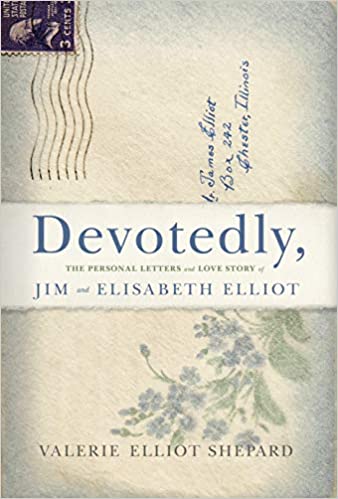
Devotedly, The Love Story of Jim and Elisabeth Elliot

If you’ve read here long, you know Elisabeth Elliot is a heroine of mine, a mentor from afar.

If you’re not familiar with Elisabeth, her husband and four of his colleagues were killed by a tribe they were trying to reach in the Ecuadorian jungle in 1956. She told the men’s stories in Through Gates of Splendor. Then, a few years later, she and her young daughter and the sister of one of the men went to live with the tribe in the jungle. A few years later, Elisabeth brought her daughter back to the US and became an author and speaker.

Jim and Elisabeth’s love story is unusual because they both thought God was going to send them to the mission field single. Jim was Elisabeth’s brother’s roommate in college and spent one Christmas vacation at their home. Then they had several classes together and began to study together.

They were different in personality. Jim was outgoing and spoke freely and easily (a little too freely sometimes). “The same bold, aggressive temperament that served him well as a daring disciple of Christ could sometimes come across as harsh and abrupt, even meddling, especially when dealing with a woman” (p. 258). Elisabeth was intellectual and reserved. But they thought alike on many subjects and began to find themselves drawn to each other.

Elisabeth seemed willing to take this development as from the Lord much sooner than Jim was. He had taken to heart Matthew 19:12 about some making themselves “eunuchs” for the kingdom of God (remaining single, unattached) and 1 Corinthians 7 about people being better able to serve God without distraction if they are single. He had given other guys in college a hard time about dating. He knew God was calling him to a pioneering field which would include rough living conditions. He didn’t feel he could ask a wife into that situation.

On top of everything else, he wrestled in his journal with the thought that if he loved a woman, it would mean that Jesus wasn’t enough for him. Somehow he missed that God Himself said “It is not good for man to be alone” when He created woman.

But for him, the thought of being romantically involved was a complete paradigm shift. It wasn’t something he could change his mind about in a short time. Plus, as they both graduated from college, each was not sure where God would have them. They worked at different jobs and helped in different ministries until they both felt led to go to Ecuador.

Elisabeth had told their love story in Passion and Purity and used it as a springboard to talk with young people about dating issues. She gave her letters and journals to her daughter, Valerie, to go through “when she had time.”

As a mother of eight, Valerie only recently had time. After reading the letters and journals and rereading her mother’s books, she felt she needed to share her parents’ love story. There was too much to copy entirely, so Lifeway helped her decide what to share. The result is Devotedly, The Personal Letters and Love Story of Jim and Elisabeth Elliot.

Valerie tells the story, interspersing the narrative with excerpts from her parents’ letters and journals. At times she adds a word of explanation, a little further insight, her thoughts on different points, or how her parents influenced her own story.

We’re so used to hearing the mature Elisabeth, who did most of her writing and speaking after decades of walking with the Lord. It’s interesting to read her young adult thoughts.

They spent a great deal of their relationship apart, so they got to know each other through letters. They went through the same difficulties as everyone else, with one person taking something the wrong way, the other having to explain, etc. They had no problem taking each other to task when they disagreed, but they did it as kindly as they could.

But mostly they encouraged each other to draw close to God and be and do all He wanted them to.

When they struggled with whether they should even be corresponding, they concluded that “what they shared together, even knowing the possibility they would spend their lifetimes apart, was more than worth it” (p. 42).

Valerie says they handled their love “with extraordinary sacredness” and “modeled—not perfectly, but persistently—the way God intends us to handle love, steward it, and keep it continually under His guidance” (pp. xiv-xv).

It’s interesting (and fun) to note the change in Jim’s writing from wrestling to acceptance that his love for Elisabeth was from God. He found that these two loves enriched each other rather than detracting from each other.

A few other thoughts that stood out to me:

Valerie noted that In the earliest pages of her mother’s journals, the words “though punctuated, of course, with the typical cares and crises of any young woman’s life—would never shift from this due-north orientation. God was first; God was supreme; God was all” (p. 1).

I thought this principle was a good one: comparing Christian life to a railroad, Jim wrote about decisions, “A block signal—a crisis—is lighted only where there is a special need. I may not always be in sight of a ‘go’ light, but sticking to the tracks will take me where the next one is” (p. 109).

Though we consider both Elliots stalwart examples of faith today, they each had their discouragements. Valerie wrote, “When you hear my mother at twenty-two saying she feels ‘useless’ and ‘fearful’ and ‘ashamed,’ recall what she went on to become in life by God’s grace and power. Think what our Father is capable of doing, encouraging you to press into Him, as she did, for His glory” (p. 66). As Elisabeth “grew older in Christ,” she realized she enjoyed “having the floor” and saw her tendency to want to “have the last word” and “straighten people out.” “She could be cut to the quick at times by her own insensitivity towards others who were speaking to her, and she wanted to become more gracious to those who didn’t have their words or facts straight” (p. 104).

Elisabeth had a nice singing voice and was often asked to sing in meetings. She wrote:

Oh, sometimes I wonder if I should not abstain from singing altogether until I know that Christ is my motive. Truly I do desire that my voice, as well as my life and will, be wholly given to His praise. But the flesh is ever with me—it manifests itself in the most singular forms sometimes. I discover that self-effacement, springing wholly from selfish motives, taints my very highest aspirations to act of God’s glory. So I am driven once again out of myself, for I am all unprofitable. . . I am but a branch, and without Thee can do nothing (pp. 138-139)

In Becoming Elisabeth Elliot, Ellen Vaughn mentions almost in passing an article someone had written proposing that perhaps Jim’s strong friendships with other men, his aversion to marriage, and his long wrestling over his relationship with Elisabeth meant that perhaps he was really homosexual at heart. One can’t read much of his writing without rendering such a possibility ridiculous. He wrote often of struggling against lustful thoughts, even more so the closer they got to their wedding. After one such entry, Valerie noted, “Let’s not pretend that my father was above the temptation. Yet, in response to it, he did what all godly men (and women) must do when accosted by strong, unholy thoughts. He called them out, considered it war, and made impassioned pleas that God would be his strength to endure” (p. 164). Even before, his teenage relationship with girls “warned me that my affections go out very easily and are jealously tenacious. Recognizing this fact, that I would lose my heart at every turn if I didn’t discipline myself carefully, I withdrew from dating and even close associations with girls whom I knew attracted me, or to whom I was somehow attractive” (p. 53).

Jim also wrestled with feeling inferior to Elisabeth and feeling “I can never be all she ought to have in a husband” (p. 192).

So we see that neither of them was perfect. That’s an encouragement to me, because I’m not, either. I wrestle with some of the same things they did. Sanctification is a lifelong process. But God’s grace is available every step of the way.

We miss a lot by not writing letters today. These letters are not only deeply spiritual, but they’re often poetic and literary as well. I’d love to include some of the more lyrical entries, but this is too long already.

Some years ago a philosophy started going around Christendom that God did not have a specific will for people regarding life work, location, spouse, etc.; He left it up to individuals to do what they wanted. That never set well with me, for too many reasons to go into here. But I saw anew one reason through these letters and journals: the sanctifying affect that waiting for and trying to discern the will of God could have. Near the end of the book, Valerie records her father’s words: “I have sought slowly the will of God, and the slowness has brought strength into the conviction of it, and joy in the realization of it” (p. 233).

Jim wrote, “The Lord has a certain slow dignity about His movings which constantly shames my fretting unbelief” (p. 163).

It touched my heart that they chose for their wedding verse Isaiah 25:9: “Lo, this is our God; we have waited for Him.”

Valerie shares that “If I could express my one hope for compiling this book, my prayer is that these entries of theirs would call us to search faithfully for God in His Word. And upon discovering His unchanging, faithful, merciful, and loving character, I pray we would be more fully moved in obedience to Him that we too might leave a lasting legacy of faith as my parents did” (p. 45).

The Elliots’ writing does encourage me in my walk with God and continues to spur me on to seek Him in His Word and find and do His will.

(By the way, last year, Revive Our Hearts did a series of interviews with Valerie about her parents’ story and writing the book here. I enjoyed listening to them then, and they have the transcripts up now.)

(Sharing with Grace and Truth, Hearth and Soul, Senior Salon,
InstaEncouragements,Carol’s Books You Loved, Booknificent)

Book Review: Fear and Faith

I was telling a friend recently that I wished we could pray and study the Bible on certain issues like anxiety or anger or being more loving and then have them settled for all time. But some of these issues seem to require a regular (sometimes daily) dose of truth. Fear and Faith: Finding the Peace Your Heart Craves by Trillia J. Newbell is another dose of truth for me.

I was not familiar with Trillia until someone I knew on Twitter kept retweeting her posts. I always liked what she had to say, so I started following her myself. I don’t remember if I discovered this book or had it recommended, but when I saw Trillia’s name, I got it. But then, it’s been sitting on my shelf for a while. I enjoyed her God’s Very Good Idea, a book for children about God’s design for different races and types of people. And then I finally picked up Fear and Faith, going through a chapter on recent Saturday mornings.

Trillia confesses she is one who “struggles with fears regularly and is fighting for faith . . . who firmly believe God is in control and yet still struggles with fear” (pp. 13-14). Exactly! I know God is in control, powerful, wise, loving, and kind. Yet fears and anxieties still come unbidden. Trillia reminds us that we’re not perfect yet, but we’re in a state of continual growth.

Trillia mentions control in almost every chapter. And it’s true, we’re less anxious in situations where we have control and we know what’s coming (or think we do).

The very thing we are holding onto (control) is, ironically, the thing we most need to let go of. As you and I come to understand that our God isn’t ruling as a tyrant but is lovingly guiding and instructing as a Father, we can loosen the tight grip on our lives that produces the bad fruit of fear. This isn’t “Let go and let God.” It’s “Let go, run hard toward your Savior, and learn to trust God” (pp. 16-17).

Trillia spends a chapter each on different kinds of fear: fear of man, fear of the future, fear of tragedy, of not measuring up, of other women, etc. She spends one chapter on “Why We Can Trust God” and another on “The Fear of the Lord”—the right kind of fear we’re supposed to have. One later chapter discusses “When Your Fears Come True”—when God allows the thing we feared or worse.

During our storms, you and I have the same God with us that the disciples had with them; we can trust that He is in the boat. He may or may not calm the storm immediately—we may have to endure great suffering—but He will not leave us (p. 141).

Trillia grounds everything she says on God’s Word. She shares from her experience and that of other women. Her writing is easily readable and relatable.

This is a good resource if you, like me, need regular doses of truth to combat anxiety and fear.

(Sharing with Carole’s Books You Loved, Booknificent, Senior Salon)

Book Review: Be Authentic

Be Authentic (Genesis 25-50): Exhibiting Real Faith in the Real World closes Warren Wiersbe’s trilogy of commentaries on the book of Genesis.

These chapters in Genesis focus primarily on Jacob and his sons, especially Joseph.

Jacob and his twin brother, Esau, were very different personalities. They struggled with each other even in the womb (Genesis 25:22-23), and their parents’ favoritism only fueled the fire.

God had chosen the younger Jacob to be in the line of the family He would use to bless the world rather than Esau, the older. But Jacob and his mother, Rebekah, used that information to manipulate circumstances rather than trusting God to accomplish what He had proclaimed. That brought Jacob’s conflict with Esau to a head, resulting in Jacob fleeing to his mother’s relatives.

There he fell in love and got a taste of his own scheming medicine. The next twenty years were hard, but they helped develop his character. “Little by little, Jacob was learning to submit to God’s loving hand of discipline and was growing in faith and character.”

He had twelve sons, but favored Joseph. Jacob seemed not to have learned about the dangers of parental favoritism from his own situation. “The man who had grown up in a divided an competitive home (25:28) would himself create a divided and competitive family.” Joseph’s brothers, in jealousy and hatred, sold him into slavery, took his special coat that his father had made for him, spread animal’s blood over it, then let Jacob conclude that Joseph was dead.

Though a slave, Joseph seemed to have a talent for administration. But even his master saw that “The LORD was with him, and the LORD caused all that he did to succeed in his hands” (Genesis 39:3). Joseph rose to prominence until he became second only to his master. But then he was lied about and sent to prison. He rose to prominence there as well, and aided two of Pharaoh’s servants. But the one who was restored to his portion forgot Joseph—until Pharaoh had a dream that troubled him, and the servant remembered Joseph had helped him with his dream. So Joseph was called for, interpreted Pharaoh’s dream, gave him sound advice, and once again rose to prominence as the second in the land.

And then one day his brothers showed up in Egypt. But they didn’t recognize him. These chapters are some of the most dramatic in the Bible, keeping me in anticipation even though I have read them before and knew how the story would turn out.

Wiesrbe’s title for this commentary comes from his conclusion that, “In short, they were authentic, real, believable, down-to-earth people. Flawed? Of course! Occasionally bad examples? Certainly! Blessed of God? Abundantly.” These people are an encouragement that God works with and accomplishes His will through flawed individuals.

There were many helpful and instructive things to observe in these chapters. I was blessed to see the changes in some people—Jacob over time, and his son, Judah, especially. But a few things in Joseph’s story particularly stood out to me this time. Because Joseph so often comes out on top even when he’s thrown into dire circumstances, I think we sometimes downplay his suffering. But when he named his sons in reference to his afflictions, it really spoke to my heart:

Joseph called the name of the firstborn Manasseh. “For,” he said, “God has made me forget all my hardship and all my father’s house.” The name of the second he called Ephraim, “For God has made me fruitful in the land of my affliction” (Genesis 41:51-52).

Wiersbe pointed out that Joseph could have become bitter, but instead he maintained his faith in God and kept a tender heart, showing compassion towards others. “Joseph’s sensitive heart was a miracle of God’s grace. For years dead Egyptian idols and the futile worship given to them had surrounded Joseph, yet he had maintained his faith in God and a heart tender toward his own people. He could have hardened his heart by nursing grudges, but he preferred to forgive and leave the past with God (41: 50–52).”

Then, as often as I have pored over the Scriptures about suffering and reconciled myself to the fact that it’s a tool God uses in wisdom and love, I find myself still asking “Why?” sometimes. I wondered why Joseph had to go through all he did when he was one of the “good guys.” But Wiesrbe pointed out that if Joseph had remained at home as the favored son, he might have grown up into a very different kind of person.

A few more quotes from the book:

Being a victorious Christian doesn’t mean escaping the difficulties of life and enjoying only carefree days. Rather, it means walking with God by faith, knowing that He is with us and trusting Him to help us for our good and His glory no matter what difficulties He permits to come our way. The maturing Christian doesn’t pray, “How can I get out of this?” but “What can I get out of this?”

In the life of a trusting Christian, there are no accidents, only appointments.

When God wants to move us, He occasionally makes us uncomfortable and “stirs up the nest” (Deut. 32:11 NIV).

A good beginning doesn’t guarantee a good ending. That’s one of the repeated lessons taught in Scripture, and it’s tragically confirmed in the lives of people like Lot, Gideon, Samson, King Saul, King Solomon, Demas, and a host of others. Let’s add Isaac to that list.

If we obey the Lord only for what we get out of it, and not because He is worthy of our love and obedience, then our hearts and motives are wrong.

With all their weaknesses and faults, the sons of Jacob will carry on the work of God on earth and fulfill the covenant promises God made to Abraham.

Years later, Jacob would lament, “All these things are against me” (v. 36), when actually all these things were working for him (Rom. 8:28).

God’s delays are not God’s denials.

Too many Christian believers today think that God can use only His own people in places of authority, but He can work His will even through unbelieving leaders like Pharaoh, Cyrus (Ezra 1: 1ff.; Isa. 44: 28), Nebuchadnezzar (Jer. 25: 9; 27: 6), and Augustus Caesar (Luke 2: 1ff.). 

The only people God can forgive are those who know they’re sinners, who admit it and confess that they can’t do anything to merit or earn God’s forgiveness. Whether it’s the woman at the well (John 4), the tax collector in the tree (Luke 19: 1–10), or the thief on the cross (23: 39–43), all sinners have to admit their guilt, abandon their proud efforts to earn salvation, and throw themselves on the mercy of the Lord.

According to Hebrews 11:13–16, the patriarchs confessed that they were “strangers and pilgrims on the earth.” A vagabond has no home; a fugitive is running from home; a stranger is away from home; but a pilgrim is heading home. They had their eyes on the future, the glorious city that God was preparing for them, and they passed that heavenly vision along to their descendants.

One of the major differences between a church and a cult is that cults turn out cookie-cutter followers on an assembly line, while churches model a variety of individual saints on a potter’s wheel.

Martin Luther said it best: This life, therefore, is not righteousness but growth in righteousness; not health but healing; not being but becoming; not rest but exercise. We are not yet what we shall be, but we are growing toward it. The process is not yet finished, but it is going on. This is not the end, but it is the road. All does not yet gleam in glory, but all is being purified. (Edwald M. Plass, comp., What Luther Says, vol. 1 (St. Louis, MO: Concordia Publishing House, 1959), 234–35).

The book of Genesis provides for a rich study. I enjoyed Dr. Wiersbe’s aid on this trek through the book.

(Sharing with InstaEncouragment, Grace and Truth,
Faith and Worship Christian Weekend,
Carole’s Books You Loved, Booknificent Thursday)

Book Review: Be Obedient

Be Obedient (Genesis 12-25): Learning the Secret of Living by Faith by Warren W. Wiersbe is the second in his three-part commentary on Genesis. These chapters cover the life of Abraham.

Humanity had not had a good track record so far In Genesis: sinning in paradise, murder, drunkenness, immorality, and rebellion. But in His longsuffering, God continued working with man.

In this section, God called Abraham to leave his family, his country, and his idols and go to the land where God sent him. God promised Abraham He would bless him, make his name great, make of him a great nation, and through him bless “all the families of the earth” (Genesis 12:1-3).

Abraham and his wife, Sarah, were not sinless examples of living by faith. While I am not happy when anyone makes wrong choices, I am encouraged that even towering figures like Abraham were not perfect, and we can confess our sin, be forgiven, pick up, and go one. Abraham and Sarah are both listed in what is sometimes called the “Hall of Faith” in Hebrews 11.

Ultimately, Abraham’s story is about God showing grace and faithfulness and setting aside a line of people through whom the promised Messiah would eventually be born.

In the last chapter, Wiersbe lists several ways “all the nations of the earth” are blessed through Abraham.

  • “Abraham left us a clear witness of salvation through faith.” Romans 15:3: “Abraham believed God, and it was counted to him as righteousness.”
  • “Abraham also leaves us the example of a faithful life. James used Abraham to illustrate the importance of proving our faith by our works (James 2:14-26). Wherever Abraham went, he pitched his tent and built his altar, and he let the people of the land know that he was a worshiper of the true and living God.”
  • “From Abraham, we learn how to walk by faith.”
  • “Abraham gave the world the gift of the Jewish nation; and it is through the Jews that we have the knowledge of the true God plus the Word of God and the salvation of God (John 4: 22).”
  • “Finally, because of Abraham, we have a Savior.” Matthew 1:1 begins, “The book of the genealogy of Jesus Christ, the son of David, the son of Abraham.”

Here are a few of the other quotes that stood out to me in this book:

Living by faith means obeying God’s Word in spite of feelings, circumstances, or consequences. It means holding on to God’s truth no matter how heavy the burden or how dark the day, knowing that He is working out His perfect plan. It means living by promises and not by expectations.

“The victorious Christian life,” said George Morrison, “is a series of new beginnings.”

God alone is in control of circumstances. You are safer in a famine in His will than in a palace out of His will.

When you disobey the will of God, the only right thing to do is to go back to the place where you left Him and make a new beginning (1 John 1: 9).

God’s remedy for Abraham’s fear was to remind him who He was: “I am thy shield, and thy exceeding great reward” (Gen. 15: 1). God’s I AM is perfectly adequate for man’s “I am not.”

The Hebrew word translated “believed” means “to lean your whole weight upon.” Abraham leaned wholly on the promise of God and the God of the promise. We are not saved by making promises to God but by believing the promises of God.

In times of testing, it is easy to think only about our needs and our burdens; instead, we should be focusing on bringing glory to Jesus Christ. We find ourselves asking “How can I get out of this?” instead of “What can I get out of this that will honor the Lord?” We sometimes waste our sufferings by neglecting or ignoring opportunities to reveal Jesus Christ to others who are watching us go through the furnace.

Once again, I am indebted to Dr. Wiersbe for his helpful insights.

(Sharing with Worth Beyond Rubies, Grace and Truth,
Carole’s Books You Loved, Booknificent Thursday)

Book Review: Be Victorious

The book of Revelation in the Bible is a challenge for many reasons. Readers and interpreters argue about what’s literal and what’s symbolic, what the symbols mean, what’s going to happen when. In Warren Wiersbe’s brief commentary, Be Victorious (Revelation): In Christ You Are an Overcomer, he mentions “I have dozens of commentaries on this book, and no two authors completely agree on everything.”

But I like Wiersbe’s emphasis:
John’s prophecy is primarily the revelation of Jesus Christ, not the revelation of future events. You must not divorce the Person from the prophecy, for without the Person there could be no fulfillment of the prophecy.

In fact, Wiersbe says in his first chapter:

The word translated “revelation” simply means “unveiling.” It gives us our English word apocalypse which, unfortunately, is today a synonym for chaos and catastrophe. The verb simply means “to uncover, to reveal, to make manifest.” In this book, the Holy Spirit pulls back the curtain and gives us the privilege of seeing the glorified Christ in heaven and the fulfillment of His sovereign purposes in the world.

Although Wiersbe gives a more detailed outline of the book, this one emphasizes how Christ is pictured in each section:

In Revelation 1—3, Christ is seen as the exalted Priest-King ministering to the churches. In Revelation 4—5, He is seen in heaven as the glorified Lamb of God, reigning on the throne. In Revelation 6—18, Christ is the Judge of all the earth, and in Revelation 19, He returns to earth as the conquering King of Kings. The book closes with the heavenly Bridegroom ushering His bride, the church, into the glorious heavenly city.

Wiersbe suggests four reasons for the heavy use of symbolism in this particular book. At the time John wrote it, he was an old man exiled on the island of Patmos, a Roman penal colony. He might have used symbols as a kind of code, so the Roman officers wouldn’t pick up on what he was saying. Another reason: the symbols’ meaning and strength would last through the years rather than being specific to a certain time and culture. A third possible reason: “symbols not only convey information, but also impart values and arouse emotion. John could have written, ‘A dictator will rule the world,’ but instead he describes a beast.” Also, some of the symbols carry over from the rest of the Bible: the church as a bride, Jesus as a lamb. In fact, Wiersbe notes that “Nearly 300 references to the Old Testament are found in Revelation! This means that we must anchor our interpretations to what God has already revealed, lest we misinterpret this important prophetic book.” And he warns that we “must not conclude that John’s use of symbolism indicates that the events described are not real.”

Something that stood out to me this time around reading Revelation was the parallels between it and Genesis. Wiesrbe has a chart with the things that began in Genesis (heaven and earth created, day and night established, the curse for sin, death, people driven from Eden, beginning of sorrow and pain, marriage instituted) and were brought to completion in Revelation (new heavens and earth, no need of sun, no night, curse, death, sorrow, tears, people restored to paradise, marriage supper of the Lamb). I know these must have been pointed in in previous studies or sermon series through Revelation, but it it was like I noticed it for the first time. Maybe I had just forgotten.

I’m not going to get into the explanation and exposition of Revelation and the arguments over the whether and what and when of millennium—that would take too much time and space. Wiersbe presents the reasons for the different views but confesses to be a premillennialist. That’s what I was taught the majority of my Christian life. Our current church is the first we’ve been in that has a different view. I also read from my ESV Study Bible. The commentator there was also careful to explain the different views before stating which he thought was correct. Though he differed from Wiersbe regarding the millennium, they agreed on many other things. Good people can differ on these things. I don’t think different views of the end times are anything to argue or separate over. But, I agree that, as Wiersbe says, “no matter what ‘key’ a student may use to unlock Revelation, he cannot help but see the exalted King of Kings as He vindicates His people and gives victory to His overcomers.”

One good reason for reading and studying Revelation, besides the fact that it’s as inspired as the rest of the Bible, is that “When you have assurance for the future, you have stability in the present.” As more than one Christian has said, “I’ve read the end of the book—I know how it all turns out.” Plus, “A true understanding of Bible prophecy should both motivate us to obey God’s Word and to share God’s invitation with a lost world.”

Here are a few other quotes that stood out to me:

Labor is no substitute for love; neither is purity a substitute for passion. The church must have both if it is to please Him.

The church that loses its love will soon lose its light, no matter how doctrinally sound it may be.

The “overcomers” are not a “spiritual elite,” but rather the true believers whose faith has given them victory (1 John 5: 4–5).

No amount of loving and sacrificial works can compensate for tolerance of evil.

Unloving orthodoxy and loving compromise are both hateful to God.

The first step toward renewal in a dying church is honest awareness that something is wrong.

If men and women will not yield to the love of God and be changed by the grace of God, then there is no way for them to escape the wrath of God.

God’s Word will be there. “The word that I have spoken, the same shall judge him in the last day” (John 12: 48). Every sinner will be held accountable for the truth he or she has heard in this life.

It’s always challenging to go through the book of Revelation, But I am thankful for the help this book gave this time around.

(Sharing with InstaEncouragement, Booknificent Thursday, Carole’s Books You Loved)


Book Review: None Like Him

The subtitle of None Like Him by Jen Wilkin is 10 Ways God is Different From Us (and Why That’s a Good Thing).

God has some attributes that we’re supposed to emulate: kindness, love, compassion, etc. He possesses those characteristics in perfection. We never will this side of heaven, but we should be growing in them as we read God’s Word.

Some of God’s attributes, however, are unique to Him: omnipotence (all-powerful), omniscience (all-knowing), omnipresence (everywhere at the same time), immutability (unchangeableness), eternality, etc. Jen devotes one chapter each to these and five more characteristics of God. A subject like this could easily be filled with ivory-tower theologicalese, but Jen doesn’t let it. Her treatment of God’s attributes is both understandable and practical while still invoking awe.

At first it might seem more practical to study the attributes of God that we’re supposed to grow in (and Jen’s next book, In His Image, does just that). But there’s good reason to ponder these unattainable attributes. Studying these characteristics helps us get to know our God better, contributes to our worship of Him, and reminds us of our limitations.

Wait—do we want to be reminded of our limitations? Well, we need to be. Sometimes our overreaching is due to pride. And it’s immensely restful to leave to God the things only He can do.

Our limits teach us the fear of the Lord. They are reminders that keep us from falsely believing that we can be like God. When I reach the limit of my strength, I worship the One whose strength never flags. When I reach the limit of my reason, I worship the One whose reason is beyond searching out (p. 25).

For instance, it never occurred to me before reading this book that our constant efforts to be in more than one place (with one person, on the phone with another, with one eye on the news) might be grasping for omnipresence. Subject ourselves to information overload might be reaching towards omniscience. We don’t want to stagnate: we want to keep learning and growing. But we do have limits.

No, we cannot be in more than one place at one time. When we reach for omnipresence ourselves, we guarantee that we will be fully present nowhere, spread thin, people of divided attentions, affections, efforts, and loyalties. Better to trust that these bodies which tether us to one location are good limits given by a good God. Better to marvel that, wherever we are tethered, his spirit surrounds us and fills us. Aware that he is witness to all we think, speak, and do, we learn to live circumspectly. Aware that he views his children through the lens of grace, we learn to choose frank confession over futile concealment. Aware that we cannot outrun his presence, we cease running, and abide. We learn to savor his nearness. No more virtual Twister. When we trust him as fully present everywhere, we are finally free to be fully present wherever he has placed us (pp. 104-105).

Here are just a few of the quotes I marked:

The thought that there might be a way to cast off at least some of these perpetual needs for perpetual needlessness is an enticing one, indeed. Take, for example, our current cultural obsession with caffeinated drinks as evidence of our desire to be sleep-optional creatures (p. 58).

Sanctification is the process of learning increasing dependency, not autonomy (p. 63).

Like Samson, when we view a particular strength as the product of our obedience to God, we will use that strength to serve ourselves rather than to serve God and others. All strength, whether physical, emotional, or intellectual, can be used either to serve or to self-elevate (p. 127).

The truth of God’s limitless power would be absolutely terrifying were it not paired with the truth of his limitless goodness (p. 135).

Our primary problem as Christian women is not that we lack self-worth, not that we lack a sense of significance. It’s that we lack awe (p. 154).

We too often approach the Bible in a self-serving way: we want to be comforted, affirmed, or assured in some way. The Bible does minister to us, but we need to approach it to learn about God.

God is incomprehensible. This does not mean he is unknowable, but that he is unable to be fully known. It is the joyful duty, the delightful task of his children to spend their lives, both this one and the next, discovering who he is. According to Jesus, knowing God is the fundamental aim of life: “And this is eternal life, that they know you the only true God, and Jesus Christ whom you have sent” (John 17:3). We take pleasure in working to grow in our knowledge of him (p. 33).

Meditating on His attributes leads us to worship and increases our faith. The more we know Him, the more we love Him, the more we trust Him.

My meditation of him shall be sweet: I will be glad in the LORD (Psalm 104:34).

(Sharing with Senior Salon, InstaEncouragament,
Carole’s Books You Loved, Booknificent)

Book Review: Breaking Anxiety’s Grip

Dr. Michelle Bengston writes from her own experience as an anxiety sufferer, a neuropsychologist, and most of all, as a Christian, in Breaking Anxiety’s Grip: How to Reclaim the Peace God Promises.

Everyone experiences worry, anxiety, and fear on occasion to some degree. But for some, they are regular companions.

After defining terms, Dr. Bengston discusses what contributes to anxiety, etc., brain chemistry, heredity, example, our own thoughts and heart, and Satanic influence. Interestingly, “While brain chemistry can impact mood and behavior, thoughts (e.g., ‘This place isn’t safe,’ ‘I can’t handle this any more,’ ‘I’m overwhelmed,’ etc.) actually impact brain chemistry” (p. 35).

The author spends the rest of the book explaining “the tools to effectively exchange our worry, anxiety, and fear for his peace” (p. 28). She doesn’t spout empty platitudes: she has put these principles to work in response to cancer diagnoses for herself and her husband, problems in her practice, a son’s major obstacles in his career path, as well as “everyday” problems and concerns. Her tools are based on the sure foundation of Scripture.

I had read a few of Michelle’s posts when she participated in some of the same of the same blog link-ups I participate in. I always enjoyed what she had to say, so when I saw she had written this book, I got it. It sat on my shelf for a while, then I picked it up, then set it aside for another book. When I finally delved into it in earnest, I knew God had led me to read it at just the perfect time. The coronavirus pandemic began just after I started this book, and the chapters I read then helped me immensely in the uncertainty and anxiety of that unprecedented situation.

Here are just a few of the principles that most helped me:

Dealing with worry, anxiety, and fear isn’t a one-time event: it’s a process.

I’m not in control. God is. He knows best and knows the big picture. What He allows may not be what I would have chosen, but He has a purpose in it for my good.

“When concern about the future comes, we can recognize it and then refuse to entertain it. We can determine to stay in the present and in God’s presence, trusting in his perfect plan” (pp. 70-71).

We can reframe our worried thoughts to focus on God’s provision: “Instead of saying, ‘I’m worried I won’t be able to make ends meet,’ exert your trust in God and declare, ‘God, I’m trusting you to provide because you promised to supply all my needs according to your glorious riches.’ Or instead of saying, ‘I’m afraid to be alone,’ look to his promises and declare your trust in him: ‘Thank you, God, that you promise you will never leave me and will always be with me so I won’t be alone'” (p. 119).

“God’s peace is not the calm after the storm. It is the steadfastness during the storm. It is in his presence that we can find peace in the midst of the storm” (p. 140).

“When self-protection is our goal, there’s no room for trusting God’s protective love. That self-protective stance leaves us lonely and unwilling to invite others in, including God. Fear is not from God. It is a direct attack from the one who wants to prevent us from drawing close to God or knowing his trustworthy love. In reality, we are powerless to protect ourselves. Fear doesn’t protect. So self-protection is futile. What we really need is a sure protector—and only a trustworthy God can be that for us” (pp. 171-172).

“Emotions are the outward manifestations of the thoughts we believe. So when we feel anxious, it’s because we’ve believe the thoughts that prompt anxiety. Instead of acting on our feelings, we must speak out against the thoughts that caused them. We must recognize that the thoughts are from the enemy, refute them, and speak back to them” (p. 186).

2 Timothy 1:7 says, “God gave us a spirit not of fear but of power and love and self-control” (the KJV and NKJV says “sound mind”). Michelle spends a lot of time unpacking and applying those verses.

There were just a couple of places in the book where I had a question mark or maybe would have had a somewhat different view. And I wish she would have said a little more about anxiety that seems to come out of nowhere, not triggered by worry, as described here. But whatever the cause, the solution of taking our thoughts captive and applying God’s truth would be the same.

Overall, however, I found this book a great encouragement to my faith. Much of it was truth I already knew, but as was said earlier, fighting against anxiety is an ongoing process rather than a once-for-all victory. This book is an excellent tool and help in the fight.

(Sharing with Grace and Truth, Literary Musing Monday, Hearth and Soul,
Senior Salon, Global Blogging, InstaEncouragement, Worth Beyond Rubies,
Carole’s Books You Loved, Booknificent Thursday)


Book Review: Be Rich (Ephesians) Gaining the Things That Money Can’t Buy

Warren Wiersbe’s Be Rich commentary on the book of Ephesians does not a promote the “prosperity gospel”—insert prayers and gifts to televangelists and receive health and wealth. No, as the subtitle goes on to say. “Gaining the Things That Money Can’t Buy.”

Ephesians 1:3 says God “has blessed us in Christ with every spiritual blessing in the heavenly places.” Just some of those blessings:

  • Chosen in Him (verse 4)
  • Adopted as sons (verse 5)
  • Redemption through his blood, the forgiveness of our trespasses (verse 7)
  • An inheritance (verse 11)
  • Believers are “sealed with the promised Holy Spirit, who is the guarantee of our inheritance until we acquire possession of it, to the praise of his glory” (verses 13-14).

Wiersbe says, “‘In Christ’ is the most frequently used phrase in the book of Ephesians, and the point is clear: If you’re in Christ, you have everything.”

Another theme in the book is unity. Not a unity that ignores truth, but unity based on truth. Paul, the author of the letter to the Ephesians, says God’s plan was “to unite all things in [Christ], things in heaven and things on earth” (1:10). The first half of chapter 2 tells how we can be reconciled with God; the second half says that God, through Christ, broke down the barriers between Jew and Gentile. “For through him we both have access in one Spirit to the Father. So then you are no longer strangers and aliens, but you are fellow citizens with the saints and members of the household of God … ” (2:18-19). Chapters 4-6 share practical ways that unity in Christ is worked out in the church community, in the home, and in the workplace.

I’ve got dozens of quotes marked, but here are a few:

The Bible is our guidebook; the Holy Spirit is our Teacher. As we search the Word of God, we discover more and more of the riches we have in Christ.

Salvation is a gift, not a reward. Salvation cannot be “of works” because the work of salvation has already been completed on the cross. This is the work that God does for us, and it is a finished work (John 17: 1–4; 19: 30). We can add nothing to it (Heb. 10: 1–14); we dare take nothing from it.

By His death and resurrection, Christ overcame the world (John 16: 33; Gal. 6: 14), and the flesh (Rom. 6: 1–6; Gal. 2: 20), and the Devil (Eph. 1: 19–23). In other words, as believers, we do not fight for victory—we fight from victory! The Spirit of God enables us, by faith, to appropriate Christ’s victory for ourselves.

The Christian life is not based on ignorance but knowledge, and the better we understand Bible doctrine, the easier it is to obey Bible duties. When people say, “Don’t talk to me about doctrine—just let me live my Christian life!” they are revealing their ignorance of the way the Holy Spirit works in the life of the believer. “It makes no difference what you believe, just as long as you live right” is a similar confession of ignorance. It does make a difference what you believe, because what you believe determines how you behave!

Of course, there’s much more to Ephesians and Wiersbe’s book.

Ephesians contains two of my favorite Biblical prayers that I sometimes pray for myself and others. I’ll leave you with those

For this reason, because I have heard of your faith in the Lord Jesus and your love toward all the saints, I do not cease to give thanks for you, remembering you in my prayers, that the God of our Lord Jesus Christ, the Father of glory, may give you the Spirit of wisdom and of revelation in the knowledge of him, having the eyes of your hearts enlightened, that you may know what is the hope to which he has called you, what are the riches of his glorious inheritance in the saints, and what is the immeasurable greatness of his power toward us who believe, according to the working of his great might that he worked in Christ when he raised him from the dead and seated him at his right hand in the heavenly places (1:15-20).

For this reason I bow my knees before the Father, from whom every family in heaven and on earth is named, that according to the riches of his glory he may grant you to be strengthened with power through his Spirit in your inner being, so that Christ may dwell in your hearts through faith—that you, being rooted and grounded in love, may have strength to comprehend with all the saints what is the breadth and length and height and depth, and to know the love of Christ that surpasses knowledge, that you may be filled with all the fullness of God. (3:14-19).

(Sharing with Worth Beyond Rubies, Carole’s Books You Loved, Booknificent Thursday)

Book Review: The Women of Easter

Women of Easter book The Women of Easter: Encounter the Savior with Mary of Bethany, Mary of Nazareth, and Mary Magdalene by Liz Curtis Higgs, as the title suggests, tells the story of Jesus’ death and resurrection through the eyes of these three Marys.

Liz lays out the narrative in eight chapters. I chose to read one a week most of the weeks leading up to Easter.

We learn about each of the the Marys. Mary of Bethany and the famous incident with her sister, Martha, the death and resurrection of her brother, Lazarus, and her anointing the feet of Jesus with expensive ointment, wiping them with her hair. Mary of Nazareth, the mother of Jesus. Mary Magdalene, out of whom Jesus cast seven demons (Luke 8:2) (and who is never called a harlot or prostitute in the Bible, though movie writers like to depict her that way).

Liz seamlessly weaves their stories in with the last several days Jesus spent on earth, using multitudes of Scripture references in different translations and snippets from commentaries. I can’t imagine all the study she did before writing this book.

Here are just a few quotes:

When Jesus “no longer moved about publicly among the people of Judea” (John 11:54) because people were after Him:

Jesus was neither afraid of them nor avoiding them. He was simply acting according to His Father’s will. Whenever my prayers are answered with a firm directive to wait, I remind myself that even Jesus had times of waiting, and more than once He did so in a desolate place.

Of Mary of Bethany’s wiping Jesus’ feet with her hair:

This devout follower, this beloved sister, used her long hair to dry a man’s feet—the “lowest job for the lowliest servant.” … Her perfume wasn’t the only thing she sacrificed. Mary laid her whole being before Him: her pride, her reputation, her social standing, her clean hands, her pure heart. She asked nothing of Him, sought no sign of approval, begged for no favors. Confident of His love and acceptance, she simply gave, expecting nothing in return.

When the disciples (not just Judas) rebuked Mary for her extravagance:

They didn’t just wag their fingers at her. They “scolded” (CEB) and “criticized” (GNT); they “censured and reproved” (AMPC). With no concern for her feelings, “they told the woman what a bad thing she had done” (ERV). Poor Mary of Bethany! To share something holy and then to be treated cruelly, not by strangers, but by those who knew her and claimed to know Christ.

Jesus offered a rebuke of His own, aimed not at Mary but at the disciples. “Leave her alone,” Jesus replied. John 12: 7

During the triumphal entry (Palm Sunday):

Worship isn’t a task. Worship is a response.

In preparation for the Passover:

Part of trusting God is letting go of our need to know and refusing to fret over the who, what, when, where, and why. When the time comes, the Lord will inform us, just as He did His disciples.

In a passage about Jesus being beaten:

During Lent it’s tempting to hurry toward Easter morning, eager to declare, “He is risen!” Yes, He certainly is. But reminding ourselves what came before His glorious victory over death is how we remain humbled by His sacrifice and grateful for His mercy. We were “bought at a price.” This was the cost.

On the way to the cross …

Jesus stopped to speak to the women. He sees us, beloved. He values us. He cherishes us. On that day He spoke a word of prophecy to these daughters, preparing them for even harder days to come.

When Jesus was buried:

“The women who had come with Jesus from Galilee followed Joseph and saw the tomb and how his body was laid in it.” Luke 23:55. Really, have you ever seen such perseverance? They stayed and they stayed and they stayed. This is one of the most important lessons these women teach us. Wherever He leads, follow Jesus. Whatever pain you are enduring, keep your eyes on Jesus. Even when hope seems gone, stay close to Jesus.

After the resurrection:

Woman. The first word spoken by the risen Christ, meant for all His daughters throughout eternity. Woman. An assurance that we matter to Him, that we count for His kingdom. Woman. A term of respect. The very word He used when addressing His beloved mother from the cross. Woman.

There were just a couple of places where I put a question mark, not sure if her observation or comment was exactly right. But I don’t recall that those points were anything major.

This book was a great way to prepare for Easter week. I’m sure I will use it again in the future. But, of course, it’s good reading year round since Christ’s death and resurrection affect us every day.

(Sharing with InstaEncouragement, Worth Beyond Rubies, Let’s Have Coffee,
Grace and Truth, Global Blogging, Senior Salon, Hearth and Soul, Happy Now,
InstaEncouragement, Carole’s Books You Loved, Booknificent Thursday)

Book Review: Be Free (Galatians): Exchange Legalism for True Spirituality

 Be Free (Galatians): Exchange Legalism for True Spirituality by Warren Wiersbe is a commentary or study guide to read alongside the New Testament book of Galatians.

Paul wrote a rather strongly-worded letter to the Galatians with none of his usual thanksgiving and commendation for his readers. That’s because the Galatians were confusing law and grace.

The first Christians were Jewish and were quite stunned when Gentiles became believers. There was a lot of confusion at first about whether Gentile believers had to follow the same practices as the Jews (see Acts 10, 11, and 15).

The apostles and the elders were gathered together to consider this matter. And after there had been much debate, Peter stood up and said to them, “Brothers, you know that in the early days God made a choice among you, that by my mouth the Gentiles should hear the word of the gospel and believe. And God, who knows the heart, bore witness to them, by giving them the Holy Spirit just as he did to us, and he made no distinction between us and them, having cleansed their hearts by faith. Now, therefore, why are you putting God to the test by placing a yoke on the neck of the disciples that neither our fathers nor we have been able to bear? But we believe that we will be saved through the grace of the Lord Jesus, just as they will. (Acts 15:6-11, emphasis added).

The initial confusion was understandable. But some, called Judaizers, persisted in teaching that Gentile believers must keep the OT law, especially the Jewish rite of circumcision. Paul insisted this was trusting in works, not grace, and we’re not saved by works.

It wasn’t that circumcision was good or bad in itself. Paul mentions bringing Titus, a Gentile believer to Jerusalem with no thought of having him circumcised (Galatians 2:1-5). But later in Acts 16:1-3, Paul had Timothy circumcised. Was Paul being inconsistent? No, Timothy was half Jewish, half Greek, and Paul wanted to bring him along on his missionary journeys. As a part Jewish man, Timothy would never have been accepted or listened to by the Jews without being circumcised. So in his case, circumcision was a matter of not being a stumblingblock to those he wanted to minister to. (John Piper goes into this more here.) The difference was that neither Paul nor Timothy were trusting in circumcision as a means to salvation or to earn favor with God. The Judaizers were.

So Paul argues against law and for grace, appealing to the Galatians personally, doctrinally, and practically. They were in danger of teaching false doctrine, of forsaking and perverting the gospel. It was serious enough for Paul to write as he did.

I won’t go into all the details or Wiersbe’s outline here. But Wiersbe makes application to our day. Probably few of us are tempted to observe Jewish law for salvation as the Judaizers were. But we can easily lapse into trusting in the rules or standards of whatever faith group we’re a part of instead of trusting Christ alone for salvation.

Millions of believers think they are “spiritual” because of what they don’t do—or because of the leader they follow—or because of the group they belong to. The Lord shows us in Galatians how wrong we are—and how right we can be if only we would let the Holy Spirit take over.

When the Holy Spirit does take over, there will be liberty, not bondage—cooperation, not competition—glory to God, not praise to man. The world will see true Christianity, and sinners will come to know the Savior. There is an old-fashioned word for this: revival.

Here are a few other quotes.

We must never forget that the Christian life is a living relationship with God through Jesus Christ. A man does not become a Christian merely by agreeing to a set of doctrines; he becomes a Christian by submitting to Christ and trusting Him (Rom. 11: 6).

We not only are saved by grace, but we are to also live by grace (1 Cor. 15: 10). We stand in grace; it is the foundation for the Christian life (Rom. 5: 1–2). Grace gives us the strength we need to be victorious soldiers (2 Tim. 2: 1–4). Grace enables us to suffer without complaining, and even to use that suffering for God’s glory (2 Cor. 12: 1–10). When a Christian turns away from living by God’s grace, he must depend on his own power. This leads to failure and disappointment. This is what Paul meant by “fallen from grace” (Gal. 5: 4)—moving out of the sphere of grace and into the sphere of law, ceasing to depend on God’s resources and depending on our own resources.

God revealed Christ to Paul, in Paul, and through Paul. The “Jews’ religion” (Gal. 1: 14) had been an experience of outward rituals and practices, but faith in Christ brought about an inward experience of reality with the Lord. This “inwardness” of Christ was a major truth with Paul (2: 20; 4: 19).

Ever since Paul’s time, the enemies of grace have been trying to add something to the simple gospel of the grace of God. They tell us that a man is saved by faith in Christ plus something—good works, the Ten Commandments, baptism, church membership, religious ritual—and Paul made it clear that these teachers are wrong. In fact, Paul pronounced a curse on any person (man or angel) who preaches any other gospel than the gospel of the grace of God, centered in Jesus Christ (Gal. 1: 6–9; see 1 Cor. 15: 1–7 for a definition of the gospel). It is a serious thing to tamper with the gospel.

Justification is an act of God; it is not the result of man’s character or works. “It is God that justifieth” (Rom. 8: 33). It is not by doing the “works of the law” that the sinner gets a right standing before God, but by putting his faith in Jesus Christ.

Reading this book was a little different from reading the author’s Be Reverent on Ezekiel. Ezekiel has 48 chapters, so Wiersbe’s commentary covered broader sections in his chapters. But Galatians only has six chapters, so Wiersbe took two chapters to discuss each chapter of Galatians. If I had been reading this on my own, I would have just read one chapter of Wiersbe’s commentary on half a chapter of Galatians a day. But because I was reading one chapter a day of Galatians for our church Bible study, I had to read two chapters of Wiersbe to keep on track. It had my head spinning a couple of days, especially in the more doctrinal parts of the book. But Wiersbe in generally pretty easy to follow and comprehend.

(Sharing with Carole’s Books You Loved, Booknificent Thursday)