The Winnie-the-Pooh Books

Winnie-the-Pooh is a creation of A. A. Milne based on the teddy bear of his son, Christopher Robin. Milne had written many other genres: plays, magazine articles, books for adults. But these days he is best known for Pooh and Christopher Robin and their friends.

My kids grew up with the Disney version of Winnie the Pooh and company. There were four individual videos at the time: Winnie the Pooh and the Honey Tree, Winnie the Pooh and the Blustery Day, Winnie the Pooh and Tigger Too, and Winnie the Pooh and a Day for Eeyore. The first three videos have since been combined into The Many Adventures of Winnie the Pooh. Then there was a Saturday morning cartoon called The New Adventures of Winnie the Pooh which we watched regularly for many years. We had stuffed Poohs (and Tiggers and Piglets) and Pooh picture books. If there were Pooh sheets or jammies, we would have had them.

But somehow, I never read the original Pooh books by A. A. Milne to my kids, and I have always regretted that. I’m not sure why I never read them. I had not read them in my own growing-up years: perhaps if I had, I would have made it a point to read them to my children just as I searched out some of the Little Golden Book titles that I’d had as a child. I dipped into one of the volumes at some point, but I don’t remember which one or if I completed it.

When I read Christopher Robin Milne’s autobiographies recently, I was reminded that I had never read the original Pooh books. So I set out to correct that lack.

There are four books that specially deal with Pooh.

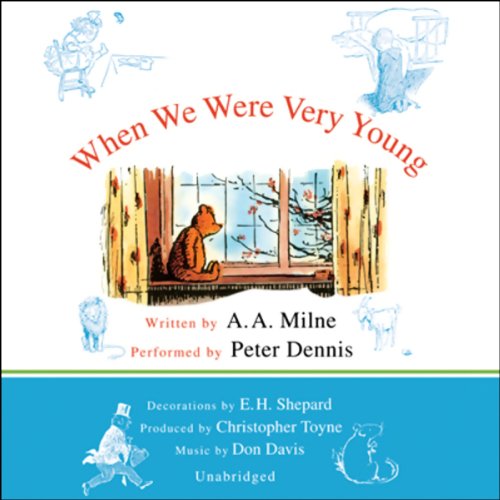
When We Were Very Young is a book of children’s poems. Christopher Robin’s bear there is named Edward. Some time after that, he renamed his toy bear Winnie-the-Pooh (with hyphens when his whole name is written, though he is often called just Pooh or Pooh Bear. The Disney version dropped the hyphens). “Pooh” was after a swan that Christopher had previously given that name to, and Winnie after a bear by that name in a zoo. Some of the poems feature Christopher, but all of them were probably inspired by him. One of the most famous is “Vespers” about Christopher saying his prayers.

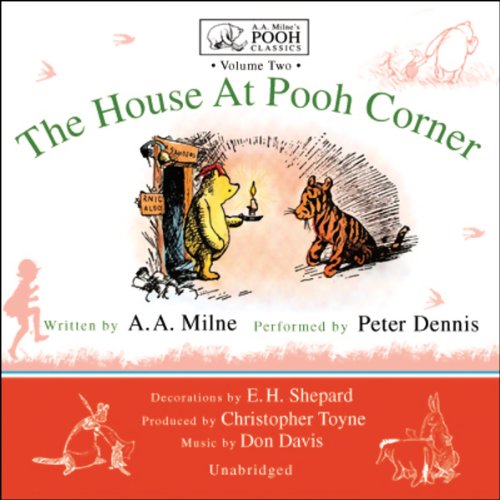
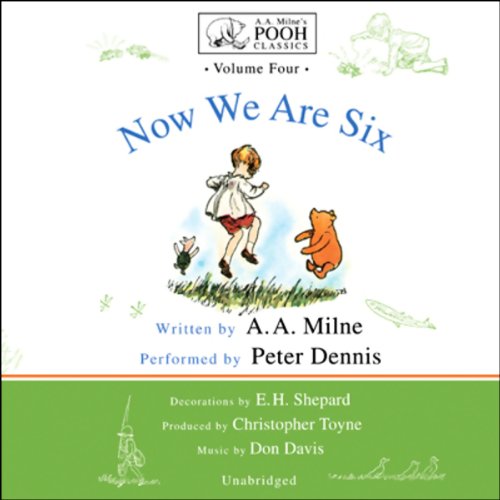
Winnie-the-Pooh is a collection of short stories about Christopher Robin and Pooh and the other animals/toys. The House at Pooh Corner, another collection of stories, was published next, and finally there was another collection of poems, Now We Are Six. “Forgiven” is one of my favorite poems from this volume.

One of the things I had liked about the videos and TV series was that they were quiet. There were conflicts and predicaments and misunderstandings, yes. But the shows weren’t full of noise and razzle-dazzle like other kid’s shows were (that was something I liked about Mister Rogers as well).

The books are the same way. The characters are endearing. Pooh is “a bear of very little brain,” but he is kind, thoughtful, and a faithful friend. He likes to make up rhymes and take time for “smackerel” of “a little something—usually “hunny.” Christopher Robin is the one everyone looks up to and the one who rescues the others when they get in trouble over their heads. Piglet is small and timid, but also kind and thoughtful. Rabbit is bossy, but has everyone’s best interests at heart. Eeyore is gloomy (actually, he’s a little harsher in the books). Owl is wise (he can even spell Tuesday!), Kanga is motherly, Roo is spunky.

One of my favorite quotes is from Pooh in The House at Pooh Corner about how poems come to him: “But it isn’t easy,’ said Pooh. ‘Because Poetry and Hums aren’t things which you get, they’re things which get you. And all you can do is to go where they can find you.” Another is this: “Sometimes,’ said Pooh, ‘the smallest things take up the most room in your heart.” And these:

Some people care too much. I think it’s called love.

People say nothing is impossible, but I do nothing every day.

It is more fun to talk with someone who doesn’t use long, difficult words but rather short, easy words like “What about lunch?”

“What day is it?” asked Pooh.
“It’s today,” squeaked Piglet.
“My favorite day,” said Pooh.
 
Piglet noticed that even though he had a Very Small Heart, it could hold a rather large amount of Gratitude.

I love how Kanga is described as carrying her family in her pocket (something Rabbit thinks strange at first).

And I dearly love this exchange between Eeyore and Pooh, read in Eeyore’s deadpan voice, when Eeyore thinks everyone has forgotten his birthday:

“Good morning, Pooh Bear, if it is a good morning. Which I doubt.”

“Why, what is the matter”

“Nothing, Pooh Bear, nothing. We can’t all, and some of us don’t, and that’s all there is to it.”

“Can’t all what?” said Pooh, rubbing his nose.

“Gaiety. Song and dance. Here we go round the mulberry bush.”

I was very glad to see that the films and videos, for the most part, told the stories almost completely as the books did. The series went on to develop their own stories based on the characters, but kept the same tone.

Milne captures childhood innocence and ways of thinking well with playfulness and gentleness. I was very sad to learn that Christopher came to resent the books about him as he became an adult, perhaps due to teasing from others when he went to boarding school. Christopher said in his own books that his father wasn’t very expressive in person: his inner thoughts came out in his writing. But his father’s obvious delight in his son and how he thought shines through in these stories and poems. I think Christopher must have come to terms with that at some point since he provided a favorable introduction to the audiobook of When We Were Very Young, saying family friend Peter Dennis’ narration presents Pooh “as he [Christopher] knew him.”

All four volumes of the books were available as part of my Audible subscription. I listened to the stories via audiobook, but read the poetry collections via Kindle (which included, thankfully, E. H. Shephard’s original illustrations).

One thing I didn’t like about the audiobooks was the long musical interludes between chapters.

But otherwise it was a sweet experience to visit these characters their original settings.

The Back to the Classics Challenge allows us three children’s classics. So I am going to count Winnie-the-Pooh as one for the “Classic that’s been on your TBR list the longest.”

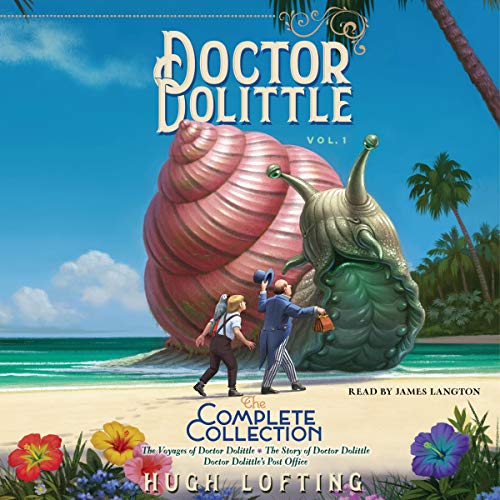
The Story of Doctor Dolittle

Hugh Lofting first created the character of Doctor Dolittle in letters home to his children while he was in WWI. The first book in the series is The Story of Doctor Dolittle: Being the History of His Peculiar Life at Home and Astonishing Adventures in Foreign Parts Never Before Printed.

Dr. Dolittle is a medical doctor, but he has a lot of pets. He begins to lose patients when they are scared by the number and kinds of pets he keeps. Someone suggests he become an animal doctor. His talking parrot tells him all animals have languages and teaches the doctor several of them. The doctor’s fame spreads far and wide since he can now diagnose and treat animals for the exact ailments they tell him about.

There’s only one problem. Animals aren’t paying customers. As much as the doctor dislikes money and wishes he didn’t have to bother with it, a certain amount is necessary to live.

So he and the animals devise ways to economize plus make some money.

Then birds bring word that monkeys in Africa are very sick, with many of them dying. They’ve heard of Doctor Doolittle and wonder if he can help them.

So after making arrangements for his house and the animals who will stay home, and finding a boat and supplies, the good doctor sets off along with several of his animal companions. They experience several misadventures during their travels and their time in Africa.

I had not realized that there were a number of books with Doctor Doliitle as the main character until I set out to read about him. I had thought that there was one main chapter book. This book is the first written, but others tell of time periods before this book. So some sets of the Doolittle books are arranged in the chronology of the settings rather than publication order. I prefer publication order of any series because that’s how the story would have originally unfolded. Sometimes we don’t care much about the back story until we come to know and care about the characters and their world. I listed to the audiobook very nicely read by James Langton. But it was put together in setting order, so I had to search through several beginnings of chapters in The Voyages of Doctor Dolittle, which had been placed first, before finding this story (the beginning of the different books wasn’t marked).

Also, I didn’t realize the set I listened to was “fully updated for the modern listener.” I would much rather read and listen to books in their original words. One new illustrated edition has taken the liberty of adding an “updated magical twist.” So if you prefer original classics, check for these things before choosing a volume.

Some editions say they have removed “ethnically insensitive” parts of the story. I assume this one did since it’s “revised for modern readers.” Generally, I’d rather leave stories as they were and explain why certain things are no longer done or said. I don’t know what things were removed from these books. Perhaps, especially in the versions designed for children to read themselves, it is better to adapt them without those offensive elements.

I hadn’t intended to read Doctor Dolittle until this set came up in a “2 books for one credit” sale on Audible. I’m glad to be more familiar with it now, but I don’t think I liked it well enough to read the other two books in this set.

I have not seen any of the film versions.

I’m counting this book for 20th century classic for the Back to the Classics Reading Challenge.

To Sir, With Love

To Sir, With Love is an autobiographical novel by E. R. Braithwaite. Braithwaite was born in Guyana, well-educated, and a pilot in the Royal Air Force during WWII. He says in the book that his color was not a factor during his military service, not even in dating, and he had almost forgotten that his color could be a factor. But after his military service, he spent almost eighteen months unsuccessfully looking for a job. He’d have promising leads until he went for an in-person interview. He began to grow bitter. A chance meeting with a stranger on a park bench put the possibility of teaching in his mind.

He found an opening at a school in the East End of London called Greenslade in the book. The headmaster said they didn’t practice punishment at the school. The students came from disadvantaged backgrounds and needed encouragement and building up. But Braithwaite wasn’t given any advice or tools to help him manage his students. When he asked fellow teachers, advice ranged from “Show them who’s boss” to “Don’t be too hard on them.”

Braithwaite found his students, for the most part, not very literate, crude, vulgar, unwashed, and uncaring about gaining knowledge or much of anything. Their reactions to him varied from ignoring him to disdain to hostility.

Finally, he hit on an approach that seemed to work. I won’t spoil the story by saying what, as for me, that was the part I was most anticipating.

Even then, the relationships between student and teacher and the students’ growth was up and down through various circumstances.

Alongside the story of Braithwaite’s journey with his students is his observations and experiences as a Black man in the later 1940s and 50s. From a white woman who refused to sit next to him on a bus, to those who refused to hire him once they saw him, to refusal of his renting a room, to a colleague making little digs by calling him “the black sheep” and “our sunburned friend,” to a waiter ignoring him, then spilling his soup and not offering to clean it up, Braithwaite experienced various degrees of racism. When asked by someone why he didn’t “stand up for himself,” he seemed to feel it just wasn’t worth it and would cause more problems than it solved. He had lived in the US for a few years and felt racism was more overt there at that time, whereas in Britain it was more subtle.

As the headmaster began to tell Braithwaite of the kinds of homes and situations the children came from, the latter thought, “I was becoming increasingly irritated by his recital of the children’s difficulties. My own experiences the last two years invaded my thoughts, reminding me that these children were white. Hungry or filled, naked or clothed, they were white. And as far as I was concerned, that fact alone made the only difference between the haves and have nots. I wanted this job badly, and would do it to the best of my ability. But it would be a job, not a labor of love.”

But, as you can surmise from the title, he does come to love the students. He felt his colleagues, except one, “accepted him unconditionally” and wanted him to do well.

A few other quotes that stood out to me from the book:

A man who is strong and tough never needs to show it in his dress or the way he cuts his hair. Toughness is a quality of the mind, like bravery or honesty or ambition; it has nothing whatever to do with muscles.

I sought to relate each lesson to themselves, showing them that the whole purpose of their education was the development of their own thinking and reasoning.

Mind? Oh yes, I do mind. But I am learning how to mind and still live. At first it was terrible, but gradually I am learning what it means to live with dignity inside my black skin.

It is not necessary for them to do anything special for a Negro or Indian or any other person, but simply to behave to them as to a stranger Briton, without favor or malevolence,but with courtesy and gentleness which every human being should give to and expect from every otherr.

I listened to the audiobook, nicely read by Ben Onwukwe. As usual, there was no back matter in the audiobook; I don’t know if there was in the print book. These days, stories based on true events often have a back section where they tell to some extent what situations were true and what were made up. According to Wikipedia, Braithwaite’s upbringing, education, military service, and teaching career were as portrayed in the book. But I would guess the students in the story were an amalgam of his real-life students. It seems like many events, as well as the progression of the story, might have been condensed somewhat from real life.

There are a number of instances of “damn,” “hell,” and the “b word” by Braithwaite as well as other adults and students. He notices and mentions students’ and women’s breasts several times. I almost didn’t get past the first chapter because of these elements.

But I enjoyed the story and felt I learned from Braithwaite’s experiences.

I don’t think I ever saw the film by the same name starring Sidney Poitier, though I want to some time. For some reason, the setting of the film was changed to the 1960s. The song from the film was popular as I was growing up.

I’m counting this book for the Classic by a Person of Color category for the Back to the Classics Reading Challenge.

The Last Chronicle of Barset

The Last Chronicle of Barset is the sixth and final novel in Anthony Trollope’s Chronicles of Barsetshire series.

There are several plot threads in this winding up of everyone’s stories. But the overarching plot involves Mr. Crawley, a curate who has been accused of stealing. Mr. Crawley was a minor character in Framley Parsonage, the fourth book in the series. He’s a curate in a small town who is very stern, proud of his poverty, critical of those who have wealth, especially other clergymen.

A twenty-pound check came into his possession, which he used to pay a bill. But then the check was found to have belonged to the lord of the manor house. The problem is, Mr. Crawley can’t remember how he got the check. First he thought Lord Lufton’s agent must have dropped it when he visited, then he thought his friend the dean must have given it to him. Unfortunately, the dean and his wife are out of the country, and Lufton’s agent insists he did not drop it.

Most people don’t think Crawly actually stole the check or confiscated it for his own use. They think it was a mix-up. But the case goes to court (not due to Lord Lufton. He would rather the whole thing had not come to light). Unfortunately, the bishop, or rather, the bishop’s wife, Mrs. Proudie, who wields actual control, thinks Crawley did steal the check and should be removed. Crawley himself almost wonders if he is going mad since he can’t remember for sure how he got the check.

Mr. Crawley was not one of my favorite characters, so at first I wasn’t terribly excited that much of the book focused on him. But after reflecting, I felt this plot line could not have worked with anyone else. And it is used to affect and bring out the personalities and motives of many other people.

The other major plot line is that Archdeacon Grantley’s son has fallen in love with Crawley’s daughter, Grace. The Grantleys are some of the wealthiest people in the area, and the thought of their son joining with a possible criminal’s daughter causes conflict between everyone involved.

Lily Dale from the fifth book, The Small House at Allington, shows up in this story as Grace’s friend. Lily had loved someone who jilted her for someone else richer and higher in society. But she still loves him. John Eames had loved her since childhood, but Lily only thinks of him as a brother. Then when Lily visits friends in London, she runs into the man who jilted her.

There is a totally unnecessary plot thread about a young artist’s flirtatious interactions with a married lady. Neither of them really care for each other romantically and consider their flirtations a game. But the relationship still causes problems when he falls in love with someone else and her husband begins to suspect something. The only connection between any of these people and the other characters is that the artist was a friend of John Eame’s. I don’t think flirting is a harmless game, especially among people married to others, so I could have done without this whole thread.

The Proudies, in all the books til now, have been almost humorous with him as a henpecked husband. They’re on the opposite sides of the fence politically and concerning church matters as many of the other people, and Mrs. Proudie is manipulative, so they’re ofttimes the “villains.” But things come to a very sad head for them.

Mrs. Crawley’s cousin, Mr. Toogood, a lawyer, has suspicions about where the check might have come from, and his pursuit reminded me a lot of Charles Dickens (who was a contemporary of Trollope).

Mr. Harding was the main character of the first book, The Warden. I think he may be the only clergyman in this series that doesn’t have a major flaw. He does tend not to stand up for himself even when he should, but whether that’s a flaw or not depends, I guess, on your point of view. It was said of him by his son-in-law, the Archdeacon: “He lacked guile, and he feared God,—and a man who does both will never go far astray. I don’t think he ever coveted aught in his life.” He has appeared throughout the series as a kindly older man. Now he is nearing his last days, and that all is handled in such a touching way.

Two of my favorite characters were the wives of difficult men in opposite circumstances: Mrs. Grantly and Mrs. Crawley. I would almost say they knew how to “handle” their husbands, but they were not manipulative like Mrs. Proudie. They each knew their husbands’ quirks and foibles and knew how to help them see reason and bring out their best. Mrs. Crawley knew her husband was very proud and unwilling to accept help, but she could find ways of accepting help without violating his desires. She didn’t complain of their poverty, though she had come from a more prosperous home. “She had been very strong through all her husband’s troubles,—very strong in bearing for him what he could not bear for himself, and in fighting on his behalf battles in which he was altogether unable to couch a lance; but the endurance of so many troubles, and the great overwhelming sorrow at last, had so nearly overpowered her.” Archdeacon Grantly is a blustery person, as well as a man of wealth and authority. Mrs. Grantly is about the only one who can speak plainly to him and point out where his thinking might be wrong, yet in a way that doesn’t disrespect him or undercut his authority. It was said after one of their encounters, “He knew very well that he could not get the better of her, and was apt at such moments to think that she took an unfair advantage of him by keeping her temper.”

I had wondered about the fact that Trollope doesn’t show his clergymen (who are the main characters in all most of the books) doing religious things. Mr. Crawley is shown in his religious duties more than anyone else, preaching, teaching in the school, visiting those in his parish. Evidently others wondered the same thing, “accusing” Trollope, “always without bitterness, and generally with tenderness—of having forgotten, in writing of clergymen,” to show “their professional duties, their high calling, their daily workings for the good of those around them.” Trollope answers that he had wanted to “paint the social and not the professional lives of clergymen,” just as he would write of lawyers’ and doctors’ lives without going deeply into their professions. Some also said all the clergymen in the books were flawed to some degree. Trollope answers, “Had I written an epic about clergymen, I would have taken St. Paul for my model; but describing, as I have endeavoured to do, such clergymen as I see around me, I could not venture to be transcendental.” But, he says, for his part, he would be happy to spend time with any of them.

Just a couple more samples of Trollope’s writing: He says of one Mr. Thumble, an ambitious lackey of Mrs. Proudie’s who hopes to take Mr. Crawley’s place, “who, having heard his own voice once, and having liked the sound, thought that he might creep into a little importance by using it on any occasion that opened itself for him.” One man’s wife dies in the book, and at the end of his story line, Trollope says, “We will now say farewell to him, with a hope that the lopped tree may yet become green again, and to some extent fruitful, although all its beautiful head and richness of waving foliage have been taken from it.”

The last couple of books had a similar feel to Mitford, Jan Karon’s books, except set in Victorian England. But it took the previous four books to get to this place.

I am very glad I read (or listened to) the last three books in succession. When I read the fourth, it had been a while since I read the previous books, and I had to remind myself who everyone was and how they were related. So I wanted to read the last three one after the other so I didn’t have to go through that process with each one.

My favorite of the series is Doctor Thorne, the third book. Wikipedia says it was that book that caused the series to take off. The site also says that Trollope didn’t originally intend to write a series. But he set later books in or near the same place as the first couple, and later on, publishers asked him for another book in the same area or with related characters. The last three novels were first released serially in magazines.

I listened to all the books via audiobook, all but the third wonderfully narrated by Simon Vance. Most, if not all of them, were included in my Audible subscription, so I didn’t have to use my credits on them. Most of the Kindle versions were free or 99 cents, so in some cases I would go back and forth between e-book and audio.

I’m sorry in many ways to see the series come to an end, and I’ll miss these characters. But I’m happy to become acquainted with Trollope and look forward to reading more of his books.

I’m counting this book for the “wild card classic” category of the Back to the Classics Challenge.

The Small House at Allington

The Small House at Allington by Anthony Trollope houses three occupants in the 1860s. Mrs. Dale is a widow with two teenage daughters, Lily and Bell. Lily is lively and outgoing, almost a little saucy, and rash sometimes. Bell is quieter and more mature.

The “small house” belongs to the manor house owned by Squire Dale, Mrs. Dale’s brother-in-law. The squire had not cared for his brother’s wife, but he wants to care for her girls since his brother died by giving them a place to stay and introducing them to society they otherwise would not have encountered. Mrs. Dale and the squire maintain a polite atmosphere but avoid each other as much as possible.

Bernard Dale, the squire’s nephew by another brother, stays with the squire several months out of the year and is in line to be the squire’s heir. Lily and Bell don’t mind the squire’s preference for Bernard: they’re simply grateful for the squire’s beneficence toward them.

On one of Bernard’s lengthy visits, he brings a friend, Adolphus Crosbie. Crobie falls in love with Lily “with all his heart,—with all the heart that he had for such purposes.” And though he thinks she is a dear, sweet girl, he has high ambitions. Crosbie knows Lily has no money or rank and therefore would not be welcome in the circles he aspires to. They become engaged, and Lily gives her whole heart to Crosbie. However, inwardly he wonders about an earl’s daughter he met from de Courcy castle.

Johnnie Eames is a neighbor of the Dales’ and has loved Lily since childhood. But he dares not speak to her of his feelings. He knows he has nothing to offer. Lily senses his regard and is kind to him, but does not encourage him. John is now a clerk living in a boarding house in London. His landlady’s daughter sets her cap toward him, not out of love, but to entrap him into a commitment. It seems if a girl had written proof of a man’s matrimonial intentions towards her, and then he backs out, she could sue him.

Doctor Crofts is a dear friend of the family and loves Bell, but he is early in his practice and does not have much money.

Meanwhile, Squire Dale wants Bernard and Bell to marry (I guess cousins could wed in those days). Bernard doesn’t love Bell, but he’s amenable to the arrangements. Bell, however, only thinks of Bernard as a brother and does not want to hear about marriage. It’s not until Bell refuses, multiple times, that Bernard begins to be in earnest about wanting to marry her,

Whew. Though much of the book traces this romantic heptagon, there are other strands of plot as well. There are a couple of other romances—or at least flirtations—not involving these characters.One young man helps an earl out in a crisis, and the earl becomes a patron and mentor of sorts. One young man rises in others’ regard while another sinks, though they make similar mistakes. Some of the office politics of both are seen.

I especially enjoyed the growth in Mrs. Dale’s and the squire’s relationship. He is described as one of those men who comes across as gruff, but really does have a tender heart.

All of these happenings are couched within the times. Trollope makes wry observations regarding class consciousness, gossip, hypocrisies, city vs. town life, etc. A couple of examples: when two of the young men come to blows over the wrongs of one of them, an older lady who is a righteous, upstanding woman and the moral center of her set expresses “by the light of her eyes anything but Christian horror at the wickedness of the deed.” When the police are called over the incident: “‘What’s all this?’ said the superintendent, still keeping on his hat, for he was aware how much of the excellence of his personal dignity was owing to the arrangement of that article.”

The ending was disappointing to me. One character got his comeuppance in a away. But one couple I was rooting for didn’t come to the end I had hoped. I saw one character’s name in some chapter titles of the next book, so perhaps their happy ending comes later.

Still, I enjoyed the book as a whole.

This book is the fifth and next to last in Trollope’s Chronicles of Barsetshire series. Though several of the characters are new, it was fun to see several old friends from earlier books. When I read the fourth, Framley Parsonage, I decided maybe I’d better go ahead and read the rest of the series in succession so I didn’t have to remind myself of who the characters were and their relationship with each other with each book.

The Kindle edition of this book is free at this time, and the audiobook was included as part of my Audible subscription. They were synced so that I could pick up where I left off in either one, which worked out nicely. Simon Vance was the excellent narrator for this, and I think for all the Barsetshire series I’ve listened to.

I’m counting this for the “Classic set in a place you’d like to visit” for the Back to the Classics Reading Challenge.

Framley Parsonage

Framley Parsonage is the fourth of Anthony Trollope’s Barsetshire Chronicles.

The story opens with Mark Robarts, boyhood friend of Ludovic Lufton. Lady Lufton, Ludovic’s mother, thinks Mark would make a fine vicar. So she pays for his training, gives him the living connected with Framley, and even finds a wife for him.

Mark is grateful for Lady Lufton’s graciousness to him, but he wants his own way occasionally. The one area he steps outside of Lady Lufton’s preference is in his friendships. He feels that to move up in the world, he needs to seek our relationships with some from higher society, introduced to him by Ludovic. Lady Lufton feels that these associates are not of high moral character, beside their being opposite from her politically. Nevertheless, Mark feels, and convinces his wife, that he needs to move in the circles of the elites.

It’s not long before Mark gets into trouble. He realizes that these people do not have the same values he has. But then he gets himself entangled in a mess when a Mr. Sowerby urges him to sign a bill for him (essentially to cosign a loan). Mark knows he doesn’t have the money to pay the bill if it should come to him, and he knows Sowerby has an awful reputation for running up debts. Yet Mark lets himself get talked into signing the bill.

Another plot line involves Mark’s sister, Lucy. When their father dies, Mark and his wife, Fanny, take Lucy into their home. Ludovic tries to draw out the quiet young women and soon becomes attracted to her. But his mother has another bride in mind for him—the statuesque beauty, Griselda Grantly, daughter of the archdeacon. Ludovic accommodates his mother by dancing with Griselda, but he finds her cold.

As these two plot lines develop and intersect, a few subplots wind in and out as well: a political falling out, a severe parson “proud of his poverty” whose family needs help that he won’t accept, two mothers trying to one-up each other in the choice of their daughters’ suitors, and even a visit from Dr. Thorne, the main character from the previous book in the Barsetshire Chronicles which bears his name.

It took me a little while to get into this story. I was not much interested in the political aspect and got irritated by Mark’s lack of backbone. But when his circumstances began to catch up with him and affect him, I began to sympathize with him more. Lucy was my favorite character, and I loved her story. The book has a heart-warming ending, with even Lady Lufton seeming more human and less severe.

Trollope continues to have his narrator speak as one of the community, though he never inserts himself into any of the scenes. The narrator also often breaks the “fourth wall” to speak directly to the reader.

Some of my favorite quotes:

It includes two populous villages, abounding in brickmakers, a race of men very troublesome to a zealous parson who won’t let men go rollicking to the devil without interference (p. 93).

I know it will be said of Lord Lufton himself that, putting aside his peerage and broad acres, and handsome, sonsy face, he was not worth a girl’s care and love. That will be said because people think that heroes in books should be so much better than heroes got up for the world’s common wear and tear. I may as well confess that of absolute, true heroism there was only a moderate admixture in Lord Lufton’s composition; but what would the world come to if none but absolute true heroes were to be thought worthy of women’s love? What would the men do? and what—oh! what would become of the women? (p. 136).

She confessed to herself that Griselda’s chance of a first-rate establishment would be better if she were a little more impulsive. A man does not wish to marry a statue, let the statue be ever so statuesque (p. 164).

She was so glad she knew it, that she might comfort him. And she did comfort him, making the weight seem lighter and lighter on his shoulders as he talked of it. And such weights do thus become lighter. A burden that will crush a single pair of shoulders will, when equally divided—when shared by two, each of whom is willing to take the heavier part—become light as a feather. Is not that sharing of the mind’s burdens one of the chief purposes for which a man wants a wife? For there is no folly so great as keeping one’s sorrows hidden (p. 218).

To endure with her lord all her lord’s troubles was easy to her; it was the work to which she had pledged herself. But to have thought that her lord had troubles not communicated to her,—that would have been to her the one thing not to be borne (p. 218)

So he went his way . . . thinking as he went which was most unreasonable in her wretchedness, his friend Lady Arabella or his friend Lady Scatcherd. The former was always complaining of an existing husband who never refused her any moderate request; and the other passed her days in murmuring at the loss of a dead husband, who in his life had ever been to her imperious and harsh, and had sometimes been cruel and unjust. (p. 254).

Wounds cannot be cured as easily as they may be inflicted (p. 271).

At the time of this writing, the Kindle edition of this book was free and the Audiobook was included as part of my Audible subscription. I mostly listened to the audiobook wonderfully read by Simon Vance, but I read a few parts in the Kindle edition.

I’m counting this book for the Classic from the 19th century category for the Back to the Classics Reading Challenge.

Back to the Classics Challenge Wrap-Up

Karen at Books and Chocolate hosts the Back to the Classics Challenge. Books have to be 50 years old and fit within the categories chosen for the year in order to qualify. Karen draws a name from participants at the end of the year to receive a $30 gift card towards books, and the number of categories you finish determines how many entries you get.

Here are the categories I finished this year. Titles link back to my reviews. I actually finished back in June (a record for me, I think), but am just now finishing this post.

1. A 19th century classic: The Warden by Anthony Trollope
2. A 20th century classic: Brave New World by Aldous Huxley
3. A classic by a woman author: Silas Marner by George Elliot (Mary Ann Evans)
4. A classic in translation: The Adventures of Pinocchio by Carlo Collodi
5. A classic by BIPOC author: The Narrative of Sojourner Truth by Sojourner Truth and Olive Gilbert
6. A classic by a new-to-you author: Daddy Long Legs by Jean Webster
7. New-to-you classic by a favorite author: Nicholas Nickleby by Charles Dickens
8. A classic about an animal, or with an animal in the title: Animal Farm by George Orwell
9. A children’s classic: Peter Pan by J. M. Barrie
10. A humorous or satirical classic: Barchester Towers by Anthony Trollope
11. A travel or adventure classic (fiction or non-fiction): A Room With a View by E. M. Forster
12. A classic play: Our Town by Thornton Wilder.

Karen wants us to put the number of entries we get for the prize drawing based on the number of categories completed. I have three entries because I completed all twelve categories.

Karen also wants us to put our contact email here: barbarah06 (at) gmail (dot) com.

Once again, I very much enjoyed this challenge. Some of the books were cozy; some were challenging. All stimulated thinking in one form or another. That they still speak and still provoke thought and discussion after to so long a time is, I suppose, what makes them classics.

The Adventures of Pinocchio

The Adventures of Pinocchio by Carlo Collodi was originally written in serial form for a children’s magazine in Italy in the 1880s. Collodi had ended the series with the fifteenth chapter. But readers clamored for more, so Collodi gradually added eleven more chapters. The series was published as a single book in 1883.

The story was meant to be didactic. A poor woodcarver named Geppetto begins to carve a marionette out of a piece of wood given to him by his friend. Before the puppet is even fully carved, he starts making trouble: sticking out his tongue, calling names, pulling Geppetto’s wig off. He’s wild and self-willed and won’t listen to anyone. And, of course, he gets into various kinds of trouble. Gradually he begins to be disciplined by his hardships and turns into “a real boy.”

Parts of the story are comedic, but parts are scary. Some are darker than I’d expect in a children’s book.

Pinocchio doesn’t have Jiminy Cricket as a companion. Instead a Talking Cricket tries to advise Pinocchio–and Pinocchio throws a hammer at him and kills him!

The Blue Fairy is here the Maiden with Azure Hair. Other familiar characters are the evil theater director, a shark (not a whale) that swallows Pinocchio, the friend named Lamp-wick who tempts Pinocchio to the Land of Toys. And there are several more characters I had not heard of before.

I was glad that Pinocchio didn’t change in one sudden burst of realization. Rather, he gradually learned a bit, fell back, went forward, fell back again. Most of us mature and learn that way.

The chapter titles or headings seem to me to give away much of the story. Chapter 17 is “Pinocchio eats sugar, but refuses to take medicine. When the undertakers come for him, he drinks the medicine and feels better. Afterwards he tells a lie and, in punishment, his nose grows longer and longer.” Chapter 23 is “Pinocchio weeps upon learning that the Lovely Maiden with Azure Hair is dead. He meets a Pigeon, who carries him to the seashore. He throws himself into the sea to go to the aid of his father.” Maybe that was the style then.

I was surprised to learn that Pinocchio is “the most translated non-religious book in the world.” Another surprise learned from Wikipedia is “Children’s literature was a new idea in Collodi’s time, an innovation in the 19th century. Thus in content and style it was new and modern, opening the way to many writers of the following century.”

Most of us are familiar with the Disney version of Pinocchio. I wonder if anyone, particularly if any children or families, read the unabridged original book today. By today’s standards it might seem a little too long and didactic. Then again, kids might enjoy reading about Pinocchio’s antics and seeing him get his comeuppance several times over. Personally, just when I was starting to get a bit tired of the story, Pinocchio began making some real advances.

I read this book for the classics in translation category of the Back to the Classics Reading challenge. In all honesty, I chose it mainly because it was short. I’ve read some hefty Russian tomes, like War and Peace and The Brothers Karamazov, for this category in past years. But I just didn’t feel like getting into something like those this year. However, I do also like reading the original versions of familiar stories.

I listened to the audiobook by Librivox which, as it’s read by volunteers, is a mixed bag. But it’s free. I also looked up portions on the online Gutenberg version here. Both use the translation by Carol Della Chiesa.

Have you ever read The Adventures of Pinocchio? What did you think of it? Do you think children today would like the longer original version?

A Room With a View

In E. M. Forster’s A Room With a View, set in the early 1900s, Miss Lucy Honeychurch is traveling through Italy with her older cousin, Miss Charlotte Bartlett, as a chaperone. They’re lamenting to each other that their rooms overlook a courtyard, when they were supposed to overlook the Arno River. An older man, Mr. Emerson, overhears them and joins the conversation. He and his son have rooms with a view of the river, and they don’t particularly care about the view. They’d be happy to switch rooms with the ladies.

However, Miss Bartlett feels this won’t do, it isn’t proper, and the offerer is ill-bred, so she declines. But a short while later the ladies run into Mr. Beebe, a rector they knew in England. They tell him the situation. He feels that, even though Mr. Emerson is “peculiar,” “has no tact,” and “will not keep his opinions to himself,” he’s not a bad man and it would be all right to accept his offer.

So the switch is made. Lucy runs into the Emersons in their visits around town. Though they are not refined, she feels they are kind. Mr. Emerson is irreligious, and George seems morose because “the things of the universe . . . won’t fit.”

On one of Lucy’s rare excursions alone, she laments that she hasn’t had any adventures. “Nothing ever happens to me.” But “Then something did happen.” She witnesses a murder and faints. As she wakes up, she finds that George Emerson has carried her away from the scene.

Later, several of the English tourists go on a day trip to the countryside, There, in a field of violets, George kisses Lucy.

Miss Bartlett comes across them and is mortified. She asks Lucy not to tell her mother what happened, fearing she’ll be blamed for not chaperoning adequately. They decide to go on the next leg of their travels.

Part 2 opens at Lucy’s home in England, where she has just accepted Cecil Vyse’s proposal of marriage. Cecil, as Lucy’s mother says, is good, clever, rich, and well-connected. But he’s also snobbish, arrogant, and controlling.

When a property in the area needs new renters, who should the new tenants be but the Emersons.

Thus Lucy is pulled in two different directions–the conventional and expected or the freeing and individualistic.

I probably won’t take the time, but I’d love to go back and trace every time Forster mentions a view in this novel. It comes up quite often. Cecil even says he connects Lucy with a certain type of view, while she responds that she always pictures him in a room, like “a drawing room without a view.” Obviously, he’s presented as close-minded and unopen to change, while she’s the opposite.

This was written at the end of the Victorian era, when some of the old social order was changing. Forster doesn’t seem to be saying all conventionality is wrong–one character, Miss Lavish, is often described by others as “original,” a little more free-thinking than most. She goes with Lucy in Italy for an “adventure” and takes Lucy’s guidebook away so they can see the “real” Italy and not the prescribed tourist’s view. But then Miss Lavish sees someone she wants talk to and disappears, leaving Lucy alone in a strange country with no guidebook. Later Miss Lavish shares an incident someone told her confidentially in her new novel. So she takes things a little too far.

At one point the author has Lucy wonder:

Why? Why were most big things unladylike? Charlotte had once explained to her why. It was not that ladies were inferior to men; it was that they were different. Their mission was to inspire others to achievement rather than to achieve themselves. Indirectly, by means of tact and a spotless name, a lady could accomplish much. But if she rushed into the fray herself she would be first censured, then despised, and finally ignored.

Then later, when Lucy has an outburst, Cecil thinks:

He longed to hint to her that not here lay her vocation; that a woman’s power and charm reside in mystery, not in muscular rant. But possibly rant is a sign of vitality: it mars the beautiful creature, but shows that she is alive. After a moment, he contemplated her flushed face and excited gestures with a certain approval.

George, by contrast, tells her, “I want you to have your own thoughts even when I hold you in my arms.”

I liked this description of the Honeychurch family: “So the grittiness went out of life. It generally did at Windy Corner. At the last minute, when the social machine was clogged hopelessly, one member or other of the family poured in a drop of oil.”

One beef I have with the story is that George does not seem at all attractive. What he says about her having her own thoughts comes later in the book. At first he’s shown as moody, odd, and not terribly communicative. He’s only shown as happy twice in the book. I also felt that Mr. Emerson didn’t always make sense to me when he was pushing Lucy towards George.

Unfortunately, I could probably never see a film version of this book because there’s a scene where George, Lucy’s brother, and the rector are “bathing” in a pond when Lucy, Cecil, and Lucy’s mother come upon them unexpectedly. When George speaks to Mrs. Honeychurch, “He regarded himself as dressed. Barefoot, bare-chested . . .” So they’re not running around naked. But I’m sure filmmakers would play this scene up. In fact, I looked up the parental guidelines of the one film I was interested in, and sure enough, they take it too far.

I’m counting this for the travel or adventure classic for the Back to the Classics Reading Challenge. I’m thankful to another participant for giving me the idea. I really didn’t feel like a Jules Verne type of novel this year, and I was glad to finally become familiar with A Room with a View.


Animal Farm

My youngest son and I were discussing communism and capitalism not long ago. I don’t know if you realize it, but there is a lot of anti-capitalism sentiment out there. Young people are frustrated with the greed of capitalism. But, as I told my son, no economic system is going to be perfect, because no individual or group of people is perfect. Those at the top in communism are just as oppressive (more so, in my opinion). Nothing illustrates this better than Animal Farm by George Orwell, a combination fable, allegory, and satire about the Russian revolution of 1917 and Stalin’s takeover.

But even if you’re not familiar with the details of the Russian revolution, Animal Farm is a good illustration of what often happens when oppressors are overthrown: the formerly oppressed become the new oppressors.

In the book, Manor Farm is owned by a careless man who likes to drink a lot: Mr. Jones. One night the old boar, Old Major (Marx/Lenin), calls all the animals of the farm to a meeting. He encourages them to overthrow Jones and adopt animalism (communism), where they work for themselves.

Old Major passes away, and soon the animals’ opportunity comes. Jones forgets to feed them for several days. The animals don’t really plan an organized revolt, but they are so hungry and fed up, they drive Jones and his men off the property with great rejoicing (the revolution).

Two pigs, Napoleon (Stalin) and Snowball (Trotsky) become the leaders. The farm’s name is changed to Animal Farm. Seven commandments of Animalism are adopted, like “No animal shall sleep in a bed,” “No animal shall kill another animal,”etc. But the most important is “All animals are equal.”

The pigs teach themselves to read from a child’s primer in the house. Snowball tries to teach the other animals to read. They adopt a green flag with a horn and hoof emblem. Napoleon takes the newborn litter of puppies to train them. Snowball and Napoleon clash sometimes, but things come to a head when Snowball proposes that they build a windmill and outlines all the improvements it will bring. Napoleon disagrees and downplays the idea. But then Napoleon brings out the dogs he has been training into his own personal guard. They turn on Snowball and chase him off. Then Napoleon declares the windmill was his idea, which Snowball had stolen. Snowball is conveniently blamed for everything that goes wrong.

Since the pigs are the smartest an therefore the leaders, they take up residence in the house. They take the best food and all the milk, because of course they need to be in top form for all the decisions they have to make.

One by one, the promises made to the animals in the early days are broken. The pigs’ spokesman, Squealer, comes out and explains away anything that looks untoward. When the animals object to anything, they’re reminded, “We’re better off than when Jones was here” and “You don’t want Jones to come back, do you?” If any animal object too much, some reason is found for those animals to be executed. When the rest think they remember something about animals not killing each other, some who remember how to read go to check the seven commandments that had been painted on the barn wall. Now the sixth commandment reads, “No animal shall kill another animal without cause.”

When the pigs are discovered to be sleeping in beds in the farmhouse, the barn wall reads “No animal shall sleep in a bed with sheets.”

And as the pigs become more and more like the human oppressors, the barn is found to say, “All animals are equal, but some animals are more equal than others.”

Wikipedia says that Orwell wrote in an essay “Why I Write” “that Animal Farm was the first book in which he tried, with full consciousness of what he was doing, ‘to fuse political purpose and artistic purpose into one whole.'”

I hadn’t realized until now that this book first came out in 1940s, when the UK and the Soviet Union were allied against Germany. Publication was delayed, and the book “became a great commercial success when it did appear partly because international relations were transformed as the wartime alliance gave way to the Cold War” (Wikipedia).

The Wikipedia article details many more of the symbolic details and allegoric references.

Some of the most noteworthy quotes from the story:

Do not imagine, comrades, that leadership is a pleasure! On the contrary, it is a deep and heavy responsibility. No one believes more firmly than Comrade Napoleon that all animals are equal. He would be only too happy to let you make your decisions for yourselves. But sometimes you might make the wrong decisions, comrades, and then where should we be?

The needs of the windmill must override everything else, he said. He was therefore making arrangements to sell a stack of hay and part of the current year’s wheat crop, and later on, if more money were needed, it would have to be made up by the sale of eggs, for which there was always a market in Willingdon. The hens, said Napoleon, should welcome this sacrifice as their own special contribution towards the building of the windmill.

But the luxuries of which Snowball had once taught the animals to dream, the stalls with electric light and hot and cold water, and the three-day week, were no longer talked about. Napoleon had denounced such ideas as contrary to the spirit of Animalism. The truest happiness, he said, lay in working hard and living frugally.

Somehow it seemed as though the farm had grown richer without making the animals themselves any richer–except, of course, for the pigs and the dogs.

I had read this book back in high school and remembered the overall story, but had forgotten a few particulars. Orwell did a masterful job. Reading the book as an adult, it’s easy to recognize the “spin” that leaders and their influencers can put on events. I don’t advocate mistrusting all political leadership, but it’s wise to be aware and wary.

I listened to the audiobook nicely read by Ralph Cosham. This will count for a classic about animals for the Back to the Classics Reading Challenge.

(I often link up with some of these bloggers)