Book Review: A Little Salty to Cut the Sweet

Salty Boomama is a popular blog by Sophie Hudson that I’ve read off and on through the years, so I was happy to find a book of hers on sale for the Kindle a while back: A Little Salty to Cut the Sweet: Southern Stories of Faith, Family, and Fifteen Pounds of Bacon.

The book mainly is anecdotes about Sophie’s real life extended family and their quirks, interactions, and funny moments, undergirded with faith and life lessons.

As she says in her introduction:

We’re no strangers to the drama. I will say, however, that my grandparents set a high standard in terms of how they expected us to treat each other, so even when we’re aggravated, we’re much more apt to talk about it than to storm out of a room. On top of that, this book is not meant to be An Airing of the Grievances; it’s meant to be a celebration of family.”

The best way to express the flavor of the book is to give you a few excerpts. Some of her chapter titles are:

Not to Mention That Her Apple Tarts Would Change Your Whole Life

The Saga of the Homemade Biscuits

A Denominational Showdown in the Frozen Foods Aisle

For Better, For Worse, and in the Increasingly Likely Chance of Heatstroke

Because Nothing Says “Welcome” Like Rifling Through a Handbag

Saturday Lunch and the Fine Art of Funeral Planning

Because Nothing Says “Happy Anniversary” like Eight Pounds of Bacon

Some other sections I particularly enjoyed:

As we share our stories with those people God has specifically ordained to walk with us on this side of eternity—and as they share their stories with us—we see the sacred in the ordinary. We see the profound in the mundane. We see the joy in the day to day. We see the hand of God writing a much bigger story—a story of rescue and redemption and hope and glory. Right here in the middle of the hilarious and the tragic and the sublime and the sad.

Watching and learning from Mama and the other women in my family gave me a deep love for home and hearth and taking care of people. I knew from a young age that there was eternal value in those things.

Like Scout Finch in To Kill a Mockingbird, I saw the effortless grace and elegance of the women around me and realized that “there was some skill involved in being a girl,” and I knew I didn’t just want to grow up and be a woman. I wanted to grow up and be a lady.

I think it’s safe to say that I spent a significant portion of third grade standing at the intersection of Nerdy and Oblivious.

I loaded two carts to overflowing before you could say, “This celebratory meal appears to be somewhat high in trans fats.”

Family life isn’t always easy, and complications are inevitable, and whether you like it or not, sometimes you’re going to get your feelings hurt. Sometimes you may even be the one who does the hurting. But you stay with it, and you get after it, and you love each other, and you forgive each other, and you keep coming back to the table. No matter what. You keep coming back to the table. And once you’re there, you sit down, and you settle in, and you remember. You share your stories.

I’m glad the editors let Sophie’s penchant for ALL CAPS and multiple parentheses remain, because they’re just so characteristically her.

I’ll admit that every now and then I felt a little like a guest at someone else’s family reunion, but that quickly faded as I got into the stories. Overall a very pleasant read.

(Sharing with Semicolon‘s Saturday Review of Books, Literary Musing Monday, Carole’s Books You Loved)

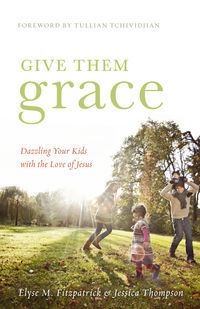
Book Review: Give Them Grace: Dazzling Your Kids with the Love of Jesus

give-them-graceYou might wonder why I would read a book on parenting when my children are all grown. I read Give Them Grace: Dazzling Your Kids with the Love of Jesus by mother-daughter team Elyse M. Fitzpatrick and Jessica Thompson partly to see where they were coming from and whether or not I could recommend it to young moms. I’d heard this book mentioned quite a lot a few years ago, and, in fact, where some people took the principles they said they got from the book raised an eyebrow for me, so I also wanted to see what they said vs. what people think they said.

Areas of agreement:

The basic premise is one I agree with: our children aren’t saved by keeping rules, and though there is a place for rules and law, they need the gospel, not more rules heaped on them. Kids (and adults) can keep all the rules perfectly and still be unsaved (and, in fact, can be blinded by their need of a Savior because they’re considered “good kids”). Only Jesus kept all the law perfectly, and once we believe on Him, His record is transferred to our account, so to speak. And no parenting method is an ironclad guarantee that our children will become Christians and live for God: only the grace of God working in their hearts and their response to it will accomplish that.

They illustrate this in the introduction with Jessica’s son, Wesley, fighting with his little brother. When she separated them and told Wesley, “You must love your brother!” he responded, “But he makes me so mad! I can’t love him!” Elyse says that when she was raising her own children, she would have responded, “Oh yes you can, and you will! God says that you must love your brother, and you better start – or else!” Years later she realized that the better response would have been to tell him that he is exactly right, that we can’t obey God’s laws on our own, that Jesus died because we can’t, and that when we believe on Him, His great love for us will enable us to love others.

They warn that it is dangerous to tell children they are good, because “there is none good but God” (Mark 10:18), plus it will confuse them about their need for a Savior if they think they are already good. I wrestled with this when my sons were small. It was so easy to say “Good boy!” to encourage them when they did something right, but I wasn’t entirely comfortable with that for those reasons. I started saying “Good job!” or something similar instead, or, as my sister-in-law suggested, commented on what “big boys” they were getting to be, as kids aspire to be more “grown up.” But I think these authors take that concept way too far (more on that in a moment).

They assert that the Bible is not just a book about moral stories, and I’d agree there. It’s about God. The main point of Jonah, for instance, isn’t that if we disobey, God will send a whale (or something comparatively awful) after us, so don’t be like Jonah. The point is God’s gracious provision both for the Ninevites plus his unloving, recalcitrant prophet.

But we are instructed to discipline, warn, correct, train, etc., our children. “Discipline proves relationship. Instruction demonstrates love. Grace is not averse to training. In fact, one of the functions of grace is training in righteousness (Titus 2:11-14)”. “Grace does not forbid us from correcting our children. But gospel correction reminds us to bring correction to them in the context of what Jesus has already done for them and his great love for them.” They make a distinction between management (basic instructions like “Don’t run in the street,” chore charts, etc., that aren’t necessarily meant to “get to the heart,” but are just a part of child training), nurturing (telling and demonstrating God’s love and care for them), [gospel] training (pointing them what Jesus has done to take care of their sin and enable them to live for Him), correction, and reminding him of God’s promises. They discuss ways to know what a situation calls for and how to apply gospel truth to their situation.

They have a fairly good section on striking a balance between interacting with other families and kids yet guarding against worldly practices influencing your children through others. I agree that we shouldn’t have homes that are monasteries or pack up the family to the prairie 50 miles from neighbors to keep them from “the world,” but sometimes those interactions can be tricky to navigate.

I thought these quotes were quite good:

The one encouragement we can always give our children (and one another) is that God is more powerful than our sin, and He’s strong enough to make us want to do the right thing. We can assure them that his help can reach everyone, even them. Our encouragement should always stimulate praise for God’s grace rather than our goodness.

We are always to do our best, striving to be obedient and to love, nurture, and discipline (our children). But we are to do it with faith in the Lord’s ability to transform hearts, not in our ability to be consistent or faithful. Seeking to be faithfully obedient parents is our responsibility; granting faith to our children is his.

The only power strong enough to transform the selfishly rebellious and the selfishly self-righteous heart is grace. The law doesn’t transform the heart of either…it only hardens them in pride and despair.

Grace teaches us to rest in what Christ has done for us and to live lives of godly gratitude.

The chief end of our parenting is not out own glorification as great parents but rather that we glorify God and enjoy him forever.

It is a kindness when [God] strips us of self-reliance, because it is there, in our emptiness and brokenness, that we experience the privilege of his sustaining grace.  It is only when we arrive at the dreaded place of weakness that we discover the surpassing power of Christ.

Areas of disagreement:

They give a plethora of examples of how to apply the gospel to our children’s everyday needs and issues, but most of their examples are impossibly long. They say that, of course, you wouldn’t say all of this every single time. Still, some real life examples of these truths in short bursts would have been better than lengthy paragraphs that no parent would probably ever say. (BTW, Kevin DeYoung’s example of trying to have such a conversation with his child is hilarious – and a lot more realistic).

One of their examples is how to talk to a child who made the last out in a ball game which caused his team to lose and is understandably unhappy. They list about 4 pages of what to say to him (at least it’s 4 pages in the Kindle app – I don’t know how many in the physical book). Some of it is good, like instructing that throwing his bat when angry is harmful and wrong, and that he can congratulate his teammates even though he doesn’t feel like it because Jesus set aside His desires for him. But then they go on to suggest saying things like, “Losing a baseball game is not the worst thing that could ever happen. Losing Jesus is” and “I  understand why you’re mad about not winning. It’s because winning is all you have.” They assert that the child “needs to repent not only of his anger and desire to approve of himself but also of desiring to be perfect on his own and of ignoring the perfection Jesus has provided for him in his justifying love.” Well, there’s truth there, but maybe he just needs to be encouraged to practice more or to be comforted with the reminder that even the pros strike out sometimes, that no one performs at 100% capacity all the time.

In a section on the grief of rebellious children, they make the point (rightly, I think) that God can be glorified just as much when everything seems to have gone wrong, because His grace shines through our fallenness and need for redemption. But I was astonished to read these two sentences:

Because the Lord always acts for his glory, and because he predestined the sin of the Romans and the Jews in his Son’s cruel execution, their sin glorified him. It was the means he used to demonstrate his mercy, justice, and love…”

Everything God does is for his glory, and he is completely sovereign over everything that occurs. He uses our sin and the sin of our children to glorify him. If he did not, we would not sin.

While I agree that God works “all things together for good” (Romans 8:28), and I agree that his mercy in the light of our sin glorifies him, I have a real problem saying that God predestines us to sin. I am not of the Reformed persuasion, and the authors are, so that may be where that difference comes from, but I have never heard anyone say something like this before.

I mentioned before that I felt that the authors took the point about not telling children they are “good” way too far. They say it is always wrong to tell a child that God is pleased with them, because “God’s smile,” as they call it, is only bestowed upon us because of Jesus’ record of righteousness in our place. While it is true that nothing we can do pleases God in the sense of counting towards earning points with Him, there are several verses that talk about God being pleased. Hebrews 11:6 says, “without faith it is impossible to please him,” so all of these must be considered within that context. 1 Thessalonians 4:1 says, “Furthermore then we beseech you, brethren, and exhort you by the Lord Jesus, that as ye have received of us how ye ought to walk and to please God, so ye would abound more and more.” Hebrews 13:6 says, “But to do good and to communicate forget not: for with such sacrifices God is well pleased.” Part of the prayer in Colossians 1:9-11 is that we might “walk worthy of the Lord unto all pleasing.” Even children obeying their parents is said to be “well pleasing unto the Lord” (Colossians 3:20). 1 John 3:22 says, “And whatsoever we ask, we receive of him, because we keep his commandments, and do those things that are pleasing in his sight.”  None of these is meant in a way to work up righteousness but to work out righteousness: to live out what God has done in our hearts. I pondered this point a lot while reading this book. Positionally, yes, when we’re saved, our sins are forgiven, and God sees us through the lens of Jesus’ righteousness and not our own. Our own doesn’t count for anything. But what we usually call our sanctification is a growth process. God is constantly convicting and directing us away from what displeases Him and towards what pleases Him. Just like earthly families, children don’t earn parents’  love or belonging by their behavior: the child will always be a part of that family by birth or adoption. So the parents’ guiding and disciplining a child isn’t a matter of making that child fit to become a part of the family or keep his place there: it’s a matter of helping him grow to maturity, and part of that is letting him know what is pleasing and what is displeasing. (I found this post right about the time I was thinking through these things. Though he is coming at the idea of pleasing God from a different angle, he brings out many good points and helped assure me that I was thinking along the right lines.)

I also disagreed with them in saying that “Every time someone was mean to [Jesus], he fought to love” and He had to “work every day at not giving in to sin.” It makes it sound like Jesus had a sin nature to grapple with. He had a human nature, but not a sin nature. He battled Satan, so perhaps they mean these things in that way.

I thought the authors’ tone was somewhat condescending sometimes.

I couldn’t recommend this book unreservedly, but someone with some discernment might be able to use the best parts and disregard the rest.

Genre: Nonfiction Christian parenting advice
Potential objectionable elements: Some areas of theological disagreement.
My rating: 5 out of 10

(Sharing at Semicolon‘s Saturday Review of Books and Literary Musing Monday)

literacy-musing-mondays-300x300


Save

Save

Save

Save

Save

Save

Book Review: SEAL of God

SEAL of GodI got SEAL of God by Chad Williams and David Thomas a few years ago when it came up on a Kindle app sale without really knowing much about it.

It’s the story of Chad Williams, who, as he was growing up, was talented athletically, played baseball, went on to skateboarding (even making commercials and receiving sponsorships), and then made a lot of money sport fishing, but his interest in each fizzled out after a time. He didn’t do well at school, not because he couldn’t, but because he didn’t like academic work. He was from a Christian home, but was not a believer (beyond the occasional prayer for help out of a jam) and got into drinking, doing drugs, and partying. He liked taking risks, pulling pranks, and doing crazy, senseless (to anyone else) stunts just for the thrill. But at a point in his freshman year of college when the thrill of everything else was gone, and desiring to do “something big,” he decided he wanted to be a Navy SEAL.

His parents were dismayed, not only because of the danger, but because nothing in his life indicated that being a SEAL would work out for him. But he was determined. They had numerous discussions and confrontations that ended in stalemates until his father hit on the idea to ask a former navy SEAL to put him through the toughest workout he could. But that backfired – the SEAL, Scott Helvenston, saw something in Chad and took him on to train him for SEAL tryouts. They developed a close friendship through their time together, and Chad looked on Scott as a mentor.

Before Chad left for the Navy, Scott accepted a contract with a security firm that aided the military to go to Iraq. Only nineteen days before leaving for boot camp, Chad learned that Scott had been one of four Americans killed when Iraqis ambushed their vehicle, beat them, dragged them through the streets, and then hung them upside down from a bridge. Chad was crushed, but his sorrow turned to rage and a desire for revenge.

A good chunk of the book tells of the SEAL training, beyond rigorous both physically and mentally.

Chad continued his drinking, partying, and drug use when he was away from the base. On one trip home, he placated his parents during an argument by agreeing to go to church with them and planning to go to a party afterward. He warned his girlfriend what the service would be like and cautioned her not to raise her hand during the service if the preacher asked if anyone wanted to get right with God because it was a trick – they would then ask anyone who raised their hands to come forward and go to a room and talk with someone. But as Chad listened to the message, something finally clicked. He ended up raising his hand, going forward, and trusting Christ as Savior.

Fairly soon afterward, he had a desire to be an evangelist. He tried to see if there was a way to leave the SEALs early, both because of this desire and because his becoming a Christian and not going with the guys to drink any more put a wedge between them: they thought he was diluting their camaraderie and even physically attacked him. He ended up having to stay but was transferred to another unit. He eventually was “one of only thirteen out of a class of 173 to make it through to graduation.”

The rest of the book tells of some of his missions, his first forays into ministry, and how God led in both his ministry and his personal life.

One aspect that surprised and greatly interested me was that this story touched on two other books I had read. In the Presence of My Enemies by Gracia Burnham tells of her and her husband’s experience being captured by the militant group Abu Sayyaf, and a couple of years after that, Chad’s SEAL group along with some Green Berets helped “lay the groundwork” to overcome them. Also his group almost was part of the SEAL group that rescued Captain Richard Phillips, whose ship was commandeered by Somali pirates.

There is a lot of good spiritual truth in this book, but one that stood out to me was his description of how, during his SEAL training, his instructors would push them to the brink of quitting – not because they wanted anyone to quit, but because they wanted the trainees to be able to resist that temptation when they were in adverse conditions on the field. Instructors would either berate them or tempt them with the nice warm bed and food that would be awaiting them if they quit. Whenever someone wanted to quit during what was called their BUD/S course (Basic Underwater Demolition SEAL) and Hell Week, they’d have to go ring a bell specifically designed for the purpose. One particularly hard night, “the bell kept ringing at the hands of guys who were walking out on their dream for just a little bit of comfort.” I can identify with that. I would not have lasted a day in SEAL training, but in other areas of life, it’s so tempting to go the easy route when God’s help is available for whatever He wants us to do.

I enjoyed the book, especially seeing how God radically changed Chad. There are people for whom I am praying for just such a radical change, and seeing it in Chad’s life when there was no previous inclination bolsters my hope for others.

(Sharing at Semicolon‘s Saturday Review of Books)