Book Review: God Is Just Not Fair

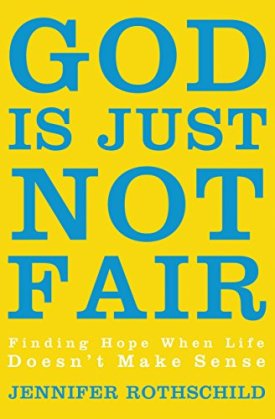
Not FairWhen Jennifer Rothschild was 15 years old, she was blinded by Retinitis Pigmentosa, effectively killing her dreams of becoming an artist and cartoonist. Then, several years later, she experienced a time of deep depression which, as she put it, tore holes in her blanket of faith.

In God Is Just Not Fair: Finding Hope When Life Doesn’t Make Sense, Jennifer Rothschild explores from her Bible study and personal experiences the questions that often come up when experiencing some sort of trial or trauma: Does God care? Why did He allow this? Why did this person experience healing but I didn’t?

That last question, not only of unanswered prayer on my part, but of the very same prayer being answered in someone’s else’s life, can bring up questions of God’s fairness. Fairness doesn’t mean He does the exact same thing in every person’s life. We’re not robots or cookie cutter Christians: God works in our lives individually according to what He wants to do in us and how He wants to grow us and show Him forth in our own circumstances and sphere of influence. And Jennifer turns this around to ask if it’s fair that we receive mercy and blessings instead of wrath for our sin. If we got what we truly deserved, we’d all be in trouble.

But Jennifer doesn’t tell us to therefore stifle our questions. She encourages us to bring them to light. We might not find answers to all of them, but we will for a few, and for the rest we can trust Him. Where He doesn’t give answers, He gives Himself.

There is so much good teaching here, it’s hard to sum it up. But I’ll give you a few examples:

If God allows you to wrestle with him, it is not so there will be a winner and a loser. He doesn’t need to prove he is stronger and you are weaker. No. The point of wrestling with God is to give you an opportunity to cling to him. God wants you to hang on to him no matter what — and the result will be blessing. You are blessed when you bring your hurts and questions to God and struggle with them in his presence. In that divine wrestling match, you may feel wounded, but you will also receive a blessing you couldn’t have received any other way.

He sometimes allows something bad in our lives to prevent something far worse in our lives. That is a wondrous work of God I cannot even see, because sometimes I have no idea how God is working on my behalf.

Being willing to thank God doesn’t mean you ignore what bothers you. It just means you are willing to look beyond what bothers you and see the good in a situation also.

Paul positioned gratitude as a choice, not a feeling. My friend, even when we don’t feel grateful, we can still be grateful.

Your difficulty can be hard enough, but the resentment or anger you drag along with it can be even more debilitating than the difficulty itself.

When we are enduring hardship, perhaps the better questions to focus on are not about the whom of suffering but about the how: • How will God use this redemptively in my life? • How will he use this loss for my gain? • How can I cooperate with my loving God’s master plan through this current suffering? • How can this possibly help me grow or change? The why of suffering is sometimes never answered. But to ask the how of suffering allows us to begin to see the beautiful redemption of what God can do in and through our suffering.

God’s ways may seem strange to us, but his ways do not have to live up to our standards or our analysis. He is who he is, and we are who we are. He is beyond error, perfect in all his ways. If his ways confuse or disappoint you, guard against the temptation to re-create him into a god you like better. You and I are to humble ourselves before him and seek to conform to his standard, not the other way around. He is sovereign and good, compassionate and merciful. If we do not accept God in his wholeness, we will never experience our own.

Ultimately, I trust God’s will to be best. He knows more, sees more, and loves more than I do.

Faith is the evidence of things unseen; instant response is not the evidence.

Unanswered prayers and prayers with disappointing answers can be greater gifts that getting what we thought we wanted.

He may allow your suffering to remain because he is using that hard thing to protect you from something far worse, preserve you for something far better, or provide for you what you don’t even realize you need. His apparent inactivity is not a sign that he is forgetful or lacks compassion, but rather an indication of his deep compassion and higher purpose for you.

God allows you to struggle, even though his power could prevent it, because his wise and compassionate authority knows that the benefit of your struggle far outweighs the comfort you may experience from his rescue.

God delivers us in different ways. Sometimes he protects us from awful things so we never have to endure them. Other times God delivers us by rescuing us or healing us. Sometimes God brings us through hard things —that’s also a form of God’s deliverance. But then there are the times that God, out of his great care for his children, delivers us out of the horror and into glory.

Thomas’s questions and doubts could have led him away from the Christ he loved and away from his friends who followed the Christ. But what a loss that would have been. Your questions and doubt can take you many places if you let them. They can take you down a road of cynicism, despair, or loneliness. But, my friend, what a waste of your doubts and questions! When you are full of questions and doubt, might you respond like Thomas? Might you stay connected with your friends who follow Christ? Will you take whatever faith or curiosity you have and channel it toward Christ himself? He welcomes questions, and he welcomes the questioner. He already knows your questions, but ask him anyway. Jesus won’t just give you the lesser gift of an answer; Jesus will give you himself because he is the answer…It was in the midst of Thomas’s honest struggles that Jesus revealed himself to Thomas. He will do that for you, too.

Being too self-focused makes every sorrow deeper, every problem bigger, and every slight more personal. It harms us and makes us forget God and others.

Never stop seeking; never stop walking with and toward him. Jesus invites us to keep taking steps toward him, even if every stepping-stone is in the shape of a question mark. As you continue to seek, don’t let theological information become a substitute for faith. Don’t let knowledge become a substitute for wisdom. And don’t seek God only for the answers he gives —seek God himself. Pursue an encounter with the God who loves you. Don’t settle for mere answers, my friend. Be satisfied with nothing less than God himself.

Every difficult, confusing season in life offers a choice. You can either surrender your questions and sorrow to God so he can use them, or you can surrender to bitterness and the enemy of your soul, who will use them against you. Don’t give him the weapons to hurt you.

The only quibble I noted or can remember is one phrase near the end of the book about “forgiving God if you need to.” God does no wrong, so He has no need of our forgiveness, and whenever I see that thought, it strikes me as a little pretentious. But what I think Jennifer is getting at is, don’t hold whatever God has permitted in our lives against Him. She speaks in the rest of this paragraph of trusting Him, being patient, and humbling ourselves before Him. As Jesus said, “And blessed is he, whosoever shall not be offended in me” (Matthew 11:6).

Because Jennifer has gone to the mat with these questions and wrestlings in her own life, her words are authentic rather than empty platitudes. And because she has sought the Scriptures and bases what she shares there, she can offer the only real hope we have: that God loves us, has a reason for everything He allows, will use it to develop us, and will give us the grace to go through it.

(Sharing with Semicolon‘s Saturday Review of Books, Faith on Fire, Literary Musing Monday, Carole’s Books You Loved), Wise Woman, Tell His Story, Woman to Woman Word-filled Wednesday)


Laudable Linkage

IMG_0195

Here’s some interesting reading discovered recently:

What Is Inductive Bible Study?

How To Be a Friend to Someone Who Has Breast Cancer. The tips here are great for a friend with almost any illness.

I Got Pregnant. I Chose to Keep My Baby. And My Christian School Humiliated Me. “My school could have made an example of how to treat a student who made a mistake, owned up to it, accepted the consequences, and is now being supported in her decision to choose life. But they didn’t.” This is a difficult situation. I understand Christian schools not wanting to appear to be condoning certain behaviors, but I think a girl in this situation needs to be affirmed for doing the right thing in having her baby rather than having an abortion.

A Theology of the Home, HT to Challies.

Check Your Privilege, HT to Challies.

A Patient Perseverance: a mother’s prayers for a wayward son.

And finally, this is me. 🙂

Or this is even more my style, minus the spa.

Happy Saturday!

Laudable Linkage

IMG_0195

I don’t usually do these two Saturdays in a row, but I came across a lot of good reading this week.

When Control-Craving Hearts Get Angry.

Why We Don’t Need to Fear the Moment of Our Death, HT to Challies.

Embrace the Life You Have.

In Defense of the Unspoken Prayer Request.

Which Bible Woman Are You Like?

Advance in Favor. Sometimes an “I don’t care what people think” attitude helps when standing for right and truth when others are not. But the Bible says Jesus increased in favor with God and man. I appreciated this article on what that means.

Don’t Hide Those Grey Hairs.

Infuse Your In-law Relationships With Grace and Love. I am happy to have good relationships with both my mother-in-law and daughter-in-law.

If I have Enough Faith, Will God Heal Me?

At the bottom of the above link is this video, worth the 12+ minutes to listen:

Save

Laudable Linkage

Welcome to my (usually) bimonthly collection of noteworthy posts around the web! Hope you find something of interest here.

The Deadly Doctrines: Pattern and Protection.

How to Love When You Don’t Feel It.

Love’s Edges.

Boring Church Services Saved My Life, HT to Challies.

Completely and Utterly Lost. “If something is lost, you can’t find it. So if my will is lost in God’s will, then it is indistinguishable from His.”

How Not to Help a Sufferer, HT to True Woman.

Killed For Christ in the Amazon. This is a very short (a little over 4 minutes) retelling of Jim Elliot and his five missionary coworkers who were killed by the people then know as Aucas, told by his daughter Valerie Shepard. At such a short telling, there is so much left out, but it’s a good intro for people who might not be familiar with the story, and it was on the BBC web site.

A Just Silence, HT again to Challies. “We’ve all felt the pressure to speak out about things that we know little to nothing about. The increasingly prevalent sentiment is that if Christians-and especially Christian leaders-don’t speak up on the hot button issues of the day, then they are complicit in fueling social injustice.”

A Letter to the Young, Gentle Christian Mama.

Saw this online and thought it was so appropriate for social media of any kind:

tweet

And this cracked me up:

Happy Saturday!

Save

Save

Protection for wounded spirits

img_0052As many of you know, I broke and dislocated my little toe about ten days before Christmas. I had never broken any bone before, and this has left me feeling very glad that I hadn’t and hoping that I never will again. Even though it’s just a little toe, the pain, discomfort, and inconvenience have had an impact on me as well as the rest of the family.

The first week I was to stay off of it as much as possible and keep it elevated as much as possible. When I saw the doctor for a follow-up visit a week after the injury, I was hoping for some specific directions for the next weeks. But the doctor was rather vague. He said it should heal in six or so weeks, and if it hurt, that meant I should stay off of it a bit. I was hoping to avoid hurting it.

One thing the doctor did emphasize, though, was protecting the toe. I didn’t have to “buddy wrap” it to the next one like the doctor did the first week, but he gave me adhesive tape to wrap lightly around the foot to keep the toe in place and told me to continue wearing the boot I was given or a good walking shoe. Thankfully we’re coming up on the six week mark, when it should be fully healed.

The emphasis on protecting the broken toe while it heals caused me to think of other injuries or wounds that we don’t really associate with needing protection: spiritual or emotional hurts. The protection for a broken bone involves supporting the broken member so the bone heals correctly. For an open wound, protecting it not only keeps other things from bumping it and causing pain, but covering it keeps it from infection. But we don’t usually think about protecting those who have been wounded in non-physical ways, except perhaps the first few days. And how would we even go about that, anyway?

You might think the answer would be that Christian community should surround and support the wounded member. “Community” seems to be the popular, go-to solution for everything these days. And, yes, we are to “Bear one another’s burdens, and so fulfill the law of Christ” (Galatians 6:2) and “weep with those who weep” (Romans 12:15). Community can do much to help and aid.

But what if community is part of the problem?

When you’re single, longing for someone to love, and there are no prospects on the horizon, but at a wedding people ask, “So when is it going to be your turn?”

When you’ve had four miscarriages, with only the first made public, and someone asks, “So when are you guys going to start a family?”

When you’re mourning on the anniversary of a loved one’s death, and a friend says, “Shouldn’t you be over that by now?”

When years later your family is still suffering the effects of a trauma that, to other eyes, seems to be all over, and someone says, “Shouldn’t you have moved on from that by now?”

When you’re visiting a new church in a new town with some trepidation, and the members of your small group or class aren’t cliquish in the sense that they deliberately keep others out, but they have all been friends for so long that anyone new feels out of the loop. When an observer mentions aside to the leader that perhaps they could take pains to reach out to the new ones, the leader says, “Well, the Bible says if you want to have friends, you should be friendly. They need to extend themselves.”

When people say the wrong things, we need to extend grace and assume they meant well. Thank God for sensitive, Holy Spirit-filled and led people who truly know how to come alongside and help, who know how to comfort as they have been comforted. Lisa shared a wonderful post recently on Invisible Band-aids and the need to be alert and attentive to those wounds which don’t show.

But other people can’t be there all the time, and in a sense it’s true that, as the old hymn says, no one understands like Jesus.

The best protection and support for wounded hearts, minds, and spirits is God’s truth, whether we apply it ourselves or share it with someone else..

When Hannah was childless and her rival provoked her and her husband didn’t understand the full weight of her sorrow, she poured out her heart to the Lord, knowing He was the only one who could meet her need.

When Joseph was betrayed, lied about, and forgotten, he trusted that God was sovereign and meant it for good.

When David’s men blamed him when the Amalekites raided their camp and kidnapped their families, to the point that they were going to stone him, David encouraged himself in the Lord.

When the psalmists brought problems and trials and anguish before the Lord, they eventually reminded themselves of His character, power, and love.

Paul was “troubled on every side, yet not distressed; we are perplexed, but not in despair;  Persecuted, but not forsaken; cast down, but not destroyed; Always bearing about in the body the dying of the Lord Jesus, that the life also of Jesus might be made manifest in our body” (2 Corinthians 4:8-10).

All throughout the Bible, you see people in various troubles or problematic situations reminding themselves of what they knew to be true of God, staking their souls on what He said, no matter how things looked or felt at the time.

A few other parallels between physical and internal wounds came to mind. You often don’t realize what muscles are used where until something is injured. I didn’t realized my toes dug in to keep balance when I picked up something on the floor, or that I pushed off with my toes when reaching for something from a cabinet, or moved my toes when I stretched in bed, and I got some rude awakenings when I did those things. Years ago, recovering from an old-fashioned gallbladder surgery before they started doing them laparascopically, one of the things I had been told to hold off doing was vacuuming. I thought that was odd – vacuuming didn’t seem strenuous to me. But the first time I tried it, I discovered, wow, you do use abdominal muscles when you vacuum! Similarly, after the deaths of my parents, I was unprepared for being blindsided by waves of grief set off by the most innocent things.

Both of them passed away at Christmas time, so for the first few years, though we celebrated, rejoiced, and even laughed, we just weren’t into what a friend called the “froth” of the season. I remember thinking that I wished sometimes that we still wore mourning clothes for a season after the death of a loved one to let others know to be sensitive. With my “boot” now, or when I used a walker or cane after transverse myelitis, I’ve been glad that I had some way of conveying to others that there was a reason I was walking a little more slowly, and hoped those devices signaled them to be careful and not to jostle me. We don’t have any such signalers after a trauma or loss or heartbreak.

Even though the intensity lessens over time, that spot still may be tender for a very long time. One friend whose husband was in prison for several years is very sensitive to jokes about prisoners, or condescending stereotypical remarks about them, or things like baby onesies made to look like prison uniforms, and after her experience, I’m more sensitive to them, too.

We need to take appropriate measure to promote healing – setting a bone, resting, taking medicine for physical wounds; for spiritual ones, we might need to confront an offender, confess any wrong on our parts, forgive, and seek reconciliation. Both health and spiritual ills usually get worse when they are not dealt with. We do have to be careful that we’re not preventing healing or making things worse by nursing our wounds.

But we can no more tell someone with a broken spirit to “get over it” any more than we could someone with a broken limb. Healing takes time. Community can and should help. But ultimately we need to splint our souls to God’s truth, to prevent the infection of bitterness by resting in His love and care, to protect our broken hearts and spirits by trusting in His grace.

The Lord is near to the brokenhearted and saves the crushed in spirit. Psalm 34:18

He healeth the broken in heart, and bindeth up their wounds. Psalm 147:3

Remember your word to your servant, in which you have made me hope. This is my comfort in my affliction, that your promise gives me life. Psalm 119:49-50

Let, I pray thee, thy merciful kindness be for my comfort, according to thy word unto thy servant. Psalm 119:76

Unless thy law had been my delights, I should then have perished in mine affliction. I will never forget thy precepts: for with them thou hast quickened me. Psalm 119:92-93

The hymn “Still, My Soul, Be Still” has ministered to me since I first heard it, and the last couple of stanzas especially bring out the need to stake ourselves on God’s truth:

Still my soul be still
Do not be moved
By lesser lights and fleeting shadows
Hold onto His ways
With shield of faith
Against temptations flaming arrows

Still my soul be still
Do not forsake
The Truth you learned in the beginning
Wait upon the Lord
And hope will rise
As stars appear when day is dimming

God You are my God
And I will trust in You and not be shaken
Lord of peace renew
A steadfast spirit within me
To rest in You alone

~ Words and Music by Keith & Kristyn Getty & Stuart Townend

(Sharing with Inspire Me Monday, Testimony Tuesday, Woman to Woman Word-Filled Wednesday, Tell His Story, Thought-provoking Thursday)

Save

Save

Save

Save

Save

Laudable Linkage

It’s a busy time of year, but I’ve discovered several thought-provoking reads online the last couple of weeks. Perhaps some of them will pique your interest as well.

Weep, Groan, Wail: The Need to Lament. “How is it possible to grieve, mourn, and wail but still know God is good?”

Even If He Doesn’t. “When the bad things come, when the kind of rescue we think we need just isn’t part of our story, will we be able to testify before a watching world that God can do it, that He will do it, but even if He doesn’t, we won’t turn away.”

Immanuel. From a friend’s whose 25 year old daughter is fighting yet another setback in her cancer battle. God is with us, even in the hard places, even in bad news.

5 Reasons to Read the Bible When You Feel Absolutely Nothing. I kept thinking Yes! all throughout reading this.

Jesus Isn’t Threatened by Your Christmas Gifts. Loved the practicality and balance in this. “The implicit messaging is that Christmas is a kind of either/or proposition in which we can either emphasize Jesus or emphasize gifts. But one always threatens to displace the other. I disagree with this.”

Miracles at Midnight.

5 Ways We Stunt Our Spiritual Growth.

Seekest Thou Great Things For Thyself? HT to Challies.

It’s Time to Take Your Medicine. “As we read the letters of Paul we find he always frames things this way: ‘God has done this for you in Christ, therefore you should respond in the following ways.’ ‘Thus the motivation, energy, and drive for holiness are all found in the reality and power of God’s grace in Christ.'”

Words That Shimmer. “For Christians, isn’t it amazing that our gracious God chose something as powerful as words to communicate to us His glorious truth? Everything pertaining to life and godliness (2 Peter 1:3). What a gift! What a treasure! Collectors of words take heart:”

Praying Biblical Prayers.

(Re)Remembering What We Mean. “Fairy tales employ the tool of the fantastic to jar us back to a truer vision that sees that all things are fantastic. Wonder is an appropriate response to all things because all things are wonderfully made.”

On parenting:

Should Parents Lay Down The Law Or Give Grace? “Grace is not rejecting authority. Grace is not walking away from the need of my children to have boundaries in their life—grace is about the way that I do that.”

My Changing Thoughts On Being a Mother. I wrestled with many of the same things mentioned here.

On writing:

Why Backstory Is Better Than Flashbacks.

And finally, I loved this video of a deer and rabbit playing. At least the deer is playing – it takes a while for the rabbit. Someone posted this on Facebook with the caption “Bambi and Thumper are real!”

Happy Saturday!

A God We Don’t Understand

When Adoniram Judson first went to Burma, six long years passed before anyone fully received his message and was converted. A few years later he was arrested and accused of being a spy when his country was at war with Burma. His feet were tied to poles that were then raised so that only his shoulders rested on the ground. Prisoners were executed daily, and no one knew when their time would be next. They were taken on a death march to another prison. Finally he was released after two years. But his brave and faithful wife died from a fever, with their child soon following after – their third child to have died. For a while Adoniram built what he called a hermitage in the woods where he would go off to be alone. He dug an empty grave and spent time looking at it and contemplating death. On the third anniversary of his wife’s death, he wrote, “God is to me the Great Unknown. I believe in Him, but I find Him not.”

After C. S Lewis’s wife died, in his grief he wrote, “Not that I am (I think) in much danger of ceasing to believe in God. The real danger is of coming to believe such dreadful things about Him. The conclusion I dread is not ‘So there’s no God after all,’ but ‘So this is what God’s really like.'”

The book of Job is filled with his laments and questionings of God. Jeremiah accused God of deceiving him.

Our 52 year old pastor died of pancreatic cancer right in the middle of a fruitful ministry. A young mom in our church died suddenly and totally unexpectedly due to a reaction to a drug, leaving behind a grieving  husband and two children. The 3 year old grandson of friends has been diagnosed with leukemia; the 25 year old daughter of friends is fighting breast cancer, the 6 year old relative of a brother-in-law was shot in cold blood at his school. When I started writing this, a hurricane was barreling toward the east coast after having already passing over several islands.

In some ways man’s inhumanity to others is understandable in that God gives people free will, and many choose to exercise it away from Him rather than toward Him. It doesn’t explain why a teenager would shoot a child except that it’s an extreme example of exercising self-will to sin against another.

We can even come to terms with death in the big picture view of the result of living in a fallen world.

But a child getting leukemia, adults dying in their prime, death and destruction from storms — that’s a little harder to come to grips with.

He doesn’t always explain why He allows what He does. Sometimes He just wants us to trust Him. But sometimes I think He doesn’t explain because we just wouldn’t understand.

I always told myself that I would never be one of those parents who said something must be done “Because I said so!” But I learned early on that you can’t always explain something to a child. They don’t have the understanding, the context, or the experience to comprehend why certain things are required of them and why others things are denied them. At times they think that the parents who are trying to do what’s best for for the children they dearly love are horribly unfair. Sometimes they just want what they want when they want it and they don’t care about any reasons why they can’t have it.

It helps to remind ourselves there are Scriptural reasons for suffering. It helps even more to go back to what we know of the character of God. He is kind. He is good. He is love. He loves us. Nothing that happens to us negates any of those truths.

Amy Carmichael, when pondering some of the same questions, wrote:

Yet listen now,
Oh, listen with the wondering olive trees,
And the white moon that looked between the leaves,
And gentle earth that shuddered as she felt
Great drops of blood. All torturing questions find
Answer beneath those old grey olive trees.
There, only there, we can take heart to hope
For all lost lambs – Aye, even for ravening wolves.
Oh, there are things done in the world today
Would root up faith, but for Gethsemane,

For Calvary interprets human life;
No path of pain but there we meet our Lord;
And all the strain, the terror and the strife
Die down like waves before his peaceful word,
And nowhere but beside the awful Cross,
And where the olives grow along the hill,
Can we accept the unexplained, the loss,
The crushing agony – and hold us still.

Children who love their Father know that when He says, “All things work together for good to them that love God,” He must mean the best good, though how that can be they do not know….

What does a child do whose mother or father allows something to be done which it cannot understand? There is only one way of peace. It is the child’s way. The loving child trusts.

I believe that we who know our God, and have proved Him good past telling, will find rest there. The faith of the child rests on the character it knows. So may ours, so shall ours. Our Father does not explain, nor does He assure us as we long to be assured… But we know our Father. We know His character. Somehow, somewhere, the wrong must be put right; how we do not know, only we know that, because He is what He is, anything else is inconceivable. For the word sent to the man whose soul was among lions and who was soon to be done to death, unsuccored, though the Lord of Daniel was so near, is fathomless: “And blessed is he whosoever shall not be offended in me.”

There is only one place we can receive, not an answer to our questions, but peace — that place is Calvary. An hour at the foot of the Cross steadies the soul as nothing else can. “O Christ beloved, Thy Calvary stills all our questions.” Love that loves like that can be trusted about this.

And when Job, Adoniram Judson, and so many others mentioned come out on the other side of the trial, though they may not have answers to their “whys,” they often testify that they know God better, felt His goodness and grace like never before, found Him good and faithful and trustworthy, found themselves upheld in ways they could not have imagined. Adoniram Judson wrote in a letter, “The love of Christ! The breadth and length and depth and height of the love of Christ! If I had not felt certain that every additional trial was ordered by infinite love and mercy, I could not have survived my accumulated sufferings.”

As one whom his mother comforts, so I will comfort you…Isaiah 66:13a

I believe that I shall look upon the goodness of the Lord in the land of the living!
Wait for the Lord; be strong, and let your heart take courage; wait for the Lord! Psalm 27:13-14

For I consider that the sufferings of this present time are not worth comparing with the glory that is to be revealed to us. Romans 8:18

Surely he has borne our griefs and carried our sorrows. Isaiah 53:4a

img_1866

(Sharing With Inspire Me Monday, Testimony Tuesday, Tell His Story, Woman to Woman Word Filled Wednesday, Thought-provoking Thursday. Linking does not imply 100% endorsement.)

Save

Save

Save

Save

Save

Laudable Linkage

Time again for another roundup of links I found noteworthy over the last couple of weeks:

What to Do When God Says No, Not Right Now.

The Instagram Bible. “Beware the Instagram Bible, my daughters – those filtered frames festooned with feathered verses, adorned in all manner of loops and tails, bedecked with blossoms, saturated with sunsets, culled and curated just for you. Beware lest it become for you your source of daily bread. It is telling a partial truth.”

3 Quick Questions Before Quitting Your Church.

What the Old Testament Prophets Say to Us During This Election Season. This is helpful if you, like me, are discouraged with our choices this election and the state of our nation in general.

Parenting 001. I linked to this on a recent book review, but for those who may not have seen it there, I wanted to share it again.

Third Culture Adult Identity Crisis by my friend Lou Ann, a missionary for 32 years. Helpful not only for missionaries but for those who minister to them.

And finally, an entertaining ballet number, even if ballet is not your thing. I was thinking that it is probably harder to do it this way that the “right” way.

Happy Saturday!

Book Review: Eight Twenty Eight: When Love Didn’t Give Up

828Ian and Larissa were like many college-age young couples, getting to know each other as friends, moving on to dating seriously, heading toward probable engagement. But then the unforeseen and unthinkable happened: Ian was in a car accident, receiving various injuries, but worst of all, damage to his brain. Larissa details their story from first meeting to eventual marriage, with the accident and all that it involved inbetween. Ian has come a long way but is still not fully recovered, so Larissa had to face whether her love was enough to handle being the wife of a man with serious needs. She’s fairly transparent about the struggle and difficulties involved, but both she and Ian have experienced God’s grace in their relationships with Him and each other.

I think I first became aware of their story through an article on the Desiring God Web site. and saw this video:

Just a few quotes from the book:

It’s good to have hope as long as we build the foundation correctly. This was a delicate balance for my young heart to make, believing that God could heal Ian, but knowing it wasn’t guaranteed. But I needed to learn God’s promises, trust that He would remain faithful, without knowing what His faithfulness would exactly look like. And I had to learn these things quickly, because fear was chasing closely behind e and constantly nipping at my heels.

I tried to dig myself into the Bible on my good days, and bury myself in Spurgeon on the bad ones. Because on the bad days, I simply couldn’t understand a God who was okay with shunts and feeding tubes, so I read the words of those who had Him more figured out than I did.

Yet I let myself focus on the giving up, the sacrificing, and didn’t see that Gd was caring for me as well. He had storehouses of riches at His feet if only I would see them, if only I would reach out and touch His garment. He wasn’t asking me to keep giving and giving and choosing the uncomfortable life of vulnerability without prefacing it with grace.

While waiting, we know, is a good thing — like the nine-month anticipation God creates inside the womb — the living of it is long and impatient. We were each being forced to learn that it’s inside the womb of waiting where beauty and character grows.

Isn’t this what I have been called to? This life of dependency on the One who made me? This life that doesn’t make me comfortable, because the discomfort is exactly what I need to make heaven more irresistible?

The title Eight Twenty Eight comes from three factors: Ian’s father, who developed a brain tumor and passed away during this time, had a birthday on 8/28; their wedding was on 8/28, and Romans 8:28: “And we know that for those who love God all things work together for good, for those who are called according to his purpose.”

Besides letting God’s grace shine through their journey, another aspect of the book that Larissa might not have had in mind is giving us a window inside the mind of a person whose loved one is severely injured. For instance, she wanted to be with Ian as much as possible, even moving in with his family to be part of his therapy. When she went anywhere else, her thoughts and heart were back with him. She writes of attending a conference after his injury that they had previously attended together, and how hard it was to be in such a setting without him. Her world basically shrunk to his room and whoever else was there. I think these things help us when we have friends going through similar trials, to understand some of what they’re thinking and to avoid well-meant but glib advice.

All in all, my heart was encouraged and blessed reading the truth and grace they experienced on this journey.

(Sharing at Semicolon‘s Saturday Review of Books)

Save

Book Review: The Butterfly and the Violin

Butterfy and the ViolinIn The Butterfly and the Violin by Kristy Cambron, Sera James owns and manages an art gallery in Manhattan. For years she has been looking for a painting she saw as a child which held special meaning for her. She has finally found at least a copy of it, but hopes it will lead to finding the original. The owner, William Hanover, refuses to sell but wants to hire Sera because he also wants to find the original, but for very different reasons. They develop a relationship, but Sera is reluctant to open her heart again after having been left at the altar by her fiance two years ago. Unraveling the mystery of the painting at first brings them closer together but then suddenly brings a sharp division between them.

The painting portrays a young woman with piercing eyes, a shaved head, and a number tattooed on her wrist holding a violin. Cambron switches back and forth between the present day and Sera’s situation to the 1940s and the story of the woman in the painting, Adele von Braun, revealing more of Adele’s story in both narratives.

Adele’s father was a high-ranking official in the Third Reich, and she was a well-known violinist nicknamed “Austria’s sweetheart.” She loved a cellist named Vladimir, but her father would not sanction their relationship since Vladimir was only the son of a merchant. Adele kept seeing Vladimir in secret and eventually learned that he was part of a network that smuggled Jews out of the country to safety. Adele had hidden Jewish friends of her own that she secretly brought supplies to, but when she tried to help them escape, she was discovered, arrested, and sent to Auschwitz. There she became part of the prison orchestra, made to play every day as the prisoners were sent out to work, during executions, and occasionally at a Nazi social event. While she felt her spirit dying, her friend tried to help her see that there could be beauty and service to God even in such a place.

God is here. He sees. He knows what is happening in this place.

This, child, is our worship. To live and survive and play to God from the depths of our souls. This is the call that binds us. When we worship in the good times, it brings God joy. But worship in the midst of agony?…That is authentic adoration of our Creator.

One day we will be free. And we become free by living despite what they do to us. We live by working, and we work for God.

I had known that their were musicians among those in WWII prison camps who were made to play for the Nazis. And I knew that the Nazis had confiscated a lot of art during those years. But I hadn’t known that there were many paintings and other art by the prisoners themselves discovered after the camps were liberated – over 1,600 pieces in “partially destroyed warehouses and old barracks of Auschwitz,” according to the author’s note at the end. Those pieces still survive even now, though many of the artists are unknown. As one character muses in the story,

She told herself that to have something of worth in a world full of chaos was the very definition of beauty.  It felt like a spiritual liberation that couldn’t be silenced.  These prisoners, the ones who painted or wrote poetry or played in the orchestra – they refused to let that spirit die.  And this, she decided, is why the heart creates.

God plants the talent and it grows, sustained by a spirit-given strength to endure, even in the midst of darkness. It thrives in the valleys of life and ignores the peaks. It blooms like a flower when cradled by the warmth of the sun. It remains in a hidden stairwell in a concentration camp. It grows, fed in secret, in the heart of every artist.

I enjoyed both Sera’s and Adele’s stories and the themes of God’s presence in suffering and the need to create. This is Cambron’s first novel, and it has deservedly won many awards. My overactive internal editor stumbled over just a few minor places where I felt the writing was a little awkward, but I’m not even going to go into them because overall this was a gripping, fascinating, heart-breaking, yet beautiful story.

(This review will also be linked to Semicolon‘s Saturday Review of Books.)