Here’s my almost-weekly round-up of good reads found this week:
The Secret to Not Being Manipulated. “We take it in, often uncritically. Yet right on the surface are aspects that should make us question what’s going on. . . . The key word is uncritically. We don’t stop to question. Thinking critically about what we read or hear doesn’t mean being critical in the sense of finding fault. It means asking questions.”
How to Kill Your Love for God’s Word. ‘Green thumb, black thumb, or somewhere in between—many of us are following these steps, and I’m not just talking about houseplants or gardening. If you want to kill your love for God’s Word, the same steps apply. “
As You Pray About Roe v. Wade. “But as we pray for America, I want to encourage us to widen our gaze a little bit and pray for the matter of abortion in other countries as well. Because, strange though it may be, the potential overturning of Roe v Wade, which is the law of the land in only one country, is already having ripple effects around the globe.”
Growing Up to Be Mom, HT to Challies. “Little hands on mighty hips, my seven-year-old face-offed with her teacher. The innocent question, ‘What do you want to be when you grow up?’ torched the classroom. It seems out of the entire class only my daughter thought the response, ‘I want to be a Mom,’ worth defending.”
A Mother’s Prayers. ‘Being a mother is a great joy—but also a heavy responsibility. And that’s why this Mother’s Day, I wanted to give the gift of prayer to each of our readers. I asked several mothers to share with me a specific way they pray for their children.”
Finally, this video of cakes that look like other objects is fascinating, HT to Steve Laube. I can’t even make regular old cakes that well. I watched a show with my son and daughter-in-law that was a contest like this: people had to choose everyday objects and then make a cake to look like their objects, then judges were brought in to determine which was the cake and which was the object. Amazing!
Yikes! I fell asleep in my desk chair this morning and woke up very late. Thankfully, I had most of this post written yesterday.
It’s hard to believe we’re through the first week of May already. It’s time to stop and reflect on the good things of the week with Susanne and others atLiving to Tell the Story.
1. Raises. Jesse, my youngest son, received some new responsibilities at his job, which included a nice raise. Then Jim told me last night that he had also gotten a raise.
2. Celebrations. We turned a family gathering into a celebration for Jesse. Mittu made his favorite meal (hamburger stroganoff) ad some gorgeous and delicious gluten-free lemon cupcakes.
3. Important paperwork. We got our wills, living wills, and powers of attorney all set and notarized this week–something that’s been on our to-do list for ages. It’s nice to have them done.
4. Planters planted. Just today (Thursday), I got my front and back planters planted. We’re supposed to have thunderstorms tonight, so I hope the plants don’t get pummeled. I not only love the flowers themselves, but both areas look neater with plants rather than the residue from last year. Update: we had rain and storms all night, and we’re supposed to have them all day as well. The flowers look okay but a little bedraggled. Unfortunately, I didn’t take a picture of them when I first planted them, and they’re too droopy for photos now. But, my roses are blooming!
5. Ceiling fans. The temperatures have not been high at night, and we have central AC anyway, but I have been waking up very hot. The ceiling fans help without my having to turn the AC down and freeze Jim out.
Winnie-the-Pooh is a creation of A. A. Milne based on the teddy bear of his son, Christopher Robin. Milne had written many other genres: plays, magazine articles, books for adults. But these days he is best known for Pooh and Christopher Robin and their friends.
My kids grew up with the Disney version of Winnie the Pooh and company. There were four individual videos at the time: Winnie the Pooh and the Honey Tree, Winnie the Pooh and the Blustery Day, Winnie the Pooh and Tigger Too, and Winnie the Pooh and a Day for Eeyore. The first three videos have since been combined into The Many Adventures of Winnie the Pooh. Then there was a Saturday morning cartoon called The New Adventures of Winnie the Pooh which we watched regularly for many years. We had stuffed Poohs (and Tiggers and Piglets) and Pooh picture books. If there were Pooh sheets or jammies, we would have had them.
But somehow, I never read the original Pooh books by A. A. Milne to my kids, and I have always regretted that. I’m not sure why I never read them. I had not read them in my own growing-up years: perhaps if I had, I would have made it a point to read them to my children just as I searched out some of the Little Golden Book titles that I’d had as a child. I dipped into one of the volumes at some point, but I don’t remember which one or if I completed it.
There are four books that specially deal with Pooh.
When We Were Very Young is a book of children’s poems. Christopher Robin’s bear there is named Edward. Some time after that, he renamed his toy bear Winnie-the-Pooh (with hyphens when his whole name is written, though he is often called just Pooh or Pooh Bear. The Disney version dropped the hyphens). “Pooh” was after a swan that Christopher had previously given that name to, and Winnie after a bear by that name in a zoo. Some of the poems feature Christopher, but all of them were probably inspired by him. One of the most famous is “Vespers” about Christopher saying his prayers.
Winnie-the-Pooh is a collection of short stories about Christopher Robin and Pooh and the other animals/toys. The House at Pooh Corner, another collection of stories, was published next, and finally there was another collection of poems, Now We Are Six. “Forgiven” is one of my favorite poems from this volume.
One of the things I had liked about the videos and TV series was that they were quiet. There were conflicts and predicaments and misunderstandings, yes. But the shows weren’t full of noise and razzle-dazzle like other kid’s shows were (that was something I liked about Mister Rogers as well).
The books are the same way. The characters are endearing. Pooh is “a bear of very little brain,” but he is kind, thoughtful, and a faithful friend. He likes to make up rhymes and take time for “smackerel” of “a little something—usually “hunny.” Christopher Robin is the one everyone looks up to and the one who rescues the others when they get in trouble over their heads. Piglet is small and timid, but also kind and thoughtful. Rabbit is bossy, but has everyone’s best interests at heart. Eeyore is gloomy (actually, he’s a little harsher in the books). Owl is wise (he can even spell Tuesday!), Kanga is motherly, Roo is spunky.
One of my favorite quotes is from Pooh in The House at Pooh Corner about how poems come to him: “But it isn’t easy,’ said Pooh. ‘Because Poetry and Hums aren’t things which you get, they’re things which get you. And all you can do is to go where they can find you.” Another is this: “Sometimes,’ said Pooh, ‘the smallest things take up the most room in your heart.” And these:
Some people care too much. I think it’s called love.
People say nothing is impossible, but I do nothing every day.
It is more fun to talk with someone who doesn’t use long, difficult words but rather short, easy words like “What about lunch?”
“What day is it?” asked Pooh. “It’s today,” squeaked Piglet. “My favorite day,” said Pooh.
Piglet noticed that even though he had a Very Small Heart, it could hold a rather large amount of Gratitude.
I love how Kanga is described as carrying her family in her pocket (something Rabbit thinks strange at first).
And I dearly love this exchange between Eeyore and Pooh, read in Eeyore’s deadpan voice, when Eeyore thinks everyone has forgotten his birthday:
“Good morning, Pooh Bear, if it is a good morning. Which I doubt.”
“Why, what is the matter”
“Nothing, Pooh Bear, nothing. We can’t all, and some of us don’t, and that’s all there is to it.”
“Can’t all what?” said Pooh, rubbing his nose.
“Gaiety. Song and dance. Here we go round the mulberry bush.”
I was very glad to see that the films and videos, for the most part, told the stories almost completely as the books did. The series went on to develop their own stories based on the characters, but kept the same tone.
Milne captures childhood innocence and ways of thinking well with playfulness and gentleness. I was very sad to learn that Christopher came to resent the books about him as he became an adult, perhaps due to teasing from others when he went to boarding school. Christopher said in his own books that his father wasn’t very expressive in person: his inner thoughts came out in his writing. But his father’s obvious delight in his son and how he thought shines through in these stories and poems. I think Christopher must have come to terms with that at some point since he provided a favorable introduction to the audiobook of When We Were Very Young, saying family friend Peter Dennis’ narration presents Pooh “as he [Christopher] knew him.”
All four volumes of the books were available as part of my Audible subscription. I listened to the stories via audiobook, but read the poetry collections via Kindle (which included, thankfully, E. H. Shephard’s original illustrations).
One thing I didn’t like about the audiobooks was the long musical interludes between chapters.
But otherwise it was a sweet experience to visit these characters their original settings.
The Back to the Classics Challenge allows us three children’s classics. So I am going to count Winnie-the-Pooh as one for the “Classic that’s been on your TBR list the longest.”
It’s a shock to the system when you realize someone thinks of you as “old.”
For me, it happened when a fast-food cashier rang up my order with a senior discount—and I was only 50.
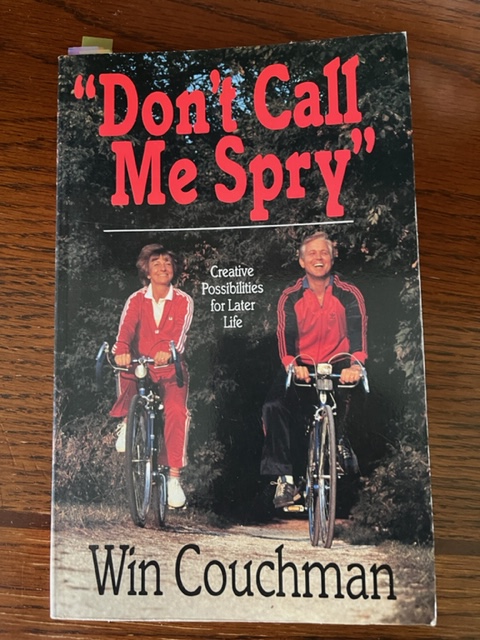
For Win Couchman, it happened when she ran into an old friend who commented, “You’re so spry!” “Spry” was a “compliment reserved for exclusively for old people.”
As the shock of this well-meant statement brought Win to tears, she began to consider aging.
I am at the young end of old: junior-high old. Youth is gone and now, also, middle age. My life at sixty-four is rich, adventurous, blessed, and full of joy (p. 2).
I am not only wrinkling. I am growing. And while I am forgetting some things, I am learning much that is new. This season of my life is as fearsome and exciting as turning fourteen. Nobody told me it would be this way (p. 3).
She decided to investigate “what it means to grow old” from the Bible, culture, the examples of older people in her life (“Not everything I learned from Grandmother about aging was glamorous, but all of it was valuable” [p.84]). She wanted to “notice and enjoy the perks that come with old age” (p. 4).
The results of her study and contemplation is “Don’t Call Me Spry”: Creative Possibilities for Later Life.
Win noted, “The halves of my life each merit my attention. The tension between the material and spiritual aspects of reality are normal. The struggle is to keep a balance: to live in light of the unseen while resetting the washer from ‘permanent press’ to ‘delicate fabrics.’ In order to live for God’s glory and not lose heart, I have the perspective of the eternal as a gift” (p. 4).
In their fifties, Win and her husband, Bob, began to pray and consider what to do when he retired. For many years, they had hosted a ministry called Forever Family which combined hospitality, mentoring, counseling, and teaching. But they were sensing maybe the time had come to do something different.
Through a series of events and contacts, the door eventually opened for them to minister in a variety of other countries eight months out of the year. They enjoyed the novelty and the opportunities to minister, resulting in some never-to-be forgotten experiences.
But they also experienced stresses with travel and continual adjustments, and they handled them differently. She liked to talk things out when stressed or anxious; he withdrew and became quiet. I’m sure those tendencies were always a part of their personalities, but these new experiences brought them to the forefront and required them to meet each other half-way.
Bob’s retirement brought other stresses and adjustments, like sharing space that she had previously had to herself.
Then new stresses arose when Win developed a heart issue which brought not only their international travel to a close, but their full-time active ministry as well. She had to rethink what she could do within her new reality. “It grieved me to give up thinking I could do anything anyone even a generation or two younger than I can do” (p. 45).
It saddened me to give up the illusion that I could always push myself a bit more if I needed to, that pushing was the thing to do. I could no longer be casual about getting too tired. I was newly aware of another true separation between me and those who are younger (p. 46).
She tells how God led her to other types of ministry, mainly mentoring, prayer, being involved with her grandchildren. She still taught and spoke on a limited basis.
One of my favorite chapters is “The Downside,” dealing with some of the negative aspects of aging. “When you ask me how I am, sometimes it is a little hard to know how to answer” (p. 107).
But even though Win describes herself as a pessimist, overall the book is hopeful and positive. The Bible assures that God’s care and love and grace will always be with us. In addition:
As I have looked repeatedly into the mirror of these verses, I have not only been provided with new assurance of God’s caring for me, but I have a greatly enhanced concept of the possibility of lifelong usefulness (p. 136).
While searching for more information about Win, I came across this video of her.
I had not heard of Win before until I read a chapter by her in The Wonder Years: 40 Women over 40 on Aging, Faith, Beauty, and Strength compiled by Leslie Leyland Fields. I didn’t discover until recently that her chapter, “The Grace to Be Diminished,” originally came from a magazine here. Then I found her poignant article, “The Beds I Have Known,” about living separately from her husband of 72 years when she could no longer care for him. I saw somewhere that she had written this book, so I searched for it. It’s out of print, but I found a used copy in good condition for $5 at Amazon.
I am glad to have found and read it. It gave me much encouragement as I look ahead.
In 1940, Isobel Kuhn found herself hitchhiking on an obscure Chinese road. She “had always thought that womanly women did not do such things,” but there was no other way to get where she needed to go. She caught a ride with a truck driver, “cringing with humiliation inside.”
She asked God why she had to be put in such situations. The verse came to mind, “For I think that God hath set forth us the apostles last, as it were appointed to death: for we are made a spectacle unto the world, and to angels, and to men” (2 Corinthians 4:9). A spectacle was just what she felt like. She was a little comforted. Even though this particular incident was a small one, she felt she endured it for His sake since she was a missionary.
Isobel felt that the spectacle Paul probably had in mind was the Arena in Rome, where Christians were thrown to the lions for sport. Later, she wrote:
Through the several years which followed, years of war strain and danger, this thought kept returning to me. The different trials of us Christians of the twentieth century are like so many platforms in the world’s Arena of today. The unbeliever looks on at our struggles and is only impressed or influenced if he sees the power of God working there. The purpose of the Arena experience is not for our punishment; it is that God might be revealed.
. . . God taught me through the years to view my own trials as platforms in today’s Arena. I thought this concept was original with me, but one day my husband found that Hudson Taylor had formed the same opinion many years ago. He said, “Difficulties afford a platform upon which He can show Himself. Without them, we could never know how tender, faithful, and almighty our God is.” I found it so, too. . . It seemed that my most valuable lessons have been learned on these platforms.
Her book In the Arena was written with this idea in mind, showcasing how God manifested Himself through obstacles, frustrations, strain, necessities, danger, and illness.
In 2 Corinthians 12, Paul had been praying for deliverance from a “thorn in the flesh.” Commentators offer good evidence for the different possibilities as to what that “thorn” might have been, anything from some physical ailment to actual demonic oppression. I agree with what Warren Wiersbe said in his commentary: it’s good we don’t know exactly what it was, so we can apply it to any kind of “thorn” in our lives.
Paul said God gave him this thorn in response to some special revelations He had given Paul. Paul mentioned earlier in this chapter that he had one experience in the “third heaven” that he was not even allowed to tell the details about.
We’re easily prone to pride when we hit spiritual heights, as though we had anything to do with them. So God gave this “thorn” to Paul “to keep me from becoming conceited” (verse 7). Paul asked God three times to remove the thorn. But God said no. Instead:
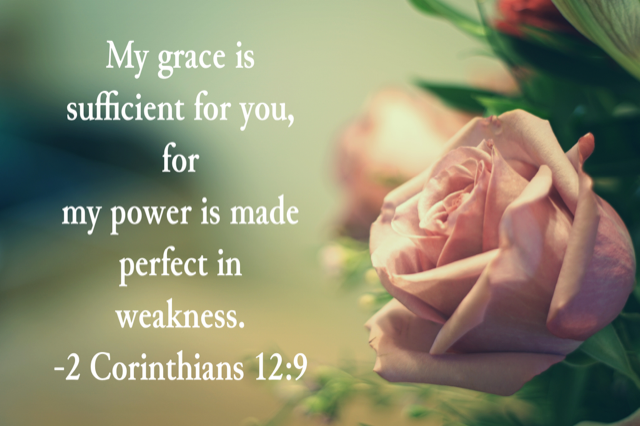
He said to me, “My grace is sufficient for you, for my power is made perfect in weakness.” Therefore I will boast all the more gladly of my weaknesses, so that the power of Christ may rest upon me.For the sake of Christ, then, I am content with weaknesses, insults, hardships, persecutions, and calamities. For when I am weak, then I am strong (2 Corinthians 12:9-10).
The ESV Study Bible says twice that “Paul’s earthly weaknesses, not his revelations, are to be the platform for demonstrating the Lord’s power and grace” (p. 2238).
That’s just the opposite way we think it should work, isn’t it? We think some mountaintop experience, some spiritual high point, will “show off” God’s power. And God does use those moments in people’s lives. But we don’t reach those heights in our own strength. Moses spent 40 days alone with God, and his face shown afterward. David went from the depths of despair to the heights of praise in the psalms. Elijah faced off with the prophets of Baal for a showdown of their respective deities. Yet spiritual highs don’t keep us from sin. Relying on God’s power does. Each of these men had very human weaknesses for which they needed God’s grace.
Paul’s thorn not only kept him humble; it kept him dependent. God had told him, “My grace is sufficient for you, for my power is made perfect in weakness.” When we’re tempted to go off on our own, our weaknesses remind us we can’t: we need God’s help. When a trial is more than we can handle, we’re reminded to give it to the One who can handle it.
The ESV Study Bible points out that in 2 Corinthians 12:9, when God says His grace is sufficient for Paul, the word “sufficient” is in the present tense, “underscoring the ever-present availability and sufficiency of God’s grace” (p. 2238).
Sometimes we don’t want people to get close enough to see our weaknesses. We think our weaknesses will mar our testimony. But people see our blind spots that we’re unaware of: they know we’re not perfect. When they see God’s grace and power in our lives, they know there is hope and help for themselves as well.
Seeing those needs in people’s lives makes them more relatable. When we see them recover from a stumble or struggle with human weakness, it encourages us that we can access God’s grace and carry on.
Even our Lord Jesus, though He never sinned, experienced weakness that draws us to Him. The fact that He stooped to experience humanness for our sakes shows us how much He loves us. We know He understands our weaknesses and needs, not just from omniscience, but from experience.
Since therefore the children share in flesh and blood, he himself likewise partook of the same things, that through death he might destroy the one who has the power of death, that is, the devil, and deliver all those who through fear of death were subject to lifelong slavery. . .Therefore he had to be made like his brothers in every respect, so that he might become a merciful and faithful high priest in the service of God, to make propitiation for the sins of the people. For because he himself has suffered when tempted, he is able to help those who are being tempted (Hebrews 2:14-15, 17-18).
Since then we have a great high priest who has passed through the heavens, Jesus, the Son of God, let us hold fast our confession. For we do not have a high priest who is unable to sympathize with our weaknesses, but one who in every respect has been tempted as we are, yet without sin. Let us then with confidence draw near to the throne of grace, that we may receive mercy and find grace to help in time of need (Hebrews 4:14-16).
Paul said he was not only content with “weaknesses, insults, hardships, persecutions, and calamities,” but he boasted in them (gloried, the KJV says). Some translations say “delight” instead of “am content.”
My first response in any trial is to pray for deliverance, and maybe secondarily to ask that I might learn what I am supposed to from it. But to be content in it? Even more, to delight in it? I can’t say I am there yet.
But maybe I’d be closer if I looked at the situation like I am supposed to, as a way for God’s power to be displayed.
One guest preacher at my college spoke of giving everything he had over to the Lord. When the car broke down, he prayed, “Lord, Your car needs help.” That’s probably a good way to look at it.
So we can be content with our thorns and even glad for them, because:
They keep (or make) us humble.
They remind us our strength is not in ourselves.
They keep us dependent on God’s grace and help.
They’re a testimony to others.
They make us more relatable.
They showcase God’s power.
How about you? Do these truths help you with your “thorns in the flesh”?
This song written by Mike Harlan and Cary Schmidt has helped me carry these truths with me:
Here are some good reads that ministered to me this week.
How to Hold Fast to Jesus in a World That’s Spinning Out of Control. “I could easily spiral into hopelessness and despair. But like my daughters, I learned at an early age to hold fast to Someone. I don’t get it right all the time, and I’ve spent time wandering and lost. But that urge to hold fast keeps me close to the only Solution I know.”
No One Knows My Pain, HT to Challies. “Rather than inviting others into my pain and grief, I’ve often pushed them away. I’ve felt a vague sense of self-righteousness, confident that no one could speak into my life except God himself. I’ve dismissed others’ experiences, even the comfort of friends, because they couldn’t fully relate to my suffering.”
Mentoring Our Next Generation. “Looking back, I am amazed to think that none of these people were a part of the youth staff at my church. They did not have a position that would have prompted their involvement in my life. What they did have was a heart that was burdened for me and a big enough concern to pursue me and challenge me to walk with God. They mentored me!”
Keep It Simple, HT to Challies. “What do you feel when someone asks you to disciple them? I imagine you’re excited because a hungry, likely younger Christian, wants to grow. I imagine there’s probably also stress because you don’t know where to begin. A wealth of good resources is at your fingertips, but that can make things more complicated. So where do you start?”
“I’m so sorry”—“Thank You,” HT to Challies. “When I sat down to write those obligatory notes of thanks, I never expected to receive so much in return. What I thought would be a tedious, hand-aching process instead was cathartic and healing.”
The Virtue of Argument, HT to Story Warren. “As I sat down to write this, my daughter asked me what I was writing about. Adequately explaining virtue to a 9-year-old seemed like it might take more time than I wanted to devote at the moment, so I simply said, ‘I’m writing about how argument can be good.’ She instantly responded vehemently with, ‘No, it can’t!? Arguing is a bad thing?!'” We’d probably all react that way to the writer’s premise. But she’s calling for “an exchange of ideas” in a virtuous way rather than “winning at any cost.” Since we constantly come across people with different ideas than we have, it’s good to think about how to talk about our ideas while still respecting the other person’s.
6 Lessons for Tending Your Time. “You ever feel like that? Like you can’t win with your schedule? Like you’re swinging between laziness and frenetic activity? Maybe you’re looking, like I was, for a better relationship with time.”
This was a funny video about the difference between mothering toddlers and teens:
It’s the last Friday of April, time again to pause and reflect on the good things of the week with Susanne and others atLiving to Tell the Story.
1. Ham bone soup with the remnants of our Easter ham has become a delicious tradition. We had enough to have the family over with a good bit leftover besides.
2. Lunch with a friend was good because of the fellowship but also because we ate at Cracker Barrel.
3. Sales on dresses. I don’t usually shop at Old Navy except for my middle son and his family. They haven’t had anything I was interested in the few times I’ve been there. But lately they’ve been advertising some styles I really liked. I ordered a couple of things online. Then I was near the store for some errands and stopped in–and found three dresses I love for $19.99 each!
4. A washed car. My husband doesn’t want me to use a drive-through car wash because he doesn’t think some of the plastic pieces on our car would hold up well in a commercial car wash. This past weekend, he cleaned my car inside and out. It looks so nice!
5. A good errand-running day. I had a lot I wanted to get packed into one afternoon and thought I might run out of time or energy before I finished. But I hit all the places I wanted to, then got groceries, gas, and prescriptions, and brought Arby’s home for dinner. It was nice to crash that evening.
I don’t know what happened to April. It seemed to zoom by more quickly than usual.
We’re still in up-and-down weather, but we’re gradually having more warm days than cool ones. We’re getting plenty of “April showers,” so hopefully that will make up for the dry spell and fire warnings we were experiencing and prepare us for an abundance of “May flowers.” I’m relishing these warm days before the heat of summer sets in.
We celebrated my grandson’s birthday and Easter this month. I don’t think we had any major outings.
Timothyisms
Last week I included in my “Laudable Linkage” this video of a new baby who seems unimpressed with the outside world.
When I showed it to Timothy, he said to the baby, “You’ll get used to it.”
Creating
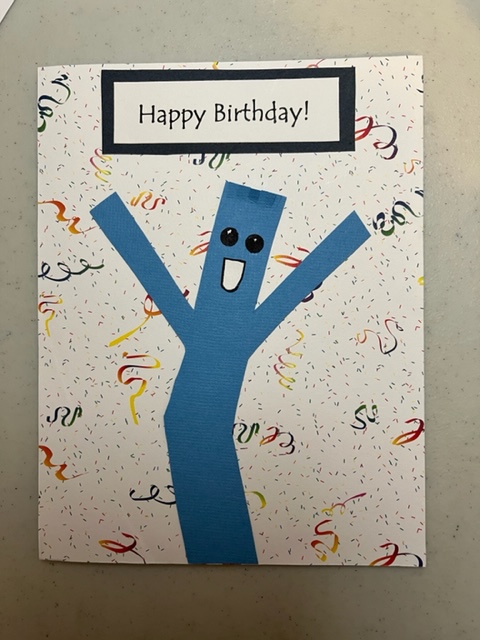
I only made one card this month, for Timothy’s birthday. For years he has loved “balloon men,” or, as we discovered they were called, air dancers. I had seen a couple of cards with them on Pinterest, but I didn’t want to copy them exactly (especially since they were both items the makers were selling.) But Cricut didn’t have any images of them, and I couldn’t find a template of them. I’ve mentioned before that I am not at all good with freehand drawing. But I printed out a couple of samples and got out my ruler and pencil, and came up with a reasonable air dancer.
I cut out the eyes from white cardstock with a hole punch and then used a Sharpie marker to color in all but the little white dot. I thought about using tissue paper for the “hair,” but in the end decided to make it simple by just cutting slits in the top and then fanning them out a bit.
Watching
Jim and I saw a few movies, but the only one I thought really good was The 12th Man. It’s based on a true story. Twelve Norwegian men disguised as fishermen sabotaged several German facilities in Norway during WWII. But then they could not find a man they were supposed to meet, running into another man by the same name instead. That man, fearing he was being tested by the Nazis, reported the group. The Nazis found and killed all but one of the Norwegian men. The head of this Nazi group followed the escapee, Jan Baalsrud, with Javert-like persistence. Jan headed toward neutral Sweden, but the brutally cold weather, lack of supplies, injury, and other factors hindered his progress. Jan became something of a national hero, symbolizing hope to his fellow countrymen.Those who helped him were taking their lives in their hands. The majority of the film is in other languages with English subtitles, but after a while we got caught up in the story and didn’t mind watching that way. There is an annual event in Norway following Jan’s pathway. (Warning–a few bad words).
Reading
I felt a little bad that the first couple of weeks, I only finished reading and reviewing one book each week. Then the last couple of weeks, I finished and crowded in several. I’d like the book reviews to be spread out a little more evenly, but that doesn’t always work out.
Since last time I finished (titles link to my reviews):
Dormant Souls. “Believers have their winters too,” says John Newton. Yet dormant is not dead. With the light of God, the nourishment of His Word, and “springs of living waters,” He can bring us out of dormancy and into vitality and growth and fruitfulness.
What We’re to Be Before We Teach. Most teaching from Titus 2 centers on the content older women are to teach younger. But first, Scripture talks about the character of older women.
Lamb of God, who died to take away our sins when we believe on Him.
“At Least I’m Still Good for Something.” Sometimes we’re so caught up in taking care of loved ones’ needs, especially elders’ needs for safety, that we forget to let them know they still matter.
As we change the calendar over to May this weekend, I look forward to a short road trip with a friend (more on that later), Mother’s Day, and filling our planters. Jim takes care of the yard work and what landscaping we have, but I enjoy arranging two big planters in front of the house and one on the patio. Somehow these plants survive my lack of green thumb more than houseplants do. I want to try planting peonies somewhere in the yard. I may start a sewing project. I’ve mended and made curtains and pillows, but I have not sewn clothes in ages. I’m not looking forward to a scheduled colonoscopy except for getting it over with.
How was your April? Looking forward to anything in May?
Hugh Lofting first created the character of Doctor Dolittle in letters home to his children while he was in WWI. The first book in the series is The Story of Doctor Dolittle: Being the History of His Peculiar Life at Home and Astonishing Adventures in Foreign Parts Never Before Printed.
Dr. Dolittle is a medical doctor, but he has a lot of pets. He begins to lose patients when they are scared by the number and kinds of pets he keeps. Someone suggests he become an animal doctor. His talking parrot tells him all animals have languages and teaches the doctor several of them. The doctor’s fame spreads far and wide since he can now diagnose and treat animals for the exact ailments they tell him about.
There’s only one problem. Animals aren’t paying customers. As much as the doctor dislikes money and wishes he didn’t have to bother with it, a certain amount is necessary to live.
So he and the animals devise ways to economize plus make some money.
Then birds bring word that monkeys in Africa are very sick, with many of them dying. They’ve heard of Doctor Doolittle and wonder if he can help them.
So after making arrangements for his house and the animals who will stay home, and finding a boat and supplies, the good doctor sets off along with several of his animal companions. They experience several misadventures during their travels and their time in Africa.
I had not realized that there were a number of books with Doctor Doliitle as the main character until I set out to read about him. I had thought that there was one main chapter book. This book is the first written, but others tell of time periods before this book. So some sets of the Doolittle books are arranged in the chronology of the settings rather than publication order. I prefer publication order of any series because that’s how the story would have originally unfolded. Sometimes we don’t care much about the back story until we come to know and care about the characters and their world. I listed to the audiobook very nicely read by James Langton. But it was put together in setting order, so I had to search through several beginnings of chapters in The Voyages of Doctor Dolittle, which had been placed first, before finding this story (the beginning of the different books wasn’t marked).
Also, I didn’t realize the set I listened to was “fully updated for the modern listener.” I would much rather read and listen to books in their original words. One new illustrated edition has taken the liberty of adding an “updated magical twist.” So if you prefer original classics, check for these things before choosing a volume.
Some editions say they have removed “ethnically insensitive” parts of the story. I assume this one did since it’s “revised for modern readers.” Generally, I’d rather leave stories as they were and explain why certain things are no longer done or said. I don’t know what things were removed from these books. Perhaps, especially in the versions designed for children to read themselves, it is better to adapt them without those offensive elements.
I hadn’t intended to read Doctor Dolittle until this set came up in a “2 books for one credit” sale on Audible. I’m glad to be more familiar with it now, but I don’t think I liked it well enough to read the other two books in this set.
To Sir, With Loveis an autobiographical novel by E. R. Braithwaite. Braithwaite was born in Guyana, well-educated, and a pilot in the Royal Air Force during WWII. He says in the book that his color was not a factor during his military service, not even in dating, and he had almost forgotten that his color could be a factor. But after his military service, he spent almost eighteen months unsuccessfully looking for a job. He’d have promising leads until he went for an in-person interview. He began to grow bitter. A chance meeting with a stranger on a park bench put the possibility of teaching in his mind.
He found an opening at a school in the East End of London called Greenslade in the book. The headmaster said they didn’t practice punishment at the school. The students came from disadvantaged backgrounds and needed encouragement and building up. But Braithwaite wasn’t given any advice or tools to help him manage his students. When he asked fellow teachers, advice ranged from “Show them who’s boss” to “Don’t be too hard on them.”
Braithwaite found his students, for the most part, not very literate, crude, vulgar, unwashed, and uncaring about gaining knowledge or much of anything. Their reactions to him varied from ignoring him to disdain to hostility.
Finally, he hit on an approach that seemed to work. I won’t spoil the story by saying what, as for me, that was the part I was most anticipating.
Even then, the relationships between student and teacher and the students’ growth was up and down through various circumstances.
Alongside the story of Braithwaite’s journey with his students is his observations and experiences as a Black man in the later 1940s and 50s. From a white woman who refused to sit next to him on a bus, to those who refused to hire him once they saw him, to refusal of his renting a room, to a colleague making little digs by calling him “the black sheep” and “our sunburned friend,” to a waiter ignoring him, then spilling his soup and not offering to clean it up, Braithwaite experienced various degrees of racism. When asked by someone why he didn’t “stand up for himself,” he seemed to feel it just wasn’t worth it and would cause more problems than it solved. He had lived in the US for a few years and felt racism was more overt there at that time, whereas in Britain it was more subtle.
As the headmaster began to tell Braithwaite of the kinds of homes and situations the children came from, the latter thought, “I was becoming increasingly irritated by his recital of the children’s difficulties. My own experiences the last two years invaded my thoughts, reminding me that these children were white. Hungry or filled, naked or clothed, they were white. And as far as I was concerned, that fact alone made the only difference between the haves and have nots. I wanted this job badly, and would do it to the best of my ability. But it would be a job, not a labor of love.”
But, as you can surmise from the title, he does come to love the students. He felt his colleagues, except one, “accepted him unconditionally” and wanted him to do well.
A few other quotes that stood out to me from the book:
A man who is strong and tough never needs to show it in his dress or the way he cuts his hair. Toughness is a quality of the mind, like bravery or honesty or ambition; it has nothing whatever to do with muscles.
I sought to relate each lesson to themselves, showing them that the whole purpose of their education was the development of their own thinking and reasoning.
Mind? Oh yes, I do mind. But I am learning how to mind and still live. At first it was terrible, but gradually I am learning what it means to live with dignity inside my black skin.
It is not necessary for them to do anything special for a Negro or Indian or any other person, but simply to behave to them as to a stranger Briton, without favor or malevolence,but with courtesy and gentleness which every human being should give to and expect from every otherr.
I listened to the audiobook, nicely read by Ben Onwukwe. As usual, there was no back matter in the audiobook; I don’t know if there was in the print book. These days, stories based on true events often have a back section where they tell to some extent what situations were true and what were made up. According to Wikipedia, Braithwaite’s upbringing, education, military service, and teaching career were as portrayed in the book. But I would guess the students in the story were an amalgam of his real-life students. It seems like many events, as well as the progression of the story, might have been condensed somewhat from real life.
There are a number of instances of “damn,” “hell,” and the “b word” by Braithwaite as well as other adults and students. He notices and mentions students’ and women’s breasts several times. I almost didn’t get past the first chapter because of these elements.
But I enjoyed the story and felt I learned from Braithwaite’s experiences.
I don’t think I ever saw the film by the same name starring Sidney Poitier, though I want to some time. For some reason, the setting of the film was changed to the 1960s. The song from the film was popular as I was growing up.