Book Review: Loving People

I’ve mentioned several times here that I struggle with my own selfishness and with not being more loving (not thinking of romantic love necessarily, but generally loving others) . Recently I was discussing with a friend that overcoming selfishness is not a once-and-done effort. It requires an every day yielding to God instead of ourselves.
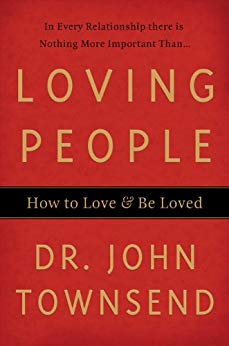
So when Loving People: How to Love and Be Loved by John Townsend came through on a Kindle sale, I got it. I had heard of Townsend but never read him before.

Early in the book, Townsend says:

You may have noticed that the title of this book has a double meaning. Loving can be both a verb (the action of demonstrating love) and an adjective (the description of someone who demonstrates love). The intent here is to bring attention to the reality that both meanings are necessary for each other to exist. If you want to be a loving person, you must actively show love to people. And if you want to love people, you are to be a person characterized by loving.

A few more of his introductory comments about love:

Care and love aren’t the same thing. Almost any of us could say that we truly care about some people. We can freely admit that, and we are glad these people are in our lives. We want what’s best for them. But the reality is often that we don’t know how to treat those we care about in the most loving way. We want to be the best for those people, but we don’t know how to love them in the way that is best. That is, we would like to be close to them, to be a positive influence for them, and to bring them to intimacy and a better life. But there is a disconnect between our care for those we love and how we address or approach them.

Love is much more than good feelings or intentions. It has direction, movement, and purpose. But while we may feel love, we may not be doing love. Most of us don’t know how to experience and become competent in the art form of love.

We cannot force ourselves to feel anything. Feelings are the result of changes inside us. They aren’t a cause; they are an effect. Trying to will ourselves to feel love doesn’t work. Yet when we say that love is only a feeling, we reduce it to something less than what it truly is. As I said earlier, love encompasses and experiences feelings, but love is not limited to feelings. It is much more—genuine love involves the heart, soul, and mind.

In this book, I define love simply as “seeking and doing the best for another.” When we love someone, we bend our heart, mind, and energies toward the betterment of someone else. That is what loving people do. It involves the whole person. It is ongoing and intentional.

As the architect of love, God lives out this definition. He is constantly seeking and doing what is for our best, things that help us connect, grow, and heal. He is actively doing whatever it takes for us to be the people he designed us to be. The ultimate example of his love is, and always will be, in the sacrifice of Jesus for an alienated and broken creation: “For God loved the world so much that he gave his one and only Son, so that everyone who believes in him will not perish but have eternal life.”

He proposes that love is made up of the following components:

  • Connecting—making an emotional bond
  • Truth-Telling—honesty that serves the other person
  • Healing—repairing brokenness
  • Letting Go—giving up what should be surrendered
  • Romancing—the unique love of being a couple

He spends more than a fourth of the book on connecting, which he defines as “a heart-to-heart attachment that goes beyond knowing about someone to actually knowing that person.” He gives multiple examples: one involved a wife who shared problems and frustrations about her day, and her husband, thinking he was being helpful, suggested possible solutions. But she didn’t want solutions, at least, not yet. She wanted the connection: she wanted to know she was truly heard and understood. By contrast, disconnection isn’t just missing someone who is away for a few days, but rather “the inability to feel and experience the warmth of connection over time. It is the absence of the security of being attached. It is the lack of bonding inside.”

I thought truth-telling was an odd inclusion, because of course you don’t lie to people you love. But Townsend means truth-telling as more than just not lying: it means confronting the other person in a kind and loving way when they need to be confronted. “If your loved one’s life is going down the drain, someone needs to say something. Be that person.” “People who are truly loving will confront, limit, and quarantine people who consistently make wrong choices. So keep that distinction in mind: love seeks the best, but it does not enable bad behavior.”

Under healing, he says: “Loving people are the primary agents of restoration.”

About letting go: “Sometimes love means knowing when it is time to let someone go or to let him do something he is going to do. When you accept reality and give up efforts to control someone’s life or change who he is, you are being loving . . . Letting go is the ability to surrender and to allow what is real to exist. By letting go, I mean giving up efforts to control, manipulate, or force someone to do something different.”

About romance: “Romance is a wonderful aspect of love, but it is not as broad or as deep as love itself. Romance must fit into and serve love. Love can never serve romance.”

He discusses the components of each of these aspects and gives numerous examples, illustrations, and balancing considerations.

This book is not a Bible study, so it reads differently from one. Surprisingly absent from a book by a Christian about love was any discussion about the classic biblical passage on love, 1 Corinthians 13 (except for verses 1 and 13). But Townsend provides a biblical basis for most of his points. In the chapter on connection, for instance, I thought, “This is all well and good, but where do you get this from the Bible?” Well, from the One who made the greatest effort to connect with people who were not only uninterested in Him, but opposed to Him. “Therefore he had to be made like his brothers in every respect, so that he might become a merciful and faithful high priest in the service of God, to make propitiation for the sins of the people. For because he himself has suffered when tempted, he is able to help those who are being tempted” (Hebrews 2:17-18).

The last chapter, “Putting It All Together,” didn’t really put it all together for me. I had hoped it would recap the main points. Instead, it contained instructions to “assemble your team” and “measure and evaluate your process of growth.”

I got a lot of helpful points and thoughts from the book, but I can’t say, “Aha! Now I’ve got it!” Townsend brought up aspects of love that I had not heard or read in other pieces on this subject, but he also did not address other aspects that are usually considered.

While Townsend had a lot of good things to say, his style just didn’t gel with me. Not to say there is anything wrong with his style: he is a best-selling author, after all. But many of the conversations he described in the book are just not the kind I can imagine anyone I know having. Real people did have them, but I guess they were very different personalities from mine and my family and friends.

The best advice I’ve heard about love came from a book I have not been able to recall or find again. But the writer said that for years she berated herself for not being more loving. She was a missionary in a difficult area, and she found herself too often irritated with unloving thoughts towards others. The more she tried to become more loving, the more frustrated she became. But then she started to think about God’s love for her, gracious and undeserved. And without even being aware of it at first, resting in His love overflowed into her own heart and actions.

That’s not to say we can’t learn from books like this. I was particularly convicted about connecting, truly listening and empathizing instead of just offering my two cents to fix the other person’s problems.

I’ve heard similar definitions of love before, that’s it’s a self-sacrificing desire to meet the needs of the loved person. And I’ve heard that it’s not just a feeling. Yet I struggle with doing the right thing, but with resentment. That’s part of having a sin nature, I guess, and we’ll never have it down perfectly while here on earth. Maybe in some ways love is doing your best for another despite resentment. But that’s not how God loves. And I want to love more like Him.

What helps you to be a more loving person?

(Sharing with Carole’s Books You Loved, Booknificent)
Book Review: Honey, I Don’t Have a Headache Tonight

Many Christians are in a quandary when it comes to talking about sex.

We know God invented it. We know He created it not just for procreation, but for our enjoyment, within the parameters He ordained (Song of Solomon, Proverbs 5:18-19, Hebrews 13:4).

The Bible is actually quite frank about a number of matters that we wouldn’t express in exactly the same way today. Perhaps the culture at the time allowed for that. Perhaps our over-charged sexual culture these days causes us to keep all discussion of sex to “the talk” parents give their children, to premarital counseling, and between husband and wife.

One of my professors at a Christian college, I think in a class about the home I took as a Home Economics Education major, recommended The Act of Marriage by Tim and Beverly LaHaye. Of course, we knew the basics, nature will take its course, and people will figure it out (and have for thousands of years). But some of us like to be a bit better prepared.

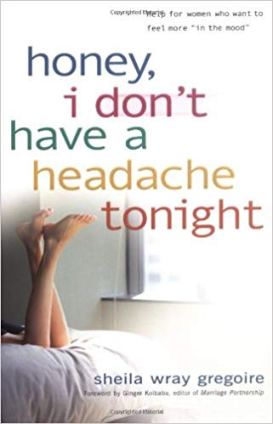
I just rediscovered another helpful book that I had hidden away (perhaps so my sons wouldn’t stumble across it when they were younger) and forgotten about: Honey, I Don’t Have a Headache Tonight by Sheila Wray Gregoire.

The theme of the book is a common problem: men are usually “in the mood” more often than women are. Sometimes the situation is reversed (in as many as 1/3 of marriages at the time this book was written). Sheila addresses some of the matters that cause this discrepancy and shares ways to deal with them from a Biblical basis. There’s a chapter on each of the following topics:

  • Men and women are wired differently.
  • Paying attention to the rest of the marriage will affect the sexual aspect.
  • Lack of energy
  • The problem of pornography, past abuse, wrong attitudes, and “reclaiming godly sexuality”
  • Respect
  • Romance
  • Roles and gender
  • Self-image

The last chapter deals with a number of questions and problem issues.

A few quotes from the book:

We treat sex as if it’s something purely instinctive, not something imbued with all the relational and emotional components that God gave it (p. 64).

God made sex because He wants us to enjoy it. It’s precious. But think of how you treat other precious things. Men who collect antique cars polish them, wax them, and watch for any blemish or problem so they can take care of it before it gets out of control. They’re constantly vigilant. We need to have the same attitude about sex. It’s precious, it’s fragile, and it needs our tender care so that it can shine, too (p. 80).

Don’t feed your mind with romance novels, soap operas, or other harmful illusions that will just make you chronically unsatisfied. Take the initiative yourself to warm up the relationship to romance (p. 97).

While I didn’t agree with every little point in the book, overall I found it very helpful. I debated with myself a long time about whether to mention the book here on the blog. But since, as I mentioned earlier, these matters are common problems, I thought I’d share this as a good resource. And it’s a good resource even without problems, since it emphasizes the relationship, unselfishness, thoughtfulness, and marriage as the picture God intended.

(Sharing with Inspire Me Monday, Literary Musing Monday, Global Blogging, Happy Now, Carole’s Books You Loved, Booknificent)
“Just Wait: It Gets Harder”

A young mom friend shared that she gets the above response whenever she mentions that life can be hard with several little children at once.

Why do we women do that to each other?

I’m so thankful that when I was a young mom, a special older lady told me that each stage of our children’s lives has it’s high and low points, and we shouldn’t dread any stage. I think at the time my oldest was about to turn two, thus I was cringing at the thought of the “terrible twos.” Her words helped me not to view that season of life negatively, and the “twos” were not all that terrible.

Though baby- and toddlerhood hold some cute, sweet, fun, and incredibly precious  moments, small people depending on you for every little thing can be exhausting. I loved my babies and little ones, but this stage of life was hardest for me. When they can feed themselves, go to the bathroom by themselves, dress themselves, etc., life gets a lot easier.

Perhaps for some moms, what I call the “taxi years” are the most taxing, when you’re chauffeuring kids to sports practice, music lessons, church activities, birthday parties, school activities, etc., etc. That season does have its challenges. We tried hard to strike the right balance by offering our kids a number of opportunities without the whole household revolving around children’s schedules. It’s not easy. But one perk was that one of our children opened up much more in the car than if I tried to draw him out across the table.

Probably most who warn about harder years of parenting are referring to the teen years. Once, when my children were still young, an older mom and I were working on a bulletin board together at church. As she shared something about her teenage daughter, she said something like, “Don’t dread the teen years. If you keep the relationship good, keep communication open, and train them up in the nurture and admonition of the Lord, the teen years don’t have to be a trial for either of you.” And she was right, just like my mom friend who told me not to dread the “terrible twos.” The world has bought into this idea that rebellion is a teenage rite of passage, but it doesn’t have to be. They do ask hard questions, but we should welcome them and help them seek answers. They should be coming to a point where their beliefs are becoming their own rather than just rotely following what they’ve always been told. There might be a few bumps in the road towards independence, but it doesn’t have to be an all-out war.

And then we come to parenting adults. In some ways, it’s a relief that all their decisions are their own responsibility now. Yet we have to let them make their own mistakes. We only offer advice when asked, and then carefully. We have to let go, but we can pray.

Each stage of development is a necessary part of growing up. Each has its hardships and its blessings. We need to encourage each other all along the way.

Imagine you’re hiking up a mountain trail. The way is rough, you’re hot, and you’ve still got a long way to go. Way up ahead you see another hiker. You call out to her and ask how the trail is between you. She says, “You think it’s bad now; you think you’re tired now; just wait. It only gets harder the further you go.”

How encouraged would you be? Not at all.

How much better if those ahead on the path called back, “Yes, it’s tough. But God gives grace. You can do it. Keep up the good work!” Or, even better, we can share how we found verses like 2 Corinthians 9:8 true in relation to motherhood: “And God is able to make all grace abound to you, so that having all sufficiency in all things at all times, you may abound in every good work.”

Motherhood has been one of the hardest aspects of my life. Not much else (besides caregiving) showed me how selfish I was and how much I needed God’s grace. But watching and learning from other moms was a great encouragement.

Much has been said in recent years about mentoring, but we don’t need to set up formal mentoring relationships in order to encourage others. So often, I’ve received the most encouragement from off-the-cuff, seemingly random conversations in passing. But looking back, I know they weren’t random. I know God placed those people in my path for  my encouragement.

I’ve shared before this poem from an unknown author that was quoted in Rosalind Goforth‘s autobiography, Climbing (one of my favorites). I had always thought of it in relation to life in general, Christian life in particular. I had mostly thought of it in relation to missionary and other Christian biographies. Even though it’s not specifically about motherhood, much of it can apply. We don’t need to demean or “one-up” others. Older moms, let’s call back encouragement to younger moms. Older women, let’s support younger women whether they are mothers or not, married or not.

Call Back!

If you have gone a little way ahead of me, call back-
It will cheer my heart and help my feet along the stony track;
And if, perchance, Faith’s light is dim, because the oil is low,
Your call will guide my lagging course as wearily I go.

Call back, and tell me that He went with you into the storm;
Call back, and say He kept you when forest’s roots were torn;
That when the heavens thunder and the earthquake shook the hill.
He bore you up and held where the very air was still.

O friend, call back, and tell me, for I cannot see your face;
They say it glows with triumph, and your feet bound in the race;
But there are mists between us and my spirit eyes are dim,
And I cannot see the glory, though I long for word of Him.

But if you’ll say He heard you when your prayer was but a cry,
And if you’ll say He saw you through the night’s sin-darkened sky-
If you have gone a little way ahead, O friend, call back-
It will cheer my heart and help my feet along the stony track.

Has someone “called back” in a way that encouraged you? I’ve love to hear about it in the comments.

(I’ve read several posts about encouragement this week. This must be a
message God wants emphasized at this particular time.
I love how Kelly expanded this truth to all scenarios here.)

(Sharing with Inspire Me Monday, Global Blogging, Literary Musing Monday,
Hearth and Home, Purposeful Faith, Tea and Word, Tell His Story,
Happy Now, InstaEncouragement, Anchored Abode,
Let’s Have Coffee, Recharge Wednesday, Share a Link Wednesday,
Wise Woman, Worth Beyond Rubies, HeartEncouragement,
Grace and Truth, Faith ‘n Friends)


Friday’s Fave Five

It’s Friday, time to look back over the blessings of the week
with Susanne and other friends at Living to Tell the Story .

October is here! And though it’s still hot and muggy in eastern TN, cooler weather is in the forecast! I can’t wait! Meanwhile, I’m pressing “pause” today to reflect on some of the best parts of the last week.

1. Movie with Timothy and his Grandmas. My daughter-in-law’s mother came to visit, and she invited me to come watch a movie with her, her mom, and Timothy. They had tried taking Timothy to the theater a year or two ago, but he wasn’t quite ready for it yet. Most of the fun of this excursion was hearing his excitement. We were in a theater that has recliners and serves food, so he enjoyed eating pizza while watching. I especially enjoyed his comments and observations throughout the experience. I wish I had recorded all his comments, but the ones I remember are:

During each trailer: “I like this movie!”

“Why did they turn the lights off? It must be night outside.”

“I miss Daddy.”

2. A nice visit. My son’s family brought Mittu’s mom over for dinner last Sunday night. We had a good visit.

3. Bringing food in. Jason and Mittu came over another night later in the week and brought Mexican food from a favorite local restaurant. Jesse and I also got take-out one night while Jim was out of town. It was from a nicer restaurant and a little more expensive—especially as we splurged and got desserts. (Why do restaurant desserts cost so much?! I could have gone to the grocery store next to this restaurant and got 3-5 pies or cakes for the price of two of their desserts.) So we probably won’t be doing that again any time soon. But it was a nice treat. And the desserts did last two days (which does account for some of the expense, but not as much as they charged!)

4. A quiet week. The movie and dinner get-together were last weekend, and there was nothing on the schedule the rest of the week. I enjoy the activities, but I love just regular, ordinary weeks, too—and need them in-between busy times.

5. Wellness, or at least feeling better. Jim has been battling upper respiratory issues for about three weeks now. First a cold, then an infection. He feels immensely better, though he still has a hacking cough sometimes.

And, as a bonus, I had especially prayed for some encouragement for my youngest son’s job hunt. He had a phone interview that went well, so we’ll see if anything comes of that. Just having some response on that front is encouraging, but it would be especially encouraging if something would pan out! But we know God will connect him with just the right job at just the right time. I shared with him that my evening reading for Monday from Daily Light on the Daily Path was all about God’s guidance.

Happy Friday!

Book Review: A Constant Heart

 A Constant Heart by Siri Mitchell takes place towards the end of Queen Elisabeth’s reign. The Earl of Lytham, a nobleman who was one of Elisabeth’s courtiers, needed to advance himself in her favor so as so as to earn a pension, knighthood, or something to increase his own fortune. To garner money to finish and maintain his homes, he found a knight paying a good dowry to marry off his daughter. Lytham did not really care about the girl, and was, in fact dismayed that she was beautiful. His first wife had been beautiful—and traitorous and unfaithful.

The earl’s new bride, Margret, had been trained since she was five only to please her future husband. Since it was obvious she could not please the earl personally, she sought to advance his interests at court. But she was an outsider, and a beautiful outsider at that. No one must outshine the queen. Marget’s life as a courtier fell flat until Lady de Winter took her in hand and advised her to do what every other female courtier did: shave her eyebrows, paint her face white with ceruse (a white lead mixed with vinegar), and dye her hair red to look like the queen’s.

The longer Margret stayed at court, the more she discovered the futility of life there. “It was a way of life that seemed to produce nothing of worth and yet consume everything of value.” And she came to understand that few there could be trusted. But she seemed to have no choice but to continually turn herself into what she was not.

And then the most dangerous development occurred. Lytham and Margret came to actually love each other. But no courtier was to love anyone more than his queen.

My thoughts:

I loved the depths of historical research deftly layered into this book. Siri states in a note to readers that the main characters were fictitious, but the circumstances were real. Elisabeth wore the ceruse paint to cover up both signs of aging and the smallpox she had endured. People didn’t realize the negative effects of lead paint until later. I had hoped Siri would also talk about some of the other details of the story in her note, but she didn’t. I did some reading about being a courtier in Elisabeth’s time, and many of the details Siri brought out were mentioned. Siri didn’t go into any of Elisabeth’s many accomplishments: perhaps all or most of those occurred before this last decade of her reign.

Some would want to know that sex is referred to often in the book. Since one method some used to curry favor involved sexual advances, that kind of thing could not help but be mentioned. But nothing is explicit.

I enjoyed Margret’s and Lytham’s journey toward learning to truly love each other and wrestling with just who the sovereign was in their lives. Grace was contrasted with the consuming machinations to court the favor of a capricious monarch. The integrity of a faithful heart was shown to have great value in all eras.

(Sharing with Carole’s Books You Loved, Booknificent Thursday)

Making the Bible Come Alive

“He really makes the Bible come alive!”

Have you ever heard that about a preacher, speaker, teacher, or writer?

People could mean several different things by that statement. Perhaps they mean the teacher is exciting. They have a dynamic presentation. Or maybe they make the Scriptures seem particularly relevant. Maybe they help us understand things from the Scripture that we hadn’t before. They use a lot of eye-opening illustrations.

Those are all good traits. Years ago, at a former location, a Christian radio station ran a program from a local pastor who spoke in a monotone. I used to turn off the radio when his program came on. I actually got angry at him and thought, “Doesn’t the Bible deserve better treatment than that?” Then I got convicted of a wrong attitude. The man had been a pastor and had this program for years, so he obviously had listeners. Maybe some people like monotones, who knows.

But here’s the thing: we don’t make the Bible come alive. It IS alive.

Jesus said “It is the Spirit who gives life; the flesh is no help at all. The words that I have spoken to you are spirit and life.” (John 6:63, ESV).

For the word of God is living and active, sharper than any two-edged sword, piercing to the division of soul and of spirit, of joints and of marrow, and discerning the thoughts and intentions of the heart. (Hebrews 4:12, ESV).

We’re the ones that need to be made alive. And what enlivens us? I like the King James word “Quicken,” which sometimes means to make alive, sometimes revive. God quickens us with His Word:

My soul cleaveth unto the dust: quicken thou me according to thy word. (Psalm 119:25)

This is my comfort in my affliction: for thy word hath quickened me. (Psalm 119:50)

I will never forget thy precepts: for with them thou hast quickened me. (Psalm 119:93)

God making us alive through His Word is not surprising, really. He created the universe and everything in it with His Word.

God’s Word can enliven us even if it’s read in a monotone.

That doesn’t mean we should be careless when we read, explain, or teach from it. There’s no virtue in reading the Bible in a monotone or presenting it in a dull way if we know better and can help it. We should try to present it in as understandable and winsome a way as possible.

Each of the Bible writers has a style about them: the Holy Spirit gave them the words, yet worked through each of their personalities to express truth.

But we should be careful of our tendencies to follow “exciting” teachers. If they can be exciting and Scripturally accurate, great. But too often, people gravitate towards excitement rather than truth.

For the time is coming when people will not endure sound teaching, but having itching ears they will accumulate for themselves teachers to suit their own passions, and will turn away from listening to the truth and wander off into myths. 2 Timothy 4:3-4, ESV).

The Bible is so full of good truth that convicts, comforts, enlightens, teaches, rejoices our hearts, builds us up. We don’t need to dress it up or manipulate it to make it “interesting.” We just need to show people what it says. And we need to know it well enough to seek teachers who do the same.

Your words were found, and I ate them,
    and your words became to me a joy
    and the delight of my heart,
for I am called by your name,
    O Lord, God of hosts. (Jeremiah 15:16, ESV)

(Sharing with Inspire Me Monday, Global Blogging, Literary Musing Monday,
Hearth and Soul, Purposeful Faith, Tell His Story, Tea and Word,

Happy Now, Anchored Abode, Let’s Have Coffee, Worth Beyond Rubies,
Recharge Wednesday, Wise Woman, Share a Link Wednesday,
Heart Encouragement, Grace and Truth, Faith on Fire, Faith ‘n Friends.
Links do not imply 100% agreement)

Ive-Been-Featured-at-LMMLinkup-300x300


End-of-September Musings

I don’t have my fall decorations out yet. It’s hard to get motivated when it doesn’t feel like fall yet. I’ve seen this going around on Facebook (I was unable to trace who originated it):

But! It will come! Sooner or later!

Meanwhile, here’s a look back at the month.

Family

Our big family event for the month was my youngest son, Jesse’s, birthday. He’s still job-hunting and hoping to be on his own soon, so this birthday the major concentration was gifts for his own place. Too bad they don’t give showers for single people. 🙂

We also enjoyed the Tennessee Valley Fair and a couple of family movies.

Mittu had a bad cold and now Jim has it. We’re hoping and praying it doesn’t spread further.

I got some medical stuff out of the way: my annual physical, a treatment for vertigo with a physical therapist, and an eye examination. Besides having a dentist appointment next month, I should be done with everything medical for a long while.

By the way, does anyone else get tired of hearing “That’s part of getting older” when you tell doctors your symptoms?!

Timothyisms

From my five year old grandson:

When Mittu asked Timothy if he wanted to tell Grandma the Bible verse he was learning, he replied, “Too much pressure.”

He didn’t believe his toy cow was a girl even though it had an udder. When asked why, he said, “It doesn’t have eyelashes.”

We were playing a game that involved choosing sounds to represent various scenarios (Earwax). Timothy loves to laugh at the different sounds. One of the categories was “What does love sound like?” I asked Timothy that question, and he said, “A beatboxing trumpet.”

Creating

I only made one card this month, for Jesse’s birthday. He likes video games, and this is supposed to look like his Nintendo Switch controller.

Watching

I’m continuing to watch When Calls the Heart while riding my exercise bike. We enjoyed America’s Got Talent, especially the finale (one of their best). Jesse and I usually watch something together while eating lunch, and lately we’ve been working our way through Merlin. It’s about Merlin as a teenager, just making his way to Camelot and meeting Arthur as a young man. They do change some details from the usual legend. But it’s amazingly clean. Of course, it deals with magic. We’re careful about that kind of thing, and when the kids were young I avoided any books or shows with magic. But then I realized that fairy tale magic is a different thing from the occult:real witches don’t turn people into toads and such.

We watched The Lion King a few weeks ago and the new Aladdin movie with Jason, Mittu, and Timothy.Then we took Timothy to his first in-theater movie with other visiting grandmother and saw Abominable. Cute in places, but probably not my favorite kids’ movie. But it was fun watching Timothy’s reaction to everything.

Writing

Still chipping away at revising the book I’m working on.

Reading

This month I completed:

  • Rachel’s Prayer and Sarah’s Promise, the last two books in Leisha Kelly’s series about the Worthham and Hammond families. Loved these dearly.
  • There’s a Reason They Call It GRANDparenting by Michele Howe. Good resource for grandparents who want to be a good influence in the grandchildren’s lives.
  • Anna Karenina by Leo Tolstoy. Better and deeper than I had anticipated.
  • A Promise in Pieces by Emily T. Wierenga, about a WWII nurse who takes a dying soldier’s letter to his widow after the war The widow gives her a baby quilt, which she uses as a midwife. Good and touching story.
  • The Magnificent Ambersons by Booth Tarkington. It’s something of a forgotten classic, but I enjoyed it quite a lot once I got into it.

I’m currently reading:

  • Loving People: How to Love and Be Loved by John Townsend . . . still. I used to read this kind of thing after my devotional time, but lately there hasn’t been time. I need to finish this one!
  • On Writing Well by William Zinsser
  • Moby Dick by Herman Melville. Just started this, and it is SO good!
  • A Constant Heart by Siri Mitchell

Blogging

Some of the blog posts from this month:

  • Forsaking Thoughts. It doesn’t help just to tell ourselves not to think about certain things. Here are some strategies for changing our thoughts.
  • What If We Really Don’t Measure Up? Someone will always be better than we are. But we’re only responsible for what God wants us to do.
  • Let Us Lift Up Our Hearts to the One Lifted Up for Us. A quick look at the phrase “lift up” in the Bible. Because He was lifted up for us, we can lift up our souls, eyes, voices to Him.
  • That’s Just the Way God Made Me.” Knowing how we’re wired helps in many ways. But good traits have offsetting weaknesses that we shouldn’t excuse. Plus, God sometimes wants us to extend ourselves out of our comfort zone and rely on Him to do what does not come naturally to us.
  • Making the Bible Come Alive. We can’t—it IS alive. We’re the ones who need to be made alive by the Word of God.

As we close out September, I’m looking forward to October: more fall weather, beautiful colors, no major events on the calendar. Oh, there are potlucks and a baby showers and Bible studies and always things to be done. But after our busy “birthday season” from the last few months, I’m looking forward to a lighter schedule between now and the holiday season.

How was your September?

(Sharing with Linda, Inspire Me Monday, Global Blogging,
Literary Musing Monday, Hearth and Soul, Purposeful Faith,
Happy Now, Tea and Word, Tell His Story, Shannan,
Let’s Have Coffee, Worth Beyond Rubies, Porch Stories,
Grace and Truth, Faith ‘n Friends.
Linking does not imply 100% agreement)

Laudable Linkage

I have a very short list today, but a good one. I started to save them for next week, but by then I might have so many they’d get lost in the shuffle.

Redefining Balance So We Stop Thinking We’re Doing Life Wrong, HT to Edie Melson at the Blue Ridge Conference Writers Facebook Page. “Juggling is exhausting. It’s also not supposed to be a full-time gig. Professional jugglers don’t juggle every day, all the time. Which brings me to the whole idea of balance because juggling involves balance.”

Maintaining Confidence in the Process. “Too often we overestimate the growth we can gain in a week, but underestimate the growth we can gain in a year.”

The Casserole Rules. “As people of faith, we are very good at meeting people in times of death and illness. There are no judgments around these things, and we do not need discernment about who was in the wrong. We don’t have to wonder about whether one’s grief is deserving of a casserole. The rules about other human conditions are not so clear. Casseroles for the death of a marriage? For a mental breakdown? For rehab?”

My five-year-old grandson likes the “Dude Perfect” guys on YouTube and shared several of their videos with us. This was one of my favorites:

I don’t necessarily like the “Rage Monster,” who appears in all their “stereotypes” videos. Being so angry you’re out of control is scary rather than funny to me. I guess someone must have been looking to take up a gym floor here. 🙂

Happy Saturday!

Friday’s Fave Five

It’s Friday, time to look back over the blessings of the week
with Susanne and other friends at Living to Tell the Story .

The last Friday of September and the first Friday of autumn! It still doesn’t feel like autumn yet, but some trees are starting to turn color. It’s just a few degrees lower, but I sure am looking forward to cool breezes, hopefully soon. Meanwhile, here are some of the best parts of the last week:

1. Mending is not a favorite, but it does feel good to take clothes from unwearable to wearable status. I had not worn a couple of items in a long time, so it almost feels like getting something new!

2. A good report from the ophthalmologist. I hadn’t seen the eye doctor for years since our last one retired and his replacement went to a pediatric office. I seemed to have an excess of new floaters, so I wanted to make sure everything was ok with my retina. My husband’s retina detached a few years ago, and the first symptom was a lot of floaters. I was glad to hear everything was ok with my eyes.

3. Movie night Jason and Mittu rented the live-action Aladdin and brought it over to watch. I hadn’t seen the animated version, so I don’t know how it compares, but we enjoyed it a lot.

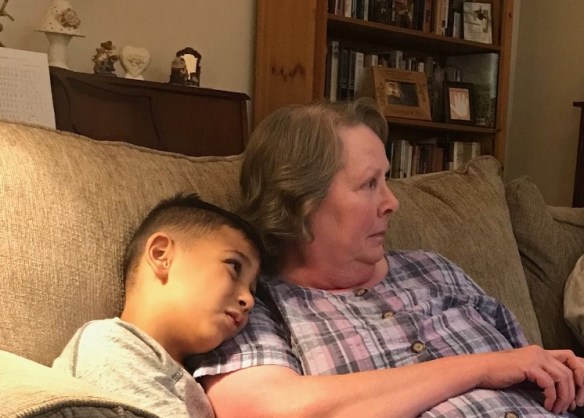
4. Cuddling with Timothy while watching the movie. He usually sits with his mom and dad or on a kid’s couch when we watch something, so it was sweet he took the initiative to sit next to me.

5. Antibiotics. My poor dear husband has had some kind of upper respiratory problems for a week and a half now. He called in for an antibiotic a couple of days ago, and it’s starting to help. He’s still pretty sick, but hopefully he’ll be well before too much longer.

Bonus: Munchkins! I was craving a donut after my eye doctor appointment, but didn’t want to go into a store with my eyes dilated (with all the bright lights. And I didn’t want to wear my sunglasses inside in public). I didn’t think we had a donut shop near, but discovered a Dunkin Donuts not too far way. I like their bite-sized assortment.

Happy Friday!

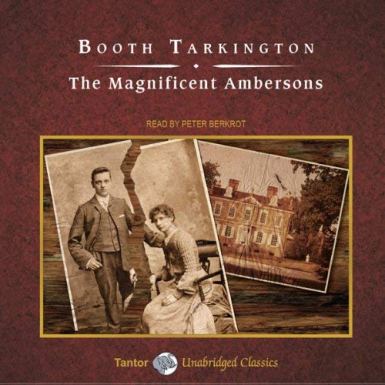
Book Review: The Magnificent Ambersons

Booth Tarkington won a Pulitzer prize for The Magnificent Ambersons, set in Indiana in the late nineteenth to early twentieth centuries.

One one level, the story focuses on Georgie Amberson Minifer, only grandchild of the great Major Amberson. “His grandfather had been the most striking figure of success in the town: ‘As rich as Major Amberson!’ they used to say.” The town was proud of the Major, and his mansion was the big finale when people took visitors on a tour. But Georgie was considered a “princely terror” who felt his entitlement even as a child. Many people looked forward to the day when Georgie would “get his comeuppance.”

As a reader, I began to look forward to the same thing and wondered how it would come about. I also wondered if it would be the ruin of him or the making of him. Even though Georgie is not a likeable character at first, one does feel sorry for him during his “comeuppance.”

On another level, the book masterfully conveyed the changes of the times: the advent of the automobile, which many considered just a fad at first; the growth of the little town into a big city with the problems that kind of growth can bring; the decline of “old families” and their pedigrees and the rise of industrialism and entrepreneurship.

But automobiles have come, and they bring a greater change in our life than most of us suspect. They are here, and almost all outward things are going to be different because of what they bring. They are going to alter war, and they are going to alter peace. I think men’s minds are going to be changed in subtle ways because of automobiles; just how, though, I could hardly guess. But you can’t have the immense outward changes that they will cause without some inward ones, and it may be that George is right, and that the spiritual alteration will be bad for us.

The city was so big, now, that people disappeared into it unnoticed, and the disappearance of Fanny and her nephew was not exceptional. People no longer knew their neighbours as a matter of course; one lived for years next door to strangers—that sharpest of all the changes since the old days—and a friend would lose sight of a friend for a year, and not know it

A big part of the first chapter describes the various ways the rich distinguished themselves in fashion, facial hair, architecture, and such. It was an enjoyable observation of changing styles. I found it interesting that the term “hand-me-downs” came not from getting clothes that had belonged to someone else, but from getting them “off the shelf” rather than specially made from a tailor: “Trousers with a crease were considered plebeian; the crease proved that the garment had lain upon a shelf, and hence was ‘ready-made’; these betraying trousers were called ‘hand-me-downs,’ in allusion to the shelf.”

It took me just a bit to get into the story, as it begins with a heap of description. One thing I most appreciated about Tarkington’s writing was his skill in conveying things to the reader through Georgie’s eyes that Georgie himself missed. For instance, various people comment on his father not looking well, but Georgie thinks he looks just as he always did—and then Georgie is surprised to find out his father really is ill. Georgie’s fairly young throughout the book, so he’s forgiven for a bit of immaturity. But his lack of understanding other people or situations comes more from his exalted view of his own opinion.

Gossip can be a problem for anyone, but it’s a partuclar bane for the rich and famous. I found the advice Georgie’s uncle George gave him worth consideration:

In this town, naturally, anything about any Amberson has always been a stone dropped into the centre of a pond, and a lie would send the ripples as far as a truth would.

“Gossip is never fatal, Georgie,” he said, “until it is denied. Gossip goes on about every human being alive and about all the dead that are alive enough to be remembered, and yet almost never does any harm until some defender makes a controversy. Gossip’s a nasty thing, but it’s sickly, and if people of good intentions will let it entirely alone, it will die, ninety-nine times out of a hundred.”

People who have repeated a slander either get ashamed or forget it, if they’re let alone. Challenge them, and in self-defense they believe everything they’ve said: they’d rather believe you a sinner than believe themselves liars, naturally. Submit to gossip and you kill it; fight it and you make it strong. People will forget almost any slander except one that’s been fought.

Nobody has a good name in a bad mouth. Nobody has a good name in a silly mouth, either.

I also found especially interesting the Major’s thoughts when he knows his time is coming near:

The Major was engaged in the profoundest thinking of his life. No business plans which had ever absorbed him could compare in momentousness with the plans that absorbed him now, for he had to plan how to enter the unknown country where he was not even sure of being recognized as an Amberson—not sure of anything, except that Isabel would help him if she could. His absorption produced the outward effect of reverie, but of course it was not. The Major was occupied with the first really important matter that had taken his attention since he came home invalided, after the Gettysburg campaign, and went into business; and he realized that everything which had worried him or delighted him during this lifetime between then and to-day—all his buying and building and trading and banking—that it all was trifling and waste beside what concerned him now.

For those who would want to know, the book has a few objectionable elements: a smattering of bad words and taking the Lord’s name in vain, the condescending view of “darkeys” and a couple of uses of the “n” word, and one character visiting a medium. That character (not Georgie) said he wasn’t superstitious, only believed what the medium said for about ten minutes, and realized he had inadvertently supplied her with information enough for what she told him. But the incident was a major turning point in his attitude, and I was disappointed Tarkington used it to bring that about.

Wikipedia says, “In the 1910s and 1920s, Tarkington was regarded as the great American novelist, as important as Mark Twain.” I’m nor sure why he’s not read as much today. I’m thankful I chose this book for the Classics from the Americas category of the Back to the Classics challenge. I enjoyed Tarkington’s story and insights very much.

I mostly listened to the audiobook read by Peter Berkrot, but I read the last few chapters in the free Kindle version because I can read faster than the narrator does, and I wanted to finish it. It’s also online free through Project Gutenberg. There are a couple of movie versions of the book, but I haven’t seen any of them.

(Sharing with Carole’s Books You Loved, Booknificent Thursday)