Book Review: The Incorrigible Children of Ashton Place: Book VI: The Long-Lost Home

Incorrigible The Incorrigible Children of Ashton Place: Book VI: the Long-Lost Home is the long-awaited finale to the Incorrigible Children series by Maryrose Wood.

If you’re not familiar with the series, it’s about three children raised by wolves whom Lord Frederick Ashton brings home after he discovered them on a hunting trip. Needing someone to teach and “tame” the children, Lord Ashton advertised for a governess. He was sent the plucky Miss Penelope Lumley, graduate of Agatha Swanburne’s Academy for Poor Bright Females.

A number of intriguing mysteries and connections have been traced through the first five books: the fact that Penelope’s hair is the exact same color as the Incorrigibles, that Frederick Ashton gets “wolfy” during full moons, that Frederick’s presumed-dead father is not really dead but has not revealed himself. Book V ended with Penelope separated from the Incorrigibles,  having been tricked into switching places with a tutor to the  Horrible Babushkinovs in Plinkst, Russia.

In this final book, the looming due date of Lady Constance Ashton’s baby means the family curse will come to a head, and one side or the other will be destroyed.  How can Penelope help them while so far away? How can she possibly get home with no resources?

All of the various threads are satisfactorily resolved in this final book. I’ve mentioned before that I don’t normally go for books about “curses” or ones that have soothsayers as recurring characters. Those weren’t elements in the first book that got me hooked on the series. The most objectionable element to me was a seance, I think in Book III. If you read this with your children, you’ll have to discuss these issues in concert with your beliefs.

I also don’t read all that many children’s books, and I am not sure what age level this book is intended for.

But what I love most about the series is the clever writing and the humor. Every book is sprinkled with Agatha Swanburne’s pithy sayings and includes explanations and references to a couple of classics (Hamlet and The Count of Monte Cristo, in this case). Values such as hard work, resourcefulness, basic decency, and loving family are emphasized in each book.

I loved the distinction between “Optoomuchism” – an overly optimistic and ultimately untenable outlook – and “pessimax” – pessimism to the extreme.

I happened to listen to the first book due to a free audio version, and I fell in love with Katherine Kellgren’s fantastic narration, character voices, and inflections. I chose to listen to all of the books via audio because she added so much to them. Sadly, she passed away before the final book was published. There is a very touching afterword in this book honoring Katherine and telling of the friendship that had arisen between the author and narrator. Audiobooks don’t always include forwards and afterwards, so I am glad this one did. This audiobook was ably narrated by Fiona Hardingham.

These are my reviews of the previous books:

The Incorrigible Children of Ashton Place, Book 1: The Mysterious Howling 

The Incorrigible Children of Ashton Place, Book II: The Hidden Gallery

The Incorrigible Children of Ashton Place, Book III: The Unseen Guest (for some reason did not review this one)

The Incorrigible Children of Ashton Place: Book IV: The Interrupted Tale

The Incorrigible Children of Ashton Place, Book V: The Unmapped Sea

(Sharing with Carole’s Books You Loved)

Friday’s Fave Five

FFF daisies
It’s Friday, time to look back over the blessings of the week with Susanne at Living to Tell the Story and other friends.

I was so sorry to have missed last week! With preparations for a church baby shower, two family birthdays, and a visit from my out-of-town son, I just didn’t have time to sit down and compose a post then. But I am glad to be back now with a full week and heart. Here are some of the best parts:

1. My son’s visit. He’s here for a little over a week!

2. My son’s birthday. He wasn’t here on his actual birthday, but we celebrated a few days late.

IMG_1100

We had a grilled hamburger feast, and Timothy wanted to do a pinata. I thought it would fall apart with one whack, but it took a while to break through! Jason and Mittu had filled it with a little candy but also some little fun things like small bubble solutions, little finger lights, etc.

img_1089.jpg

IMG_1098

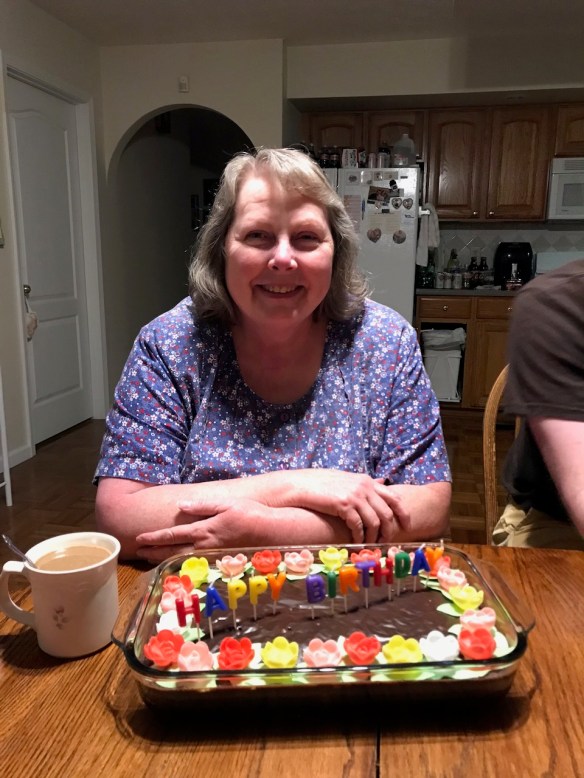
2. My birthday! It was nice to have the family all together for it. We usually can’t go out to eat dinner due to Jim’s mom needing someone with her, but we asked her daytime caregiver to come back that evening. We went to one of my favorite restaurants right on a lake. The view was gorgeous and the food was great. It seems like every time we go to a restaurant lately, something is wrong with someone’s order, but this time everything came out right.

39913637_10160906166835637_7633998219076173824_n

IMG_0035

My daughter-in-law made my lovely cake!

3. Family time. I always enjoy having everyone together to talk, play games, or just hang out. Besides my oldest son being here, my husband took the week off, and Jason and Jesse took a day or two off as well. We didn’t have any “big” outings this week, but we’re looking forward to a picnic this weekend.

4. A rediscovered lamp. My sewing room has never had enough light, even when I open the blinds and turn on two lamps and the closet light. But it’s better in the afternoons when the sun is on that side of the house and more light comes in the window. One day last week, however, I needed to work in there in the morning and was frustrated over the lack of light. I remembered that my husband had gotten me a lamp for my work table a long time ago, but I had not put it out because there wasn’t a place for it. But I got it out and tried it. Even though there is still not a good place for it, it helped so much having light right where I needed it. I found out the lamp has three settings, too, so I can adjust it just right.

5. A ceiling fan for my bedroom. I have wanted one for a long time and finally got one for my birthday.

Happy Friday!

Book Review: Before We Were Yours

Truth is stranger than fiction, the saying goes. It is also more heartbreaking. One of the saddest and strangest situations in history is the story of Georgia Tann and the Tennessee Children’s Home Society she operated. Georgia would abduct poor children by various illegal means: outright kidnapping, taking children born to unwed mothers for “medical care” and then telling the mothers their babies died; tricking parents into signing their children over to the home, and others. Policemen, family court judges, a crime boss, and others were a part of Tann’s network. The children they obtained would be adopted out to unsuspecting couples or sometimes sold to high-profile, wealthy families. Records were often destroyed or falsified. Even though Tann thought the children would be better off in their new situations, ultimately her enterprise was a money-making scheme. Tann died while she and the home were investigated, but before she could be brought to justice.

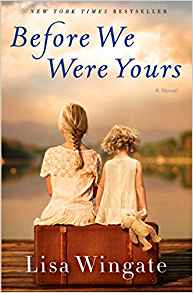
Before we were yoursLisa Wingate sets her novel Before We Were Yours in these circumstances.

Avery Stafford is a senator’s daughter being groomed to take his place. On a trip with her father to a nursing home, a resident pauses before Avery, seems to recognize her, and calls her “Fern.” An aide hustles the woman away, chalking the incident up to dementia. But the woman made off with Avery’s heirloom bracelet, and when Avery goes back to the woman’s room to retrieve it, she sees a framed photograph of a woman who looks remarkably like Avery’s grandmother. Conversations with the resident, May, lead Avery to look into her grandmother’s journals. Every scrap of information uncovered produces more questions. Avery isn’t sure what she will ultimately find or what the consequences will be, but she feels compelled to know the truth. And the process causes Avery to question whether she is living a “role” in life set out for her by others.

May’s story is told in flashbacks. She was born Rill Foss, the oldest of five children who lived with their parents on a houseboat. When Rill’s mother goes into hard labor, the midwife insists that she be taken to the hospital. While Rill’s parents are gone, a policeman comes to pick up the children, saying he will take them to see their parents. Instead, he takes them to a woman waiting in a nearby car, who whisks them away to a children’s home.

Children in the home are neglected, not well fed, and abused. But when potential adoptive parents come, the children are dressed up and threatened to be on their best behavior. One by one Rill’s siblings disappear, but when she protests or tries to thwart their removal, she is punished and her remaining siblings threatened.

Even though May’s history is heart-rending, ultimately the book ends redemptively and hopefully.

Lisa’s scenes on the river are so real, I could almost see and smell and feel the surroundings. I ached with May through her story and the ultimate hard choice she had to make, and rejoiced at how things wrapped up for her. And I enjoyed Avery’s story as well.

A very well-written, excellent book.

(Sharing with Semicolon‘s Saturday Review of Books, Literary Musing Monday, Carole’s Books You Loved)

Book Review: Reshaping It All

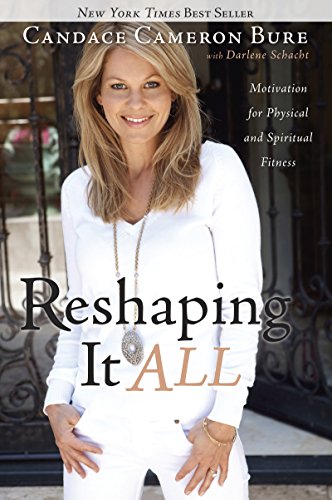
ReshapingSome of you may remember Candace Cameron Bure as oldest daughter D. J. Tanner in the TV series Full House several years ago. I have not really kept up with her career since then, but somehow I was aware that she’d had some eating issues, had lost weight, and was an outspoken Christian like her brother Kirk Cameron. So when her book, Reshaping It All: Motivation for Physical and Spiritual Fitness came up on a Kindle sale, I got it.

Although the book is not a full-fledged memoir, Candace gives glimpses of her growing-up years, family, time on Full House, marriage, and motherhood.

Her family seems remarkably grounded: even though Cameron and her brother were making all kinds of money, their father still made them work (at other jobs: he didn’t consider acting “work”) when they wanted something.

He could see that hard work was not only a prerequisite for success but that it was also a prerequisite for strong character. Struggling for the things we get teaches us the all-important lesson of self-disciple while it strengthens our body and spirit. It wasn’t enough for us to achieve a certain level of success in this world: our parents wanted us to reach our full potential as people who are strong in spirit and mind.

But Candace received mixed signals about food. He father provided “cardboard-tasting ‘health’ food” while her mother brought in doughnuts and such. Various other factors came into play, resulting in Cameron’s being about 25 pounds overweight and suffering from bulimia in her early twenties.

What I didn’t realize at the time is that my heart was longing for the things of this world. I ran to comfort food instead of running to God. I discovered my sin, but I hadn’t discovered that my heart was in the wrong place. I sought moral reformation instead of spiritual transformation. I had known who He was, but I still hadn’t grasped who I was in His sight.

She tells how she changed her approach to food and fitness. She didn’t follow a specific diet plan, and she believed everything was allowable in moderation, but she had a few principles she went by.

Transforming our bodies must begin by the renewing of our minds. Our bodies aren’t making these detrimental choices for us; they are simply animated by a mind that needs a mental makeover.

One such principle was HALT. “When you feel like reaching for food, ask yourself first if you are hungry, angry, lonely, or tired. If you’re hungry, then proceed, but it you are reaching for food in response to emotion, then halt your behavior immediately.”

And even though the book is primarily about her journey towards fitness, she applies some of the same principle to style, clutter, marriage, and other facets of life.

Candace became a Christian at age 12, and the life principles she espouses are based squarely on Scripture. She writes in a conversational, level-headed, encouraging, easy to read style.

Standing face-to-face with a mountain can be overwhelming, especially when your perspective is that of looking up from the bottom. But if we decide to take one step and then another, looking only at the ground set before us, we realize the potential we have.

The only negative for me was the fan letters. At the end of every chapter, Cameron includes a fan letter asking her a question related to the chapter before. That was fine, but each letter also contains a certain amount of fannish praise that I felt awkward reading.

This book was written back in 2011, before her co-hosting stint on The View and other pursuits. She has written a few more books since that time, too.

I enjoyed the book very much and took away a few nuggets to help me in my own journey.

(Sharing with Semicolon‘s Saturday Review of Books, Literary Musing Monday, Carole’s Books You Loved)

“A Heart at Leisure From Itself”

We all need encouragement some times. We all occasionally feel down in the dumps, or inadequate, even ugly. We have an enemy of our souls who specializes in tripping us up and bringing us down.

The KJV rendering of Proverbs 12:25 says, “Heaviness in the heart of man maketh it stoop: but a good word maketh it glad.” We know the blessing of that “good word” that meets us just at the right time in our moment of need. I am thankful for the encouragers among us who, sensitive to the Holy Spirit’s leading, specialize in thoughtful observation and uplifting words.

However, I have seen women Bible teachers express concern over the plethora of material for Christian women which is based on emotion and self-esteem: “You are beautiful.” “You are wonderful.” “You are enough.” There are a handful of blogs I only read occasionally because every single post seems to espouse these messages.

I share that concern, for a few reasons. As I said, we all need a boost every now and then. But this kind of encouragement focuses on self, and the sheer volume of these messages makes me wonder whether we are altogether too preoccupied with self. And if Christian leaders and teachers are constantly feeding us esteem-building maxims, we’re lacking the teaching we most need: that which turns our attention to God and His truth. And, just occasionally, these kinds of message are wrong: for instance, as we discussed last week, we are not enough in ourselves.

Please understand: I am not trying to heap guilt on top of other negative feelings. I’m just turning our attention to a better focus and message. When we’re bombarded by self-defeating thoughts, we need to take them captive and apply God’s truth to them.

I am ugly. “I praise you, for I am fearfully and wonderfully made. Wonderful are your works; my soul knows it very well.” Psalm 139:14, ESV.  “And your renown went forth among the nations because of your beauty, for it was perfect through the splendor that I had bestowed on you, declares the Lord GOD.” Ezekiel 16:14

I am worthless. “Knowing that you were ransomed from the futile ways inherited from your forefathers, not with perishable things such as silver or gold, but with the precious blood of Christ, like that of a lamb without blemish or spot.” 1 Peter 1:18-19

I am inadequate. “Not that we are sufficient in ourselves to claim anything as coming from us, but our sufficiency is from God. 2 Corinthians 3:5

I am not enough. “Abide in me, and I in you. As the branch cannot bear fruit by itself, unless it abides in the vine, neither can you, unless you abide in me. I am the vine; you are the branches. Whoever abides in me and I in him, he it is that bears much fruit, for apart from me you can do nothing.” John 15:4-5

I am not lovable. God shows his love for us in that while we were still sinners, Christ died for us.” Romans 5:8

Personally, a lot of my self-esteem issues were solved once I truly got hold of the KJV translations of Ephesians 1:6: “He hath made us accepted in the beloved.

Some years ago at a leaders meeting for a church ladies’ group, the pastor’s wife was encouraging us to speak up when we each did our various parts during the meeting. She mentioned almost offhandedly that “Self-consciousness is consciousness of self, and we are supposed to forget self.” That was another concept that helped me turn from my preoccupations with self (which increased anxiety about messing up in some way) to forgetting self in doing what God wanted me to do in the moment, trusting Him for the grace and ability.

Last week I caught a couple of Elisabeth Elliot’s radio broadcasts, replayed now on BBN Radio, in which she was talking about these very ideas. When I stopped the car, I jotted down some notes from her broadcast before I got out to run my errands. I was so hoping I could find a transcript of the program online, but I have had no luck so far.  In searching, however, I did find the September/October 1999 copy of her newsletter in which she discussed related issues. She quotes C. S. Lewis as saying:

The very first step is to try to forget about the self altogether. Your real, new
self (which is Christ’s and also yours, and yours just because it is His) will not come as long as you are looking for it. It will come when you are looking for Him…The principle runs through all life from top to bottom. Give up your self, and you will find your real self. Lose your life and you will save it.
Submit to death, death of your ambitions and favourite wishes every day and death of your whole body in the end: submit with every fibre of your being, and you will find eternal life. Keep back nothing. Nothing that you have not given away will ever be really yours. Nothing in you that has not died will ever be raised from the dead. Look for yourself, and you will find in the long run only hatred, loneliness, despair, rage, ruin, and decay. But look for Christ and you will find Him, and with Him everything else thrown in. (She quotes from Beyond Personality, but a similar quote is in Mere Christianity as well).

She also includes a few stanzas of this poem/prayer by Anna Laetitia Waring. Two lines which most stood out to me are the author’s request for “a heart at leisure from itself, To soothe and sympathise” and “And a life of self-renouncing love Is a life of liberty.”

I also have in my files a quote from one of Elisbaeth’s old email devotionals that were sent out by Back to the Bible years ago. This one is also from her book Keep a Quiet Heart:

“His purpose in dying for all was that men, while still in life, should cease to live for themselves and should live for him who for their sakes died and was raised to life. With us therefore worldly standards have ceased to count in our estimate of any man…. When anyone is united to Christ, there is a new world (or a new act of creation); the old order has gone, and a new order has already begun” (2 Corinthians 5:15-17, NEB).

That new order is a far cry from the notion of self-acceptance which has taken hold of the minds of many Christians. Any message which makes the Cross redundant is anti-Christian. The original sin, pride, is behind my “poor self-image,” for I felt that I deserved better than I got, which is exactly what Eve felt! So it was pride, not poor self-image, that had to go. If I’m so beautiful and lovable, what was Jesus doing up there, nailed to the cross and crowned with thorns? Why all that hideous suffering for the pure Son of God? Here’s why: There was no other way to deliver us from the hell of our own proud self-loving selves, no other way out of the bondage of self-pity and self-congratulation. How shall we take our stand beneath the cross of Jesus and continue to love the selves that put Him there? How can we survey the wondrous cross and at the same time feed our pride? No. It won’t work. Jesus put it simply: If you want to be My disciple, you must leave self behind, take up the cross, and follow Me.

I also remember Elisbaeth commenting on the radio program that what we sometimes think of as self-hate is actually self-love, because so much of our thought and time is still caught up with self.

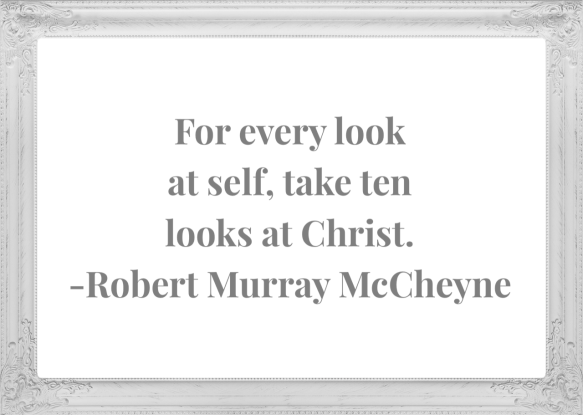
Please understand, again, all this talk about forgetting self and dying to self doesn’t mean we neglect self-care. Our bodies are temples of the Holy Spirit, and we take care of them in thankfulness to Him and for His usefulness. He wants us to glorify Him in our body and spirit. Sometimes we need help with twisted or negative self-talk or self-concepts due to abuse, or a lifetime of put-downs, or other reasons. But the best way to heal from these things is to see what God’s Word says about how He made us and how much He loves us and how He longs to work in and through us. As Robert Murray McCheyne said, “For every look at self, take ten looks at Christ.”

IMG_1106

(Sharing with Literary Musing Monday, Inspire Me Monday, Let’s Have Coffee, Porch Stories)

Laudable Linkage

IMG_0195

I’ve been mostly absent from the blog this week. It’s rare for me not to do a Friday’s Fave Five, even if I don’t post anything else. But it has been a busy week: card-making and present-shopping and wrapping for a baby shower and my oldest son’s upcoming birthday, house-cleaning for my son’s visit from out of state, buying tons of food for family get-togethers, etc, etc. It’s amazing what you can done when you’re not blogging! 🙂 I am not sure how much I will be online the next week. My oldest son is here, my husband is off, we’ll have more time with the whole family. But, in the past when I have thought I would not be posting much, I have been surprised. Our whole family likes our computer time, so we’ll see.

Meanwhile, I have collected in odd moments online the last week some thought-provoking, helpful reads I wanted to share with you.

Poor Interpretation Lets Us “Believe” the Bible While Denying What It Actually Say, HT to Challies. “Historically, theological liberals denied Scripture, and everyone knew where they stood. But today many so-called evangelicals affirm their belief in Scripture, while attributing meanings to biblical texts that in fact deny what Scripture really says. Hence they ‘believe every word of the Bible’ while actually embracing (and teaching) beliefs that utterly contradict it.”

Grace Comes With Refills.

Love Is Not a Feeling.

Praying the Words of Jesus for Your Teen.

Pants on Fire. The folly of the “I don’t know whether this is true or not; but I just wanted to get it out there” type of post.

Are We All “Harmless Torturers” Now? HT to Challies. “When we think of the savagery of social media, we often think of awful individual behavior…Harmless Torturers never go that far; we just like, retweet and add the occasional clever remark. But there are millions of us, and we’re all turning the dial.”

Why Getting Lost in a Book is So Good for You, HT to Linda.

Finally, you might be blessed by this video even if you don’t know Ron and Shelly Hamilton (of Majesty Music, aka Patch the Pirate and Sissy Seagull) and Shelly’s parents, Frank and Flora Jean Garlock. I had no idea the Garlocks were in this situation or that Ron had been diagnosed with dementia. This is not only an update of how they are doing, but a sweet testimony of a man caring for his wife.

Book Review: Full Assurance

For several years I struggled with whether or not I was really a Christian. During that time we visited my mother-in-law’s home, and I discovered on her book shelves Full Assurance by H. A. Ironside. I borrowed it, and it helped me with one key point in particular.

Recently while looking for something else on my bookshelf, I came across this volume again (I guess that means I never gave it back – sorry, Mom!) I couldn’t remember much about it except for the one point that had helped me so much some 30 or so years before, so I decided to read through it again.

Ironside says in his introduction that he wrestled with assurance for a while himself, and he wanted to “make as plain as I possibly can just how any troubled soul may find settled peace with God” (p. 7). He said that “so many people who profess to want help along these lines are too indifferent to investigate,” but he wanted to appeal to “earnest seekers after truth” (p. 7). He assures that God cares about us and wants us to rest in His salvation.

In subsequent chapters he unpacks several verses that speak specifically of assurance, like Isaiah 32:17 (“And the work of righteousness shall be peace; and the effect of righteousness quietness and assurance for ever”) and Colossians 2:1-3 (especially verse 2: “That their hearts might be comforted, being knit together in love, and unto all riches of the full assurance of understanding“).

Then his longest chapter deals with “Difficulties Which Hinder Full Assurance” in the form of questions and answers, like “How can I be sure I have repented enough?” and “I do not feel fit to come to God” and “I don’t know if I can hold out.”

Ironside had been a preacher for almost 50 years at the time of this writing, and he deftly handles every issue from the Scriptures and shares several anecdotes to illustrate his points.

The point I mentioned having trouble with was whether I had repented “right” or “enough.” Forgive the long quote, but I wanted to share his whole answer here:

Very often the real difficulty arises from a misapprehension of the meaning of repentance. There is no salvation without repentance, but it is important to see exactly what is meant by this term. It should not be confused with penitence, which is sorrow for sin; nor with penance, which is an effort to make some satisfaction for sin; nor yet with reformation, which is turning from sin. Repentance is a change of attitude toward sin, toward self, and toward God. The original word (in the Greek Testament) literally means “a change of mind.” This is not a mere intellectual change of viewpoint, however. but a complete reversal of attitude.

Now test yourself in this way. You once lived in sin and loved it. Do you now desire deliverance from it? You were once self-confident and trusting in your own fancied goodness. Do you now judge yourself as a sinner before God? You once sought to hide from God and rebelled against His authority. Do you now look up to Him, desiring to know Him, and to yield yourself to Him? If you can honestly answer yes to these questions, you have repented. Your attitude is altogether different to what it once was.

You confess you are a sinner, unable to cleanse your own soul, and you are willing to be saved in God’s way. This is repentance. And remember, it is not the amount of repentance that counts: it is the fact that you turn from self to God that puts you in the place where His grace avails through Jesus Christ.

Strictly speaking, not one of us has ever repented enough. None of us has realized the enormity of our guilt as God sees it. But when we judge ourselves and trust the Saviour whom He has provided, we are saved through His merits. As recipients of His lovingkindness, repentance will be deepened and will continue day by day, as we learn more of His infinite worth and our own unworthiness (pp. 89-90).

One other point that I remember being struck with, though I can’t find now the specific place he discusses it, is from Hebrews 6:11-12: “And we desire that every one of you do shew the same diligence to the full assurance of hope unto the end: That ye be not slothful, but followers of them who through faith and patience inherit the promises.” Showing “diligence to full assurance” helped me understand that when we’re having problems along this line, we need to “be not slothful” but diligently seek God’s Word for the answers rather letting doubts and questions fester in the background for years.

I have many places marked in the book. Here are a few of the helpful, standout quotes:

It is well to remember that some vivid emotional experience is not a safe ground of assurance. It is the blood of Christ that makes us safe and the Word of God that makes us sure” (p. 29).

Faith is not the savior. Faith is the hand that lays hold of Him who does save. Therefore the folly of talking of weak faith as opposed to strong faith. The feeblest faith in Christ is saving faith. The strongest faith in self, or something other than Christ, is but a delusion and a snare, and will leave the soul at last unsaved and forever forlorn (p. 39).

Assurance is not based upon any emotional change, but whatever emotional experience there may be, it will be the result of accepting the testimony of the Lord given in the Scriptures. Faith rests on the naked Word of God. That Word believed gives full assurance (p. 45).

So long as a man considers himself worthy there is no salvation for him; but when, in repentance, he owns his unworthiness, there is immediate deliverance for him through faith in the Lord Jesus Christ. Without repentance the sinner is unable to believe unto salvation (pp. 91-92).

Many times Ironside counsels readers to study the Bible:

As soon as one knows he is saved, he should begin, in dependence upon the Holy Spirit, a careful regular, systematic study of the Word of God. The Bible is our Father’s letter to us, His redeemed children. We should value it as that which reveals His mind and indicates the way in which He would have us walk. ‘All Scripture is given by inspiration of God, and is profitable for doctrine, for reproof, for correction, for instruction in righteousness: that the man of God may be perfect, throughly furnished unto all good works” (II Tim. 3:16-17). The study of the Word will instruct me in the truth, it will show me what needs to be rectified in my life and walk, it will make clear how I may get right with God, and it will guide me in paths of uprightness. No Christian can afford to neglect his Bible. If he does, he will be stunted and dwarfed in his spiritual life, and he will be a prey to doubts and fears, and may be carried away by every wind of doctrine (p. 48).

Nothing will make up for lack of this diligent study of the Bible for yourself. You cannot get the full assurance of understanding without it. But as you search the Scriptures, you will find truth after truth unfolding in a wonderful way, so that doubts and questions will be banished and divinely given certainty will take their place (p. 50).

How necessary then for His redeemed ones to study His Word in dependence upon His Holy Spirit, that they may be delivered both from the fears that are a result of ignorance of His truth and pride that is a result of self-confidence. The liberating Word alone will give to the honest, yielded soul who searches it prayerfully, in order that it shall have sway over his life, the full assurance of understanding, for it is written: ‘The entrance of thy words giveth light; it giveth understanding unto the simple'” (p. 54).

There’s a very helpful section for those fearing they might not be “elect” or “predestined,” but it’s about three pages long, too long to share here. But one excerpt: “But what does the Word say? ‘Christ died for the ungodly.’ Are you ungodly? Then He died for you. Put in your claim and enter into peace” (p. 92).

I have seen this book listed by various titles just Full Assurance, or Full Assurance: How to Know You’re Saved; Full Assurance, or A Series of Messages for the Anxious Soul, and the author’s name sometimes listed as Harry A., most times as H. A. Ironside. I assume they are all basically the same book, but I don’t know whether there might have been some revisions between reprintings. The copy I have is from 1968, but it says it is a revised edition. If you look at Kindle versions, check the reviews first: one I came across said that several chapters were left out.

This book is an excellent resource especially for those who have wrestled with assurance of salvation or those who counsel such people, but it is also a good resource for those who want to learn more about what salvation is or for those who are already saved to understand and appreciate more what their salvation involves.

(Sharing with Semicolon‘s Saturday Review of Books, Literary Musing Monday, Inspire Me Monday ,Let’s Have Coffee, Carole’s Books You Loved)


You are not enough

I keep seeing the same message all over the place: “You are enough.” I’m sure people mean it as an encouragement. Sometimes we feel broken down, inadequate, criticized, unsure of ourselves, and dear encouragers want to lift us up by assuring us, “You can do this! You are enough!”

But the thing is, I know I am not enough.

Apart from me you can do nothing. John 15:5

For I know that nothing good dwells in me, that is, in my flesh. For I have the desire to do what is right, but not the ability to carry it out. Romans 7:18

We have all become like one who is unclean, and all our righteous deeds are like a polluted garment. We all fade like a leaf, and our iniquities, like the wind, take us away. Isaiah 64:6

I know, because the Bible tells me. I know, because I have tried in my own strength and failed.

But thankfully, the story doesn’t stop there.

And your renown went forth among the nations because of your beauty, for it was perfect through the splendor that I had bestowed on you, declares the Lord God. Ezekiel 16:14

Abide in me, and I in you. As the branch cannot bear fruit by itself, unless it abides in the vine, neither can you, unless you abide in me. I am the vine; you are the branches. Whoever abides in me and I in him, he it is that bears much fruit, for apart from me you can do nothing. John 15:4-5

I can do all things through him who strengthens me. Philippians 4:13

Not that we are sufficient in ourselves to claim anything as coming from us, but our sufficiency is from God. 2 Corinthians 3:5

God is able to make all grace abound to you, so that having all sufficiency in all things at all times, you may abound in every good work. 2 Corinthians 9:8

But he said to me, My grace is sufficient for you, for my power is made perfect in weakness.” Therefore I will boast all the more gladly of my weaknesses, so that the power of Christ may rest upon me. 2 Corinthians 12:9

His divine power has granted to us all things that pertain to life and godliness, through the knowledge of him who called us to his own glory and excellence, by which he has granted to us his precious and very great promises, so that through them you may become partakers of the divine nature, having escaped from the corruption that is in the world because of sinful desire. 1 Peter 1:3-4

Ye are complete in him, Colossians 2:10, KJV

For a while when I was facing a task that I felt was particularly beyond me, it helped to reduce 2 Corinthians 9:8 to a few words to carry with me and remind me what God had promised: All grace. All sufficiency. All things. All times.

Sometimes as Christians encouraging Christians, we take God’s grace and help for granted when we assure others, “You are enough.” We think, “Well yes, of course it’s understood that we are only enough in His strength. Of course they know that.”

But we shouldn’t gloss over or take for granted that wonderful truth that God enables us to do His will when we abide in Christ. Sure, sometimes we need a boost of confidence or a switch from a negative to positive attitude. But we need to remind ourselves every day that we can only do His will by His grace and power. We need to consciously depend on Him. And when we achieve success, we need to remember that it came from Him, thank Him, and give Him the glory.

If you have blogged this phrase recently, please don’t be offended or think I am “getting after” or “correcting” you. I am not “blogging at” anyone in particular and have not kept track of the places I have seen this phrase. I’ve just been pondering the concept, and the Daily Light on the Daily Path selection for August 9 dovetailed with my own thinking. I wanted to share what was on my heart.

So what would some better encouraging phrases?

If this is God’s will, He will help you.

You can do all things through Christ. He will strengthen you.

God’s got this!

Or just quote 2 Corinthians 9:8.

What phrases encourage you yet keep the focus on God?

I Need Thee Every Hour

by Annie, S. Hawks, 1872

I need thee every hour,
most gracious Lord;
no tender voice like thine
can peace afford.

I need thee every hour,
stay thou near by;
temptations lose their power
when thou art nigh.

I need thee every hour,
in joy or pain;
come quickly, and abide,
or life is vain.

I need thee every hour;
teach me thy will,
and thy rich promises
in me fulfill.

I need thee, O I need thee;
every hour I need thee!
O bless me now, my Savior,
I come to thee.

(Sharing with Inspire Me Monday, Literary Musing Monday, Let’s Have Coffee, Porch Stories, Woman to Woman Word-filled Wednesday, Wise Woman, Faith on Fire)

Laudable Linkage

I have just a short list today, but I thought it best to go ahead and share it rather than have an overly lengthy one next time.

The Greatest Thing You Can Do With Your Life.

Know the Neighborhood, HT to True Woman. “Because many Christians have not ‘walked the streets’ of our Bibles, we are overly susceptible to the views of others, right or wrong. Like would-be travelers or gullible sightseers we take as fact the opinions of the ‘experts’ about the 66 cities we have rarely or never been to visit.”

Why Women Should Be Readers of Good Books, HT to Out of the Ordinary.

The “At Least” Among Us, HT to True Woman. “The thing about saying ‘At least’ to someone—particularly someone who’s confessing their own anger, fear, grief, or sadness at the circumstances of their life, is it negates their wrestle and it naturally elevates our own.”

Five Dangers of Reading Christian Biographies, HT to True Woman. You know I love Christian biographies, but there are some potential stumbling blocks in reading them.

And finally, HT to Laura, this fun real estate listing showed a guest using the various facilities on the property.

Happy Friday!

Friday’s Fave Five

FFF daisies
It’s Friday, time to look back over the blessings of the week with Susanne at Living to Tell the Story and other friends.

Funny how this week seems to have gone fast in some ways, slow in others. Here are my favorite parts.

1. Sunday lunch out with the family. Somehow we were all out of church and in the same vicinity at the same time, so we texted and met for lunch.

2. Lunch with my friend Melanie. We hadn’t been able to get together for a while. so it was nice to catch up. Plus we ate at Cracker Barrel, one of my favorite places. Plus I took home a slice of their Chocolate Coca-Cola cake, which is always scrumptious. Plus Melanie gifted me with a pretty teacup, as she is downsizing her collection.

3. A not so bad week. That might sound odd. 🙂 Jim was gone from Monday through Thursday this week, longer than he usually travels. He tries to keep it to a day or two, but it couldn’t be helped. I sometimes get a little down or depressed in regard to having all of his mom’s care on my shoulders for even a night, so I was afraid I was going to be a basket case before the week was over. But I prayed about it at the beginning of the week, tried to just take it a day at a time, and here we are nearly at the end. As I write this on Thursday, he is on his way after being delayed due to storms. (Update: he got home a few hours later than planned, but safely.) Jason and Mittu brought dinner over one night and then cleaned up the kitchen while I fed Jim’s mom, and that was a big help.

4. Cutting back sweet treats. I have been telling myself that I needed to cut back on sweets to at least once a day, but I keep not doing it. Then this week I was reading a book about someone changing their lifestyle and routine to a healthier version, and she mentioned she only had sweets a couple of times a week. I thought, “I should probably do that.” And, only by God’s grace, I have! I’m astounded, especially after struggling so long with the idea of cutting back at all. And though I occasionally crave my Hershey’s miniatures or other treats, once I ignore the craving and go on to do other things, I am not bothered by it any more. I still drink my glass of decaf sweet tea with lunch, but everything else I drink is sugarless. It’s only been a few days, but I’ve lost five pounds already! Though there are other measures I need to take in addition, this was a big one. To God be the Glory!

5. Two anniversaries. My son and daughter-in-law celebrated their anniversary this week! And it was eight years ago today we moved to TN. That was a year of many big changes, but God was good and faithful through them all.

Happy Friday!