Doing or Don’t-ing?

The Christian community I was once part of seemed to emphasize what we as Christians don’t do. We don’t dress like that. We don’t listen to that kind of music. We don’t watch those programs. We don’t play those games. We don’t use that kind of language. Any new fad was viewed with suspicion and placed on the “don’t” list.

During part of this time I had a job in retail sales. I wanted to be a good testimony. I definitely stood out as I politely said no to invitations to places I didn’t feel comfortable going with my coworkers, as I quietly absented myself from certain conversations, as my style of dress was noticeably different from that of others. They knew I didn’t do a number of things: some were even kindly protective of me, careful not to put me in situations where I might be uncomfortable. I couldn’t help but wonder, however, what these actions (or inactions) indicated to my coworkers and customers. They knew I was “religious.” But could they tell the difference between me and an adherent of any number of other religions? They saw my standards, but did they see my Jesus?

The Bible does have a lot to say about what we should not do. God’s command for our holiness filters down into every part of our lives, and our love for Him does influence our choices of dress and entertainment. We need to understand what things are wrong. We need to realize we’re innately drawn towards wrong. Paul said, “if it had not been for the law, I would not have known sin. For I would not have known what it is to covet if the law had not said, ‘You shall not covet'” (Romans 7:7). It’s important to remember the Bible’s warnings against sin. Some people fall off-balance by minimizing or even overlooking the “don’ts” in the name of love and positivity or an effort to be inoffensive.

But the Bible doesn’t stop with a list of “don’ts.” “So flee youthful passions,” 2 Timothy 2:22 says. But it goes on to say, “and pursue righteousness, faith, love, and peace, along with those who call on the Lord from a pure heart.”

Colossians 3:5-9 tells us to “ Put to death ” or “put away” “sexual immorality, impurity, passion, evil desire, and covetousness, which is idolatry….anger, wrath, malice, slander, and obscene talk from your mouth. Do not lie to one another.” The reasons given: “on account of these the wrath of God is coming” and though “you too once walked” in them, “you have put off the old self with its practices.

But then verses 10-17 continue: “...and have put on the new self, which is being renewed in knowledge after the image of its creator.”

Put on then, as God’s chosen ones, holy and beloved, compassionate hearts, kindness, humility, meekness, and patience, bearing with one another and, if one has a complaint against another, forgiving each other; as the Lord has forgiven you, so you also must forgive. And above all these put on love, which binds everything together in perfect harmony. And let the peace of Christ rule in your hearts, to which indeed you were called in one body. And be thankful. Let the word of Christ dwell in you richly, teaching and admonishing one another in all wisdom, singing psalms and hymns and spiritual songs, with thankfulness in your hearts to God. And whatever you do, in word or deed, do everything in the name of the Lord Jesus, giving thanks to God the Father through him.

Ephesians 4:17-32 has similar instructions to “to put off your old self, which belongs to your former manner of life and is corrupt through deceitful desires, and to be renewed in the spirit of your minds, and to put on the new self, created after the likeness of God in true righteousness and holiness” (verses 22-24). We trade lying for truth (v. 25), stealing for honest work (v. 28), corrupt talk for edifying words (v. 29). We don’t let anger linger (v. 26), and we replace bitterness, wrath, anger, clamor, slander, and malice with kindness, tenderheartedness, and forgiveness “as God in Christ forgave you” (vv. 31-32).

We’re not aiming just for “positive thinking”: we’re seeking a balanced focus. “Putting on the new” not only keeps us balanced, but it actually helps us put off the old. We have known of preachers who have fallen into sexual sin after years of preaching against it. Surely a number of factors contributed to their fall, but one may have been an undue focus on the forbidden. Erwin Lutzer shared a helpful illustration in How to Say No to a Stubborn Habit: if someone tells you not to think of the number eight – suddenly that’s all you can think about. The more you try not to think about it, the more it fills your mind. But if you start thinking of other numbers or working equations, you’re distracted from eight. Likewise, if I try to diet by repeating to myself, “Don’t eat chocolate cake,” my mind is filled with chocolate cake and I am likely to give in and have some. But if I turn my thoughts toward other things I can eat, chocolate cake lessens it’s hold on me, and now I can focus on the positive, on what I can do rather than what I can’t. Years ago I read in a forgotten source about “chastity meetings.” The author didn’t elaborate, but evidently these meetings were held to help young people make a decision to pursue purity. His wise advice was, “Have your chastity meetings, but then go on to another subject.” If every single week these young people were warned about sexual sin and urged to avoid it, their thoughts would be filled with it just like mine would be with the chocolate cake I needed to avoid.

Concentrating on “doing” rather than just on “don’t-ing” not only helps us avoid sin and pursue good, but it presents a better testimony. If all we talk about is what we don’t do, we sound either curmudgeonly or self-righteous. Pursuing the positive also creates joy in Christ rather than mourning what we can’t do.

But we don’t follow a list of impossible good works in order to gain favor or rack up points with God. We focus on these good traits not to become righteous but to demonstrate that God has changed us and made us righteous. The Ephesians passage mentioned above says the goal is to  “attain to the unity of the faith and of the knowledge of the Son of God, to mature manhood, to the measure of the stature of the fullness of Christ” (verse 13). It also says we effect these transformations by being “renewed in the spirit of [our] minds (v. 23) and because that’s the way we have learned Christ (vv. 20-21). Romans 12:2 tells us “Do not be conformed to this world, but be transformed by the renewal of your mind.” Colossians 3:10 tells us our “new self…is being renewed in knowledge after the image of its creator.

We learn to reflect our Savior by beholding Him: “And we all, with unveiled face, beholding the glory of the Lord, are being transformed into the same image from one degree of glory to another. For this comes from the Lord who is the Spirit” (2 Corinthians 3:18). He works these changes in us as we behold Him in His Word, as we study Him and get to know Him better. 

(Sharing with Inspire Me Monday, Literary Musing Monday, Tell His Story, Let’s Have Coffee, Woman to Woman Word-filled Wednesday, Porch Stories, Faith on Fire)

Writing thoughts and questions

The writer’s conference I attended last March became a catalyst to take my writing off the back burner and make it a priority. I had a list of ideas for further writing, but one topic most on my heart and the most developed so far: encouraging women to read the Bible and dealing with some of the problems (distractions, busy schedules, etc.) that keep us from God’s Word. Different sources I’ve consulted say that a non-fiction book should total somewhere between 30,000-50,000 words. I have 24,000 so far!

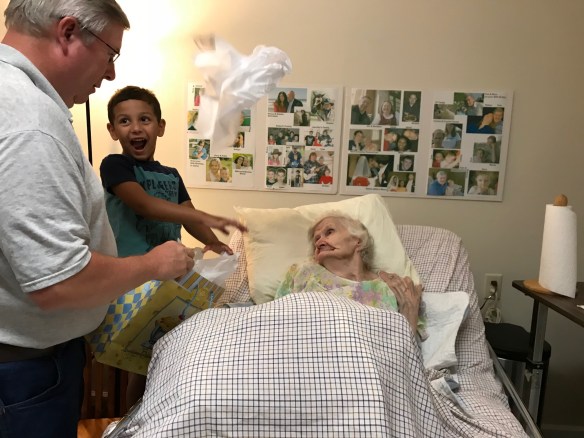
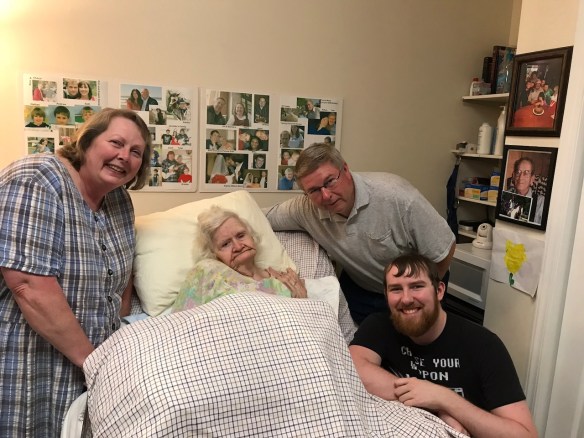
One of my biggest writing roadblocks was making time. Every piece of writing advice I have seen says to make a schedule to write and keep your writing time sacred. But that just doesn’t work in my situation with caring for my mother-in-law at home, having caregivers and hospice people coming in and out (never knowing quite when some of them will be here), having a son working at home and taking online classes at home, and a husband who started working some days from home just about the time I decided to focus on writing. I was distressed for a while, but I knew that if God wanted me to write now, He’d help me find or make a way. Finally the idea came to focus on my writing as much as possible when my husband is away from home and then to spend the time he is here working on my household tasks. Even though this schedule isn’t the same each week. it has helped me make more progress with less stress than the hit or miss style I was working under before.

Several weeks ago I submitted a guest post to a particular site. The site owner sent back several helpful editorial suggestions. Sometimes writing just flows, and sometimes almost every word is a struggle. This was one of the latter times. I spent more than two weeks of my available writing time revising. The end result was immensely better than what I had sent originally sent in, but I was discouraged that the process was so laborious and took so much time. If a 1,000-word blog post took that much time, how long is it going to take me to finish a book? Around that time I came across a blog post on What 20 Famous Authors Had to Say About Rewriting. A couple of samples that most spoke to me:

Books aren’t written – they’re rewritten. Including your own. It is one of the hardest things to accept, especially after the seventh rewrite hasn’t quite done it. ~Michael Crichton

More than a half, maybe as much as two-thirds of my life as a writer is rewriting. I wouldn’t say I have a talent that’s special. It strikes me that I have an unusual kind of stamina. ~John Irving

I have rewritten–often several times–every word I have ever published. My pencils outlast their erasers. ~Vladimir Nabokov

Those and other sources I read encouraged me that rewriting is just a part of the process.

I’ve had moments of thinking, “I love this! I want to do more!” and other moments of, “What was I thinking? Who am I kidding?” But, from what I have read, those roller coaster feelings are pretty normal.

I had also started following some blogs and Twitter accounts for writers. While they were helpful in many ways, I got discouraged after a while reading every single day “Here are 20 things you MUST do or you’ll never be a successful writer.” So I cut back on some of those. There is still a lot I need to learn, but I am taking it in smaller doses and working on a bit at a time. I’ve started a Pinterest board for articles and memes about writing.

I’ve also been wrestling with some of the following issues:

  • What name to use. There is already an author by my name who writes on water birth (something I know nothing about). Should I just use my name and trust that readers won’t mix us up? Or should I include my middle or maiden name or initial? I asked Facebook friends, and no one cared for the middle initial, but they were split pretty evenly between adding my middle or maiden name. I’m not crazy about using a three-word name, but it might be best.
  • Everything I read says an author needs an online presence, a platform, before submitting a manuscript for publication. Publishers want to make sure you have something of an audience already. At some point I’ll make a separate author Facebook page, and I will probably use my Twitter account as is, since I don’t use it for much now except linking blog posts. But I wonder if I should create a new blog or use this one. On one hand, though this blog isn’t viral by any means, I do have some readers. I’d hate to start over with a new blog. On the other hand, when I started blogging, blogs were more informal and neighborly. I love my little hodgepodge blog, but I wonder if a “professional” blog would work better for an author platform. I would probably still keep this as a personal blog.
  • What should I do about book reviews? I write them because I love talking about what I have read and want to share these books with others, who hopefully will love them, too. And while I am not nitpicky or hypercritical, I want to be honest if a book contain problems (mainly bad language, risque scenes, or iffy theology, but sometimes poor writing). Some of you have told me that you buy books based on my reviews, so I want to be especially careful that I am not steering anyone into problem areas without at least a heads-up. But would it seem unprofessional as a writer to criticize another author’s work? I once read a particular new book based on the recommendation of a favorite author, and the writing was some of the worst I had encountered. I felt I had been deceived and wondered if all authors recommended each other’s books unreservedly. I couldn’t honestly do that, but maybe the solution is just not to mention the books I have problems with.   If I kept this as a personal blog, I would probably continue with book reviews as I do them now. If I transformed this into a writer blog, I might create a separate book review blog.
  • For tax purposes, do writers file as self-employed, or do they form a company (an LLC, my husband suggests, but I have only a vague idea what that even is. One more thing to learn…)
  • If I “crowdsource” and ask for opinions or ideas on a blog or Facebook page, and I use one of the ideas suggested, do I owe the person who suggested it anything other than a mention in the book’s acknowledgements? For instance, the title I had always wanted to use for this book has been used by someone else recently. The editor who critiqued the few pages of my manuscript at the writer’s conference did not like the alternate title I came up with. I’ve jotted down some other ideas, but nothing really grabs me yet. I’d love to get some feedback, but if I ask for it in a public way, I’m not sure what the implications are. Perhaps if I present it as a contest, and offer the winner a free copy of the book (or something), that would be sufficient?
  • If you quote from someone’s blog, do you need to ask them first, or just attribute them properly?
  • What about those quotes all over the Internet from famous people that you can’t find a source for? They’re just recorded in lists of quotes, but further searching doesn’t reveal an original source. Can they be referred to just as “as quoted by C. H. Spurgeon” on this site?
  • I’d love to find a critique group of not just new writers in the same boat I am, but with experienced authors as well. A couple of authors who were at the writer’s conference are involved in Word Weavers, and they have a local branch. So that might be a possibility, though there is a fee. Both the critique at the writer’s conference and the editorial suggestions I mentioned in regard to my guest post have shown me how valuable it is to have a more experienced person’s eyes to take a look at my writing and provide feedback.

So those are some of the “behind the scenes” thoughts and issues I’ve been grappling with on the writer’s front. Some answers I can probably find with a little more research; others I just need to ponder a while. If you have any thoughts about anything I’ve written here, I’d love to hear them!

(Sharing with Literary Musing Monday)

Friday’s Fave Five

FFF daisiesIt’s Friday, time to look back over the blessings of the week with Susanne at Living to Tell the Story and other friends.

Some Fridays, it takes time and thought to come up with five good points from the previous week. Other times it is hard to contain the blessings into just five points. This week I have the latter good problem.

1. Jim’s mom turned 90.

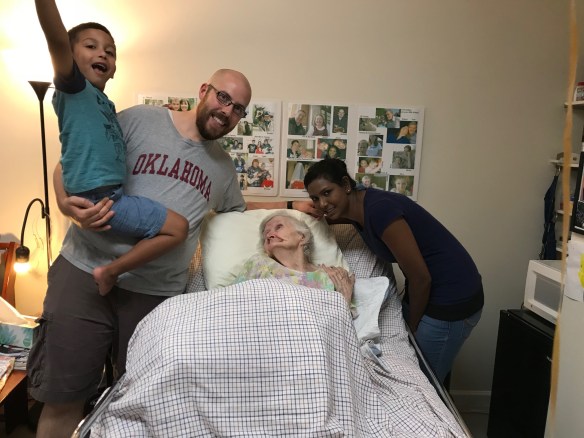
I went to a party supply store specifically to look for plates and candles with “90” on them, but all they had was a package of black napkins! So we improvised. I don’t know if she quite understood the hoopla, but I hope she enjoyed it. A bonus: I had ordered a couple of hospital-type nightgowns from a place not known for its speedy delivery, and I was afraid they wouldn’t get here in time for her birthday. But they did!

2. Time off and a lunch date. Jim took time off work on Monday and Tuesday and got a number of things done around the house, mostly in the garage. The garage looks really nice now! We went out for a lunch date Tuesday. We tried a new restaurant and ended up not liking it (too-loud music and soggy, lukewarm food), but enjoyed the outing and time together.

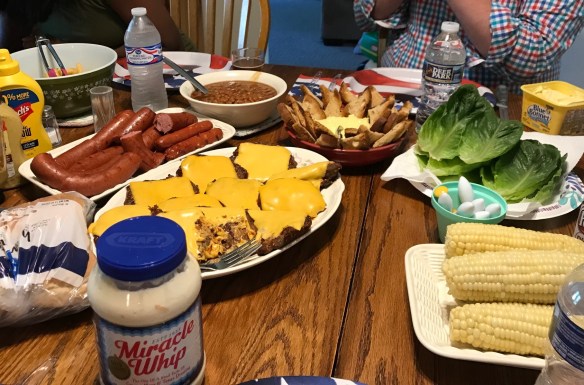
3. Independence Day! Though our country has its flaws, I still think it’s the best in the world, and I wouldn’t want to live anywhere else (no offense to friends from others countries – I hope you feel the same way about yours). We had quite the feast, and even got to see a few fireworks in the distance from our front yard.

4. Not losing AC. After a loud clap of thunder during a storm, our air conditioning was still blowing air, but not cold air. My husband checked fuses and other issues, but couldn’t find a fixable problem, so we were resigned to calling an AC serviceman out the next day. Thankfully ceiling fans in a few rooms kept the temperatures manageable. By the next morning, the AC seemed to be back to normal on its own without a service call and has been working fine ever since.

5. Sunday lunch. For various reasons, my son and daughter-in-law ended up not being able to make it to their church last Sunday morning. They came over to our house and made lunch. It’s such a nice feeling to come home and have a meal already in process. We enjoyed a good visit.

Bonus: Jim and I watched “The Book Thief.” Wonderful movie, without the profanity of the book (unless it was in some of the German words I couldn’t understand)

And that wraps up our full week. Happy Friday!


Free Indeed

free-indeed450.png

Glorious Freedom

by Haldor Lillenas

Once I was bound by sin’s galling fetters,
Chained like a slave, I struggled in vain;
But I received a glorious freedom,
When Jesus broke my fetters in twain.

* Refrain:
Glorious freedom, wonderful freedom,
No more in chains of sin I repine!
Jesus the glorious Emancipator,
Now and forever He shall be mine.

Freedom from all the carnal affections,
Freedom from envy, hatred and strife;
Freedom from vain and worldly ambitions,
Freedom from all that saddened my life.

Freedom from pride and all sinful follies,
Freedom from love and glitter of gold;
Freedom from evil, temper, and anger,
Glorious freedom, rapture untold.

Freedom from fear with all of its torments,
Freedom from care with all of its pain;
Freedom in Christ, my blessed Redeemer,
He who has rent my fetters in twain.

John 8:32, 3: And ye shall know the truth, and the truth shall make you free. If the Son therefore shall make you free, ye shall be free indeed.

Romans 8:2 For the law of the Spirit of life in Christ Jesus hath made me free from the law of sin and death.

Book Review: Villette

Villette was the last book written by Charlotte Bronte (another was published posthumously but was actually her first book). I had only recently heard of Villette, but since Charlotte penned one of my top three novels, Jane Eyre, I thought I’d give it a try.

Villette is a semi-autobiographical novel based on parts of Charlotte’s life. She and her sister, Emily, had taught for a time in a boarding school in Brussels, Belgium. They both went back to England when their aunt died, and Charlotte returned to the boarding house alone. Villette is a fictional town in France, but based upon Brussels. By the time Charlotte started writing this novel, she was the only remaining sibling of the original five in her family, and she well captures that feeling of being all alone in the world.

The story’s heroine is Lucy Snowe. After some unexplained tragedy in her family, Lucy was left totally alone and needing to make her own way in the world. She heard that some French families hired English-speaking governesses for their children, so she took what money she had and went to France though she knew almost no French and no one in the country. She met a young English girl, Ginevra, on the ship, who went to a French boarding school. After getting lost in Villette, Lucy found herself on the doorstep of the same boarding school run by a Madame Beck. Lucy begged for a job doing anything at the school. She was hired to take care of Madame Beck’s children, but eventually she was asked to teach English at the school.

Lucy on the outside seemed like a quiet, almost mousy person (someone called her a shadow), but inside her feelings ran deep. Charlotte named her Snowe on purpose (she was originally going to go with Frost) to portray how she seemed to other people.

In addition to the ups and downs at the school and encounters with the spoiled Ginevra, Lucy came across her godmother and his son in town, who, unknown to her, had moved to Villette. The son was a teenager at the beginning of the book but became a doctor. Later Lucy encountered a father and daughter she had also met at the beginning, and had several run-ins with an abrasive fellow teacher, M. Paul Emanuel.

One article I read said “Everyone loves Paul Emanuel.” I did not. He constantly criticized Lucy and tended to dominate, not letting her leave for lunch when he wanted to talk to her, locking her up in the attic to learn lines for a school play he was directing. Later he is shown to have several redeeming qualities, but I never got over the initial dislike.

Since France was primarily a Catholic country Lucy stood out as one of the few Protestants. M. Emanuel and a priest took it upon themselves to try to convert her, but Lucy stood firm. Lucy had no use for Catholicism (” the CHURCH strove to bring up her children robust in body, feeble in soul, fat, ruddy, hale, joyous, ignorant, unthinking, unquestioning”), but came to believe that “there are good Romanists.” She and M. Emanuel eventually came to an understanding that they both trusted in “God, be merciful to me, a sinner,” and they left each other’s religious affiliations alone after that. The priest, however, thwarted some of her interests later.

Though there are several aspects to the story, it’s primarily a psychological drama of sorts with Lucy’s highs and lows, known mostly just to herself. There are comic moments in Lucy’s asides to herself, especially in her conversations with Ginevra. But Lucy gets so low at one point, when she is left alone at the school during a long break with a mentally disabled student and then falls ill, that she has a breakdown. One passage that’s characteristic is Lucy’s encouraging of herself:

Courage, Lucy Snowe! With self-denial and economy now, and steady exertion by-and-by, an object in life need not fail you. Venture not to complain that such an object is too selfish, too limited, and lacks interest; be content to labour for independence until you have proved, by winning that prize, your right to look higher. But afterwards, is there nothing more for me in life—no true home—nothing to be dearer to me than myself, and by its paramount preciousness, to draw from me better things than I care to culture for myself only? Nothing, at whose feet I can willingly lay down the whole burden of human egotism, and gloriously take up the nobler charge of labouring and living for others? I suppose, Lucy Snowe, the orb of your life is not to be so rounded: for you, the crescent-phase must suffice. Very good. I see a huge mass of my fellow-creatures in no better circumstances. I see that a great many men, and more women, hold their span of life on conditions of denial and privation. I find no reason why I should be of the few favoured. I believe in some blending of hope and sunshine sweetening the worst lots. I believe that this life is not all; neither the beginning nor the end. I believe while I tremble; I trust while I weep.

Some article I read herald the novel’s “feminism” and Lucy’s independence, but here she shows a longing for a “true home,” someone “dearer to me than myself.” I read that she wanted to write a sad and unfulfilled ending, but her father (and I think perhaps others) urged a conventional happier one. The ending is a little ambiguous, so readers can interpret it whichever way they like.

There are several parallels between Villette and Jane Eyre. Both protagonists are women alone; neither would be considered beautiful; each has a rather unconventional romance with an unlikely suitor. There is even a bit of gothic mystery in both: Jane’s Mr. Rochester is found to have a mad wife locked up in an unused part of the house; Villette’s boarding school has a legend of a dead nun who haunts the place, which Lucy encounters a couple of times (though later a logical explanation is found for the appearances).

One downside to Villette is that much of the conversation is written in French with no translation. That posed a problem for me to listen to the audiobook since I know almost no French. Thankfully I found an annotated copy of the novel at the library with translations and other notes, but it was disjointing to have to look up passages later after reading them.

I listened to the audiobook wonderfully read by Davina Porter. Though I enjoyed the novel, Jane Eyre is still my favorite Bronte work.

(Sharing with Carole’s Books You Loved, Semicolon‘s Saturday Review of Books, Literary Musing Monday)


Louisa May Alcott Challenge Wrap-up

LMA-button2018

The Louisa May Alcott Reading Challenge hosted by Tarissa at In the Bookcase hosts this month has ended. I read two books for the challenge:

I watched the recent Masterpiece Theatre remake of Little Women and enjoyed it quite a bit – I think it aired last month. But I enjoyed watching several of the behind-the-scenes videos of the show. I didn’t know the Alcott home, Orchard House, was still preserved today with many of its originals furnishings, Louisa’s desk, and even May’s (Amy’s counterpart) sketchings on the walls. I learned, also, that one of May’s art students sculpted the sitting Lincoln Memorial.

I also listened to several of the podcasts Tarissa linked to for us.

It was fun to spend so much time reading and thinking about Alcott this month. I already have at least one book planned for next year’s challenge.

Thank you for hosting, Tarissa! It was fun!

When the solution I want isn’t what I need

I saw a new point in an old story today.

A man had been an invalid for thirty-eight years waited for “a long time” by a pool of water which, in his day, would heal any who could get into the pool when the water was stirred. But because he could not move quickly, others got in before him, and he couldn’t make it into the water in time.

One day a stranger came up to this man and asked him if he wanted to be healed. The man explained his dilemma, his inability to get to the pool in time. Perhaps the man thought this stranger would help him get to the pool. Instead, the stranger told him the oddest thing: “Get up, take up your bed, and walk.” The invalid could have thought, “Weren’t you listening? That’s exactly what I cannot do.” But before the words even formed in his mind, he found that all of a sudden he could stand! Not only that, but he could walk and carry a load, all impossibilities just a few moments before.

This story, as I am sure many of you know, is from John 5:1-17 and occurred at the pool of Bethesda. Among other things, this incident shows us Jesus’ power. The invalid wasn’t a “plant” in the audience who had been engaged to respond to a healer. The invalid had been lame for a long time and was known to stay at this pool. Anyone who knew him, anyone who hung around that area, would have known the invalid and his condition. The fact that he could stand, walk, and carry his bedding instantly, when his muscles would have been atrophied, when he otherwise would have needed time regain his balance, all magnified the ability of Jesus to heal.

What I had always missed in the story, however, was this: the invalid was fixated on the one solution to his problem, and had been for a very long time. His one focus was to get into that pool, and he kept trying despite repeated failed attempts. He didn’t recognize that the stranger standing in front of him could provide another solution, much less be a better solution. And the invalid did not even realize that the healing of his body was not his primary need. When Jesus found the former invalid later, Jesus told the man to “Sin no more.”

We have a tendency to fixate on our own solutions, too, don’t we? If we can just marry that guy, land this job, get that loan, treatment, or whatever, life will be perfect. We’ve looked at the situation from every angle, and, yes, this is what we need. And we overlook Jesus in the process.

Too, while we’re so focused on that one area of desire, we can miss the greater need: the need of our hearts for forgiveness and a closer walk with Jesus.

There may be nothing at all wrong with what we want. It may, in fact, even be the Lord’s will to provide us with that very outcome. But it might be God’s will to bring that answer about in a different way than we had planned, or to provide a different (and better) outcome, or to withhold the answer we wanted while providing grace to deal with it.

One of my favorite prayers in the Bible is Jehoshaphat‘s in 2 Chronicles 20. When King Jehoshaphat learned that a great enemy was coming, “Jehoshaphat was afraid and set his face to seek the Lord, and proclaimed a fast throughout all Judah” (verse 3). He reminded himself who his God was: “O Lord, God of our fathers, are you not God in heaven? You rule over all the kingdoms of the nations. In your hand are power and might, so that none is able to withstand you” (verse 6). He recounted times of God’s provision in the past and His promises. He laid out the problem. He asked for God’s help. And he confessed, “we are powerless against this great horde that is coming against us. We do not know what to do, but our eyes are on you.

We do not know what to do, but our eyes are on you.” How often I have prayed something like that. “Lord, this is what I think the solution might be. But I don’t know all the ramifications. You know the need. You know the best way to meet it. I don’t know what to do. But I love You, and I trust You. Your will be done.”

Let’s not overlook the Lord in our desperation to get our needs met. Let’s not overlook our spiritual needs while trying to meet our outward desires.

Therefore do not be anxious, saying, ‘What shall we eat?’ or ‘What shall we drink?’ or ‘What shall we wear?’ For the Gentiles seek after all these things, and your heavenly Father knows that you need them all. But seek first the kingdom of God and his righteousness, and all these things will be added to you.

Matthew 6:31-33, ESV

IMG_1005

(Sharing with Inspire Me Monday, Literary Musing Monday, Tell His Story, Let’s Have Coffee, Porch Stories, Faith on Fire)

 

Laudable Linkage

img_0021

Here’s another round of notable reads found recently:

How to Avoid Becoming (Heavenly) Hangry on Vacation.

What Your Child Needs More Than Self-esteem, HT to Story Warren.

A Parent’s Guide to the 5 Skeptics Who Want to Shame Your Kids for Being Christian, HT to Challies.

When You Don’t Enjoy the Little Years. Even though you love your little ones dearly, some days are hard.

Can I Trust God With My Child’s Suffering? HT to True Woman.

How to Bring the (Whole) Bible to Life for Kids, HT to True Woman. Though I chafe at the phrasing of the title (the Bible IS living – John 6:63), I know what the author meant, and there are some great ideas here.

When the Content Police Came for the Babylon Bee, HT to Challies.

Hope for People With Food Allergies, HT to True Woman.

The Real Story of Christopher Robin, HT to Glynn. Sad, but I hope on some level the family retained some joy that the Pooh stories were such a dear part of many people’s childhoods.

Several people have asked me if I’ve heard of the recent ruling to remove Laura Ingalls Wilder’s name from a literary award. I’m not surprised, especially in today’s climate. There were characterizations and incidents in the books that we cringe at today. But I hope this does not lead to a pulling of her books from shelves or reading lists. We encounter what we would consider wrong attitudes in a number of older books, even classics. If we tossed books that had anything in them we disagreed with – well, we wouldn’t have much left. It takes long years to change cultural thinking. The better way, I believe, is to realize that every person and every generation is a mixture of good and bad and to educate about both sides. A couple of good articles I’ve seen on this are Scrubbing Laura Ingalls Wilder is a Dangerous Step Toward Ignorance (HT to Melanie) and How to really Read Racist Books to Your Kids, (HT to 19th Century Classic Children’s Books You Might Have Overlooked, which I found through Story Warren). I wouldn’t agree with every point in the latter (mainly the evolutionary lens), but both articles make good points.

I usually like to close these posts with a funny or thoughtful picture or meme – but I don’t have one handy and need to get on to today’s tasks, so I’ll wish you a Happy Saturday!

Friday’s Fave Five


It’s Friday, time to look back over the blessings of the week with Susanne at Living to Tell the Story and other friends.

I’m late today! Had a project to finish up. Here are some of the highlights of the last week or so:

1. Finally using a gift card. Someone gave us a gift card to a restaurant so long ago that I can’t even remember when. The restaurant was not nearby, and of course arranging care for Jim’s mom outside the usual time gets expensive, so we just never went. But we pass by this restaurant on the way to the church we’ve been visiting, and I commented a while back that we ought to stop there one Sunday after church. It finally worked out to do that this last weekend. The food was really good, and I enjoyed the time out – and of course someone else doing the cooking and cleaning up.

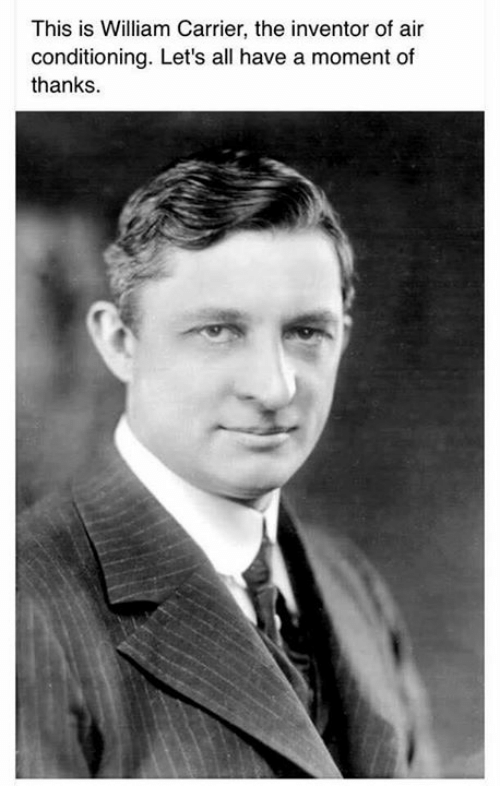
2. Air conditioning. I’ve seen this floating around Facebook.

AC Inventor thanks

3. Finishing books. I love reading, but I like completing a book as well. I had been plugging away at some and finished three within two days of each other this week.

4. Scrapbooking paper. This is an odd one, I know. I have not done much scrapbooking, though I need to. But I use the paper to make cards, and there are just so many beautiful options. I wish I could find fabric in some of the paper designs.

5. A community Facebook page. Someone just told me this week about a Facebook page for our little area. It’s nice for things like finding out where the power is out, where traffic snarls are, lost or found pets, etc.

Bonus: not losing power during the several thunderstorms we had this week. The lights flickered a bit, but thankfully never went out.

Happy Friday!

Book Review: A Small Book About a Big Problem

Anger“Anger lodges in us. It comes home, kicks off its shoes, plants itself in front of the TV, and expects to stay. It doesn’t even look at you when you tell it to leave. But it can be moved. It just takes more than a day” (p. 35).

You wouldn’t think I was an angry person if you observed me much. I don’t generally yell or scream. I might occasionally throw something if I am alone. I tend to seethe rather than explode. Part of that is my upbringing; my father was the only one allowed to express anger. But quiet anger is still anger and still destructive. I experience it enough that when I saw A Small Book About a Big Problem: Meditations on Anger, Patience, and Peace by Edward T. Welch, I got it as soon as possible. Ed’s book, Running Scared: Fear, Worry, and the God of Rest, was a big help to me with anxiety, so I trusted this book would be just as helpful concerning anger. And it was.

It is indeed a small book. It’s only about four by six inches and 185 pages. It’s divided into 50 chapters, but they average about three pages each. Ed advises reading just one chapter a day and meditating on its main point rather than rushing through the book without absorbing it. And that’s a wise strategy. I confess I did sometimes read two at a time, if one was short or a expressed a truth that was already a part of my thinking. But I tried to move slowly. I went back through the book after finishing it and made a list of main points and quotes from each chapter. That overview over about three days helped bring out some of the recurring themes and connections.

The first need is to acknowledge that anger is a problem.

“To be angry is to destroy…In its commonness we can overlook our anger’s volatile and destructive disposition” (p. 1).

“Anger is known to take a toll on our bodies. It is not healthy” (p. 2).

“Jesus…enlarged the boundary of murder so that it includes all kinds of anger. In order to do this, He links them at the level of the heart, where they share the same lineage of selfish desire. We want something–peace, money, respect–and we aren’t getting it. The only difference is in our choice of weapons” (p. 18).

Sometimes we’re “deaf to [our] anger” because it sounds like what we grew up with; it seems normal (p. 117). Prov. 22:24-25: “Make no friendship with a man given to anger, nor go with a wrathful man, lest you learn his ways and entangle yourself in a snare.”

Wisdom–learning what God says about anger–and humility are our best aids to diffuse anger.

“Humility might sound like your worst nightmare because it seems to destine you for mistreatment. People can now treat you any way they like, or so you think. In response, you can only meekly turn the other cheek. Humility, however, is not necessarily silent, and it is certainly not passive. Instead, it is the foundation for all wisdom. It has the flexibility to rebuke, overlook offenses, invite, or get help” (pp. 25-26).

“One of your desires is “I WANT AN EASY LIFE. When this is thwarted, you will likely pounce on the offender” (p. 157).

It’s not the incident that made us angry: anger was lurking in the form of desires (James 4:1). Some desires are legitimate, but we elevate them from a desire to a need, and then get angry when they are thwarted.

Anger may not seem to relate to God, but when we don’t get a desire we have deemed important, that “says something very significant about our relationship with God” (p. 43). James 4:4. “We are not thinking about God. We simply want something or someone else, at least temporarily. Our selfishness blinds us to the betrayal. We want what we want, and we don’t want Him” (p. 44).

James 4:13-16 talks about taking the Lord’s will into account in our planning. This is hardest for me in the “little” areas of life, like traffic jams keeping me from getting somewhere on time. But “If we learn this, we no longer live as if we are slaves to the circumstances of life” (p. 108).

The passage in James reminds us our life is but a mist. “We are mere mortals who will die. What makes us so important that life must go according to our plans?” (p. 108) (emphasis mine).

Anger can seem powerful, gives an illusion of control, gets results. But “A man without self-control  is like a city broken into and left without walls” (Proverbs 25). “Whoever is slow to anger is better than the mighty, and he who rules his spirit than he who takes a city.” (Proverbs 16:32). “Real strength and real power, however, never lash out. Those who are truly strong are composed, while others are not. Real strength is used to rule our spirit rather than rule others” (p. 92).

Other chapters discuss covert forms of anger (grumbling, which reveals our displeasure that God isn’t doing things our way, sarcasm, coldness, and even indifference), the need for forgiveness, taking care of the “log” in our eye before dealing with the “speck” in someone else’s (Matthew 7:1-5). Anger can feel like fear, threat, being misunderstood, fatigue, injustice, depression, guilt, shame. Some even use anger as a shield for their own pain and vulnerability, like a hurt animal. We need to recognize these in ourselves but show mercy and patience when we recognize them in others.

The author looks at anger as shown by God the Father and Jesus and how their anger differs from ours.

“When other people’s welfare was at stake, Jesus was angry. Here is how He is unlike us: He was never angry when He was personally violated” (p. 53). 1 Peter 2:23 – when He was reviled, reviled not again.

“Does this leave you deaf, bind, and mute in the face of personal injustices? No, it leaves you so that you are not mastered by the injustices of others. Anger might feel powerful, but it is not. It renders you a servant of the one who hurt you. The way of Jesus is the way of Spirit-given power. In this power you have a clear mind to consider how and when to act” (p. 54).

“Jesus was confident that His Father was in control; there would be justice in the end” (p. 54).

“Jesus served by blessing His enemies (Luke 6:27-31), which is a good thing, because we ourselves have been His enemies” (p. 54-55).

When the only one who has a right to be angry chooses love and service, when He considers the interests of others more important than His own and chooses humility–He changes everything” (p. 55).

And he encourages us that God loves us and wants to forgive us and help us change.

“When we see our anger clearly, we would expect God to forget about us. Instead, He pursues us with even more zeal, and He gives us even more power to stay faithful to Him” (p. 70).

“He doesn’t forgive us because of our resolve to never be angry again. He forgives us because of His resolve to forgive those who come to Him” (p. 47).

Hebrews 4:15-16 – our high priest (Jesus) sympathizes with our weakness, has been tempted like we are. Draw near to throne of grace for grace to help in time of need.

One chapter that brought me to tears was “Day 22: You Have Been Anger’s Victim.” And later, for those of us who grew up with anger:

“Retrain your ears as you listen” for anger. “Decide that the culture of anger will stop with your generation” (p. 118).

“As a protest against the anger around us, who will you bless with your words today?” (p. 119).

Our example of how to respond when wrong, is of course, Jesus, who “when He was reviled, reviled not again” (1 Peter 2:23). And when we remember how much we have been forgiven, we realize we have no right to withhold forgiveness from others (Matthew 18:27-35). Remember the love and cost to our forgiveness, freely offered (Eph. 1:7-8; 2:4-5). But even beyond forgiveness, God wants us to love and bless those who wrong us.

Forgive me for such a long, quote-heavy post. But there is so much that was so helpful in this book, and I have only shared maybe half of it. Needless to say, I highly recommend it.

(Sharing with Semicolon‘s Saturday Review of Books, Literary Musing Monday, Colletta’s Book Club, and Carole’s Books You Loved)