What’s On Your Nightstand: June 2017

What's On Your Nightstand

The folks at 5 Minutes For Books host What’s On Your Nightstand? the last Tuesday of each month in which we can share about the books we have been reading and/or plan to read.

It’s nearly the end of June (already!), so it’s time to summarize this month’s reading.

Since last time I have completed:

The Sweetest Thing by Elizabeth Musser, reviewed here. Two girls with different personalities, lifestyles, families, economic situations, and religious persuasions become closest friends and help each other through the trials in their lives. Very good,

Though Waters Roar by Lynn Austin, reviewed here. A girl lands in jail for breaking the Prohibition laws her grandmother fought for and reflects on the heritage of strong women in her family and their causes, wondering what her part in it all is. Very good.

Grow Old With Me by Melinda Evaul, reviewed here. A middle-aged bed and breakfast owner with looming physical issues meets a middle-aged man horribly disfigured from a fire. Good.

No Little Women: Equipping All Women in the Household of God by Aimee Byrd, on the need for women to grow in discernment and knowledge of God, reviewed here. Good.

I’m currently reading:

Don Quixote by Miguel de Cervantes. Almost done!

Fierce Convictions: The Extraordinary Life of Hannah More by Karen Swallow Prior and Eric Metaxas

Songs of a Housewife: Poems by Marjorie Kinnan Rawlings, edited by Rodger L. Tarr

A Proper Pursuit by Lynn Austin

Finishing Our Course with Joy: Guidance from God for Engaging with Our Aging by J. I. Packer

Up Next:

The Illusionist’s Apprentice by Kristy Cambron

The Story Keeper by Lisa Wingate

Threads of Suspicion by Dee Henderson

The Strange Case of Dr. Jeckyll and Mr. Hyde by Robert Louis Stevenson, spurred not only by the Back to the Classics Challenge but also Rebekah’s review.

What are you reading this summer?

Save

Save

Book Review: No Little Women

No Little WomenAimee Byrd takes the title of No Little Women: Equipping All Women in the Household of God from 2 Timothy 3:6-7:

For among them are those who creep into households and capture weak women, burdened with sins and led astray by various passions, always learning and never able to arrive at a knowledge of the truth.

Other translations use the descriptors “gullible,” “foolish,” “idle,” “silly” women. She says the literal translation is “little women” or “small women” and “was a term of contempt” (p. 23).

“Of course, Paul is not making a blanket statement about all women” (p. 21). “Paul isn’t soft-pedaling the issue here. And he isn’t being chauvinistic. His writing in Scripture shows a high view of women and much appreciation for their service. I wish we could all be the kind of woman who is praised in his writing. And Paul is not saying men are never gullible. He is saying that a particular type of immature woman was being targeted by false teachers looking to manipulate and infect households” (pp. 23-24).

In pondering why women would be such a target, she discusses the value of women, first of all from having been made in God’s image, but also in having been created as a helper. Sometimes we bristle at that word “helper,” but the word is also used of God “as a ‘helper’ to Israel throughout the Old Testament” and this word “communicates great strength” (pp 24-25). She quotes one author’s interpretation of the word for helper, ezer, as a “necessary ally”  which “brings into view the joint mission for which the male and female are created to rule God’s earthly kingdom” (p. 26). It emphasizes their relatedness to each other and dependence on each other.

To get to Adam, Satan went after a target of value to him. It is no surprise, then, that he is still relentless in trying to deceive Christ’s bride, the church, through false teachers, ill-placed priorities, felt needs, fear tactics, and coping mechanisms, to divert them from resting in Christ and in God’s wisdom, provision, and sovereignty” (p. 26).

In these days, this often happens via women’s ministries and books targeted to women.

In many cases, women’s ministry becomes a back door for bad doctrine to seep into the church. Why are there still so many gullible women? Have we made any progress in equipping our women to distinguish truth from error in what they are reading? Do the women in your church actually have the skills to lead a Bible study? Why is it that so many women sit under good preaching and have all the best intentions, yet fall prey to the latest book marketed to them that is full of poor theology? And why do so many women in the church fail to see that theology has any practical impact on their everyday lives?” (p. 22).

No matter what our different circumstances and vocations may be, every woman is a theologian. We all have an understanding about who God is and what he has done. The question is whether or not our views are based on what he has revealed in his Word about himself. And yet many women are either turned off or intimidated by doctrine” (p. 53) (emphasis mine).

Further complicating the problem is that sometimes pastors are unaware of what is being taught in women’s Bible studies, or, in some cases she cites, concerns women bring up to pastors about the books they’re reading are dismissed as if they don’t matter. I appreciate that she encourages pastors and leaders not just to give women’s ministry leaders lists of approved and disapproved authors, but to engage their questions and concerns and teach them how to be discerning in their reading.

Aimee delves further into what it means to be a “necessary ally,” why women should be theologically robust, how church leaders can help, how to be more discerning in our reading. She goes into church and feminist history to a degree. She demonstrates that, though a woman is not to hold an authoritative office over men, that doesn’t mean men can never learn from women (e.g, Hannah and Mary’s prayers are theologically rich and recorded as inspired Scripture, Priscilla is named with her husband Aquila as having “explained to [Apollos] the way of God more accurately,” Abigail reasoned with and appealed to David, diverting him from killing her household). She discusses different levels of doctrines: there are core ones that not to believe is heresy, such as the inspiration of the Bible, who Jesus is, how one can be saved, etc. But there are secondary ones that we might disagree over yet acknowledge that the other person knows and loves God, and we might benefit from their teaching while not necessarily agreeing with every little point. She has one section where she takes excerpts from popular books for Christian women and shows how to ask questions of them to discern what they are saying and how it lines up with Scripture.

I very much appreciate that she summarizes well after a section of writing. Not many non-fiction authors do this any more: maybe they feel they’ll bore the reader. But it helps me for the author to step back every now and then and review in a more concise form what they’ve just been talking about. Sometimes it’s hard to keep in mind the flow of the book and the connection between individual chapters and the overall point, so it helps when an author does that occasionally.

I have multitudes of places marked, much more than I can share in this already-long review, but here are just a few quotes that stood out to me:

The reason why so many people have an aversion to theology may be that it takes fitness. Returning to Hebrews 10:23, holding fast to anything requires fitness. It requires exercise, conditioning, stamina. We are exhorted to hold fast to our confession of hope because there is always something working against our fight for spiritual health and growth. John Owen picks up on this, saying that these two words insinuate an opposing force–we could even say a “great danger.” “To ‘hold fast’ implies the putting forth our utmost strength and endeavors in so doing.” This is going to take awareness and a real fight. Faith is a gift of God, but it is a fighting grace. To be fit theologically, we must be conditioned by God’s Word, exercising this gift actively by living a life of faith and obedience (pp. 57-58).

Sometimes we get so invested in our favorite authors and teachers that we have trouble separating their personalities from the content of their teaching. How do you handle it when your favorite books or speakers are challenged by constructive criticism? Do you take it personally? Do you think you have any blind spots when it comes to reading with discernment? (p. 64).

Our evangelical culture is one that promotes tolerance and love. But it isn’t loving to tolerate bad teaching in the church. Love requires the work of guarding the Word of the One who is truly loving. He loves us enough to be direct about holiness, sin, and the way to everlasting life. We have a responsibility to discern the teaching of those who eagerly wish to disciple others (p. 87).

We need to be careful not to be led by our sentiments to the detriment of our competency in God’s Word (p. 166).

Discernment is necessary in our relationships and in all of our learning. We are to pursue truth, and that means we have to distinguish truth from error (p. 201).

Aren’t we striving for unity? Of course we are! But what is it that unites us? We have a beautiful prayer recorded in Scripture, offered by Jesus for the unity of his church (see John 17:11). In it, he prays for his disciples, “Sanctify them in the truth; your word is truth” (John 17:17). To sanctify means to set apart. So we see that Christ’s disciples were to be set apart by his word….We can be united only by the truth; anything else is superficial. God’s Word is the truth! And yet there is a setting apart, as truth needs to be separated from lies and errors (pp. 221-222).

But isn’t love the most important thing? [Quotes Jesus from Matthew 22:37-39, ties back to Deuteronomy 6:4-5.] So yes, love is of extreme importance–not only with our hearts and souls, but with our minds as well (p. 222, emphasis mine).

[After quoting Galatians 1:6-9 about letting those be accursed who bring a false doctrine] Those are very strong words. But they are loving words! It isn’t loving to accept any teaching in the church that is damning to our souls (p. 229).

What they believe to be true about God and themselves will shape their everyday decision making and behavior. But, more than that, it is an eternal matter. Impress the truth upon both the women and the men that they are theologians. We all have some sort of knowledge about God. The question is whether we are good theologians or poor ones. We are called to a life of faith and obedience. How does the knowledge of who the Lord is and what he has done on our behalf affect us? (p. 269).

If you’ve read here long, you know I take sound doctrine seriously, and I agree with what Aimee says about the need to read, understand, believe, obey, and teach what God says. I, too, have been saddened or dismayed by some of the problems in some of the most popular Christian books marketed to women. So I am very happy to see the emphases in this book on robust theology and discernment.

However, there are a few areas where I’d disagree with Aimee, though they all fall under secondary issues.

She wonders if there is any need for separate women’s ministries at all, and if there is, she feels they should be called initiatives rather than ministries. She feels that calling every other endeavor in church a “ministry” takes away from the ministry of the preaching of the Word of God, from which everything else we do in church should flow. I agree that the preaching of the Word is the primary ministry, but I have no problem with a women’s ministry or children’s ministry or prison ministry. The Bible does teach that we are all supposed to minister to others, and I have never had the example or even the thought that these other ministries of the church are competing with or downplaying preaching.

Somewhat connected with that, she quotes Hannah Anderson’s Made for More as saying, “When we craft our learning and discipleship programs around being ‘women,’ we make womanhood the central focus of our pursuit of knowledge instead of Christ.” I have not read Hannah’s book, but I don’t have a problem with a women’s ministry’s focus primarily concerned with Christian womanhood. A lot of what older women are instructed to teach younger women in Titus 2 has specifically to do with their womanhood, yet it is all within the context of sound doctrine (verse 1). I’ve been involved with women’s ministries for most of my adult life, and they’ve mostly been set up with monthly or quarterly meetings built around fellowship and outreach with occasional Bible studies at other times. The preached Word that we receive in other services during the week (4 or more for many of us) forms the basis and context for what we do in the women’s ministries. Having a women’s ministry built around Christian womanhood does not necessarily mean that we’re elevating that above knowing Christ: we’re seeking how to be the kind of women He wants us to be under the leadership of Titus 2 older women.

In a section about Adam and Eve, she states that “They were to expand the garden-temple, and therefore God’s presence, to the outermost parts of the world” (p. 68). I have a question mark under “God’s presence.” He is already everywhere. I’ve never heard this as a part of their instruction to be “fruitful and multiply and fill the earth and subdue it, and have dominion over the fish of the sea and over the birds of the heavens and over every living thing that moves on the earth” (Genesis 1:28). Later in this section she faults Eve for being “hospitable to the enemy, allowing the Serpent to converse with her in the garden-temple” (p. 69). Is talking to him being hospitable? And did she even know he was an enemy at that point? I’ve often wondered about this scene. She shows no surprise that a serpent speaks to her. Did all animals speak then? I don’t know. It seems to be a real serpent as opposed to a figurative one (like the dragon or beast in Revelation. We take them as figurative representations of real people with dragonish and beastly characters) because the curse in Genesis 3:14-15 has him crawling on his belly like a snake. Granted, when he started questioning and twisting God’s Word, that should have raised a red flag for Eve, and maybe that’s all that Aimee means, that Eve should not have kept listening to the snake at that point. But she seems to find a lot of fault with both Adam and Eve long before the Bible charges them with sin.

In a discussion of our unity with Christ, with His being the head and we His body, she makes the statement, “Christ has united himself in such a way to his church that we can be called the total Christ, or the one Christ!” (p. 171). While I agree with everything else she said about our union with Him, this statement bothers me, but I would need to ponder it more than I have.

Aimee writes from a Reformed perspective, and I am not Reformed, so we would have some differences there. Some day I really should write out why, but it would take too long to get into all of it here.

There are a couple of areas I wish she had gone into more, such as why we believe the canon of Scripture is closed and there is no new revelation at this time and hermeneutics (principles for Bible interpretation), as those are two areas of error in a lot of popular books.

But overall, I found much food for thought and much I agreed with thoroughly. I thought this was a very helpful book and I highly recommend it for every woman who wants to be strong in the faith rather than a spiritually immature or “little” woman.

(Sharing With Inspire Me Monday, Literary Musing Monday, Semicolon‘s Saturday Review of Books, Wise Woman, Carole‘s Books You Loved)

Save

Save

Save

Save

Laudable Linkage

IMG_0195

It’s been a couple of weeks since I’ve been able to share the interesting reads I’ve come across, so I have quite a list accumulated.

Love Is More Than a Choice.

How I Process the Moral Failures of My Historical Heroes. I’ve been pondering this for some time, with the thought of possibly writing a post about it, so I was glad to see some thoughts very similar to my own.

Pray Them Home: Three Prayers to Pray for Prodigal Children.

The Father Who Eliminates Shame.

Ecumenical vs. Evangelical, HT to Challies. A good, concise summary of the history and the issues involved.

The Not So Simple Life. “No matter where you land on this simplicity spectrum, all of these endeavors don’t satisfy the peace we hope to gain from the ‘simple life’…Even simplification is a vain pursuit when it takes up so much room in our minds and our hearts.”

Don’t Take This Personally. “We each cast ourselves as the star (and director and producer) in our own movie. All our life’s plots revolve around us. And all the people in our relationships are supporting actors. But here’s the catch: The supporting actors in our movies are actually busy starring in their own movies.”

Dear Girl: Please Don’t Marry Him. “Your fear of breaking off the relationship should be obliterated by the fear of making a foolish marital choice which is far, far worse.” I don’t know anything about this author, but thought this was a good article.

Teens Who Choose Life in Unplanned Pregnancies Need Support and Respect, Not Shame, HT to Challies. Being pro-life is not just a matter of being anti-abortion.

The Art of Days. Seeing beauty in the everyday tasks.

Let Your Kids In On Your Ministry.

Desire, Choice, Consequence: Building Character Through Stories, HT to Story Warren.

Member of the Family.

As You Grow, So Should Your Dresses.

Is the ESV Literal and the NIV Gender Neutral? HT to Challies. Very little, if any, translation from one language to another is literally word for word the same, due to differences in sentence construction, words for which there are no equals, etc.

6 Keys to Help You Be the Boss of Your Blog.

The Numbers Trap, HT to True Woman.

Is Screen Time the Enemy of Reading? I almost didn’t read this, figuring I knew where it was going to go, but I was pleasantly surprised.

To a Schoolgirl in America: Writing Advice From C. S. Lewis.

Free ebooks, HT to Worthwhile Books.

I saw this on a friend of a friend’s Facebook, and I don’t know who originated it, but I think it’s great. The OT is so much more than moralistic stories.

What the Bible's About

(Links do not imply 100% endorsement of site or author.)

Save

Friday’s Fave Five

It’s Friday, time to look back over the blessings of the week with Susanne at Living to Tell the Story and other friends.

Another Friday is here! The first FFF of the summer! Here are some highlights of the last week:

1. Father’s Day. Always a joy to celebrate my husband and son and father and step-father – as well as enjoy some good food and having the family together. 🙂

2. A “man bouquet.” My daughter-in-law made this as a centerpiece for Father’s Day dinner. I’m sure they liked this better than flowers. 🙂

Man bouquet

3. A medical test completed. I decided to go ahead and schedule an ablation surgery for the atrial fibrillation I’ve been experiencing, which will be next month, and a test I had to have in preparation for that was a CT scan of the heart. I’m told that will provide the cardiologist a “map” for when he does the surgery. That was Wednesday, and everything went well. Sometimes technicians can treat you like a piece of the furniture, placing you where they need you but not really interacting and not pleased with questions. But this one was very friendly and efficient, explaining everything well, telling me what to expect, and answering a question I had. When I got a little lost on the way to the imaging department, a hospital worker passing by noticed me looking at the signs and helped me find my way. Normally even for familiar and simple medical appointments I have a little undercurrent of nervousness, but about halfway in I realized God was giving me a remarkable calmness. I’m glad that’s done and I hope the actual procedure next month goes as well.

4. Timothy. My daughter-in-law told me that one day this week, out of the blue, my grandson Timothy said, “Grandma loves Timothy.” That warmed my heart. I’m so glad he knows that.

5. Passing the summer solstice. I like having some extra daylight in the evenings, but sometimes it’s hard to wind down when it is light so late and mentally it doesn’t seem so late. I like the in-between rather than the extremes of summer and winter. 🙂

Happy Friday!

Save

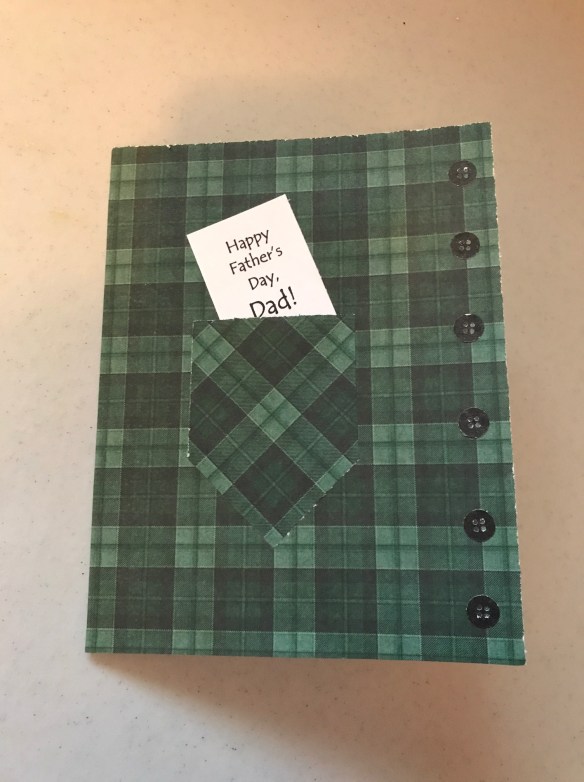
Father’s Day Cards

I thought I’d show you the cards I made for this last Father’s Day.

This was for my step-father, adapted from an idea seen on Pinterest.

IMG_0238

I love that it’s simple but still makes for a nice design. The buttons were made on the Cricut machine. I toyed with using real buttons and thread, but I was afraid they might fall off in transit.

This was for my son. My grandson likes super-heroes, so I thought it was fitting for a super-dad. 🙂

IMG_0239

This was from one of the Cricut Design Space’s “Make It and Take It” cards, but I tweaked it a bit from what they had – they didn’t have the “Super” at the top, and their whole card was the size of the blue frame.

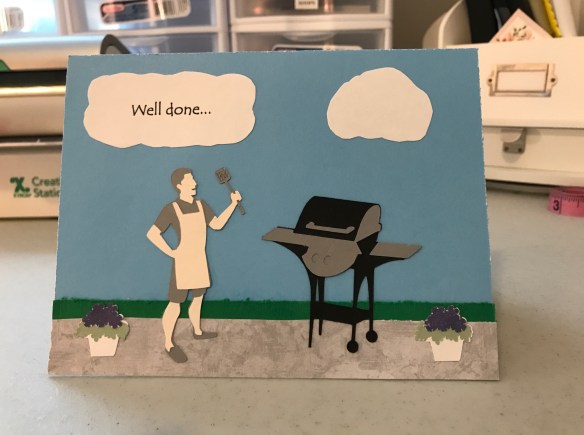
For my husband, I wanted something to do with grilling, so I searched the Cricut Design Space’s files for “grill.” Both this grill and the little man showed up, so I used both of them. The design kind of evolved as I worked. I cut little snippets with scissors in the “grass” so it would look like grass blades. I started to stick the figures in the grass, but we grill on our patio, so I used the textured-looking grey paper for the patio. I was going to put “Well done” at the top (a play on the idea of well-done food and well-done fathering), then decided I would put that in a cloud. I had everything centered in the middle but thought the cloud looked odd centered right over the figures as if it was about to rain on them. So I moved it to the side and added another for balance, cutting them both out freehand (I had typed the “Well Done” and printed it on cardstock, along with the inside sentiments of the cards). Then the bottom corners looked like they needed something, so I looked up flowerpots. This flower design actually had a couple of other layers on the flowers and leaves, but they were so tiny they didn’t come out well. I decided the flowers looked ok as is.

IMG_0240

That was it for this time. I think everyone liked their cards. 🙂

(Sharing with Made By You Monday)

Book Review: Though Waters Roar

Though Waters RoarIn Though Waters Roar by Lynn Austin, Harriet Sherwood is a young woman in the early 1900s who has just landed in jail for defying the Prohibition’s liquor laws – but not for the reasons you might think. As she spends the night in jail, she contemplates how ironic it is that she’s there, given that her grandmother spend much of her adult life fighting for Prohibition. Trying to trace how she got to where she is, she reminiscences about the women in her heritage.

Her great-grandmother, Hannah, helped hide slaves and smuggle them to the Underground Railroad. Her grandmother, Bebe, stepped out of the conventional role of her new marriage in upper-class society to help those less fortunate, participate in the Women’s Christian Temperance Union, and fight against “Demon Rum,” landing in jail herself for taking an axe to whiskey barrels. Her mother, Lucy, though having a very different personality and upbringing, eventually stepped out of her shallow lifestyle to try to help others as well. Finding that the means to appeal to civic authorities for needed changes was blocked by those authorities because she was a woman, she fought for women’s right to vote.

Harriet “didn’t want to be like my fiery grandmother and end up in jail, any more than I wanted to be a dutiful wife like Mother or a virtuous siren like Alice [her sister]. But how was I supposed to live as a modern woman, born just before the dawn of the twentieth century? What other choices did I have? That’s the question I was endeavoring to answer when I ended up in jail.”

The story of Harriet’s ancestors takes up most of the book and is told in flashback. With each mother-daughter pair, the mother tries to teach eternal truths to a daughter not always willing to listen, at least at first. But eventually each finds her own way, and Harriet is reassured that “Someday…God is going to give you a task to do in your own time and place. Then you’ll have to put your faith in Him as you follow your conscience.”

A few favorite quotes:

Thank goodness you’re such a plain child. You’ll have to rely on your wits.

Grip the rudder and steer, Harriet. Don’t just drift gently down the stream. If you don’t have a map, you might run aground somewhere or end up crushed against the rocks. Always know where you’re headed.

Bitterness is like a weed. Remember how hard it always was to pull out thistles once they take root? Remember how deep those roots grow, and how if you just snapped off the end of it, the plant would grow right back? You have to dig down deep inside. Let God search your heart. Let Him show you what’s there and help you root out all that bitterness.

There’s no shame in changing direction, Harriet. In fact, once you’ve seen the warning signs, it’s always wise to turn around.

Our daughters aren’t the same people we are, nor are they extensions of ourselves. They are unique individuals in God’s eyes, responsible to Him for the choices they make, not to their mothers.

As much as our communities might need it, and as bad as things are, imposing our morality on others isn’t the answer. It doesn’t work. People may be forced to give up alcohol, but they are still going to hell. That’s our calling—to bring people to Christ—not to force them to behave the way we want them to or to solve all their external problems.

I had not known until fairly recently that there were different waves of feminism and that when it first started, it fought for good and necessary ways to help others. It was later on that other agendas and prejudices crept in. So it was interesting to read how this first wave came about. Even in fighting for good causes, though, there were problems with balance in being away from home so much, leaving children to others to raise, and occasionally defying husbands. I don’t think the author is saying those things are necessary or right, but that it’s always a struggle to maintain the right balance. Even Grandma Bebe (speaker of the last quote listed) comes to realize in the end that her life would have been better spent in eternal pursuits.

I actually didn’t like Harriet very much, but I think her personality was indicative of both having been left to herself too much and trying to find her way. When she does seem to be finding it and some pieces start to fall together for her, some of the rough edges smooth over.

I did enjoy the story and the look into the lives and journeys of the women. I was about to say which one I identified most with, but then found I couldn’t really name one – there was much to glean from and identify with in each woman’s life.

(Sharing with Semicolon‘s Saturday Review of Books, Literary Musing Monday, Carole‘s Books You Loved)

Save

Why Study Doctrine?

Doctrine can seem like a cold, dry concept, something stuffy theologians fuss over when they should be trying to reach others. We’re more excited by a group study on relationships or parenting or womanhood or just about anything rather than a doctrinal study. We don’t usually approach our time in the Bible or church rubbing our hands eagerly anticipating what doctrine we’ll learn about today. We’re usually looking for help, encouragement, affirmation. We want to feel something. But feelings don’t last. If I get a warm fuzzy spiritual feeling in my devotions, that can dissipate in seconds when someone crosses me or something goes wrong. Winsome sermons and books may inspire me for a short while, but unless there is meat to them, that inspiration won’t last.

But doctrine is vital. You can hardly read a NT epistle without coming across a mention of doctrine and warning against false doctrine. If we think of sound doctrine as a manifestation of God’s truth and character, we can in turn worship Him by knowing and sharing the doctrines of His Word.

A.W. Tozer once wrote that “there is scarcely an error in doctrine or a failure in applying Christian ethics that cannot be traced finally to imperfect and ignoble thoughts about God.”

So what are some advantages to studying right doctrine in the Bible?

Doctrine leads us to true worship. When we don’t worship God for Who He truly is, then we are worshipping a god of our own making, and that is idolatry. Now, of course, all of us are imperfect in our knowledge of Him and are, or should be, ever growing in Him, and He’ll correct our understanding along the way. But that is different from not knowing Him for Who He is due to neglect or misapplication of the Word.

Doctrine increases our intimacy with God. We can’t know Him aright apart from what He has revealed of Himself in His Word. As we learn more of Him, we love Him and worship Him more, and what seemed like “dry doctrine” then does become something that warms and thrills our hearts as the Holy Spirit brings that truth to mind.

Doctrine protects against error and therefore the wrong path. For example, years ago when cult leader David Koresh was in the news, I watched an interview with someone from his compound. I was shocked to hear her say that she was impressed that he knew his Bible so well. Nearly everything he brought from the Bible, he twisted. Knowing doctrine would have kept this person and others from being deceived by him and others like him.

Doctrine bolsters our faith and confidence in God.  Recently I was troubled by a question I had no answer for that cast doubts on God’s character. I still don’t have an answer for it, but I rested on the previously studied truth that He is good, righteous, kind, and merciful.

Doctrine meets our deepest needs at the most basic level. If I am feeling lonely, what most helps except the truth that God is present everywhere, even with me? If I am afraid, what helps most but meditating on God’s power? When a trial comes and people feel forsaken, what most comforts but the precious truth that God will never forsake us? If I am feeling ashamed, sinful, and unworthy, my only help is turning to the only One who can wash away my sin and remind me that I am in Him and beloved by Him.

Doctrine is stabilizing. “So that we may no longer be children, tossed to and fro by the waves and carried about by every wind of doctrine, by human cunning, by craftiness in deceitful schemes” (Ephesians 4:14, ESV). I’ve known women and read women who do just this, float around with whatever is popular with little discernment. 2 Timothy speaks of “silly women laden with sins, led away with divers lusts, Ever learning, and never able to come to the knowledge of the truth” who are “lead captive” by a whole host of wrongdoers in the “perilous last days” (2 Timothy 3:1-7, KJV). By contrast, Titus 2 exhorts us to “speak thou the things which become sound doctrine” (v. 1, KJV).

Doctrine determines deeds. Our beliefs affect our behavior. When a lie seems the only way out of a tough situation, what keeps us from it but the knowledge that it will displease a God whose essence is truth? Even the Titus 2 admonition to older men and women is couched in the context of sound doctrine.

Doctrine honors God. He is the one who determined what sound doctrine us. If we love Him we should want to know what He says and live accordingly. It’s so important to Him, He inspired John to write, “Everyone who goes on ahead and does not abide in the teaching of Christ, does not have God. Whoever abides in the teaching has both the Father and the Son. If anyone comes to you and does not bring this teaching, do not receive him into your house or give him any greeting, for whoever greets him takes part in his wicked works” (1 John 1:10, ESV).

Doctrine is not an end in itself. If it is, then it does become dry and stale. The point of doctrine isn’t to line up our beliefs in neat, orderly systems and leave them there. The point is to know God better, serve Him in the ways He desires, and minister His truth to others.

People concerned about right doctrine can seem pesky and picky, and, true, it’s too easy to be that way. We shouldn’t be nitpicky just to be so. But we should “Be diligent to present yourself approved to God as a workman who does not need to be ashamed, accurately handling the word of truth” (2 Timothy 2:15, NASB), and as kindly and gently as possible bring His truth to bear in our conversations and interactions. We have to remember to let our speech be always “with grace” (Col. 4:6) and to speak the truth in love (Eph. 4:15). We don’t need to “pounce” on every comment or reference another person might make, but graciously seek what the Lord might have us say. We also have to distinguish between clear doctrine and those areas where good people can differ or personal preferences.

II Corinthians 3:18: “But we all, with open face beholding as in a glass the glory of the Lord, are changed into the same image from glory to glory, even as by the Spirit of the Lord” (KJV). We “behold Him” through His Word. And, the more we behold Him, the more we are changed into His likeness.

Learning doctrine doesn’t necessarily mean digging up systematic theology books, though some might like to do so. In our everyday reading and Bible study, it means looking for the truth about God when we read. The Bible is so much more than moralistic stories (“Be like Joseph and Daniel; don’t be like Jonah and Judas”). Look at what God is doing in the passage, what we see of His character and wisdom in what He is doing.

So, don’t be dismayed by that word “doctrine.” II Timothy 4: 3-4 says, “For the time will come when they will not endure sound doctrine; but after their own lusts shall they heap to themselves teachers, having itching ears; And they shall turn away their ears from the truth, and shall be turned unto fables.” That is a warning to us not to turn away from sound doctrine, but also possibly an admission that sound doctrine needs to be “endured.” Learning doctrine may not always feel warm and fuzzy, but the Holy Spirit will use it in our lives in blessed ways.

(Sharing with Inspire Me Monday, Literary Musing Monday, Wise Woman, Tell His Story, Woman to Woman Word-filled Wednesday, Faith on Fire)

Friday’s Fave Five

It’s Friday, time to look back over the blessings of the week with Susanne at Living to Tell the Story and other friends.

I usually start my FFF posts on Thursdays, but this week I was drawing a  blank. It wasn’t a bad week, but nothing really stood out at first for this week’s post. But, as always, once I start to think about and look for blessings in the week, I find them.

1. A quiet week. Just the fact that it was an uneventful week, spent mostly at home, was a blessing, especially after last week’s ER events.

2. Zaxby’s Grilled Cobb salad. My errand-running usually occurs later mornings, culminating in my bringing home something for lunch for Jesse and me. One of our occasional lunch places is Zaxby’s, and I love their chicken strips, fries, toast, and sauce. But I’ve been trying to make better heart-healthy choices lately, so I got their grilled Cobb salad. It was wonderful! I can’t wait to have it again. I’ve been trying to choose grilled instead of fried at restaurants, with mixed results, but this was so good. The calorie count, which they helpfully put on their drive-through menus, was still pretty high, but I have to believe the choice was still a better one with all the fresh veggies. I’m not usually one to have a salad for a meal – I tend to think of them as appetizers or side dishes, even with meat in them. But this lasted me until dinner.

3. Timothy’s “playground,” as he calls the set we got for him. It took Jim and Jesse, with help from Jason as he had time, a couple of Saturdays to put it together. Timothy was taking a nap when it was completed, and we couldn’t stay til he woke up, so his parents filmed his first reaction to it and sent the video to us. Priceless! When he climbed up to this little perch, he said he was “so high in the sky!” And then he wanted to FaceTime with us so we could watch him play on it.

IMG_0004(3)

4. Surprise visits. Sometimes when Jason, Mittu, and Timothy are out in the evenings, they ask if they can stop by to visit. I treasure living close enough to have that happen!

5. Naps. I don’t know why I seem to be unusually sleepy this week, but I’ve been grateful for naps in the daytime to give me enough energy to then get something else accomplished.

As a bonus, we found out that some of my family is driving down from up north this summer to visit two of my sisters in SC. We can’t stay overnight because of Jim’s mom’s care, but we’re making plans to at least meet halfway between here and there for lunch one day. There is even a possibility the rest of the family in TX might come – if they did, that would be the first time since my mom’s funeral 11 years ago that all six siblings were together, so I hope it works out!

Happy Friday!

When the Message Isn’t For Me

Courtesy offreedigitalphotos.net

(Photo courtesy of FreeDigitalPhotos.net)

A week or two ago I came across a blog post that got me to thinking about how we respond when a meeting, church service, or even a Bible passage seems to apply to someone other than myself. When there is an ordination service or a Mother’s or Father’s Day message or children’s program, do I skip them because I am not a part of any of that?

I don’t think so. Here’s why:

1. “All scripture is given by inspiration of God, and is profitable for doctrine, for reproof, for correction, for instruction in righteousness: That the man of God may be perfect, thoroughly furnished unto all good works.” II Timothy 3:16-17. It is all profitable for me in some way even if the particular passage doesn’t seem to apply to me.

Some years ago the pastor of the church where we were at the time read a few verses from Exodus with instruction about oxen. He asked, “Do any of you own an ox?” No one raised their hands.

He then asked, “How many of you have even seen an ox?” One or two raised their hands.

“So,” he said, “We should just turn the page and skip this passage, right?” No, we didn’t think so, but what do we do with that passage?

He then brought out several applications from the passage. For instance, someone who owned an ox that was known for trying to push people with its horn was more liable if it injured someone. So if we have, say, a dog with a tendency to bite, we are even more responsible to keep it from people it could hurt. Or, to apply it further, if our tail lights are out on our car, we’re liable if someone crashes into us because they didn’t know we were stopped or slowing down to turn, so it behooves us to keep up with those things.

2. It helps us understand our brothers and sisters in the Lord. I may not be a pastor or a husband or a mother, but the passages that talk about them help me understand their roles, not so I can form a checklist and note when they’re not getting it right, but so that I can pray for them, understand their problems, needs, and temptations, and encourage them. The Bible says the church is the body or Christ, and “If one member suffers, all suffer together; if one member is honored, all rejoice together.” (I Corinthians 12:26).

3. Their position is under attack. Satan is not omnipresent, but he does get around, and he seeks to undermine everything God calls good. Any role or function within the church, home, or family as designed by God is under attack in some way or another. The blog post I mentioned at the beginning was complaining, in part, that the focus on married women and mothers in some women’s ministries left single ladies out. I do think that is a valid point: not all women are called to be married, not all mothers are able to stay home, and we need to find ways to minister to the whole scope of womanhood. However, there are particular ways marriage and motherhood are being particularly attacked and undermined in the world today, so we need to help support those roles.

4. I can learn something that applies to me even though the particular focus of the passage or sermon is for someone else. Loving one another as Christ loved the church is something that applies to us all, not just husbands, so I can take an illustration that may be particularly about husbands and learn something I need in loving others. Years ago in college we were encouraged to read a particular book about leadership which I gleaned a lot from even though I was not a leader at the time (and still don’t naturally feel inclined to be now).

This is not to say that I should attend every focus group within the church since we’re all part of the body of Christ. Some of those were created to handle specific concerns in a smaller group setting. But when a Bible passage or sermon or ladies’ meeting seems to apply to someone else, there is still much I can learn and benefit from if I have ears to hear and a heart to receive.

(From the archives)

(Sharing with Faith on Fire, Inspire Me Monday, Literary Musing Monday, Wise Woman, Tell His Story, Woman to Woman Word-filled Wednesday)

Stray thoughts strung together

These are some of the random things crossing my mind this week:

I don’t remember which Jane Austen book I was looking up or why I was looking it up in the first place, but in the comments section of it either at Goodreads or Amazon, someone wrote, “I’ve seen all her movies!” That struck me funny – as if she were a movie star rather than an author.

In my Things You Might Not Know About Me post a while back, I forgot to mention a major one: I can’t type. At least, not like you’re supposed to. Somehow I never had a class in it. I developed my own method (using only 2-4 fingers), and it is so ingrained now that I don’t think I could learn the right way. When my husband and I were dating in college, most girlfriends typed their boyfriend’s papers, but in our relationship, he offered to type mine. I also make tons of mistakes and hate when that shows up in my writing, making me look ignorant. I know how to spell – just not how to type. I try to let most of my writing sit a bit and come back and check it later before publicizing it so I can catch more typos that way.

We were watching America’s Got Talent one night, and whenever the “danger” acts come on, someone always says, “Don’t try this at home.” Recently I thought, “But…all these people started out by trying this at home.” Nevertheless..don’t try this at home! Those acts are not my favorite anyway – I don’t enjoy seeing people risk life and limb for entertainment.

Dontcha hate when someone calls and then doesn’t leave a message?

It seems that one of the current decorating trends is open shelving in the kitchen. Am I the only one who doesn’t like it? It just seems busy to me, plus the shelves would be constant dust magnets. I’m not a big fan of subway tiling, either – that also looks too busy to me. I’m not a fan of tile in general: the times we have had it, keeping the grout clean was a major frustration. I wonder if I’d be thought of as the “difficult” client in those shows. 🙂

When people talk about having accountability partners, it seems to me that it’s easy for that to cross over into doing things because you know you’re going to have to face that partner about it rather than doing it as unto the Lord (Ephesians 6:5b-7: “in singleness of your heart, as unto Christ; not with eyeservice, as menpleasers; but as the servants of Christ, doing the will of God from the heart; with good will doing service, as to the Lord, and not to men.”) I’ve heard people say things like that. For instance, a friend who was memorizing verses with another friend mentioned that she needed to work on her verses so she wouldn’t be ashamed when it was time to say them to her friend. I do think the Bible teaches that as Christian brothers and sisters, we’re accountable to each other, but personally I don’t know if these partnerships are the best way to work that out. I know that they seem to be a help to many, so there are probably ways to do it with a right focus.

Mittu asked me recently what I had on my “bucket list, which, if you’re not familiar with the term, is a list of things you want to do before you “kick the bucket.” I had to think about it. I don’t travel well, so going exploring and seeing sites aren’t on my ideal list of things to do. The only two places I can think of that I’d like to see some day are the “Anne of Green Gables” house in Prince Edward Isle and Laura Ingalls Wilder’s Rocky Ridge farm, her last home. But I don’t want to see either of them enough to make the effort at this point. I’d also like to visit where my son lives in RI some day. We were just talking about that last night. My one overarching thing I would like to do is write a book. Or two. I thought when all the kids graduated and the busy school years were over, there would be time for more writing. Not so far, at least not in wide open swatches like I thought there would be. So I struggle with how to arrange my time and whether that desire is from the Lord or a personal ambition. Most of the things I’d like to do someday involve learning something: how to play the piano or cello, how to quilt, how to use Photoshop, taking voice lessons. Except for Photoshop, I don’t know if I’ll ever delve into those. I have often thought that the practice it would take to be able to play music enough to enjoy it would probably be more than I want to put into it at this stage. That’s another aspect of “middle age” that I should have mentioned in a recent post: when you know you only have so much time left, you become selective about how you it. But I do want to keep challenging myself and my brain with new things, and from time to time I do entertain thoughts on those possibilities. For now, most of my ambitions are quiet ones: finishing some of the projects that are in the back of my mind to do, spending time with loved ones, reading, blogging, etc.

How about you? Do you have any burning ambitions to pursue with the rest of your time on Earth?