Book Review: Lavender and Old Lace

Lavender_and_Old_LaceLavender and Old Lace by Myrtle Reed, written in 1902, opens with 34-year-old Ruth Thorne coming to occupy her aunt’s cottage while her aunt is away. She’s never met her aunt, Miss Jane Hathaway. Miss Jane has never forgiven her sister for running away to elope, but for whatever reason, she decides to establish relationships with her niece. However, she ends up having to leave before her niece arrives, so Ruth finds only Hepsey, the farm-girl working as the maid, at the house. Her aunt left a letter with various instructions, the most mysterious and inexplicable of which was to leave a light burning in the attic window every night.

Ruth worked for a newspaper in the city, but has six months off to house-sit for her aunt. Bored and restless, she explores her aunt’s attic, the first “real attic” she’s ever been in, until she comes across her aunt’s unused wedding dress and some newspaper clippings about a couple’s wedding and the wife’s death. At first Ruth thinks the couple had been friends of her aunt’s, but then surmises that the man was Aunt Jane’s lost love who married someone else. Feeling she’s intruding into her aunt’s privacy, she leaves the attic and vows to stifle her growing curiosity.

She visits her aunt’s best friend and neighbor, Mary Ainslie, who is thought a little odd by the community because she never leaves her home. But Miss Ainslie has a reputation for being kind and sending things to people who need help. Ruth finds her gracious and beautiful, and they soon become friends. Miss Ainslie also leaves a lamp burning in her window at night for unknown reasons.

Soon Ruth has unexpected company: a young man named Carl Winfield looks her up at the recommendation of his editor. Carl works for the same newspaper as Ruth but has developed a problem with his eyes and is ordered not to read or write for several months. He’s staying in town, and their excursions eventually blossom into romance.

In fact, there’s a lot of romance happening in the book:

  • Ruth and Carl
  • Hepsey and a young man, Joe
  • a long lost love recovered
  • a long lost love forever gone

Ruth comes across as somewhat prickly at first, easily offended and angered. Carl is laid-back and merry-hearted, and once they got to the point where they expressed their feelings for each other, I enjoyed their banter and their relationship.

There is a bit of a mystery with one of the characters having an unknown connection with another that, to me, was pretty easy to put together, but no one in the book did until they came across evidence of it. The one person who did know of it, for some reason, never tells anyone else. There’s also the mystery of the lights in the windows and why Miss Ainslie never leaves her home. There’s one odd section where two people have the same dream of an old man saying the same thing to them.

The title comes from Miss Ainslie, who has dark violet eyes, always wears some shade of purple or lavender, and scents all her things with lavender. She often, if not always, wears lace as well. Various types of lace are mentioned often in the book: “Ruth was gathering up great quantities of lace—Brussels, Point d’Alencon, Cluny, Mechlin, Valenciennes, Duchesse and Venetian point.” I think in those days it was a precious commodity, possibly made by hand.

The emotions in the book seem a bit overwrought sometimes:

Ruth was cold from head to foot, and her senses reeled. Every word that Winfield had said in the morning sounded again in her ears. What was it that went on around her, of which she had no ken? It seemed as though she stood absolutely alone, in endless space, while planets swept past, out of their orbits, with all the laws of force set suddenly aside.

The earth trembled beneath Ruth’s feet for a moment, then, all at once, she understood.

That may be due to the author’s being twenty when she wrote the book, or it may be due to the times.

But quite a lot of the writing reminded me of Lucy Maud Montgomery, though her first book, Anne of Green Gables, was published six years after this book. The relationships and romances and quarrels are similar to hers, as are some of the descriptive passages:

Have not our houses, mute as they are, their own way of conveying an impression? One may go into a house which has been empty for a long time, and yet feel, instinctively, what sort of people were last sheltered there. The silent walls breathe a message to each visitor, and as the footfalls echo in the bare cheerless rooms, one discovers where Sorrow and Trouble had their abode, and where the light, careless laughter of gay Bohemia lingered until dawn. At night, who has not heard ghostly steps upon the stairs, the soft closing of unseen doors, the tapping on a window, and, perchance, a sigh or the sound of tears? Timid souls may shudder and be afraid, but wiser folk smile, with reminiscent tenderness, when the old house dreams.

The rain had ceased, and two or three stars, like timid children, were peeping at the world from behind the threatening cloud. It was that mystical moment which no one may place—the turning of night to day. Far down the hill, ghostly, but not forbidding, was Miss Ainslie’s house, the garden around it lying whitely beneath the dews of dawn, and up in the attic window the light still shone, like unfounded hope in a woman’s soul, harking across distant seas of misunderstanding and gloom, with its pitiful “All Hail!”

That night, the gates of Youth turned on their silent hinges for Miss Ainslie. Forgetting the hoary frost that the years had laid upon her hair, she walked, hand in hand with them, through the clover fields which lay fair before them and by the silvered reaches of the River of Dreams. Into their love came something sweet that they had not found before—the absolute need of sharing life together, whether it should be joy or pain. Unknowingly, they rose to that height which makes sacrifice the soul’s dearest offering, as the chrysalis, brown and unbeautiful, gives the radiant creature within to the light and freedom of day.

One of my favorite lines occurred after Ruth and Carl profess their love, but he has to return to the city for a doctor’s visit: “She had little time to miss him, however, for, at the end of the week, and in accordance with immemorial custom, the Unexpected happened.”

The ending was bittersweet – in fact, one character’s whole story was mostly shaded that way – but overall the book was a sweet, clean read.

I listened to the free audiobook at Librivox, which was, unfortunately, read with almost no expression. I enjoyed going over some passages at Project Gutenberg, where one can read the whole book online. I had thought that a movie was made of this in the 40s, but the only movie of it I found mention of was made in the 20s. I may have been confusing it with Arsenic and Old Lace, another classic film and book I’ve not yet read or seen.

(Sharing with Semicolon‘s Saturday Review of Books and Literary Musing Monday)

Save

Save

Save

My Ebenezers

I wrote this a few years ago and enjoy looking at it every now and then, reminding myself of things God has done. I thought I’d update and repost it again today.

Some of you might recall the line in the hymn “Come Thou Fount” which says, “Here I raise mine Ebenezer — hither by Thy help I’m come,” and you might know that it echoes 1 Samuel 7:12: “Then Samuel took a stone and set it up between Mizpah and Shen and called its name Ebenezer; for he said, ‘Till now the Lord has helped us.’” “Ebenezer” means “stone of help,” and it was not uncommon in Old Testament times for Israelites to set up a pile of stones for a monument marking God’s help. You can read more of the background on this story here.

A few years ago, Do Not Depart called for some modern day Ebenezer stories: those situations in your life when you knew beyond a shadow of a doubt that it was the Lord who helped you, those seeming “coincidences” that you knew were really evidence of God’s hand at work. I wrote most of this out then and added a little to it. There are numerous encouragements in the Bible to remember what God has done, not only in His Word, but in our own lives: it reminds us of His care, power, and provision, and encourages us to pray, thank Him and trust Him in our current circumstances and for the future.

Here are a few of my Ebenezers:

  • A move during junior high led to a school that was extremely cliquish. Sometimes people toss that word around lightly when they’re feeling a little lonely, but this school had definite, well-defined cliques with very little interaction between them, and I didn’t seem to be accepted in any of them. I’d had a circle of friends before, so I wasn’t sure what the problem was. I had a crush on one guy in the most “cool” group, but of course he and that group were impossible dreams. In later years I found out it was God’s great mercy that kept me from getting “in” with that crowd as they were involved in a number of things that would have been detrimental to me.
  • When I was 15, my parents divorced. It had not been a happy home for years, but the break-up of a family still hurts deeply. Besides that, we were moving from our very small town to the teeming metropolis of Houston, I was leaving my friends and all that was familiar and going into the unknown right in the middle of high school.  I laid on my bed clinging for dear life to Romans 8:28: “And we know that all things work together for good to them that love God, to them who are the called according to his purpose.” Even though I had only a surface understanding of that verse then, God honored that faith and fulfilled His Word. As a result of all those changes I began seeking Him earnestly, God led to a Christian school and a good church, I heard about the college where I would one day attend and find my husband.
  • After we moved, when we visited the high school I was to attend, I was convinced I could never go there for various reasons. We didn’t know what the alternatives could be, but we saw an ad for a Christian school. We visited and interviewed, and I wanted to go, but my parents could not afford the tuition. One day we drove to the school to tell them I wouldn’t be able to come. My mom went in, and I stayed in the car. The pastor and his wife drove up, saw me, and came over and told me someone offered to pay my way that year, and someone anonymously did the next year as well. It was through this school and church that I got stabilized in my faith in Christ and grounded in His Word.
  • My parents could not pay for college, either, but through various means God got me through five years at a Christian university. Lots of Ebenezers there! But one stands out: an offering from my Sunday School class at my home church allowed me to buy some necessities like deodorant and toothpaste. Coming back to my dorm room, I heard our hall was having a party and everyone was asked to contribute a dime for ice cream and toppings. I had literally only one dime left. As I gave it, I began to feel panicky about not having any money at all to my name. Then God reminded me of the offering just given. He was taking care of me in big and small ways.
  • One Christmas Eve morning shortly after our first anniversary, we were driving from SC, where we lived, to visit my family in TX. Our car broke down near Biloxi, MS. It was an old German car called an Opel, and when we’d had problems with it before, it took weeks to fix because the parts were hard to find. I had no idea how everything was going to work out, how we’d get home and then get back to get the car, etc. My husband found a phone booth (no cell phones in those days), and found a random mechanic with a tow truck in the yellow pages. He explained the problem and then said something like, “By the way, it’s an Opel, so it might be a problem to get parts for it.” The mechanic answered, “No problem — we just bought out the local Opel dealership.”
  • I could heap up a whole pile of Ebenezers from my experience with transverse myelitis, but I’ll share just one: when I was scheduled for an MRI, everybody kept asking me if I was claustrophobic. I wasn’t sure (nowadays I would say, “YES!”), but their questions were making me nervous. I was told that I would have to be very still for the procedure, which would last the better part of an hour. The day before, in my Daily Light on the Daily Path devotional book, all the verses were about being still. A few of them: Ruth 3:18: Sit still, my daughter; Psalm 46: 10: Be still, and know that I am God; Psalm 4:4: Commune with your own heart upon your bed, and be still (more are here). Those verses kept running through my mind while I was in the MRI machine, and God kept me very calm: I even dozed off.
  • For years my husband had to travel quite a bit. At first I was a total basket case beset by fears, but God gradually enabled me to cope. Three years ago I wrote a post about coping when a husband is away, and it has become one of my most viewed posts in 10 years of blogging. Though at first I inwardly whined and wailed about having to be alone so much, I am thankful to be able to testify of God’s grace and help and to be able to encourage other ladies in the same situation.
  • When my son was planning to be married in OK and we were making plans to drive there and back from SC, my husband planned to rent a U-Haul there in OK to bring back our new daughter-in-law’s furniture and the wedding presents. But U-Haul wouldn’t rent to him because someone with his type of car had sued them once before because of some problem. We couldn’t find any other rental options in OK, so we ended up having to rent a trailer from a local business and take it with us there and back. Everything was fine on the return trip until the trailer blew a tire. I don’t even remember where we were at the time — some stretch of Interstate between cities. We tried calling AAA, but they don’t deal with tires on rental trailers. Thankfully my oldest son had a data plan on his phone and looked up local businesses and found a Wal-Mart a few exits up. But we’d have to unhitch the trailer and leave it while we went for the tire. I remember looking out the window and praying that my kids would see God’s hand in this. We were nervous about leaving the trailer there alone, but we also didn’t want to leave any one of us alone to guard it while everyone else went to Wal-Mart. I was praying fervently that no one would break into it and steal any of my son’s and daughter-in-law’s things. When we went to Wal-Mart, they were just closing their tire service center and didn’t really want to let us in, but we explained the situation, and they did. Meanwhile we got a call from our newly-married son, on his way East on his honeymoon trip: “Dad…did you leave the trailer on the side of the road?” They were passing by just at that time and saw it. We explained what had happened, and they circled back to stay with the trailer while we got the new tire, then we went back, put the new tire on, and went to get something to eat together. Though it’s a bit unconventional to go out to eat with one’s parents on one’s honeymoon, there were so many evidences on God’s hand at work in this situation: if we had rented a generic trailer, Jason would not have recognized it as the one we had and wouldn’t have called about it; if they hadn’t been passing that way at that time, they wouldn’t have seen it; if we had been even a few minutes later, we wouldn’t have gotten into Wal-Mart, and as our other calls hadn’t led to any other options, we would have had to spend the night in town and leave the trailer out on the Interstate all night.
  • Our precious grandson, Timothy, was born 10 1/2 weeks premature and spent all of that time in the NICU. Sometimes God’s provision isn’t one big miraculous deliverance, but the grace and strength to endure the ups and downs of a long trial. We all felt His hand a number of times through those weeks, often through people who ministered to us in various ways.

There have been so many other situations…wrecks narrowly averted, running late and coming upon the scene of an accident that might have been mine if I’d been on time, financial needs met right at the needed time, finding something that was lost after earnest prayer about it, praying for wisdom and receiving it, a word of encouragement at just the right moment, help for a task that was too big for me, something from the Word that was just exactly what I needed for the day. I am so thankful for His loving, intimate, wonderful care!!

 Help me, O Lord my God: O save me according to thy mercy:
That they may know that this is thy hand; that thou, Lord, hast done it.
Psalm 109:26-27

My soul will be satisfied as with fat and rich food,
    and my mouth will praise you with joyful lips,
 when I remember you upon my bed,
    and meditate on you in the watches of the night;
 for you have been my help,
    and in the shadow of your wings I will sing for joy.
 My soul clings to you;
    your right hand upholds me.
Psalm 63:5-8

(Sharing with Inspire Me Monday, Literary Musing Monday, Testimony Tuesday)

Save

Save

Save

Book Review: Old Yeller

I loved the movie version of Old Yeller when my kids were little. I don’t know if I knew then that it came from a book, but I’ve been wanting to read the book by Fred Gipson for years. When I was searching for a classic about an animal for the Back to the Classics Reading Challenge, plus a shorter classic after finishing a very long one, this fit the bill on both counts.

Old YellerThe story is told from the point of view of Travis, the fourteen-year-old oldest son of a family in Texas in the 1860s. Though the family lived off the land easily, they didn’t have much in the way of “cash money.” Some of the settlers were joining a cattle drive to a town some 600 miles away, and Travis’s dad decided to go. He left Travis as the “man of the house,” with the responsibility of a man: shooting game for food, keeping critters out of the corn, protecting the family from Indians and wildlife, milking the cows, looking after his Mama and little brother, Arliss, marking the new pigs, and not waiting for his mom to tell him to do things.

Travis felt “pretty near a grown man” and welcomed the opportunity to prove himself. With the exception of being able to reign in Little Arliss, he put in full days of work and did a good job. He was especially gratified when his mother waited supper for him, just like she did for his dad when his work ran late.

But then one day a scruffy, yellow ugly dog showed up on the property and stole some of the family’s meat. Little Arliss claimed the dog immediately, and their mom was willing for him to have him. But Travis hated him especially because of his thieving but also because he was ugly and seemed worthless.

But it wasn’t long before the dog proved it could learn and be a big help to the family, herding hogs, chasing off bears and wolves, etc. And it wasn’t long before Travis loved the dog even more than Little Arliss.

That made it all the harder when tragedy struck, which the author speaks of on the first page.

I love “coming of age” stories, especially the character has to stretch him- or herself farther than they think they can go (Keep the Lights Burning, Abbie, is another favorite along these lines.) I also enjoyed the peek into this era. It used to be a regular thing for a teenager to be trained to do an adult’s work, though they weren’t often left with it all on their shoulders like Travis was. Sometimes I wonder if that would be a better thing than not expecting young people to take on adult responsibilities until they’re out of college or later. Then again, it was a hard life, and I enjoy the fact that young people now have avenues to explore in their teens that young people didn’t have then. I also can’t imagine being nearly alone on the edges of a settlement while a husband is away for months with no means of communication for all that time, and having to patch up serious injuries of both boys and animals and take on the extra work that they can’t do while injured.

Probably my favorite part of the book is the advice Travis’s dad gave him when he returned and heard all that had gone on in his absence:

That was as rough a thing as I ever heard tell of happening to a boy. And I’m mighty proud to learn how my boy stood up to it. You couldn’t ask any more of a grown man… It’s not a thing you can forget. I don’t guess it’s a thing you ought to forget. What I mean is, things like that happen. They may seem mighty cruel and unfair, but that’s how life is part of the time. But that isn’t the only way life is. A part of the time, it’s mighty good. And a man can’t afford to waste all the good part, worrying about the bad parts. That makes it all bad.

I listens to the audiobook very nicely read by Peter Francis James. he did a good job with the expression as well as the accents. It’s been a long while since I’ve seen the movie version, but it seems to have followed closely to the book except for drawing out the climax more.

(Sharing with Semicolon‘s Saturday Review of Books and Carole’s Books You Loved)

Save

Save

Laudable Linkage

IMG_0195

It’s time for another Roundup of Recommended Reading Researched from Remarkable Writers around cyberspace. 🙂

11 Questions to Ask of a Bible Passage, HT to Challies.

How to Be an Encouraging Friend in Times of Pain.

The Worst Consequence of Skipping Church.

Sister, You Can Do Hard Things.

Satan Wields Ignorance of the Word as a Weapon. “Most Christians I talk to have never read the entirety of the Bible. They may read it frequently but only parts of it. But daily reading parts of the Bible doesn’t mean you know it any more than daily reading the first chapter of Moby Dick makes you an expert on the famous novel. Ignorance of the whole of God’s Word makes us easy targets in the war Satan has waged against God. Lies can slip through undetected like poison gas because we’re just not that familiar with the truth.”

A Hill to Die On, HT to Challies. “When you’re fighting a war, there’s very rarely a compelling reason to die for the next yard of soil – but that’s how wars are won, and that is how the line is held – yard by yard.”

Beware of Broken Wolves, HT to Challies. “These are the false teachers who use their own authenticity, pain, and brokenness to attract believers who are also suffering and broken—and then using their “brokenness” to lead the sheep to turn away from God’s Word and embrace sin.”

Don’t Skim the “Minor” Bible Stories.

What We Gained When We Lost Our Hymnals. This was a follow-up to What We Lost When We Lost Our Hymnals. I have read online a lot of complaining about using screens vs. hymnals, but I like the advantages he brings out about using screens. There are pluses and minuses to each. Our church uses both. If a song is not in the hymnal, it is projected on the wall. If it is in the hymnal, the words are also projected but our songleader tells where it is in the hymnbook for those who prefer to use it.

Living Faithfully Instead of Fancifully in an HGTV World. HT to True Woman. “To revel in the beauty of an earthly home knowing it will never completely satisfy because there’s a heavenly one ahead”; “The pursuit of joy is good but can come dangerously close to hedonism and not the Christian kind.”

Giving Up or Giving Back. This was from the Lenten season but has some tips for “giving back” in various other settings as well.

4 Ways Satan Uses Christian Generosity for Evil, HT to Challies.

Manage profanity in writing, HT to Adam Blumer. Tips for making villainous characters realistic without filling your readers’ heads with foulness.

And, to end with a smile:

naps

mistakes

Happy Saturday!

* Links do not imply complete endorsement of site.

Save

Save

Friday’s Fave Five

It’s Friday, time to look back over the blessings of the week with Susanne at Living to Tell the Story and other friends.

Here we are at the end of another month – almost 1/3 of the way through 2017 already. It’s so vital to stop a moment and reflect on what God is doing in our lives and thank Him for it all. Otherwise it all flies by like the days on the calendar and we forget. Here are a few favorites from the past week:

1. A wedding at our church. Always a joy to share in such an occasion. Everything was lovely, and I enjoyed fellowshipping with friends at the reception.

2. Safety driving in a storm. I should have left the reception about 15-20 minutes earlier than I did. A massive storm broke out soon after I started, the worst storm I have ever driven through. The windshield wipers couldn’t keep up with the downpour and I could only barely see the lines on either side of the lane. I could see the lights of cars pulled over to wait the storm out, but not where to turn. In TN you don’t pull off a road without seeing where you’re going – there are a lot of steep drop-offs without guard rails. I did finally make out a gas station and pulled in for a little bit. I set off again when the storm seemed to let up, but before long torrents of rain and hail started coming down again until I was nearly home. I did a lot of crying out and praying and pleading on that drive, and I was rattled for hours after I got home. But I am thankful God brought me home safely.

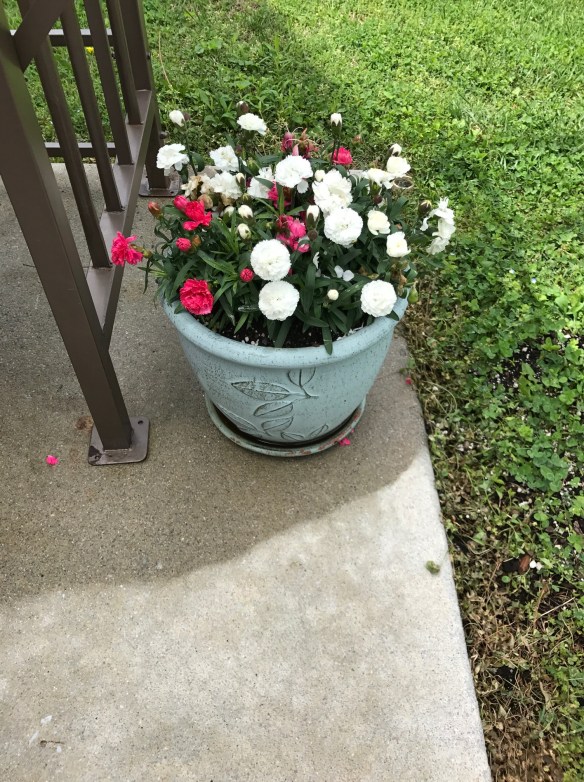
3. Flowers. I have a couple of planters on the back patio and hadn’t gotten flowers for them when I got the ones for the front a few weeks ago.

The label says these are dianthus, but they look like mini carnations to me. (I just googled dianthus, and apparently carnations belong to that family!)

IMG_0191

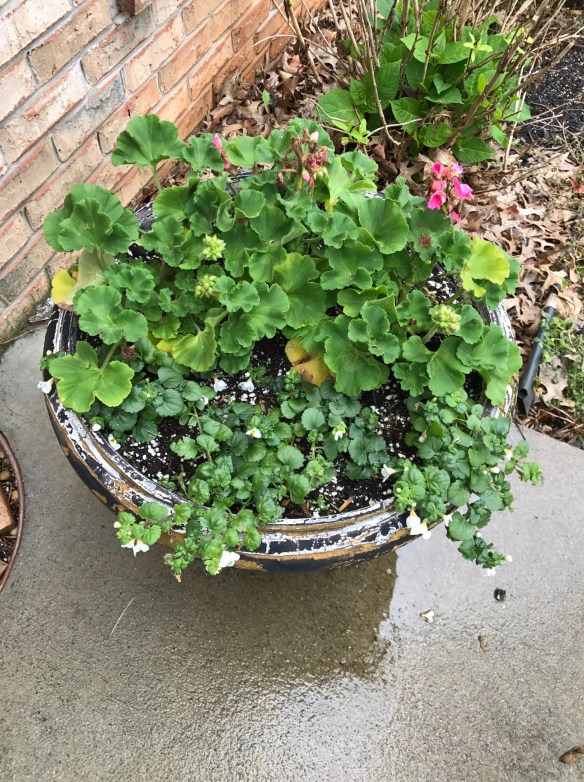
These took a bit of a beating in the storms, but there are pink geraniums in the back and a smaller white flower in the front. It looks like more geraniums are about to bloom.

IMG_0192

You can see I need to clean out the old leaves from my hydrangea behind that planter. That leads me to a question: are you supposed to cut back the old wood of a hydrangea? I never have, unless it’s poking out at an odd angle, and it has always filled in okay, but I have wondered.

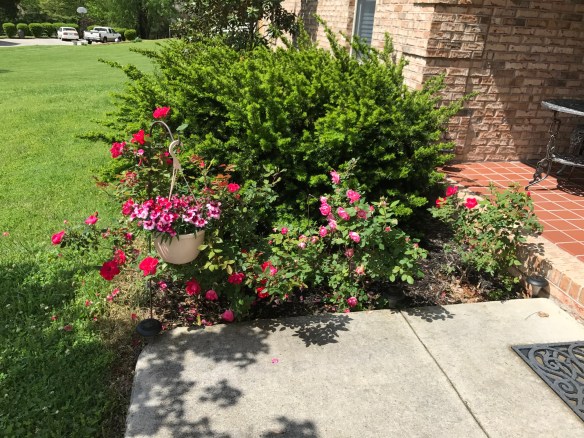
My roses in front have been blooming like crazy, even with the storms knocking some of them off.

IMG_0193

All the flowers above are pink and white, though some of them look orangey-red in the photos.

Jason and Mittu got this rose bouquet for me at Easter. Some of them are starting to droop, but some are still good.

IMG_0194

I don’t know roses, or flowers in general, like nikkipolani does, so I don’t know what these or the ones in front are called. I always think of this kind as unfolding roses – my bushy ones don’t unfold like this, and I think it’s gorgeous.

4. Fans. I tend to get hotter than everyone else, especially at night. A fan in my bedroom helps me not to have to turn the AC lower, and I have been making use of it the last couple of weeks.

5. These photos:

18194691_10154419713351820_3635529915206968186_n

18192288_10154419713891820_3432126464564398433_o

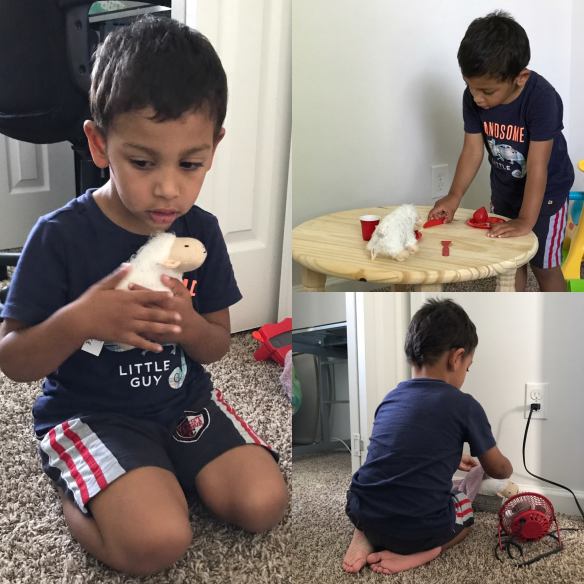
When Timothy, my grandson, was born 10 1/2 weeks premature, my son took a photo of him with the little sheep every week to kind of give a scale to see how much he was growing. Eventually he took one once a month and now once a year. When he tried to take one after Timothy’s third birthday, at first Timothy threw the sheep in the air. (Boys. 🙂 ) But then he hugged it, made it lunch, and put it to bed with a little fan on it so it would be comfortable. So cute! And such a difference three years makes. Some day I’d love to have all the photos of him with a sheep put together like in a time-lapse sequence.

Bonus: A loved one underwent some tests this week, and the results came back negative. Praise the Lord!

Happy Friday and happy weekend!

Save

Book Review: A Place of Quiet Rest

Quiet RestThe subtitle of A Place of Quiet Rest by Nancy Leigh DeMoss (now Wolgemuth) is “Finding Intimacy With God Through a Daily Devotional Life,” and that sums up perfectly the aim and emphasis of the book.

“Devotions,” for those who might not be familiar with the term, is what we call spending time alone with God in the Bible and prayer. Some people use the terms “God and I time” or “quiet time” or other phrases as well.

In Nancy’s introduction she tells a bit of her own and her family’s history, especially her father’s example of making time to spend with God, her struggles, and finally her conclusion that:

I have come to believe with all my heart that this is something worth fighting for. I have come to understand that one of the reasons it is such a battle is that the Enemy of my soul knows if he can defeat me here, he will ultimately be able to defeat me in every other area of my spiritual life.

Satan hates God, and he works tirelessly to convince Christians that they can operate on their own, independently of God. If we concede the battle to him, he knows that we will end up defeated, frustrated, barren, and useless to God. Worse, we will end up doubting God, despairing of His goodness, in bondage to our flesh, resisting His will.

…I have come to see that “devotions” is not so much an obligation of the Christian life, as it is an incredible opportunity to know the God of the universe. He has issued to you and to me an invitation to draw near to Him, to walk right into the “Holy of Holies” to enter into an intimate love relationship with Him (p. 16).

She discusses the challenges of setting apart that time in a busy schedule, the examples from the Bible of those who drew near to God, the wrong motivations for having devotions, the inward and outward purposes of devotions, elements of a quiet time, preparing for it, the high value of the Word of God, different approaches to it, questions to ask of the text, journaling, resources, our responses to what we read, prayer, and the influence our time with the Lord will have on the rest of our lives. She quotes many Christians of past years and closes each chapter with tips for making the information personal as well as the testimony of another woman, some famous (Elisabeth Elliot, Joni Eareckson Tada), some not.

I have multitudes of places marked, but here are just a few quotes that especially stood out to me:

A carefully structured quiet time with the Lord is good, but a growing life of devotion to the Savior is more – much more – that “Do A, B, or C and you will know Him better” (p 9, forward by Joni Eareckson Tada).

Developing intimacy with the Lord Jesus requires a conscious, deliberate choice. It is a choice to spend time sitting at His feet and listening to His Word, even when there are other good things that are demanding our attention. It is a choice to put Him first, above all our other responsibilities and tasks (pp. 42-43).

“Your company means more to Me than your cooking. You are more important to me than anything you can do for me” (p. 43, from a paraphrase of what Jesus was trying to get across to Martha).

Setting aside time for devotional activity, in and of itself, does not necessarily make us any more spiritual. (The Pharisees were renowned for their “devotional habits,” but they were far from spiritual.) Neither is a quiet time some sort of good luck charm that gets God on our side, guarantees our day will go better, and keeps us from having problems. Daily devotions are not a way of bartering or negotiating with God (p. 52).

Keep in mind that it is not enough that we should just read the Word. The object is that the words that are printed on the page would become indelibly written on our hearts. God never intended that we should merely get onto His Word – His intent is that the Word should get into us.

I cannot set aside time for God sporadically, whenever I can squeeze Him into my schedule, and hope to enjoy a vital, growing friendship with Him. That isn’t possible in human relationships, and it is no more possible in our relationship with God (p. 92).

Don’t let yourself get hung up in the mechanics. The particular Bible reading and study methods that are most helpful to someone else may not be as useful to you. The important thing is to make sure that you are getting into the Word and that the Word is getting into you. Find out which methods work best for you, and use them (p. 185).

There was one teeny little area where I wasn’t sure I agreed with the author: when she discussed Jesus’ example of making time to spend alone with His Father, she used phrases like, “This is where He discovered the will of God for His life” (I would say He knew that before He came); “This is where He gained the resources to do battle against Satan”; “This is where He received grace to love the unloveable and power to do the impossible” (p. 29); “Jesus had compassion on the multitudes and gave of Himself sacrificially to minister to their needs. But He knew that He could not meet their needs if He did not draw upon His relationship with His Father” (p. 101). I believe that when Jesus was in a human body on earth, He was still fully God as well as fully man (which I know Nancy believes as well), and some of these things were inherent in His nature as God, so I am not sure that His spending time with His Father was as much of a filling up after being depleted like we would need. But I hadn’t quite considered it this way before, so I need to think about and study it more.

I especially appreciated the emphasis on seeking intimacy, a close relationship with God. Making our way through the Bible, learning truth, learning doctrine, memorizing verses, are all important, but need to be exercised under the overarching purpose of getting to know Him better and drawing closer to Him in our hearts, not as an end in themselves.

The book is highly readable and I think it would be good for both beginners who haven’t really established regular devotional habits yet as well as those who have been having time set apart with God for years.

Even though many of these truths and tips were familiar to me, and even though making time for Bible reading has, by God’s grace, been a settled thing for me for some time now, I still find books like this valuable. I do learn some new things, but they reinforce what I have come to believe over the years and inspire me to keep on.

(Sharing with Semicolon‘s Saturday Review of Books, Faith on Fire, Carole’s Books You Loved), and Literary Musing Monday)

Books you loved

lmml-button-2-6

Save

Save

Save

Save

Save

Book Review: If the Shoe Fits

If the shoe fitsI scrolled through the unread books on my Kindle app, looking for something light, and spied If the Shoe Fits: A Contemporary Fairy Tale by Sandra D. Bricker. Perfect! I’ve read a few of Sandra’s books before, and so far they’ve all been lighthearted and funny, yet not purely fluff due to a spiritual undertone.

In this book, Julianne Bartlett just opened a law firm with her lifelong best friend, Will Hanes. But for all her expertise in law, she’s a bit…quirky? scatterbrained? the embodiment of Murphy’s Law? in everyday life. After narrowly missing being part of a multi-car pile-up, she witnesses a devastatingly handsome man rescuing a hurt dog from the road. When she discovers a boot and toolbox fell from his truck before he drove away, she rescues them and takes them as a sign that she’s supposed to find him again. She places an ad and they do meet, but he’s not quite the Prince Charming type. But she’s so focused on her fairy tale ideal that she’s in danger of completely missing the opportunity for a real, true relationship right in front of her.

There are some subplots with an ideal receptionist with a shady past, Julianne’s archenemy rival, Julianne’s mom and Will’s dad, and various cases as well as several bumps along the course of true love not running smooth. But it ends up in a satisfying way. I enjoyed the way Sandra wove in spiritual truth in a natural and not heavy-handed way.

Just a sample of Sandra’s writing:

She couldn’t hold a tune if it were packed up for her in a handy little box, but he sure did love to hear her try.

He waved a mug close enough to Will’s nose to bring him around, like caffeinated smelling salts.

“Apologizing.” Rand spoke the word as if it had been dipped in spoiled milk before crossing his lips.

Romantic comedy is not usually my first choice of genre for reading, but every now and then something light hits the spot. I could easily envision this as a Hallmark movie.

(Sharing with Semicolon‘s Saturday Review of Books and Carole’s Books You Loved)


Save

Save

Save

What’s On Your Nightstand: April 2017

What's On Your Nightstand

The folks at 5 Minutes For Books host What’s On Your Nightstand? the last Tuesday of each month in which we can share about the books we have been reading and/or plan to read.

Though there are still a good many days left in April, it’s the fourth Tuesday, and thus time to talk about what we’re reading.

Since last time I have completed:

Spiritual Mothering: The Titus 2 Design for Women Mentoring Women by Susan Hunt, reviewed here. Excellent study of how to apply the Titus 2 instructions for women.

Middlemarch by George Eliot, reviewed here. Long, a little slow in places, but ultimately very good.

Snapshot by Lis Wiehl, reviewed here. Based on a real photo, but not a real situation, a man arrested for killing someone at a civil rights march has reached out for help in finding the real killer, and one clue is to find the other girl in the photo, who may have seen the incident. Good historical fiction.

If the Shoe Fits: A Contemporary Fairy Tale by Sandra D. Bricker. Just finished this yesterday – hope to review it soon.

A Place of Quiet Rest by Nancy Leigh DeMoss. Just finished this yesterday as well – review coming soon.

I’m currently reading:

When Others Shuddered: Eight Women Who Refused to Give Up by Jamie Janosz

Love of the Summerfields by Nancy Moser

Old Yeller by Fred Gipson. I had originally chosen The Maltese Falcon by Dashiell Hammett for the Back to the Classics challenge category of a classic either about an animal or with an animal in the title, but there was too much bad language. So I laid it aside and chose Old Yeller instead, and am loving it. Plus it was nice to have a much shorter classic after the lengthy MIddlemarch.

Up Next:

I’m carrying these all over from last time since I haven’t gotten to any of them yet..

The Portrait of Emily Price by Katherine Reay

Waiting for Peter by Elizabeth Musser.

Fierce Convictions: The Extraordinary Life of Hannah More by Karen Swallow Prior and Eric Metaxas

Eight Women of Faith by Michael A. G. Haykin

That wraps it up for this edition of Nightstand. Are you reading anything interesting?

Save

Save

“That’s Just the Way I Am”

When my youngest son was small, he was a real chatty little guy. In fact, sometimes he could talk too much. I didn’t want to squelch his openness with people or his ability to strike up a conversation, as those are valuable traits (which don’t come naturally to me!) But on the other hand, no one wants to be around someone who talks incessantly. Once he was talking to the wife and mother of a visiting missionary family at church who was trying to soothe a fussy baby and graciously step away from him, and he kept chatting merrily on. When I tried to suggest that perhaps he was talking a little too much, he flashed his bright smile and said, “That’s just the way God made me.”

“Well,” I thought, “What do I say to that?”

After a while the Lord did bring to mind a few principles to share with him, such as the fact that God made us to eat, yet it is wrong to eat too much or the wrong things; God made us to sleep, but warns against loving sleep too much and being lazy, etc. He gives us responsibility to use our natural bent and inclinations in the right way. We talked about the warning signs that you’re talking too much — when other people look bored, sleepy, or glazed, or when they’re trying to step away or start another conversation with someone else, etc.

I’ve heard variations on that response from time to time. I used to really struggle under the leadership of someone who was not good with details: when he overlooked something that caused problems, frustrations, more work, etc., for the people under him, he’d just smile and say, “You’ll have to forgive me, I’m not good with details. I’m just not wired that way.” I’ve heard someone apologize for an angry outburst by saying, “I’m sorry, I just have a bad temper.” I’ve known people who think they have the spirituals gifts of prophesy or exhortation to harshly lambast a person or movement (and take great pleasure in doing so), forgetting that “the servant of the Lord must not strive; but be gentle unto all men, apt to teach, patient, In meekness instructing those that oppose themselves; if God peradventure will give them repentance to the acknowledging of the truth” (II Timothy 2:24-25).

When my middle son was in about the 6th or 7th grade, he was lamenting that he studied for spelling tests and yet still received disappointing grades, and a classmate hardly studied at all and yet made A’s. I explained that everyone has an aptitude for certain areas, and this friend obviously happened to have an aptitude for spelling. He brightened, thinking that since he didn’t have a natural aptitude for spelling, he didn’t really have to worry about it. I had to say, no, that doesn’t mean you don’t have to work on your spelling: in fact, in means you have to work harder!

The person who is not good with details is not excused from having to deal with them; in fact, he may have to work harder to handle them, or hire an assistant to help him. The person with a bad temper is not allowed to give it free reign because he can’t help himself. The shy or introverted person had to extend himself sometimes, even though it’s uncomfortable. Even spiritual gifts such as exhortation or mercy or giving have to be kept in balance. A person whose gift is giving for example, can’t run his family into debt or neglect their needs to give to others. He is responsible to exercise that gift in conjunction with other Scriptural instruction under God’s leadership. Scripture contains several passages of instruction concerning how to exercise spiritual gifts.

Understanding they way we’re “wired” does help us to know what direction to go in life, what ministries or vocations to choose, etc. For instance, I am not good with numbers: I can add the same list of numbers up three times and get three different answers — even with a calculator. So I would not look for a job as an accountant. I get rattled in a busy, noisy environment, so I wouldn’t likely work best there  – as a teen I lasted working for a fast-food place for only a week.

However, sometimes God does call people to do what doesn’t come naturally — Moses felt he could not lead or speak, yet God did not accept any of his excuses. Jeremiah said, “Ah, Lord GOD! behold, I cannot speak: for I am a child. But the LORD said unto me, Say not, I am a child: for thou shalt go to all that I shall send thee, and whatsoever I command thee thou shalt speak” (Jeremiah 1:6-7). We think of the apostle Paul as bold and wise, yet he said, “And I was with you in weakness, and in fear, and in much trembling. And my speech and my preaching was not with enticing words of man’s wisdom” — but he goes on to say, “but in demonstration of the Spirit and of power: That your faith should not stand in the wisdom of men, but in the power of God” (I Corinthians 2:3-5). Sometimes God uses people in the ways they seem to be bent, but other times He calls them to do something that doesn’t come naturally to them to show His power and His grace through them.

Whether dealing with a sin issue, a personality bent, or even a spiritual gift, “That’s just the way I am” is not a good excuse. God wants us to seek Him for deliverance from the power of sin, for power and grace to maintain right balances and to be diligent even in areas where we don’t have natural gifts, and for help to grow continually more Christlike every day we live. He does not want us to remain “just the way we are.” “But we all, with open face beholding as in a glass the glory of the Lord, are changed into the same image from glory to glory, even as by the Spirit of the Lord” (II Corinthians 3:18). We’re changed….by beholding Him.

IMG_0190

See also: The means of change.

(Revised from the archives)

(Sharing with Inspire me Monday, Literary Musing Monday, Testimony Tuesday. Wise Woman, Tell His Story, Woman to Woman Word-Filled Wednesday, Faith on Fire)

Save

Save

Save

Save

Save

Save

I Need Thee, Precious Jesus

I need Thee, precious Jesus,
For I am full of sin;
My soul is dark and guilty,
My heart is dead within.
I need the cleansing fountain
Where I can always flee,
The blood of Christ most precious,
The sinner’s perfect plea.

I need Thee, precious Jesus,
For I am very poor;
A stranger and a pilgrim,
I have no earthly store.
I need the love of Jesus
To cheer me on my way,
To guide my doubting footsteps,
To be my strength and stay.

I need Thee, precious Jesus,
I need a friend like Thee,
A friend to soothe and pity,
A friend to care for me.
I need the heart of Jesus
To feel each anxious care,
To tell my every trouble,
And all my sorrows share.

I need Thee, precious Jesus,
I need Thee, day by day,
To fill me with Thy fullness,
To lead me on my way;
I need Thy Holy Spirit,
To teach me what I am,
To show me more of Jesus,
To point me to the Lamb.

I need Thee, precious Jesus,
And hope to see Thee soon,
Encircled with the rainbow
And seated on Thy throne.
There, with Thy blood bought children,
My joy shall ever be,
To sing Thy praises, Jesu,
To gaze, O Lord, on Thee.

~ Frederick Whitfield