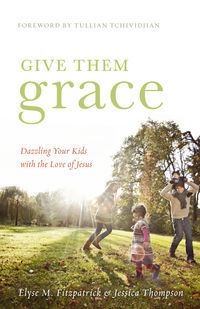
Book Review: Give Them Grace: Dazzling Your Kids with the Love of Jesus

give-them-graceYou might wonder why I would read a book on parenting when my children are all grown. I read Give Them Grace: Dazzling Your Kids with the Love of Jesus by mother-daughter team Elyse M. Fitzpatrick and Jessica Thompson partly to see where they were coming from and whether or not I could recommend it to young moms. I’d heard this book mentioned quite a lot a few years ago, and, in fact, where some people took the principles they said they got from the book raised an eyebrow for me, so I also wanted to see what they said vs. what people think they said.

Areas of agreement:

The basic premise is one I agree with: our children aren’t saved by keeping rules, and though there is a place for rules and law, they need the gospel, not more rules heaped on them. Kids (and adults) can keep all the rules perfectly and still be unsaved (and, in fact, can be blinded by their need of a Savior because they’re considered “good kids”). Only Jesus kept all the law perfectly, and once we believe on Him, His record is transferred to our account, so to speak. And no parenting method is an ironclad guarantee that our children will become Christians and live for God: only the grace of God working in their hearts and their response to it will accomplish that.

They illustrate this in the introduction with Jessica’s son, Wesley, fighting with his little brother. When she separated them and told Wesley, “You must love your brother!” he responded, “But he makes me so mad! I can’t love him!” Elyse says that when she was raising her own children, she would have responded, “Oh yes you can, and you will! God says that you must love your brother, and you better start – or else!” Years later she realized that the better response would have been to tell him that he is exactly right, that we can’t obey God’s laws on our own, that Jesus died because we can’t, and that when we believe on Him, His great love for us will enable us to love others.

They warn that it is dangerous to tell children they are good, because “there is none good but God” (Mark 10:18), plus it will confuse them about their need for a Savior if they think they are already good. I wrestled with this when my sons were small. It was so easy to say “Good boy!” to encourage them when they did something right, but I wasn’t entirely comfortable with that for those reasons. I started saying “Good job!” or something similar instead, or, as my sister-in-law suggested, commented on what “big boys” they were getting to be, as kids aspire to be more “grown up.” But I think these authors take that concept way too far (more on that in a moment).

They assert that the Bible is not just a book about moral stories, and I’d agree there. It’s about God. The main point of Jonah, for instance, isn’t that if we disobey, God will send a whale (or something comparatively awful) after us, so don’t be like Jonah. The point is God’s gracious provision both for the Ninevites plus his unloving, recalcitrant prophet.

But we are instructed to discipline, warn, correct, train, etc., our children. “Discipline proves relationship. Instruction demonstrates love. Grace is not averse to training. In fact, one of the functions of grace is training in righteousness (Titus 2:11-14)”. “Grace does not forbid us from correcting our children. But gospel correction reminds us to bring correction to them in the context of what Jesus has already done for them and his great love for them.” They make a distinction between management (basic instructions like “Don’t run in the street,” chore charts, etc., that aren’t necessarily meant to “get to the heart,” but are just a part of child training), nurturing (telling and demonstrating God’s love and care for them), [gospel] training (pointing them what Jesus has done to take care of their sin and enable them to live for Him), correction, and reminding him of God’s promises. They discuss ways to know what a situation calls for and how to apply gospel truth to their situation.

They have a fairly good section on striking a balance between interacting with other families and kids yet guarding against worldly practices influencing your children through others. I agree that we shouldn’t have homes that are monasteries or pack up the family to the prairie 50 miles from neighbors to keep them from “the world,” but sometimes those interactions can be tricky to navigate.

I thought these quotes were quite good:

The one encouragement we can always give our children (and one another) is that God is more powerful than our sin, and He’s strong enough to make us want to do the right thing. We can assure them that his help can reach everyone, even them. Our encouragement should always stimulate praise for God’s grace rather than our goodness.

We are always to do our best, striving to be obedient and to love, nurture, and discipline (our children). But we are to do it with faith in the Lord’s ability to transform hearts, not in our ability to be consistent or faithful. Seeking to be faithfully obedient parents is our responsibility; granting faith to our children is his.

The only power strong enough to transform the selfishly rebellious and the selfishly self-righteous heart is grace. The law doesn’t transform the heart of either…it only hardens them in pride and despair.

Grace teaches us to rest in what Christ has done for us and to live lives of godly gratitude.

The chief end of our parenting is not out own glorification as great parents but rather that we glorify God and enjoy him forever.

It is a kindness when [God] strips us of self-reliance, because it is there, in our emptiness and brokenness, that we experience the privilege of his sustaining grace.  It is only when we arrive at the dreaded place of weakness that we discover the surpassing power of Christ.

Areas of disagreement:

They give a plethora of examples of how to apply the gospel to our children’s everyday needs and issues, but most of their examples are impossibly long. They say that, of course, you wouldn’t say all of this every single time. Still, some real life examples of these truths in short bursts would have been better than lengthy paragraphs that no parent would probably ever say. (BTW, Kevin DeYoung’s example of trying to have such a conversation with his child is hilarious – and a lot more realistic).

One of their examples is how to talk to a child who made the last out in a ball game which caused his team to lose and is understandably unhappy. They list about 4 pages of what to say to him (at least it’s 4 pages in the Kindle app – I don’t know how many in the physical book). Some of it is good, like instructing that throwing his bat when angry is harmful and wrong, and that he can congratulate his teammates even though he doesn’t feel like it because Jesus set aside His desires for him. But then they go on to suggest saying things like, “Losing a baseball game is not the worst thing that could ever happen. Losing Jesus is” and “I  understand why you’re mad about not winning. It’s because winning is all you have.” They assert that the child “needs to repent not only of his anger and desire to approve of himself but also of desiring to be perfect on his own and of ignoring the perfection Jesus has provided for him in his justifying love.” Well, there’s truth there, but maybe he just needs to be encouraged to practice more or to be comforted with the reminder that even the pros strike out sometimes, that no one performs at 100% capacity all the time.

In a section on the grief of rebellious children, they make the point (rightly, I think) that God can be glorified just as much when everything seems to have gone wrong, because His grace shines through our fallenness and need for redemption. But I was astonished to read these two sentences:

Because the Lord always acts for his glory, and because he predestined the sin of the Romans and the Jews in his Son’s cruel execution, their sin glorified him. It was the means he used to demonstrate his mercy, justice, and love…”

Everything God does is for his glory, and he is completely sovereign over everything that occurs. He uses our sin and the sin of our children to glorify him. If he did not, we would not sin.

While I agree that God works “all things together for good” (Romans 8:28), and I agree that his mercy in the light of our sin glorifies him, I have a real problem saying that God predestines us to sin. I am not of the Reformed persuasion, and the authors are, so that may be where that difference comes from, but I have never heard anyone say something like this before.

I mentioned before that I felt that the authors took the point about not telling children they are “good” way too far. They say it is always wrong to tell a child that God is pleased with them, because “God’s smile,” as they call it, is only bestowed upon us because of Jesus’ record of righteousness in our place. While it is true that nothing we can do pleases God in the sense of counting towards earning points with Him, there are several verses that talk about God being pleased. Hebrews 11:6 says, “without faith it is impossible to please him,” so all of these must be considered within that context. 1 Thessalonians 4:1 says, “Furthermore then we beseech you, brethren, and exhort you by the Lord Jesus, that as ye have received of us how ye ought to walk and to please God, so ye would abound more and more.” Hebrews 13:6 says, “But to do good and to communicate forget not: for with such sacrifices God is well pleased.” Part of the prayer in Colossians 1:9-11 is that we might “walk worthy of the Lord unto all pleasing.” Even children obeying their parents is said to be “well pleasing unto the Lord” (Colossians 3:20). 1 John 3:22 says, “And whatsoever we ask, we receive of him, because we keep his commandments, and do those things that are pleasing in his sight.”  None of these is meant in a way to work up righteousness but to work out righteousness: to live out what God has done in our hearts. I pondered this point a lot while reading this book. Positionally, yes, when we’re saved, our sins are forgiven, and God sees us through the lens of Jesus’ righteousness and not our own. Our own doesn’t count for anything. But what we usually call our sanctification is a growth process. God is constantly convicting and directing us away from what displeases Him and towards what pleases Him. Just like earthly families, children don’t earn parents’  love or belonging by their behavior: the child will always be a part of that family by birth or adoption. So the parents’ guiding and disciplining a child isn’t a matter of making that child fit to become a part of the family or keep his place there: it’s a matter of helping him grow to maturity, and part of that is letting him know what is pleasing and what is displeasing. (I found this post right about the time I was thinking through these things. Though he is coming at the idea of pleasing God from a different angle, he brings out many good points and helped assure me that I was thinking along the right lines.)

I also disagreed with them in saying that “Every time someone was mean to [Jesus], he fought to love” and He had to “work every day at not giving in to sin.” It makes it sound like Jesus had a sin nature to grapple with. He had a human nature, but not a sin nature. He battled Satan, so perhaps they mean these things in that way.

I thought the authors’ tone was somewhat condescending sometimes.

I couldn’t recommend this book unreservedly, but someone with some discernment might be able to use the best parts and disregard the rest.

Genre: Nonfiction Christian parenting advice
Potential objectionable elements: Some areas of theological disagreement.
My rating: 5 out of 10

(Sharing at Semicolon‘s Saturday Review of Books and Literary Musing Monday)

literacy-musing-mondays-300x300


Save

Save

Save

Save

Save

Save

Book Review: The Prayer Box

prayer-boxIn The Prayer Box by Lisa Wingate, Tandi Jo Reese has just escaped from a manipulative, law-breaking husband and is trying to make a new life for herself on Hatteras Island in the North Carolina Outer Banks. She’s coming out of a fog in more ways that one: after a serious accident, her doctor-husband supplied her with pain-killers, and it’s not until she determined to get off of them that she realized she had left her 14 year old daughter Zoey and 8 year old son J. T. to largely fend for themselves, and now Zoey resents any of Tandi’s intrusion into her life. She tries to find a job but doesn’t want to use references because she doesn’t want her ex-husband to find them.

She’s rented a little cottage next to an old Victorian house, and after realizing she hasn’t seen her elderly neighbor for a while, she goes to investigate and finds that the 91 year old lady, Iola Anne Poole, has passed away. Iola has left her house to the church, and someone from there asks Tandi if she would be interested in earning a little money by cleaning the house, especially getting rid of old food, etc.

As Tandi goes through the house, she discovers in Iola’s closet 81 decorated boxes. She pulls one out to investigate and finds that they are prayer boxes, each representing a year, in which Iola wrote out her prayers to God. As Tandi starts reading, she gets caught up in Iola’s past and her faith. The island people knew little about Iola, some even resented her for various reasons, but few knew the real woman.

Tandi grew up with con artist parents who often neglected their kids but wouldn’t allow her grandparents to take them. She tends to be attracted to the wrong kind of man, mainly succumbing to their admiration of her, and is stunned to realize her daughter is about to follow in her footsteps.Though Iola’s situation was much different, in reading her letters to God, Tandi finds much that speaks to her own heart.

A number of themes run through the book: the need for a healthy sense of self-worth, the truth that though we have to accept our past as part of us, it doesn’t have to bind us, and that family sometimes transcends blood ties.

I loved the setting of the book. We lived in SC for most of our married lives, and I always thought the Outer Banks would be a nice place to visit. I grew up near the coast of TX with frequent visits to Padre Island, and one of my favorite vacations with our family was right on Folly Beach in Charleston, SC. I don’t think I’d want to live on a beach, but there’s something about it that draws me, and this little coastal community in the book sounded like such a lovely place.

In some places Lisa’s writing sings: in other places it drags. I know writers are advised to tuck descriptions throughout the narrative rather than having long paragraphs of it like writers used to do. But there were a couple of times when Tandi was going through Iola’s house, and the passage described details of what she saw and wondered about so much that It seemed to take an insufferably long time. Maybe that was supposed to heighten anticipation, especially the second time (when Tandi thinks someone is in the house), but it had the opposite effect on me. And sometimes in conversations the author has Tandi thinking about something else for several paragraphs until she answers, making it seem like she just left the other person hanging while she was lost in her thoughts for a while. It may have seemed a little more like that because I was listening to an audiobook: though I love them, one problem with them is that you can’t speed up or slow down as you could when reading.

My only other complaint is that though there are great spiritual truths in the book, faith in general seemed a vague and nebulous thing. I’ve written before that I don’t think every Christian fiction book has to have a conversion scene or the plan of salvation, I understand that novels aren’t sermons, that good fiction sometimes employs nuance and suggestion rather than spelling things out for the reader. As I said there, it’s not so much the amount the the gospel that is presented in a book, but rather the clarity of the gospel (or lack thereof) that I often have trouble with. I think an unbeliever reading this book might get that some of the characters have faith (of some kind) and help people, that some of the characters’ lives change, that God the Father loves us and we can talk to Him and ask Him for forgiveness….but I don’t remember any of that being based on Jesus and what He did to make it possible or the need to believe on and accept Him personally – unless I just overlooked it. Then again, perhaps the author intended this for a Christian audience who would already understand these things. I’ve been debating with myself about whether to elaborate more, but I think I’ll just leave it at that for now.

My favorite passage in the book is from one of Iola’s letters written when she was older:

What does a lighthouse do? I ask myself. It never moves. It cannot hike up its rocky skirt and dash into the ocean to rescue the foundering ship. It cannot calm the waters or clear the shoals. It can only cast light into the darkness. It can only point the way. Yet, through one lighthouse, you guide many ships. Show this old lighthouse the way.

Here are a few more favorite quotes:

We do not choose the vessel we’re given, Iola Anne, but we choose what we pour out and what we keep inside.

Fear builds walls instead of bridges. I want a life of bridges, not walls.

The trouble with drowning in the mess of your own life is that you’re not in any shape to save anyone else. You can’t be a lighthouse when you’re underwater yourself.

Maybe there came a point in life where you had to quit categorizing whole groups of people by a few bad experiences.

Help them to show the world that our greatness is not in things we do for ourselves, but in things we do for others. In power that channels itself into kindness, in a hand outstretched in love.

Some of the hardest things you go through will teach you the most.

Overall I did enjoy it and am looking forward to reading more in this series.

Genre: Inspirational fiction
Potential objectionable elements: Someone walks in on a couple undressing and obviously heading for sex, but nothing is explicit: the scene is more about betrayal. A few instances of drinking and drunkenness, not presented favorably.
My rating: 8 out of 10

(Sharing with Carol‘s Books You Loved and Semicolon‘s Saturday Review of Books.)

Books you loved 4

Save

Save

Mount TBR Reading Challenge Checkpoint #3

Mount TBR 2016

The Mount TBR Reading Challenge (to read books one already owned) has checkpoints every quarter where we can report how we’re doing. I read 9 books for this challenge during the first quarter of the year (listed at the first checkpoint here) and 12 more by checkpoint #2.

The books I’ve read for this challenge this quarter are:

  1. Pioneer Girl: The Annotated Autobiography by Laura Ingalls Wilder and Pamela Smith Hill
  2. Thin Places: A Memoir  by Mary E. De Muth
  3. The Methusaleh Project by Rick Barry
  4. C. S. Lewis’ Letters to Children edited by Lyle W. Dorsett and Marjorie Lamp Mead
  5. Ten Fingers For God about Dr. Paul Brand by Dorothy Clarke Wilson
  6. I’m No Angel: From Victoria’s Secret Model to Role Model by Kylie Bisutti
  7. Be Faithful (1 & 2 Timothy, Titus, Philemon): It’s Always Too Soon to Quit! by Warren Wiersbe
  8. Be Mature (James): Growing Up in Christ by Warren Wiersbe
  9. Be Hopeful (1 Peter): How to Make the Best Times Out of Your Worst Times by Warren Wiersbe
  10. Home to Chicory Lane by Deborah Raney

That brings me up to 31 books, halfway up Mt. Blanc, the second level of Bev’s challenge. I’m about 5 books short of the next level, Mt. Vancouver. But I think I’ll easily get there before the end of the year. Plus these selections complete my original list of goals for the challenge.

Bev always includes some fun questions for the checkpoints:

A. Who has been your favorite character so far? And tell us why, if you like. Out of all the books read for the challenge, not just this quarter, Emile de Bonnery from Searching for Eternity by Elizabeth Musser. The book follows him from the age of 14 through adulthood, with his having to find his way amidst confusing and conflicting issues and memories. I just found him a very sympathetic character.

B. Pair up two of your reads that are opposites. C. S. Lewis’ Letters to Children and The Methusaleh Project; also Pioneer Girl and I’m No Angel: From Victoria’s Secret Model to Role Model.

C. Which book (read so far) has been on your TBR mountain the longest? Was it worth the wait? That would be hard to say for sure without going back and checking the buy dates, but off the top of my head, I think The Reunion by Dan Walsh. I’ve had it on my Kindle app since 2012, and it has turned out to be my favorite Walsh book read so far.

On to the last legs of the challenge!

Save

It’s October!

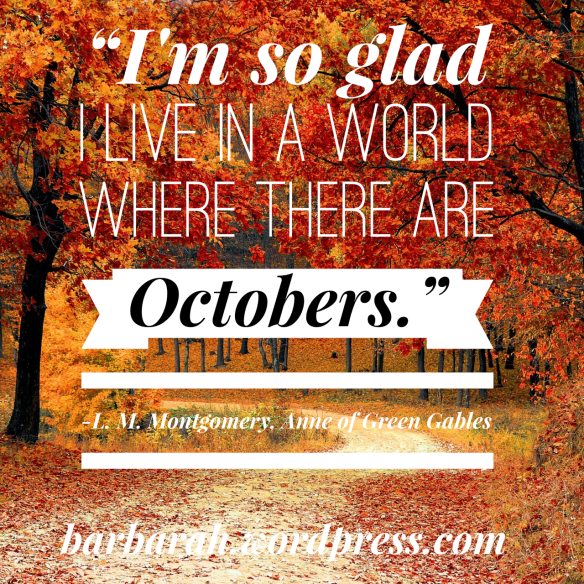
img_1862

October’s Party
by George Cooper

October gave a party;
The leaves by hundreds came.
The Chestnuts, Oaks and Maples,
And leaves of every name.

The Sunshine spread a carpet,
And everything was grand,
Miss Weather led the dancing,
Professor Wind the band.

The Chestnuts came in yellow,
The Oaks in crimson dressed;
The lovely Misses maple
In scarlet looked their best.

All balanced to their partners,
And gaily fluttered by;
The sight was like a rainbow
New fallen from the sky.

autumn-light


October’s the month
When the smallest breeze
Gives us a shower
Of autumn leaves.
Bonfires and pumpkins,
Leaves sailing down –
October is red
And golden and brown.

—Author Unknown

391883_autumn_colors.jpg

October leaves are lovely
They rustle when I run
Sometimes I make a heap
And jump in them for fun.

— Author Unknown

(I usually try to give credit for where the pictures I use come from, and I try to limit them to free sites. Most of these have been in my files for a long time and I am not sure where they originated, except that the top one was made with the Word Swag app.)


Save

Friday’s Fave Five

FFF fall flowers

It’s Friday, time to look back over the blessings of the week with Susanne at Living to Tell the Story and other friends.

Another week, another month coming to an end! Here are some of the last week’s blessings:

1. A (long overdue) nice raise and promotion for my oldest son. So happy for him! Besides the helpfulness of having a bit more money to work with, it’s an encouragement to know that your boss is pleased with your work.

2. Cool mornings and evenings. I’ve been a bit envious of those of you talking about nice fall weather. 🙂 Now it has finally arrived here. The mornings in particular have been deliciously cool.

3. A delayed appointment. I had a lot to do this week and was chafing over a dental appointment scheduled right in the middle of it. Then their office called a couple of days before and asked if they could reschedule for next week. Sure, no problem! 🙂

4. Curling up with a book and a blanket on a rainy Sunday afternoon and drifting off to sleep.

5. A tape player to phone connector. I listen to music and audiobooks in the car on my phone through a device that connects it to the cassette tape player in my car and plays the phone through the speakers. After a very long and useful life the connector failed, and I was afraid they might not make them any more. I was glad to find that they did!

Bonus: The Christmas in Mitford album. Normally I would scoff at listening to Christmas music so early…but Timothy was here one afternoon and I was looking through our music library on the Apple TV for him to take a nap to, and for some reason this was the only instrumental album to come up.Gorgeous!

41qd0r5zql

Happy Friday!

Save

Prayers please

No doubt you’ve heard of the tragic school shooting on SC. One victim was the six year old son of my brother-in-law’s cousin. His femoral artery was torn by the bullet and he had to be revived twice. I don’t know the family personally but I know they and everyone involved would appreciate your prayers.

http://www.foxcarolina.com/story/33274334/kindergarten-student-in-critical-condition-after-townville-elementary-shooting

Update: Sadly, Jacob passed away Saturday afternoon. Please pray for the family. The news story is here:
http://wspa.com/2016/10/01/jacob-hall-dies-days-after-townville-school-shooting/

jacob

What’s On Your Nightstand: September 2016

What's On Your NightstandThe folks at 5 Minutes For Books host What’s On Your Nightstand? the last Tuesday of each month in which we can share about the books we have been reading and/or plan to read.

September has seemed like a long month to me, though it’s a shorter one. But I look forward each month to sharing what I’ve been reading and seeing what others have as well.

Since last time I have completed:

The Promise of Jesse Woods by Chris Fabry, audiobook, reviewed here. A young man revisits his past growing up in a small Southern town with his two best friends: a mixed race boy and a girl from the wrong side of the tracks. Good.

Home to Chicory Lane by Deborah Raney, reviewed here. Empty nesters turn their big family home into a bed and breakfast only to have one daughter show up on opening day estranged from her husband. Enjoyed it quite a lot.

I’m No Angel: From Victoria’s Secret Model to Role Model by Kylie Bisutti, reviewed here. Kylie reached the top of her profession and then walked away after concluding that it didn’t fit in with her new Christianity. A look at the seamy side of modeling. Good.

The Remains of the Day by Kazuo Ishiguro, reviewed here. A butler muses over his life, profession, the meaning of dignity, and lost opportunities. Loved it.

Be Real (I John): Turning From Hypocrisy to Truth by Warren Wiersbe. I haven’t reviewed this particular one, but I discussed a few of the others in one post here. Very helpful.

A Sparrow in Terezin by Kristy Cambron, reviewed here. A modern timeline of a newlywed’s husband being investigated for fraud and one a young woman in Prague during WWII intersects in the life of one girl. Good.

I’m currently reading:

Give Them Grace: Dazzling Your Kids with the Love of Jesus by Elyse M. Fitzpatrick and Jessica Thompson.

I’m Still Here: A New Philosophy of Alzheimer’s Care by John Zeisel

The Prayer Box by Lisa Wingate, audiobook.

Five Brides by Eva Marie Everson

Up Next:

June Bug by Chris Fabry

Waiting For Peter by Elizabeth Musser

As usual, I have stacks both on my shelves and in my Kindle app to choose from after these.

Happy Reading!

Save

Save

Book Review: A Sparrow in Terezin

sparrow-in-terezinKristy Cambron’s The Butterfly and the Violin was one of my favorite books read last year, so I was delighted when its sequel, A Sparrow in Terezin, came through on a Kindle sale.

As with her first book, this one follows two timelines. The contemporary one picks up where it left off in the last one, with William and Sera getting married, only to have him get arrested shortly afterward. In trying to sell off some of his family’s assets, he unwittingly sold some things that he didn’t realize were no longer his, and now he is being investigated for fraud. To try to clear his name, Sera delves into a past that he’s unwilling to reveal.

The other timeline begins with a young woman, Kaja, heading to a Prague train station with her family in 1939. Her father is Jewish and her mother a Christian, but being even half Jewish is enough to get one in trouble at that time in Eastern Europe. Kaja had thought her whole family was going and is stunned to learn at the train depot that only she and her sister and brother-in-law are leaving: her parents are staying behind. Kaja protests, but it has already been decided. After spending a year with her sister in Palestine, she travels to London to work at a newspaper. There she meets Liam, a reporter who is kind and helpful to her. She suspects he is involved in something covert. Just as their relationship grows to the point of commitment, Kaja learns that her parents are in danger and travels undercover to Prague to help. But she’s caught and sent with her family to the Terezin prison camp.

The two timelines intersect with a little girl named Sophie, whom Adele helped in the last book and whom Sera met at the end. Kaja’s path also crosses Sophie’s and eventually impacts William’s family.

I mentioned in my review of Butterfly that there were a few awkward places in the writing, but I felt the story superseded them. I wished I had made note of them now, because there were some here as well. There were a few things that didn’t make sense to me at first, though they were a little more clear when I looked at them again just now.

One of my pet peeves in movies in when there is some kind of calamity, and the couple involved decide that’s a good time to kiss. That happened in this book. I seriously doubt that if I’m outside with bombs falling in London, I’m going to choose that moment to kiss. No, I’m going to be running for cover, and fast.

I didn’t end up loving this one as much as I did the first one, but it’s still a good story, Kaja’s especially. I always wonder how people could not only survive, but extend grace and love in a situation as awful as a prison camp. I thought the faith element was woven in naturally.

Genre: Christian fiction
My rating: 8 out of 10
Potential objectionable elements: None that I can recall unless one is very sensitive to descriptions of war.
Recommendation: Yes.

(Sharing at Semicolon‘s Saturday Review of Books and Literary Musing Monday and Carol‘s Books You Loved)

literacy-musing-mondays-300x300


Books you loved 4

Save

Save

Save

Save

Across the Will of Nature

img_1852

Across the will of Nature
Leads on the path of God;
Not where the flesh delighteth
The feet of Jesus trod.
O bliss to leave behind us
The fetters of the slave,
to leave ourselves behind us,
the graveclothes and the grave.

~ by Gerhard Tersteegen

The first two lines of this poem have been coming to mind often the last few days, so I had to look them up. It’s the first stanza of a poem which Amy Carmichael found inspirational. I had thought it was one of Amy’s, but I probably just first came across it in her biography.

There was a little ditty going around when my kids were teens: “Just two choices on the shelf: pleasing God or pleasing self.” One of my sons just hated that because it made it sound like any personal choice, from liking meatloaf to walks on an autumn day, were directly opposed to God. That’s one problem with reducing doctrine to a catchy phrase.

On the other hand, it is true that we have an old nature that above all else wants its own way, and often that runs contrary to what God wants or what other people want. That’s been my problem this week (well, really, my whole life. Some years ago I did a Bible study on wanting our own way – it was quite eye-opening). There are duties in my life that I really wish I did not have to deal with, but as they are squarely in my path, placed there, I am sure, by God, they’re mine to do. I wrestle with this often, and know there is nothing to do but do them and pray for a better attitude. I wish I could once for all work this out in my thinking and have the “don’t want to” go away forever. But it doesn’t work like that.

I’m sure that’s one reason Jesus said, “If any man will come after me, let him deny himself, and take up his cross daily, and follow me. For whosoever will save his life shall lose it: but whosoever will lose his life for my sake, the same shall save it” (Luke 9:23-24).

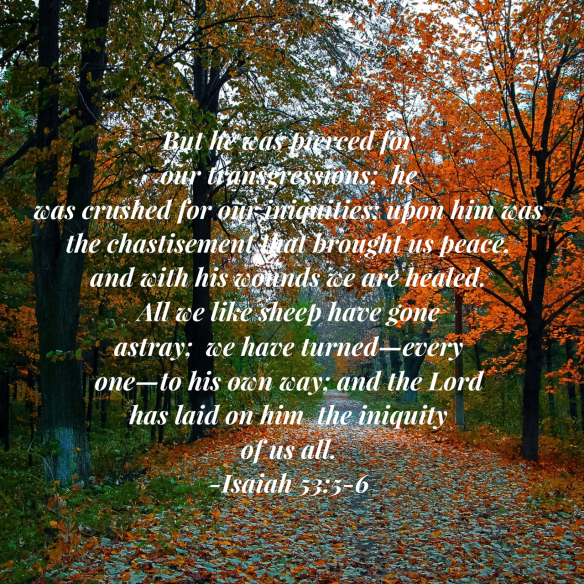
I’m immeasurably thankful that, though “All we like sheep have gone astray; we have turned—every one—to his own way,” God, in His love and patience, did not leave us there. Instead, “the Lord has laid on him the iniquity of us all” (Isaiah 53:6).

Love is patient and kind; love does not envy or boast; it is not arrogant or rude. It does not insist on its own way; it is not irritable or resentful…1 Corinthians 13:4-5

See also:

The Captain of My Fate
Wanting Our Own Way

(Sharing with Inspire Me Monday)

Save

Save

Save

Laudable Linkage

Before I get to another installment of my bimonthly roundup of recent noteworthy reads on the Web, I wanted to mention Write31Days. The idea is to choose a topic that you can blog about for the 31 days of October. I’ve participated the last few years with 31 Days of Missionary Stories, 31 Days of Inspirational Biographies, and 31 Days With Elisabeth Elliot. I’m still undecided about this year – and October 1 is only a week away! It is a lot of work, and I’m a little afraid of over-burdening readers with so many posts. But I enjoyed and benefited from it before and received positive feedback. So I am still praying about it. One topic foremost in my mind was one I was actually thinking about compiling into a book, and I thought doing it for Write31Days might be a good precursor for that. Then I thought – why would anyone buy a book if the info. is here already. 🙂 So I am still thinking and praying. At any rate, I wanted to let you all know about it in case you might want to participate as well. This year’s Write31Days page gives you the guidelines, a list of categories, links back to previous topics, etc.

On to this week’s links:

Is the Bible Foundation to Christianity? (Short answer: Yes! But here are good reasons why.)

Understanding your Bible—The Big Picture View.

What God Does With Your Sin.

Find a Friend to Wound You.

The Beginner’s Guide to Conflict Resolution.

A Secret to Parenting that No One Tells You: The Strength is in the Struggle.

5 Practical Guidelines for Reading the Old Testament Laws. This is probably the hardest section of the Bible to read – maybe after the genealogies – but these help put them in perspective.

Some Things That Have Helped Me in My Struggle With Anxiety.

Feed My Sheep. I wish I had thought more like this when my mother-in-law was in assisted living and a nursing home.

Christians, Cribs, and Co-Sleeping. I’m linking to this not for the discussion about where babies should sleep, but for how she applies truths here to others areas of parenting and faith and practice. There are fundamentals and then there are secondary issues, and on the latter we need to give each other grace to be different.

Beautiful Books and A Beautiful Book List.

And a couple of videos to give you a smile: an adorable three year old and her dad singing “At Last I See the Light” from Tangled.

And this:

Happy Saturday!