Friday’s Fave Five

FFF fall flowers

It’s Friday, time to look back over the blessings of the week with Susanne at Living to Tell the Story and other friends.

After a busy weekend, it’s been kind of a quiet week. Here are some highlights:

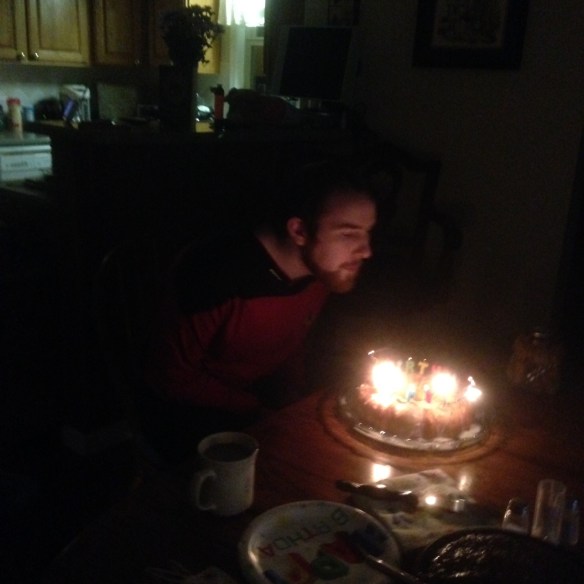
1. Jesse’s birthday. It’s a joy to celebrate my youngest son plus all the other good components of a birthday – having the family all together (one via FaceTime) and lots of talking, visiting, fun, and cake!

img_0005

2. A surprise birthday party. Jason and Mittu wanted to give Jesse a surprise party with his friends, so planned it at their house for the day after the family celebration. They invited him over under the guise of playing games with them and another couple, and Jim and I were supposedly going out on a hot date since all the kids had plans (thankfully Great-Grandma’s caregiver was available to stay with her that evening), so we left early to go over to J&M’s. He didn’t suspect a thing til he drove up and saw cars – there was no way to hide them in the neighborhood. It was a fun evening.

3. Bath aide. I mentioned last week our favorite bath aide for my m-i-l had been out with an injured hand. She’s still wearing a brace but was released to resume work this week.

4. Pudding Chip Cookies. I don’t do much baking for just the three of us – because we I can’t seem to keep my hands off of it, and we can’t send many home with J&M since she is gluten intolerant. But my husband mentioned recently that I ought to make some chocolate chip cookies, and it had been a long time since I had, so I finally found an evening to do so. Scrumptious!

5. The first day of fall. It’s still not feeling and only barely starting to look like fall, but it is official now, and I am looking forward to the rest of the season, trusting it will feel like it soon! I may get out my decorations this weekend.

673e6eb93636b69ff54d19633250343b

southeners-reward

Happy Friday!

Save

Going to a church with problems

img_1851

Over the last several years there has been much discussion about people leaving the church and speculation about why.

I’ve seen a number of blog posts and articles the last couple of years written to people who have left church completely because they’ve been hurt by one. The articles are usually quite sympathetic in tone, and the writer (who doesn’t know the person or the church or the situation) apologizes to the wounded absent church member on behalf of the church and gently tries to woo them back. I do appreciate those posts, and we do need to reach out. Sometimes these folks are in a fragile state and need much love and care to rebuild bridges and repair damage wrought by a previous church.

And there are times that leaving a particular church is necessary. Churches can hurt their members in numerous ways, sometimes seriously. Sometimes even when members try to discuss issues with leadership, they’re not heard, or worse, vilified for not being with the program.

But I don’t see anywhere in the Bible a good reason to leave church all together.

No church is perfect. None ever will be because they’re made up of sinners. Redeemed sinners, yes, but, people who are not perfect yet. That’s why there is so much instruction in the epistles about the need for forgiveness, unity, forbearance, love. Just as our personal sanctification is a matter of growth in grace, so is the church’s.

If you’re familiar with Acts and the epistles in the Bible, you may be aware of these issues that were problems in some New Testament churches:

Open factions preferring different preachers.

False teachers insisting that believers had to keep portions of the OT law to be saved.

A member living in incest with a family member which other church members knew of but did nothing about.

Teachers proclaiming to have a deeper, mysterious knowledge of Christ that differed from Biblical revelation.

A segment complaining that their needs weren’t being met.

People conspiring to lie to the leadership.

People showing favoritism to wealthy members.

People who quit their jobs to sit and wait for the Lord’s return.

In fact, most of the epistles were written to correct false doctrine, teaching, and practices within the church.

But nowhere in the epistles, the letters to the early churches, do any of the writers urge believers to just quit church over the problems. Now, some of these and other issues would be grounds to leave a particular church if, after attempting to deal with them, there was no change. We’re instructed in the NT to separate from those who preach false doctrine and believers who “walk disorderly,” who live habitually in ways that go against what the Bible teaches after every attempt has been made to reconcile them to God’s Word. We’ve been on the verge of leaving a couple of churches that didn’t have these problems but were headed in ways that we felt were contrary to Biblical teaching and example, but thankfully a job change took care of that for us.

But nowhere in the Bible are believers encouraged to just give up on organized church all together. I bring up that incomplete list of NT church problems just to contrast it with some of the lesser reasons people leave church these days. Yes, the church has problems: it always has and it always will, and we shouldn’t take them lightly.

But – and I am trying to say this as gently and kindly as I can – sometimes, sometimes, I wonder if the problem is unforgiveness or carrying a grudge (which is a type of unforgiveness). Even when there is just cause for leaving a church, is there a just cause Scripturally for leaving church all together? Could one perhaps be short-circuiting their healing or stifling their spiritual growth (or that of their children) because they are not in a church with fellow believers?

One might say that, since every believer is part of the universal church made up of all believers, and since Jesus said, “Where two or three are gathered together in my name, there am I in the midst of them,” (Matthew 18:20), then it doesn’t really matter if we go to an “official” church. Any time we meet with other Christians is church! But is that what the Bible teaches? I would say that meeting with a couple of other Christians at a coffee shop (or wherever) is fellowship: I wouldn’t call it church. I say that for these reasons:

  • The epistles were written to believers who met together locally and regularly. They and Acts refer to churches which met at specific places: “the church of God which is at Corinth” (1 Corinthians 1:2), “the church which was in Jerusalem” (Acts 11:22), “the church that was at Antioch” (Acts 13:1), “And so were the churches [plural] established in the faith, and increased in number daily” (Acts 16:5), “the church which is at Cenchrea” (Romans 16:1), “the church that is in their house” (Romans 16:5), and several more.
  • There is a leadership structure in local churches that is absent in casual get-togethers: “they had ordained them elders in every church,” (Acts 14:23); “Obey them that have the rule over you, and submit yourselves: for they watch for your souls, as they that must give account, that they may do it with joy, and not with grief: for that is unprofitable for you” (Hebrews 13:17).
  • There is an accountability structure within the church body. Jesus discussed how to respond when a fellow believer sins against us in Matthew 18:15-17, ultimately, if everything else failed, ending up in church discipline.
  • God gave gifts of leadership, teaching, and shepherding to the church: “And he gave some, apostles; and some, prophets; and some, evangelists; and some, pastors and teachers; For the perfecting of the saints, for the work of the ministry, for the edifying of the body of Christ” (Ephesians 4:11-12). John Crotts says in Loving the Church, “Don’t you need shepherds to guide you? Jesus thinks you need them! It is terrible pride to assume that you don’t need what Jesus designed for his glory and your family’s good” (p. 95). Yes, we can hear and read good sermons on the Internet. I do that when I can’t be in church, and they’re great for those who can’t go to church due to age or physical reasons. But it’s not the same as having a pastor who knows you and is praying for you.

Earlier in Crotts’ book, he says that though there are many verses referring to the church universal, “Other verses, however, clearly use the term ekklesia to refer to a smaller assembly of Christian in one location…Throughout the New Testament, the term ekklesia refers to local churches in the overwhelming majority of cases. A local assembly…is not just some tiny part of the universal church, like the pinkie toenail in the universal body of Christ. It is better understood as a local expression of the body of Christ – complete in itself” (pp. 44-45).

Crotts goes on to say in another place, “If you think of your homeschool group, businessmen’s Bible study, or campus ministry as ‘your church,’ your slice of the Christian pie is far too small” (p. 122). “According to some pastors, every Christian needs a Paul, a Barnabas, and a Timothy. Paul represents as older, wiser believer to mentor you…A Barnabas would be a believer around your own age to encourage you as you experience similar life circumstances. Timothy represents a younger believer looking to you for a godly example and counsel as he or she goes through tests you have already experienced” (pp. 122-123).

Some years ago someone sent me this quote about Jesus attending the worship services of His day:

If ever there was one who might justly plead that the common worship of the community had nothing to offer him it was the Lord Jesus Christ. But every Sabbath found him seated in his place among the worshipping people, and there was no act of stated worship which he felt himself entitled to discard…

We cannot afford to be wiser than our Lord in this matter. If any one could have pled that his spiritual experience was so lofty that it did no require public worship, if any one might have felt that the consecration and communion of is personal life exempted him from what ordinary mortals needed, it was Jesus. But he made no such plea. Sabbath after Sabbath even he was found in the place of worship, side by side with God’s people, not for the mere sake of setting a good example, but for deeper reasons. Is it reasonable, then, that any of us should think we can safely afford to dispense with the pious custom of regular participation with the common worship of our locality?

~ B.B. Warfield, Selected Shorter Writings (The full quote can be found here.)

If ever the assembly of professing believers had serious problems, it was then. But the Son of God did not absent Himself from gathering with them. And even though He took steps to correct some of the issues, it wasn’t perfected when He went back to heaven. But He did make provision for its ultimate perfection, the only way it can be fully healed: by dying on the cross for all of its individual members, who can be saved and cleansed and made whole when they repent and believe on Him.

He has not forsaken His church, and neither should we. “Let us consider how to stimulate one another to love and good deeds, not forsaking our own assembling together, as is the habit of some, but encouraging one another; and all the more as you see the day drawing near.” (Hebrews 10:24-25, NASB). Notice in those verses how it’s not just a matter of not forsaking church: it’s also a matter of love, good deeds and encouragement. We need only need the church: the church needs us. By being and doing what God wants us to, being filled with His Spirit, and exercising the gifts He gave us, we can be part of the solution.

 And he gave some, apostles; and some, prophets; and some, evangelists; and some, pastors and teachers; For the perfecting of the saints, for the work of the ministry, for the edifying of the body of Christ: Till we all come in the unity of the faith, and of the knowledge of the Son of God, unto a perfect man, unto the measure of the stature of the fulness of Christ. Ephesians 4:11-13.

See also:
Why go to church?
The Community of Believers

Lisa’s 7 reasons why I still go to church

(Sharing with Inspire Me Monday, Wise WomanWoman to Woman Word-Filled Wednesdays and Works For Me Wednesdays)

Save

Save

Save

Save

Book Review: The Remains of the Day

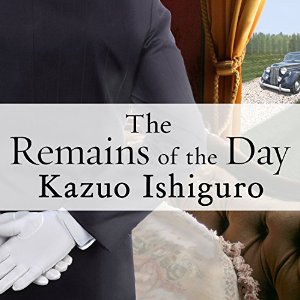
remains-of-the-dayThe Remains of the Day by Kazuo Ishiguro opens with a butler, Mr. Stevens, getting used to a new employer. Stevens had long and faithfully served Lord Darlington, who has now passed away, and an American, Mr. Farraday, has bought Darlington Hall. Not only does Mr. Farraday do and think differently from an English lord, but times have changed as well. The staff has been greatly reduced, leading to a series of small mistakes. When Mr. Farraday plans to be away for a few weeks, he encourages Stevens to take the car and see the country, something Stevens has never done. Stevens has recently had a letter from a former housekeeper, Miss Kenton, now Mrs. Benn, whose marriage seems to be failing, and he thinks perhaps she might be amenable to retaking her old position, which he feels will solve the staff problems. So he decides to take his employer up on his offer to take a “motoring tour” to see Mrs. Benn. The fact that he has a professional reason to go makes the trip more fitting to him than if he had just gone for pleasure.

The story is told in a series of journal-like entries during Stevens’ trip in which he combines the events of the day with recollections from the past and musings about life and his profession. He has given a great deal of thought and effort into determining how to be the best in his profession and what it means to have dignity. When other servants accompany their masters to Darlington Hall, the dominant topic of conversation seems to concern their profession rather than world events, books, music, etc. He comments that “Continentals are unable to be butlers because they are as a breed incapable of the emotional restraint which only the English race are capable of.”

Stevens is so emotionally restrained, though, that he stumbles over the concept of bantering. His new employer tends to make jokes in the course of everyday conversation, so Stevens feels it is expected that he should respond in kind. He studies the concept, and his attempts fall flat. When his own father is dying upstairs during a major conference at the house, Stevens takes pride in the fact that he maintained his dignity and performed his duties in such a way that his father would be proud (that and the strain in the scenes between him and his Father suggest that his father, also a butler, suffered from the same restraint). The only way we know that Stevens is at all affected by his father’s condition is the reaction of some of those he is serving who keep asking if he is all right.

Probably the most damage his restraint causes is in his relationship with Miss Kenton. At first they clash, but eventually they develop a warm working relationship. Ishiguro is a master of “showing, not telling,” especially in this relationship. Through a series of Stevens’ recollections, we deduce that Miss Kenton has feelings for Stevens, but either he is clueless or he is so restrained that he can’t accept them. In those days, members of the household staff could not marry without losing their jobs, so that probably played a big part in his lack of even thinking about the possibility.

Lord Darlington had a dear German friend who, after WWI, lost everything and ended up taking his own life. Darlington feels that the consequences meted out to Germany were too harsh and tries to set up conferences and meetings with leaders around the world to bring about what he thinks is justice. But in the climate of WWII, his affiliations cause him to be seen as a Nazi sympathizer, and he loses his good name and eventually his health. Though Stevens loyally defends the lord, he doesn’t admit to the people he meets on his trip that he worked for him, because he says it is just simpler that way. But part of his discussion about being a great butler included serving a great house and helping enabling great men to do their work well, and near the end he admits to himself he has lost even this.

It’s not until near the end of the book that we see some cracks in his armor. My favorite parts of the book are his last meeting with Miss Kenton/Mrs. Benn and a conversation with a perfect stranger on a bench at a pier where he rehashes his life and loyalties like he has done with no one else. Some say the book is a tragedy, but I think it ends on a hopeful note, with the stranger encouraging him to make the best of the time he has left. “The evening’s the best part of the day. You’ve done your day’s work. Now you can put your feet up and enjoy it.” The evening, not just of the day, but of one’s life.

I saw the wonderful film of this with Anthony Hopkins and Emma Thompson some years ago and enjoyed it, but it left me wondering what the author’s main point was. Was it a political commentary, or an unveiling of the problems in the old system where servants were expected to be nearly invisible and totally loyal, or an negative example of being so buttoned up and emotionally stifled that one can’t even have meaningful relationships? I’m glad to have read the book, which was much more fleshed out, of course, than the film, and I think that all of those subjects are a part of it, but primarily the last. There’s nothing wrong with thoughtfulness, loyalty, dignity, service, even sacrifice, or taking joy and pleasure in not being the big fish but rather aiding someone else in that position. But Stevens took it so far that he lost something of himself in the process.

I loved Ishiguro’s subtlety and style of writing. This isn’t a razzle-dazzle book full of action scenes; rather, it’s quite thought-provoking and emotionally compelling, especially near the end.

Here’s a trailer for the film. It’s been years since I have seen it, and I’d love to see it again now.

I also enjoyed reading Kazuo Ishiguro’s article How I Wrote The Remains of the Day in Four Weeks and listening to some of his comments here. I listened to the audiobook nicely narrated by Simon Prebble with occasional rereadings in a library copy of the book.

Genre: Modern fiction
My rating: 9 out of 10
Potential objectionable elements: The only thing I can recall is Mr Farraday’s coarse joke about Stevens’ taking a lady for “a roll in the hay,” which seems to go over Stevens’ head.
Recommendation: Yes.

(Sharing at Semicolon‘s Saturday Review of Books, and Literary Musing Monday, and Carol‘s Books You Loved)

literacy-musing-mondays-300x300

Books you loved 4


Save

Save

Save

Save

Book Review: Home to Chicory Lane

chicory-innIn Home to Chicory Lane by Deborah Raney, Audrey and Grant Whitman decide to turn their empty nest into a bed and breakfast in Missouri. They’ve sunk a good bit of their resources into it, hoping to make some back, and Grant has retired from his stressful job to help operate the inn. After decorating and getting everything ready, friends and family come in for the grand opening. But someone totally unexpected shows up right in the midst of the big day: their daughter Landyn, a newlywed living in NY with her husband, unannounced, alone, and with a UHaul.

Trying to get to the bottom of what’s going on with Landyn, trying to figure out how best to help, while still staying on top of things for the inn makes for a stressful time.

Landyn made me want to shake her by the shoulders at first. But I enjoyed seeing how she and her husband, Chase, finally came together and tried to work out their issues through very plot twists and turns.

I identified most with the parents: it’s hard to know sometimes with adult children when to advise, when to help, and when to step back and let them figure it out and grow on their own.

Overall it was a very enjoyable book. The one spot I didn’t like was when the young couple came together after a long separation. It’s not as graphic as Song of Solomon or Proverbs 5:19, but I would rather the scene had stopped a few paragraphs earlier.

It did convince me definitely that one thing I never want to do is open a bed and breakfast. 🙂

This is the first of three in a series called Chicory Inn novels, and I’m looking forward to getting to know more of the Whitman’s large family.

Genre: Christian fiction
My rating: 9 out of 10
Potential objectionable elements: The scene mentioned.
Recommendation: Yes.

(Sharing at Semicolon‘s Saturday Review of Books, Literary Musing Monday, and Carol‘s Books You Loved)

Books you loved 4

literacy-musing-mondays-300x300

Save

Save

Save

Friday’s Fave Five

FFF fall flowers

It’s Friday, time to look back over the blessings of the week with Susanne at Living to Tell the Story and other friends.

It’s been a fairly nice week. Still hot and humid in the day time but fairly pleasant in the evenings and mornings. I’m still longing for fall coolness, though! I feel like my body has been trying to come down with something, but I’ve gotten some extra rest to try to head it off. Here are some of the best parts of the last week:

1. Grandparent’s Day. I know that’s a holiday that hasn’t caught on in a big way yet. But I am thankful our son and daughter-in-law remember it. 🙂 We came home Sunday afternoon from church to dinner already made, flowers for me, and jerky for Jim, and I wondered what the occasion was. Then they showed us a Grandparent’s Day card Timothy had “signed” for himself. Awww! And earlier in the week Mittu had tried a new recipe and wanted to bring it over to share – Mexican Chicken Casserole. It was very good!

2. AC fixed. We noticed around bedtime last Friday that the AC had been running constantly that evening, and when I woke up in the middle of the night, it was still running. But it wasn’t putting out much air, and the air’s coolness was decreasing. We do have a service contract with the company who sold and installed it, and called them Sat. morning. Thankfully they did work on Saturdays. We hoped it just needed freon, but something with the compressor wasn’t working – a switch, if I remember correctly. Thankfully the guy had the part on his truck. So by the time it was just starting to get uncomfortable, it was fixed. I’m thankful it was done so quickly (my m-i-l has a window AC unit in her room, so she was fine.)

3. Lists made and checked off. I don’t make lists every day or every week, but if I am really busy, or the stuff I list is very important, or if I’m afraid of forgetting something, then I do. This week it wasn’t anything urgent: I just felt a bit scattered and kept forgetting to take care of some little things. So I finally put them down, and it was nice to see them crossed off one by one. One of life’s little pleasures. 🙂

4. Timothy “fixing”. He’s at that age where he learns or says something new every week, if not every day. One day he was tinkering around his little mini lawn chair saying, “I fix it!”

5. Seeing our favorite bath aide. You don’t think of being a bath aide for elderly people as a particularly thrilling job, but one lady from hospice is just superb at it, always cheerful, efficient, caring. She’s our regular person for my m-i-l twice a week. But a few weeks ago another patient grabbed her hand and wrenched it in such a way that it has been swollen and in pain ever since. She’s going to see an orthopedic surgeon next week. So we’ve been missing her. And then she suddenly showed up on our doorstep Thursday! The hospice agency sends the doctor out once ever few months to check on my m-i-l (a nurse comes once a week, and we can call any time we have a need). The doctor always has someone with her, and this time it was our bath aide! She helped take and record vitals for the doctor. It was just so good to see her and hear from her directly how she’s doing.

Hope you’ve had a good week as well!

Save

Save

Wiersbe “BE” Commentaries

I’ve mentioned before that I like reading the Bible through, for a number of reasons, but I don’t do it in a year’s time any more. I like to be able to stop when I want to spend more time digging in.

I like to really slow down in the NT epistles especially. Many of them are so short, they could easily be read in one sitting. But they’re so densely packed with truth you wouldn’t want to do that. Previously when I’ve come with them I’ve read the same one over several days in a row until I felt I had gotten a grasp on it.

For the past year or so a couple of friends have been posting when one of Warren Wiersbe’s “BE” Commentaries has come up on a sale for the Kindle app. I really enjoyed his 50 People Every Christian Should Know and With the Word: The Chapter by Chapter Bible Handbook , so I thought I’d look into these. He has written one for every book of the Bible. For larger books, like Genesis, he has taken 2-3 books to cover them. He has combined smaller ones together in one volume. I don’t have them all, but I’ve collected several.

Unfortunately I forgot I had them in my current trek through the epistles until I had already read a number of them.

I wish I had reviewed each one, but at the time, I thought, “How do you review a commentary?” But these are the ones I have read with some stand-out quotes from each:

be-readyBe Ready (1 & 2 Thessalonians): Living in Light of Christ’s Return

The Christian who is feeding others must be careful not to feed on the wrong things himself.

Paul also comforted them. This word carries the same idea of “encouragement,” with the emphasis on activity. Paul not only made them feel better, but he made them want to do better. A father must not pamper a child; rather, he must encourage the child to go right back and try over again. Christian encouragement must not become an anesthesia that puts us to sleep. It must be a stimulant that awakens us to do better.

How does God cause our love to “increase more and more”? By putting us into circumstances that force us to practice Christian love. Love is the “circulatory system” of the body of Christ, but if our spiritual muscles are not exercised, the circulation is impaired. The difficulties that we believers have with one another are opportunities for us to grow in our love.

The purpose of Bible prophecy is not for us to make a calendar but to build character.

Any teaching that encourages us to disobey another divine teaching is not Bible teaching.

be-faithfulBe Faithful (1 & 2 Timothy, Titus, Philemon): It’s Always Too Soon to Quit!

But many prefer the “vain jangling” (1 Tim. 1:6) of those who teach novelties rather than the pure Word of God that produces holiness in lives.

It is not enough for a local church to teach sound doctrine and to proclaim the gospel. The church must also defend the faith by exposing lies and opposing the doctrines of demons (1 Tim. 4:1).

The purpose of prayer is not to get man’s will done in heaven, but to get God’s will done on earth.

Not all unity is good, and not all division is bad. There are times when a servant of God should take a stand against false doctrine and godless practices, and separate himself from them. He must be sure, however, that he acts on the basis of biblical conviction and not because of a personal prejudice or a carnal party spirit.

“That they may lay hold on eternal life” (1 Tim. 6:19) does not suggest that these people are not saved. “That they may lay hold on the life that is real” would express it perfectly. Riches can lure a person into a make-believe world of shallow pleasure.

What germs are to a physical body, false teaching is to a spiritual body, the church.

Note his emphasis on the person of Christ: “I know whom I have believed.” Salvation is not the result of believing certain doctrines, though doctrines are important. A sinner is saved because he believes in a Person—Jesus Christ the Savior. Paul had deposited his soul in the care and keeping of the Savior, and Paul was sure that Jesus Christ would faithfully guard that deposit.

be-matureBe Mature (James): Growing Up in Christ

The epistle of James was written to help us understand and attain spiritual maturity: “… that ye may be perfect and entire, wanting nothing” (James 1: 4). I like the way J. B. Phillips puts it: “… and you will find you have become men of mature character, men of integrity with no weak spots.”

In the Bible, patience is not a passive acceptance of circumstances. It is a courageous perseverance in the face of suffering and difficulty.

“A temptation is an opportunity to accomplish a good thing in a bad way, out of the will of God.

Christian love does not mean that I must like a person and agree with him on everything. I may not like his vocabulary or his habits, and I may not want him for an intimate friend. Christian love means treating others the way God has treated me. It is an act of the will, not an emotion that I try to manufacture. The motive is to glorify God. The means is the power of the Spirit within (“ for the fruit of the Spirit is love”). As I act in love toward another, I may find myself drawn more and more to him, and I may see in him (through Christ) qualities that before were hidden to me.

be-hopefulBe Hopeful (1 Peter): How to Make the Best Times Out of Your Worst Times

Hope is not a sedative; it is a shot of adrenaline, a blood transfusion. Like an anchor, our hope in Christ stabilizes us in the storms of life (Heb. 6: 18–19), but unlike an anchor, our hope moves us forward, it does not hold us back.

The Word reveals God’s mind, so we should learn it; God’s heart, so we should love it; God’s will, so we should live it.

We do not study the Bible just to get to know the Bible. We study the Bible that we might get to know God better. Too many earnest Bible students are content with outlines and explanations, and do not really get to know God. It is good to know the Word of God, but this should help us better know the God of the Word.

It is necessary to understand that God is not going to replace suffering with glory; rather He will transform suffering into glory. Jesus used the illustration of a woman giving birth (John 16: 20–22). The same baby that gave her pain also gave her joy. The pain was transformed into joy by the birth of the baby. The thorn in the flesh that gave Paul difficulty also gave him power and glory (2 Cor. 12: 7–10). The cross that gave Jesus shame and pain also brought power and glory.

I’m currently working through Be Real (I John): Turning From Hypocrisy to Truth.

I’ve been going through a study Bible this year, so I’ll read one chapter of the epistle with the study Bible notes. Then the next day I’ll read the corresponding chapter in Wierbe’s book. If it takes him more than one chapter in his book to cover a chapter in the epistle, I’ll read one a day (sometimes half of one a day) until I finish with with however many chapters in his book it takes to cover that chapter in the epistle.

So, for example, on Monday I’d read the introductory material on 1 John from the study Bible, and on Tuesday I’d read the first chapter of 1 John with the notes from it. Wiersbe takes two chapter to cover 1 John 1, so I’d read those on Wednesday and Thursday – or I’d take longer if I need to. The important thing isn’t that I finish a chapter in a day, but rather that I take the time to read carefully and understand what I am reading.

So I feel this has worked well to slow me down in those short epistles and really take time to soak in them and put them together as a whole rather than reading isolated chapters.

I appreciate that Wiersbe’s tone is, as one preface says, “theologically sound but not overly academic.” He tends to take the passages in sections, explains what they’re about, relates them to the rest of the book, sometimes provides cross references and illustrations or examples.

My only criticisms are that some chapters do get a bit long and might have benefited from being broken down even further, and I wish that, as he discusses the chapter in smaller sections of a few verses at a time, he’d put those verses at the beginning of that section. It would just make it easier than having to go back and forth between the Bible and the commentary.

I haven’t yet used one of his commentaries on a longer book, but I am especially looking forward to the one on Ecclesiastes after reading Hope’s review of it. That book is a little different from the rest, so I’d appreciate his expertise in studying it. Incidentally, she has a Facebook page where she lists free or sale books for the Kindle at Worthwhile Books.

I think when I finish 1 John I might try to review it: if not I may just share pertinent quotes then.

At any rate, I wanted to make you aware of these resources. I’ve found them very helpful.

(Sharing at Semicolon‘s Saturday Review of Books and Literary Musing Monday)

literacy-musing-mondays-300x300

Save

Save

Those Perfect Friends

(Photo courtesy of stock images on FreeDigitalPhotos.net)

(Photo courtesy of stock images on FreeDigitalPhotos.net)

A recent conversation with a young mom friend brought back to mind a struggle I had years ago. We all have those friends, the ones who seem to do everything and do it well, while we’re struggling just to keep our heads above water.

One of my friends like that was a lady at church about my age with children similar in age to mine. She was not only a mom and homemaker, she worked part-time. Her house was not only picked-up, it was clean. On top of that, it was beautifully decorated. She sewed (her clothes, her children’s clothes, curtains, etc.) She did craft projects; she helped out in various ministries at church; she sang. And she was hospitable: she had people over regularly.

I don’t know how many times, after being with her, I would come home discouraged and wonder what in the world was wrong with me that I couldn’t do half that. I finally came to the place where I just had to accept that people had different gifts and capacities, and hers were more than mine.

The funny thing is, if I had talked with her about it, she probably would have felt like she wasn’t doing all that much and would’ve pointed to one of those friends in her life. She probably would have lamented to me about what she didn’t get done or couldn’t do or the ways in which she felt like a failure.

None of us has everything totally together. When friends excel in one area or another, we compare ourselves to them and end up envying them, or feeling discouraged, or trying to find a fault with them to burst the bubble of their seeming perfection. The Bible says this is not wise: “But when they measure themselves by one another and compare themselves with one another, they are without understanding” (2 Corinthians 10:12b).

Here are some things to keep in mind:

1. We all have different gifts, capacities, and circumstances.

2. There is always going to be someone who does what I do better than I do it.

3. It’s ok not to do everything, or even strive to do everything, like someone else. One friend I had in early married days was an organizational wiz. But one day as we were talking, she shared that she made one kind of soup and sandwich for her family’s lunch on Monday, Wednesday, and Friday, and another kind on Tuesday, Thursday, and Saturday. And I thought – how boring! Not to criticize her – if that’s what she and her family liked, that was fine. It did save time trying to decide what to do for lunch every day. But I decided I didn’t want to be that organized: though it took more time, I liked a little more variety.

4. We can learn from each other and appreciate each other’s gifts. Though I might not want to implement all of my organized friend’s habits, if I have an organizing question, she’d the one I’d ask for advice. I may never exercise hospitality with the ease of another friend, but I can ask her for tips or observe what she does. My friend whose home is decorated so nicely may be able to help me with a decorating dilemma.

5. Remember you only see part of the picture. Our seemingly perfect friends have their struggles, too, and probably none of them feels perfect.

6. We’re all in a state of growth. Organization used to be one of my major struggles, and whatever improvements I made, it seemed like I’d never get on top of everything. One day I realized that I would never reach 100% organizational perfection (and even if I did, it would take the rest of my life to maintain it). But that didn’t discourage me: instead it was the greatest relief. Organization (for me) is not a destination; it’s a journey. I still have areas I can improve upon, but I’m better at it that I was 10 or 20 or 30 years ago.

7. Some seasons are more limiting than others. When there is a new little one in the house, or someone is ill, or the family is taking care of an elderly loved one, or a husband is working 60+ hours a week during a crunch time, our time and attention is needed in other areas. Elisabeth Elliot said about limitations, “But my limitations, placing me in a different category from…anyone else’s, become, in the sovereignty of God, gifts. For it is with the equipment that I have been given that I am to glorify God. It is this job, not that one, that He gave me.”

8. Remember life is not a competition, at least in this sense. Oh, there are times of competition: athletic events, political races, perhaps even a job promotion, etc. But everyday life is not about trying to best others at every turn.

As we seek to improve in any area, our competition should be against ourselves rather than trying to be as good as or even better than someone else.

But ultimately, we need to keep our eyes on Christ, seek His will for our lives, and live to please Him. What He wants us to do may not look like what He wants others to do. Even in those everyday practical matters, He can help us or lead us to the resources we need to improve. If we’re walking with Him in His perfect will, we’re right where we need to be.

And we all, with unveiled face, beholding the glory of the Lord, are being transformed into the same image from one degree of glory to another. For this comes from the Lord who is the Spirit. 2 Corinthians 3:18

(Sharing With Inspire me Monday, Testimony Tuesday, Wise Woman Wednesday)

Save

Save

Save

Laudable Linkage

I’ve discovered some great reads around the Web recently. Here are the latest:

Treat Yourself to the Voice of God. “We’re prone to take one of the single greatest gifts available to us and treat it as a life-sucking obligation rather than a life-giving opportunity.”

After my post about Principles For Interpreting the Bible, I was pleased to see “Contending For Old School Hermeneutics” said some of the same things but also said some things I didn’t.

The Whole Sentence Matters. An illustration of the above, how one “popular” verse changes meaning a bit when read with the verse above it.

Kindness Changes Everything, and it’s different from just being “nice.”

Waiting to Die, HT to Challies. Working through the dark thoughts and emotions that come with a terminal diagnosis.

On Empty Nests, Christian Mommy Guilt, and Misplaced Identity by Jen Wilkin. “It’s as if our love is a cosmic batch of heart-shaped cookies we must divvy up. Give anyone more cookies than Jesus and your identity is misplaced. But shouldn’t there be a way to give Jesus all the cookies without depriving our families as well?”

A Prayer For Kindred Spirits. “The nurturing of just one kindred spirit can be enough to keep the voices at bay. It’s as if this secret I’ve been carrying around, afraid to share, has been loosed into the world, and it’s okay. There’s nothing like the deep, soul hug which takes place when realizing you’re amongst those who know the kind of person you really are. And it’s okay.”

3 Reasons Your Small Group Is Not the Church.

4 Practical Guidelines For Reading Old Testament Stories.

Do’s and Don’ts For Visiting Someone With Alzheimer’s.

Everyone Can Do Something.

9 Things You Should Know About Mother Teresa.

[Food and the Bible] When Eating Is Sinful.

Spelling Out Unconditional Love.

The High Calling of Bringing Order From Chaos. Sometimes I feel frustrated that this is such a constant battle, but this helps give it perspective.

Old Books, Disagreements, Loving People, HT to Worthwhile Books. Reasons to read books that contain things you disagree with.

Permission Not To Change a Thing. With all the nice photos on Pinterest and plethora of decorating and house-flipping shows, sometimes we feel a constant urge to do something to our homes. It’s certainly not wrong to redecorate or freshen things up or even do a grand remodeling. But it’s also ok not to.

With the 15th anniversary of 9/11 tomorrow, there are a lot of articles about it. I’ve only read a couple in depth so far: “We’re the only plane in the sky” about the president and those with him the first 8 or so hours (warning: a bit of bad language) and The Story Behind the Haunting 9/11 Photo of a Man Falling From the Twin Towers.

That’s it for today – hope you have a good Saturday.

Friday’s Fave Five

friday fave five spring

It’s Friday, time to look back over the blessings of the week with Susanne at Living to Tell the Story and other friends.

Let’s jump right in:

1. A long weekend. Having everyone off for Labor Day makes it feel like we had an extra Saturday in the week. But it means all the other days of the week I’m having to ask myself, “What day is this?” 🙂 I don’t even remember now what we did except for grilling burgers for dinner.

2. A thorough car wash. My dear husband gave my car the deluxe treatment, washing it, vacuuming the carpet, cleaning the mats, even dusting the dashboard.

3. A breakfast biscuit. When I was driving my kids to school, I used to treat myself to breakfast out about once a week. Those days have been over for years, and though I’m up at 6, I’m not usually out and about until a few hours later. But I had to fast for lab work before my physical and got breakfast afterward at a drive-through to bring home . Delicious!

4. Seeing Timothy play with a friend. My son and daughter-in-law had friends in town with a son just 7 months younger than Timothy. I was over for a bit and it was so fun to see the boys playing together like they were old friends, too.

5. Cracker Barrel. I still had a gift card for them from I don’t know when – I think two Christmases ago. I love them but my husband’s not crazy about them, and I’m not usually near one at lunch time. But I was on Wednesday! So I got their meat loaf plate and a slice of Coca Cola cake and brought it home to eat. Plus I got a couple of items in their shop – and still have a bit left on my gift card!

img_1841

Bonus: We got Mexican Food take-out one night and watched Toy Story – our old video tape of it on our old VHS player. One of the best movies ever, and it was fun to introduce it to Timothy.

Happy Friday!


Save

Save

Book Review: The Promise of Jesse Woods

jesse-woodsThe Promise of Jesse Woods by Chris Fabry opens with Matt Plumley in Chicago receiving a phone call from a voice from his past in West Virginia, sending him straight back there.

Matt had arrived in Dogwood, West Virginia from Pittsburgh when he was near 14 in the 1970s. His dad had grown up in Dogwood and was coming back to pastor the church there. Matt was not only the new kid, the new preacher’s kid at that, but he was also overweight, all of which worked against his making friends. But he did become friends with a couple of fellow outcasts, a boy of mixed race, Dickie Darrel Lee Hancock, and a girl named Jesse Woods from the wrong side of the tracks who took care of her sister because her father had left and her mother was ill.

As the three traipse around the countryside on their bikes, they get into various adventures and misadventures, revealing and keeping each other’s secrets. Matt’s eyes are opened to prejudice and mistreatment, to disappointment in his father, who goes along with Basil Blackwood, who runs everything in town, including the church, and to his first crush in Jesse.

The narration goes back and forth between the events of Matt’s childhood in 1972 and the events of 1984, when he returned. There is indication of something major that happened that caused a fallout between himself and Jesse, and though tidbits are uncovered along the way, the whole truth doesn’t come out until a big climax near the end. Even then it takes Matt a while longer to piece together the ramifications of that event to the present and to learn what he needs to learn, not only about the one promise Jesse didn’t keep, but also about himself.

Chris is a natural storyteller and weaves everything together nicely, though there was a bit too much detail about baseball for my tastes. There were also several mentions about what someone’s breath smelled like, which I thought odd in all but one instance. I would have been just a year or so older than Matt, so the parts about growing up in a small Southern town brought back many memories. There are moments of aching for children in Jesse’s situation. In one sense it’s a coming of age story – at least the 1972 scenes are. But in a larger sense it’s about Matt finally coming to terms with issues in his own life. A few times it’s pointed out to him that he’s concerned about rescuing others when maybe he’s the one who needs rescuing.

I thought the book was a smidgen too long and dragged in a couple of places, but overall it was an enjoyable read.

Genre: Christian fiction
My rating: 8 out of 10
Potential objectionable elements: There are a few “adolescent boy noticing a girl’s body” moments, though not explicit, and an attempted assault.
Recommendation: Yes.

(Sharing at Semicolon‘s Saturday Review of Books, Literary Musing Mondays, and Carol‘s Books You Loved)

Books you loved 4

Save

Save

Save

Save

Save