Laudable Linkage

Laudable Linkage

I didn’t think I’d have a Laudable Linkage this morning. It’s been a busy week, and I am way behind on blog reading. But I had a little free time yesterday afternoon and found these good reads.

Picture Perfect Christmas. “Every time I look awful, I run into my most together friend. HER. That altogether all together friend. I try not to let it, but it surely can make me cranky. And angsty. Crangsty.”

Victim Blaming and the Rich Young Ruler, HT to Challies. “The way that Jesus responded to the rich young ruler is so different from what comes naturally to me. When I see someone suffering, my mind often seeks to figure out how they are at fault for their own suffering. And that response is wrong for two main reasons.”

Grace in Afflictions. “I have been meditating for several weeks on 2 Cor. 4:15-18. The expression “light affliction” has been returning to my mind as I deal with daily, nagging physical conditions that are burdensome and uncomfortable. I’m seeking relief, improvement, and help from any source available. Even though I’m plagued by real challenges and wearing out, I’m still striving for healing and personal progress in my body and my soul. To respond I’m fleeing regularly to my study of God’s grace as revealed in scripture.” I especially love the last paragraph here.

Repeat Forever. “Can we linger just a little longer on thanksgiving before we move onto Christmas? ‘I will bless the Lord at all times; His praise shall continually be in my mouth.‘ (Psalm 34:1, NASB). One of the definitions of ‘continually’ is ‘without an intermission’ (dictionary.com). In other words, ongoing.”

Christmas quote by A. W. Tozer

Though we are keenly aware of the abuses that have grown up around the holiday season,
we are still not willing to surrender this ancient and loved Christmas Day to the enemy.
– A. W. Tozer

Friday’s Fave Five

Friday's Fave Five

Happy first Friday of December! It was nice to have a buffer week between Thanksgiving and the first of December. Though life is always busy, December is especially so. It’s even more important to schedule pauses for remembering what’s important and counting our blessings. Susanne at Living to Tell the Story hosts an opportunity to do that with Friday’s Fave Five.

Here are a few of mine:

1. Decorating for Christmas with the family. I thought about waiting til next week, just from tiredness. But I am glad we went ahead. I am so thankful that the family helps with this, even though Jason and Mittu have their own house to decorate. Not only do many hands make light work, but it’s fun to reminisce as we do. Mittu made a great lunch. for us all.

2. Lunch with Melanie. We try to get together once a month or so, but it had been a long while. We had gift cards to Red Lobster and enjoyed catching up. By the way, she had a birthday this week! Some of you know her through FFF or other blogging means—feel free to pop over and wish her a belated happy birthday.

3. A good eye exam with no new issues or problems.

4. Hot oil hair treatment. I have very dry skin and have to put lotion all over year-round. But cold, dry weather really does a number on me. I couldn’t put lotion on my scalp, however. Then I remembered I used to use VO5 hot oil treatment—a little tube you put in a cup of hot water and then massage its contents into your scalp before shampooing. I even had some in the bathroom cabinet. It felt so good.

5. Online shopping. We got a good chunk of our Christmas shopping done this week, and now enjoy receiving the deliveries!

That’s our week. How was yours?

November Reflections

November Reflections

The end of November finds us in a cold snap transitioning to the Christmas season. Since Thanksgiving was the earliest it can be, it feels like we have a bonus week to get ready for Christmas.

Jim spent most of this month continuing to recover from his surgery in October. He saw both surgeons for post-op visits plus had his yearly physical. He can pretty much do all his usual things, but still tires easily and still has some abdominal pain.

I had my yearly physical and eye exam this month, thankfully with no new issues cropping up except an easily fixed vitamin deficiency.

We enjoyed our annual family costume party at my son and daughter-in-law’s house and Thanksgiving at ours, and everyone pitched in to help us decorate for Christmas last weekend.

Creating

I made one card this month for my friend Melanie‘s birthday.

The “Happy Birthday” was printed from the computer, then I used a rose corner punch on opposing corners. I was going to do all four corners, but the punch was bigger than I had thought. I liked how it turned out, though.

Watching and Listening

As much as I enjoy Elisabeth Elliot, I don’t always hear her radio programs, which now are being re-aired by BBN Radio. However, they do have links to the week’s episodes on their web site, plus a lot of the episodes are on the Elisabeth Elliot web site here. I bypass the ones that don’t apply to me any more, like how to make children mind. 🙂 But last week she had a series on Preparing for Old Age which I enjoyed.

We didn’t watch much of interest this month except one movie called Storming Juno. It’s not the best made film I’ve ever seen, but it was interesting. It’s about Canadian troops that were first to arrive at Normandy on D-Day and first to achieve their objective. At the end they showed actual footage as well as interviews with several of the soldiers who were there.

Reading

Since last time, I finished (titles link back to my reviews):

  • Be Exultant (Psalms 90-150): Praising God for His Mighty Works by Warren W. Wiersbe, nonfiction. His commentary on the last sixty psalms.
  • As Dawn Breaks by Kate Breslin, fiction. A young woman about to be forced into an unwanted marriage by her guardian survives an explosion in the munitions factory where she works in 1918. She takes on the identity of her friend who died and leaves the country, with unexpected consequences.
  • The Wings of Poppy Pendleton by Melanie Dobson, fiction, audiobook. The young daughter of a Gilded Age couple is abducted from their castle and not heard from again. Decades later, the daughter of the castle’s caretaker first tries to avoid, and then helps a reporter trying to uncover what happened.
  • The Book of Lost Friends by Lisa Wingate, fiction, audiobook. Dual timeline novel set in 1875, where two half-sisters and a slave set out to find the missing master of the house, and 1987, where a first-year teacher tries to motivate her students to get interested in reading by sharing their families’ stories.
  • Someday Is Today: 22 Simple, Actionable Ways to Propel Your Creative Life by Matthew Dicks, nonfiction. I didn’t review it here but left a few thoughts on GoodReads.
  • Elisabeth Elliot: A Life by Lucy S. R. Austen, nonfiction.Just finished, hope to review next week.

Last time, I had finished but had not reviewed yet The Rose of Winslow Street by Elizabeth Camden and Made for More: An Invitation to Live in God’s Image by Hannah Anderson, so I reviewed them both this month.

I’m currently reading:

  • Be Skillful (Proverbs): God’s Guidebook to Wise Living by Warren Wiersbe, nonfiction
  • Adorning the Dark: Thoughts on Community, Calling, and the Mystery of Making by Andrew Peterson, nonfiction
  • Being Elisabeth Elliot by Ellen Vaughn
  • How to Write a Sentence and How to Read One by Stanley Fish, fiction
  • Secrets She Kept by Cathy Gohlke, fiction
  • Crown of Thorns by Sigmund Brouwer, fiction

I’ve completed the workbook and videos in Jen Wilkin’s Abide Bible study course on 1, 2, and 3 John for the ladies’ Bible study at church. I’ve read many of her books but this is the first of her Bible studies I’ve done. It was quite good.

I still haven’t chosen and advent devotional book to read for December . . . which I need to do before tomorrow!

Blogging

Besides the weekly Friday Fave Fives, Saturday Laudable Linkage, and book reviews, I’ve posted these since last time:

Writing

Things will probably be light on that front until December, though I’ve jotted some notes for a couple of articles.

Turning the corner into December, I’m sure we’ll be busy about the same things as many of you: wrapping presents, sending Christmas cards, attending Christmas events, and looking forward to time with the family. My oldest son flies in later in the month, so we have a lot to look forward to.

I hope you had a great November and I wish you a blessed Christmas season!

Recommended Christmas Devotional Books

Recommended Christmas or Advent Devotional Books

One of the main things that helps me keep a good perspective through December is reading a Christmas or Advent devotional book.

Some years I’ve followed reading plans for Scripture that specifically deal with the coming of Christ, including the prophecies of His birth. I don’t have one on hand, but I’m sure there are plenty online.

Most years, though, I read an Advent devotional book usually in addition to, sometimes instead of, my usual devotional time. So I thought I’d share some of the ones I’ve enjoyed with you. I’ll link the titles back to my reviews.

Heaven and Nature Sing advent devotional.

Heaven and Nature Sing: 25 Advent Reflections to Bring Joy to the World by Hannah Anderson is the newest I’ve read, just published last year. It’s also one of my favorites. Reading this book set me to reading many of Hannah’s other books this year. The title comes from a phrase in Isaac Watt’s “Joy to the World.” Hannah took inspiration from this phrase and wrote twenty-five Advent devotions based on various aspects of nature connected with the birth of Christ. Each devotion is about five pages long and written in an easily readable style.

Sample quote: “Yes, the manger signals something about this baby, but it is not simply his poverty. By being placed in the manger, he is revealed as both the rightful son of Adam charged with caring for his creation and also the eternal Son of God who created them and who provides for them. So instead of filling the manger with hay or corn, he fills it with himself.”

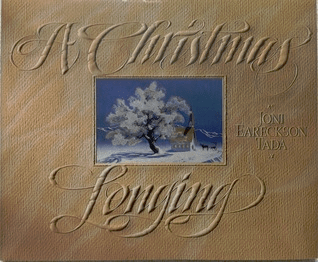
A Christmas Longing by Joni Eareckson Tada

A Christmas Longing by Joni Eareckson Tada is a gorgeous book filled with her art work, drawn by mouth due to her paralysis. It’s made up of 31 readings for each day in December centered on the theme of joy.

Sample quote:”Lives hinge and eternal destinies hang in the balance when men and women come face to face with Jesus the Christ. It isn’t always peaceful. It isn’t always painless. It isn’t always easy. But bowing the knee to Jesus Christ is always right. No matter what.”

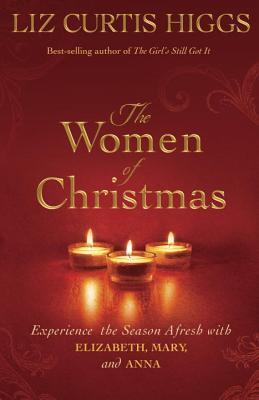
The Women of Christmas by Liz Curtis Higgs

The Women of Christmas: Experience the Season Afresh with Elizabeth, Mary, and Anna by Liz Curtis Higgs. The eight chapters here are longer, around twenty pages or more. So it might not work as a devotional unless you divided the chapters up. But I thoroughly enjoyed this one. Liz did tons of research and study, but the book is warm rather than technical and stiff.

Sample quote: “When I hear women rail that the Bible is misogynistic, I wonder if we’re reading the same book. God loves women, redeems women, empowers women – then and now. On the day we call Christmas, he could simply have arrived on earth, yet he chose to enter through a virgin’s womb. On the day we call Easter, he could have appeared first to his beloved disciple John, yet he chose as his first witness a woman set free from seven demons.”

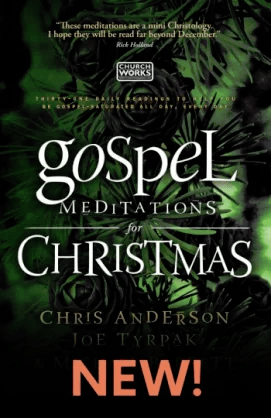
Gospel Meditations for Christmas by Church Works Media

Gospel Meditations for Christmas by Chris Anderson, Joe Tyrpak, and Michael Barrett is divided into 31 pages, one a day through the month of December (or any time, really, since these truths are eternal). Each page lists a Bible passage to read and then delves into some facet of the passage for a handful of paragraphs. The primary focus of the book is various aspects of the Incarnation

Sample quote: “Matthew begins his account of the good news with a record of Jesus’ ancestry. This isn’t some boring list of personal details that Matthew came across in research and decided to include as space-filler. No, this genealogy is Matthew’s attention-grabbing introduction, and it’s jam-packed with significance.”

Expecting Christmas advent devotional

Expecting Christmas is a 40-day devotional by multiple authors. I wished this one was 25 or 31 days so it would fit neatly in December. I didn’t know any of the author names except one (Jennifer Dukes Lee). The selections are short, which is appreciated in a month like December. Each began with a verse or two of Scripture, a page and a half to two pages (at least in the Kindle version) of text, then three questions for refection.

The readings cover a variety of Christmas topics, though several deal with light.

Sample quote: “Mary’s response was one of quiet introspection as she treasured the good news of the gospel in her heart. The shepherds, on the other hand, left young Jesus, glorifying God and praising Him with outward enthusiasm and passion. People celebrate the gospel in different ways.”

Advent readings by C. H. Spurgeon

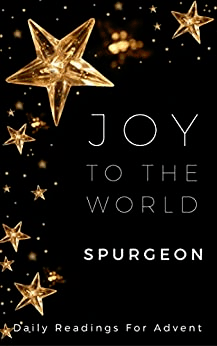
Joy to the World: Daily Readings for Advent is made up of excerpts from C. H. Spurgeon’s Christmas sermons. I had read a few books like this with lengthier portions from his sermons (like Good Tidings of Great Joy: A Collection of Christmas Sermons), but they were a little too much for morning devotionals. This one, however, had daily readings of just two to three pages on an iPad mini Kindle app.

Sample quote: “The tabernacle of old was not full of truth, but full of image, and shadow, and symbol, and picture; but Christ is full of substance. He is not the picture, but the reality; he is not the shadow, but the substance. O believer, rejoice with joy unspeakable for you come to Christ, the real tabernacle of God.”

Finding Christ in Christmas, advent devotional by A. W. Tozer

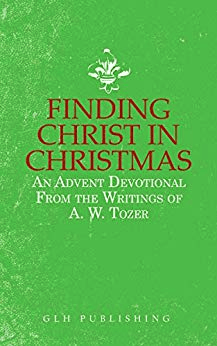
Finding Christ in Christmas: An Advent Devotional by From the Writings of A. W. Tozer has readings for December 1 – 25, ranging from just a paragraph to little more than a page. So the selections are easily readable. I felt the selections were a little haphazard, taken out of context, and some left the reader hanging a bit. But the book contained several great nuggets. Tozer’s writing is not warm and cozy, but it makes one think.

Sample quote: “The Law was given by Moses, but that was all that Moses could do. He could only ‘command’ righteousness. In contrast, only Jesus Christ produces righteousness. All that Moses could do was to forbid us to sin. In contrast, Jesus Christ came to save us from sin. Moses could not save anyone, but Jesus Christ is both Savior and Lord.”

From Heaven, an Advent devotional by A. W. Tozer

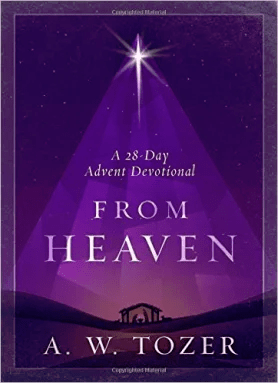
From Heaven: A 28-Day Advent Devotional by A. W. Tozer is similar to the book above and overlaps it a bit, but has some different excerpts.

Sample quote: “Even though you may still be unconverted and going your own way, you have received much out of the ocean of His fullness. You have received the pulsing life that beats in your bosom. You have received the brilliant mind and brain within the protective covering of your skull. You have received a memory that strings the events you cherish and love as a jeweler strings pearls into a necklace and keeps them for you as long as you live and beyond. All that you have is out of His grace. Jesus Christ, the eternal Word, who became flesh and dwelt among us, is the open channel through which God moves to provide.”

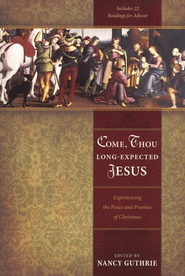
Come Thou Long Expected Jesus:Experiencing the Peace and Promise of Christmas, compiled by Nancy Guthrie, is one I have enjoyed several times. It contains 22 selections on various aspects of Advent, from Mary to conception by the Holy Ghost to Joseph to the shepherds to Jesus’s humility and others, from such teachers and preachers as Charles Spurgeon, Augustine, Martyn Lloyd-Jones to Tim Keller, John MacArthur, J. I. Packer, and Ray Ortland. I don’t know all of the authors, so I wouldn’t endorse everyone 100%, but I don’t think I read anything in this particular volume that I had a problem with.

Sample quote from J. I. Packer: “The Christmas message is that there is hope for a ruined humanity–hope of pardon, hope of peace with God, hope of glory–because at the Father’s will Jesus Christ became poor and was born in a stable so that thirty years later he might hang on a cross. It is the most wonderful message that the world has ever heard, or will hear.”

Let Every Heart Prepare Him Room, a family Advent devotional by Nancy Guthrie

Let Every Heart Prepare Him Room: Daily Family Devotions for Advent by Nancy Guthrie is another I’ve read several times. It designed for families to read together, but works well read by individuals, too. There are 31 readings, each ending with a prayer, some discussion questions, and a few more Scriptures on the topic of the chapter.

Sample quote: “Sometimes we are given a gift that we think is not really useful to us, and therefore we never take it out of the box. We stash it away in a closet or on a shelf somewhere in case we need it someday. Sadly, that’s what some people do in regard to Jesus. They want to keep him handy for when something comes along that they can’t handle on their own, but for now they have no interest in making him part of their day-to-day lives, and so they put him on the shelf. They simply don’t believe he is as good as the Bible says he is, and so they have no real or lasting joy in having received this great gift.”

Those are all the ones I can remember reading or find mention of on the blog.

Do you have any favorite Christmas or Advent devotionals? I’d love to hear your recommendations.

(I often link up with some of these bloggers.)

Content Even When in Need?

How can I be content when in need?

In the USA, we’ve just celebrated Thanksgiving. Deliberately set for the time just after harvest, the holiday traditionally called for joy and thankfulness when provisions for the next year had been safely gathered in.

Though not everyone farms or gardens these days, we still use this time to remind ourselves just how blessed we are. Those who know the Lord, and even some who don’t, thank God for what He has given.

But I’ve learned from farming friends and history that not all harvests are created equal. One can do everything possible to raise a crop, but one can’t make anything grow. Bad weather, drought, insect invasion, or plant disease can diminish, if not totally wipe out a crop.

Some Thanksgiving seasons find us overflowing with burdens rather than blessings.

What then?

It’s relatively easy to thank God in times of health and plenty. But in times of want, illness, or sorrow, are we exempt from thanking God?

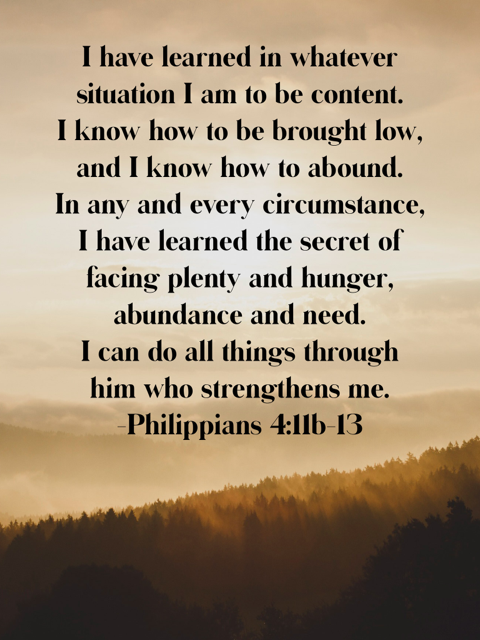
I think of Philippians 4:11-12, where Paul says, “I have learned in whatever situation I am to be content. I know how to be brought low, and I know how to abound. In any and every circumstance, I have learned the secret of facing plenty and hunger, abundance and need.”

Content in all things? Even in hunger or need?

Why would God allow His children to suffer need?

To convict of sin. Often in the Old Testament, when Israel looked to idols or other countries for help instead of God, God allowed them to suffer need. This wasn’t vindictive or petty. In love, God had to let them see that other sources they looked to were useless and powerless. This doesn’t mean every trial or need comes because one has sinned. But trials provide a good opportunity to see if any sin is hindering God from answering our prayers.

To sanctify and humble us. Paul said his thorn in 2 Corinthians 12 was given “to keep me from becoming conceited because of the surpassing greatness of the revelations” given to him.

To help us grow. In John 15, Jesus said He was the vine, his Father the vinedresser, and we’re the branches. Then He said, “Every branch that does bear fruit he prunes, that it may bear more fruit” (verse 2). I’m not good with plants, but I have discovered the truth of this principle. Many plants don’t grow as they should if they’re not cut back at times.Trimming the branches helps the plants grow not only more healthy, but more blooms. So when God removes something from our lives, we grow in ways we would not have without that pruning.

To bring us to maturity. James i:2-4 says, “Count it all joy, my brothers, when you meet trials of various kinds, for you know that the testing of your faith produces steadfastness. And let steadfastness have its full effect, that you may be perfect and complete, lacking in nothing.”

To turn our hearts to what is most important. At the end of Israel’s years in the wilderness, God told them, “You shall remember the whole way that the Lord your God has led you these forty years in the wilderness, that he might humble you, testing you to know what was in your heart, whether you would keep his commandments or not. And he humbled you and let you hunger and fed you with manna, which you did not know, nor did your fathers know, that he might make you know that man does not live by bread alone, but man lives by every word that comes from the mouth of the Lord.” (Deuteronomy 8:2-3).

As a testimony that we don’t serve Him just for His blessings. That’s what Satan accused Job of: that Job only served God because God had blessed him so much. Take away his blessings, Satan urged, and Job will curse You (Job 1). Job went through a rough time and questioned God, but he didn’t turn away from Him in faithlessness.

Elisabeth Elliot wrote in her September/October 1984 newsletter (which was later published in Keep a Quiet Heart), “It had to be proved to Satan, in Job’s case, that there is such a thing as obedient faith which does not depend on receiving only benefits. Jesus had to show the world that He loved the Father and would, no matter what happened, do exactly what He said. The servant is not greater than his Lord. When we cry ‘Why, Lord?’ we should ask instead, ‘Why not, Lord? Shall I not follow my Master in suffering as in everything else?’ Does our faith depend on having every prayer answered as we think it should be answered, or does it rest rather on the character of a sovereign Lord?”

She goes on to say, “Genuine faith is–the kind of faith that overcomes the world because it trusts and obeys, no matter what the circumstances. The world does not want to be told. The world must be shown.”

You might think, “Okay, I can see why God might allow us to suffer need sometimes. But how can I be content even then? I have a hard enough time being content even when everything is going well.”

In the Philippians 2 passage mentioned earlier, where Paul speaks of being content in every situation, whether in plenty or need, he follows that statement with a verse that we take out of context and apply to everything else: “I can do all things through him who strengthens me.”

I’ve found it amusing when two Christian ball teams claim Philippians 1:13 as they compete against each other. They’re thinking of it in terms of winning. But one team will need His strength to lose well.

In 2 Corinthians 12:7-10, Paul shares that he prayed three times for God to remove his “thorn in the flesh,” whatever that actually entailed. But God did not remove the difficulty. Instead, he promised, “My grace is sufficient for you, for My strength is made perfect in weakness” (NKJV).

Paul’s response? He didn’t whine, “That’s not fair.” He didn’t get angry. He said, “Therefore most gladly I will rather boast in my infirmities, that the power of Christ may rest upon me. Therefore I take pleasure in infirmities, in reproaches, in needs, in persecutions, in distresses, for Christ’s sake. For when I am weak, then I am strong.”

Perhaps that’s the main reason God sometimes lets us suffer need: to cause us to rely on Him.

This doesn’t mean we never seek help or take measures to deal with our needs. But we realize God is the giver of all good gifts. We can’t do anything without Him. He’s promised to meet all our needs. We don’t have to worry and fret: we can rest in His care and timing.

One time I experienced these things was minor in the grand scheme of things, but major at the time. I was getting ready to leave for a writer’s conference and prayed for a good night’s sleep. I wasn’t consciously nervous, at least not like I had been the first time I went. But I only got about an hour’s sleep all night. I tossed, turned, went to the couch, tried all my usual tricks like listening to soft music, prayed and prayed and prayed. Yet sleep wouldn’t come.

I got up around 4:30 and took a shower. I had a three-hour drive ahead of me, but knew it wasn’t safe to get behind the week in the state I was in. I had asked the Lord to search my heart for anything amiss and to help me know if this was His way of telling me not to go. I decided to try to take a nap in my desk chair and asked God to multiply my sleep like the loaves and fishes so it would be enough.

I woke up and headed out. I missed the opening session, but it wasn’t critical, and I had a wonderful time at the conference.

However, I was still confused, and even hurt, to tell the truth, that God had not answered my prayer for a good night’s sleep.

Over the next few days, some of these principles came to mind and helped. Then I realized God had answered my prayer—just not in the way I expected. The sleep I got was sufficient for my needs, even though it normally would not have been.

I’m still not sure why God allowed things to happen just that way. All I know is, sometimes He brings us to the end of ourselves so that all we can do is lay our need before Him. When we look to Him alone, He gives us the strength and grace we need.

Philippians 4:11b-13

(I often link up with some of these bloggers.)

Laudable Linkage

Laudable Linkage

Here are some thought-provoking posts discovered this week:

God’s Amazing Rescue Out of War-Torn Israel. Amazing is right. Debbie shares how her friends in Israel were able to get out with some unusual help.

A More Spontaneous and Genuine Evangelism, HT to Challies. I especially like the second point.

How to Prevent a Spiritually Dry December. “Busy days mean our schedules get squeezed. Work and school hours don’t change, so this means there’s a competition for our time at the margins. And, if you’ve been a Christian for any length of time, you know that devotional time is often a casualty in this battle.”

I’m Adopted, HT to Challies.. “For me, those heavy questions needed to be asked, then answered, before I would be able to see my adoption for the gift it is.”

Am I a Good Mom? HT to Challies. “Every day, I am faced with opportunities to fail or succeed but there is no one other than my three kids under three to see. For the last three years, I have constantly strived to be the best and most God-honoring mother I can be. In my striving, I have never, ever felt more like a failure.”

Before You Go On the Attack. “A classic strategy in times of warfare is to dehumanize the enemy. No sooner has a conflict broken out than the two sides begin to refer to one another as animals rather than men, as mere creatures rather than human beings.” I had been thinking of writing a post along these lines: now I don’t have to.

Alexander Maclaren quote: "Seek, as a plain duty, to cultivate a buoyant, joyous sense of the crowded kindnesses of God in your daily life."

Seek, as a plain duty, to cultivate a buoyant,
joyous sense of the crowded kindnesses of God in your daily life.
– Alexander Maclaren

Friday’s Fave Fives

Friday's Fave Five

Thanksgiving week, of all weeks, should be easy to come us with five favorites, right? I’m joining in with Susanne and friends at Living to Tell the Story to encourage looking for the good things, large or small, from each week.

1. Thanksgiving. I could do a whole Friday’s Fave Five on this one day. We had a veritable feast. Everyone contributed with food, preparation, and clean-up. We enjoyed family time, rest time, conversation, and games. And we had time to concentrate on what we were thankful for with our Thanksgiving tree.

2. Thanksgiving activities. In the past couple of years, I’ve gotten a tablecloth for the holidays that included puzzles, mazes, and pictures to color. I didn’t look for one in time this year, but Skip to My Lou had some free printable Thanksgiving place mats I used (She has tons of neat holiday ideas). Even though I just printed them off on 8 1/2 by 11″ paper, not really big enough for place mats, they still worked. Then, several weeks ago I found a “build a turkey” game and a kit of foam cats and dogs with different props (some got put on our Thanksgiving tree above) marked down at Hobby Lobby. Different ones of us sat down with Timothy before and after the meal, coloring or assembling.

3. Jim’s one-month post-op appointment. The surgeon was pleased with his progress and said the remaining discomfort and issues he’s still dealing with are normal and should resolve soon.

4. Family Face Time. Jeremy lives out-of-state and couldn’t be with us on Thanksgiving. He had plans with friends on Thanksgiving Day, so over the weekend we had a Face Time call with the whole family. It’s so neat that can be done with multiple people at one time.

5. A new way to do meatloaf. Sometimes it’s the little things. 🙂 For the past few years, I’ve made meatloaf in the microwave. But this time I wanted to do baked potatoes at the same time in the oven. While looking up how long to bake the meatloaf, I ran across this recipe for shaping the meat on a foil-covered sheet pan instead of a loaf pan. I had always wondered at the wisdom of the meat bubbling in it’s own juices in a loaf pan (even the leanest ground beef still has some fat). I tried this idea with my own recipe and loved the way it turned out. Plus the foil made for easy clean-up. I’ll be making meatloaf this way from now on.

How was your week?

Happy Thanksgiving!

Happy Thanksgiving

To give thanks is not the same as ‘feeling thankful.’
To give thanks in the midst of pain and problems is to take a step of faith based on the command of 1 Thessalonians 5:18: God tells us to give thanks in all circumstances
(not just those we can handle or feel on top of).
For what things can you give thanks, even while you’re hurting?

Joni Eareckson Tada,
A Thankful Heart in a World of Hurt

Though the world is full of trouble, and we have trials and problems,
God has given us much to be thankful for.
He is with those who believe on Him
and promises to give us everything we need.
He blesses us beyond measure.

Wishing you a wonderful Thanksgiving.

Review: The Book of Lost Friends

Book of Lost Friends, a novel by Lisa Wingate

The Book of Lost Friends by Lisa Wingate follows two different, but connected timelines in Louisiana.

In 1875, the Civil War has ended, but life is dangerous for Black people. Besides the activities of the Klan, unscrupulous men are willing to steal Black people and ship them off to countries that still buy slaves.

Hannie Gossett is a freed slave, having lived with the Gossetts all her life. She and a few others work as sharecroppers, coming close to the time when the land they’ve been working will be theirs. But Mr. Gossett has been gone for ages. Hannie is afraid his wife, who is most unsympathetic to the freed slaves, will somehow find a way out of keeping her husband’s obligations to them.

Juneau Jane has similar concerns. She’s Gossett’s daughter by his Creole mistress. Her father has told her he has provided for her. But she doesn’t trust that she’ll receive her inheritance unless she can get the legal paperwork to prove she’s entitled to it.

In a set of unexpected circumstances, Hannie, Juneau Jane, and Gossett’s legitimate daughter, Lavinia, find themselves on a journey to Texas to find Mr. Gossett.

Hannie had gone along mainly to help the other two when they were in a bind. But the further west she travels. the more she wonders about her people. When she was young, a man who was supposed to take the Gossett slaves to Texas as refugees during the Civil War sold them along the way instead. Hannie was the only one sent back to Louisiana. But her mother urged her to remember who was sold where. Now Hannie holds out hope that she may yet find some of her family.

At one stop, the girls see notices on a church wall from a newspaper column where Black people sought for information about loved ones they’d been separated from. The girls took the notices and added to them as they traveled.

In 1987, Benedetta (Benny) Silva is a first year teacher in a poor school in Louisiana to help work off her student loans. Her students, for the most part, are uninterested in learning. Most of the other teachers just try to make it through the week without any altercations. Gossett Industries is the major business in town. Members of the Gossett family are in control of much of the area, even the school board, though their own children attend a more prestigious school.

Benny’s landlord is a Gossett, but an illusive one who disassociates himself from the rest of the family. She finally tracks him down to ask about borrowing some books for her class: she’s been told they are sitting in the old Gossett home, unused. He grants permission. What Benny discovers sets of a chain of events that might help her students, but might also cause a rift in town.

In-between chapters, various narrators read examples of the real Lost Friends advertisements (the text of which can be seen here).

Some of the quotes that stood out to me:

I’m trying to impress upon my students that everyone has history. Just because we’re not always happy with what’s true doesn’t mean we shouldn’t know it. It’s how we learn. It’s how we do better in the future. Hopefully, anyway.

Books made me believe that smart girls who didn’t necessarily fit in with the popular crowd could be the ones to solve mysteries, rescue people in distress, ferret out international criminals, fly spaceships to distant planets, take up arms and fight battles. Books showed me that not all fathers understand their daughters or even seek to, but that people can turn out okay despite that. Books made me feel beautiful when I wasn’t. Capable when I couldn’t be.

Stories change people. History, real history, helps people understand each other, see each other from the inside out.

I ponder how we can put a man on the moon, fly shuttles back and forth to outer space, send probes to Mars, and yet we can’t traverse the boundaries in the human heart, fix what’s wrong. How can things still be this way?

The past travels with you. It’s whether you run from it or learn from it that makes the difference.

I loved the historical aspect of this book. It’s important to remember that, as wonderful as the Emancipation Proclamation was, it didn’t solve all the problems Black people had. Though they weren’t enslaved in the 1980s, they were still hindered by the policies and attitudes of the times. I love how the book made connections between the two eras.

I thought the characters were well-developed. I especially loved Hannie, Juneau Jane, Granny T, and “Aunt Sarge.”

I thought the ending overall was rather abrupt. It seemed like the author just wanted to wrap everything up by telling us what happened rather than showing us. But I loved how Hannie’s story ended.

The author dropped a lot of new information about Benny’s background right in the last few minutes of the book. I wondered if I had missed something, if there was a previous book or a sequel. But there doesn’t appear to be at this point.

Though there was much I enjoyed about the book, that plot seemed to drag. I finally realized that was because the author had a penchant for interrupting conversations and scenes with backstory, explanations, and descriptions. I don’t know how many times individual lines of conversation, or one person waiting for a response, would be sandwiched in-between several paragraphs of all this other information.

I listened to the audiobook, wonderfully read by several narrators. The author herself came on at the end to tell a bit about how the story came to be.

I would call this historical fiction rather than Christian fiction. Though others of the author’s books are Christian, there’s not much of a Christian nature here. Hannie mentions prayer, but her faith is mixed in with superstition (which is probably historically accurate for her circumstances).

Though I was frustrated with the writing in places, the overall story is good and worth reading.

Review: Be Exultant

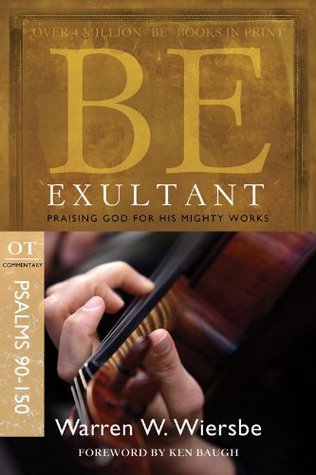
Be Exultant: Wiersbe commentary on Psalms

In my current trek through the Bible, I’ve just finished the book of Psalms. I had not planned to end the book right before Thanksgiving, but I was glad it worked out that way.

Once again, I used Warren Wiersbe’s short “Be” commentary as a companion, along with the ESV Study Bible notes.

Since Psalms is the longest book of the Bible at 150 chapters, Wiersbe divided his commentary on the book into two parts. I reviewed the first one here: Be Worshipful (Psalms 1-89): Glorifying God for Who He Is. The second is Be Exultant (Psalms 90-150): Praising God for His Mighty Works.

As I said in the earlier review, the book of Psalms is Israel’s songbook. The passages cover Israel’s history from creation to the latest happenings of the day, their return after being exiled in Babylon for seventy years.

Though David wrote a majority of the psalms, various other authors contributed as well.

The writers composed in caves, in hiding, in their rooms, under persecution, in celebration.

Many of the psalms are deeply personal, yet benefit the whole congregation.

The psalms are deeply doctrinal, some prophesying of the Messiah to come, many quoted in the New Testament.

But many people value the psalms most for their wide range of emotion, from the highest praise and exaltation to the lowest depths of misery. The psalms give us many examples of someone pouring out their heart to God in confusion, sorrow, pain, or guilt, then reminding themselves of what they know to be true about God.

Here are some of the quotes from Wiersbe’s book that most stood out to me:

Life is brief, so Moses prayed, “Teach us.” Life is difficult, and he prayed, “Satisfy us.” His work at times seemed futile, so he prayed, “Establish the work of our hands.” God answered those prayers for Moses, and He will answer them for us. The future is your friend when Jesus is your Savior and Lord (p. 25, Kindle version).

It is better to suffer in the will of God than to invite trouble by disobeying God’s will (1 Peter 2: 18–25) (p. 26).

This hidden life of worship and communion makes possible the public life of obedience and service (p. 26).

To rely on our faith is to put faith in faith, but to rely on God’s faithfulness is to put faith in the Lord. Our assurance is in the Word of God and the God of the Word (p. 102).

The Word of God performs many wonderful ministries in the life of the devoted believer. It keeps us clean (v. 9), gives us joy (vv. 14, 111, 162), guides us (vv. 24, 33–35, 105), and establishes our values (vv. 11, 37, 72, 103, 127, 148, 162). The Word helps us to pray effectively (v. 58) and gives us hope (v. 49) and peace (v. 165) and freedom (vv. 45, 133) (p. 110).

What a precious treasure is the Word of God (vv. 14, 72, 127, 162; 61: 5)! It is like a deep mine filled with gold, silver, and precious gems, and we must take time to “dig” for these treasures (Prov. 2: 1–9; 3: 13–15; 8: 10–11; 1 Cor. 3: 9–23). A mere surface reading of Scripture will not put spiritual treasure into our hearts. Mining treasure is hard work, but it is joyful work when we “mine” the Bible, as the Spirit guides us into truth. Then, the Spirit helps us to “mint” the treasure so we can invest it in our lives (obedience) and in the lives of others (witness) (p. 131).

Wrong ideas about God will ultimately lead to wrong ideas about who we are and what we should do, and this leads to a wrong life on the wrong path toward the wrong destiny
(p. 193).

I’m thankful once again for Dr. Wiersbe’s insights.