Book Review: True Strength

I don’t read many celebrity biographies or memoirs. But we had seen Kevin Sorbo in a couple of things, then noticed he starred in Christian-based movies the last several years (he portrayed the atheist professor in God’s Not Dead). And he seems to have become more outspoken about his Christian faith on Twitter and Facebook. I became interested in his story. So when I saw his book, True Strength: My Journey from Hercules to Mere Mortal—and How Nearly Dying Saved my Life, come out on a Kindle sale, I got it.

He grew up in Mound, Minnesota, with small-town values and a strong work ethic. He got some modeling jobs to help pay bills in college, then starting acting in commercials. Soon he got the starring role in three Hercules movies, which then transitioned to a TV series, becoming one of the top shows in its day.

Just as things were going well, Kevin noticed a lump on his shoulder. It turned out to be not cancer, but an aneurysm. A chiropractic maneuver released hundreds of blood clots in his arm and a few in his brain, triggering three mini-strokes. At first, the doctors’ main concern was saving his arm. But Kevin experienced a host of symptoms, from vision loss to lack of balance to buzzing and vibrating in his brain to headaches. The only treatment seemed to be physical therapy and time. Doctors called his health crisis “one in seventy-five million.”

Both because Kevin was a private person, plus he and the producers didn’t want his Hercules persona to be tarnished, the full extent of his condition was not made public. He filmed the rest of the series with minimum camera time, creative use of a body double, and plots that worked around his situation.

Kevin talks about faith in the book, but there’s no real conversion point or switchover. It’s more like he reached back for the faith he had been brought up with and started praying and relying on God to see him through. He rejected the “hellfire and eternal flames of misery on us sinners” that his childhood pastor preached. That in the Bible, but his pastor seems to have used it as a club to beat over people’s heads rather than an invitation. Kevin did believe in a “loving, forgiving God” and acknowledged that:

Before my illness I was fully preoccupied with the material side of life. Moving at the speed of light, I ignored the spiritual side, the unseen. God created this world, but I was determined to live in it to the fullest, to get the most out of it. I figured He would want that

Through his illness, he realized:

My illness made me special—in a way that I never wanted nor expected, yes, but if I was to be special, then I was going to do something with that gift. I wasn’t a half-god or any part god. I was a mere mortal, with human limitations and problems, but I was determined not to behave like a victim anymore.

His dear wife deserves an MVP award: they were engaged when Kevin’s illness struck, and she was his main support all through it.

There are some crude spots in the book, some sexual encounters (though not explicit), and a bit of bad language (though some of it is disguised comic strip-style with keyboard characters).

Even though our situations were very different, my experience with transverse myelitis helped me identify with-some of the neurological issues and the long recovery.

It was also interesting reading about some of the behind-the-scenes aspects of the film industry.

I appreciate Kevin’s sharing his story and wish him and his family all the best.

(Sharing with Carole’s Books You Loved)

Book Review: Termination Zone

Termination Zone is the sequel to Adam Blumer‘s thriller, Kill Order (linked to my review).

In the first book, pianist Landon Jeffers had surgery for a brain tumor. After he recovered, he began waking up with partial memories of things he wouldn’t normally do. He found out an organization had implanted a chip in his head in order to control him and have him do their bidding. And he discovered he was not the only one.

Landon has been in hiding in the months since the last book, but he is discovered. His method of jamming his implant’s signals is no longer working. He’s on the run again. But an unexpected help directs him home: his mother is in danger.

Landon learns the organization behind the implants is called the Justice Club. He’s also told that a covert group is trying to thwart and disable the organization. His contact tells Landon they want him to work from inside the club. It’s a dangerous prospect, and Landon is not sure whom to trust. But he decides to work with the Justice Club’s hidden opponents. Landon tries to discern what the Justice Club is up to, but their aim is bigger than he imagined. Will he find out in time? Can he do anything about it? Will it endanger the woman he loves?

This sequel starts off with a bang and grabbed me from the first page. Fast-paced action and mystery kept me riveted.

Landon had become a Christian in the last book, and he struggles realistically in this book to learn to yield to God, to pray, to seek God for discernment and guidance.

Adam has pledged to readers to keep his novels clean. There are no sexual scenes, bad language, or gore. He proves that an excellent, thrilling novel can be written without all that. There are bad guys who are out for people’s lives, but there’s nothing gratuitous.

Once again, Adam has done a superb job. The fact that thrillers aren’t my usual reading fare, yet I eagerly await Adam’s every new book, should tell you something about his writing.

Update: Here is a trailer for the book which I just became aware of:

(Sharing with Carole’s Books You Loved, Booknificent Thursday)

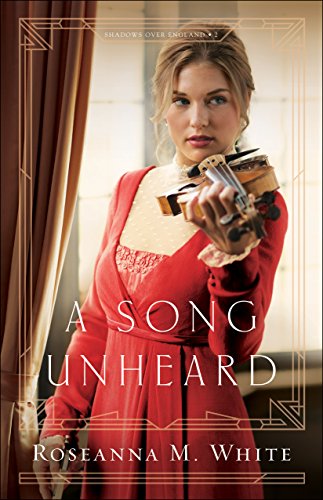
Book Review: A Song Unheard

A Song Unheard is the second of Roseanna M. White’s Shadows Over England series set during WWI. The series involves a group of young people who were orphaned or abandoned as children, found each other, and formed their own family. They support themselves by stealing, but they have a strict code to steal only from those who won’t miss the loss.

Willa Forsythe had found an abandoned violin as a child and discovered she could make it sing. She had a natural talent to play beautifully by ear.

She’s approached by the mysterious Mr. V., who gave a job to her sister, Rosie, in the previous book, A Name Unknown. Mr. V. has some connection with the British government, but they are not sure what exactly it is or whether it is in an official capacity. But he pays well. He wants Willa to travel to Wales and pretend to be an old school chum of a couple of sisters who are aiding a group of musicians from Belgium. They are trying to gather relief efforts for the folks back home. Her specific job: get to know acclaimed violist Lukas De Wilde and find a cypher that he carries with him. Lukas’ father, now deceased, had been a talented cryptographer. V. wants the cypher to aid Britain in the war.

Lukas is worried sick about his mother and sister. He had been shot in an attempt to find them and get them out of Belgium. He knew their home had been destroyed, but he didn’t know their whereabouts or status. His face and his father’s work were both well-known enough that he can’t risk going back to Belgium. Meanwhile, he tries to hide his injury and work with the orchestra while trying to figure out what to do.

He and Willa are intrigued with each other, but he’s a known flirt, so she doesn’t take him seriously. She knows they are from two different worlds, and he would never respect her if he knew what she was. But the more she gets to know him, the more she regrets that she will have to betray him. And unknown dangers lurk just beyond her awareness.

My thoughts:

I loved this book as much as the first one. The story, the history, and the characters were all wonderfully written. During the last few chapters, I wished I could set aside everything else just to find out what would happen.

One of the things I most appreciate about this author is that she is not afraid to be clear about spiritual matters. So many Christian writers are so subtle these days about the faith element in their stories that, unless you already understood what Christianity is, you’d never figure it out in their books. Roseanna proves that you can talk about Christianity normally and clearly without sounding preachy or strained or artificial.

The sister in the previous book had come to know the Lord. In a family of thieves, a conversion will necessitate some changes. Even though the sister is non-judgmental and still a loving part of the family, Willa feels a little betrayed. This is something that’s not often dealt with in Christian fiction, and I am glad Roseanna explored it.

Both of Willa’s parents had abandoned her, and she transfers her feelings about them to God. She felt He was someone who either wasn’t there or didn’t care about her. I loved her journey.

I listened to the audiobook read by Liz Pearce. I thought her narration was a little too blustery in the last book. But either I got used to her style, or her characterizations for this book were much more pleasant. At any rate, I enjoyed it and look forward to Book 3!

(Sharing with Carole’s Books You Loved, Booknificent Thursday)

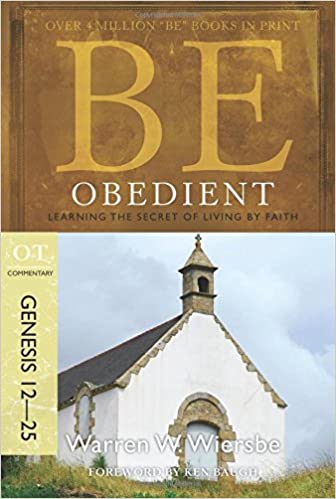
Book Review: Be Obedient

Be Obedient (Genesis 12-25): Learning the Secret of Living by Faith by Warren W. Wiersbe is the second in his three-part commentary on Genesis. These chapters cover the life of Abraham.

Humanity had not had a good track record so far In Genesis: sinning in paradise, murder, drunkenness, immorality, and rebellion. But in His longsuffering, God continued working with man.

In this section, God called Abraham to leave his family, his country, and his idols and go to the land where God sent him. God promised Abraham He would bless him, make his name great, make of him a great nation, and through him bless “all the families of the earth” (Genesis 12:1-3).

Abraham and his wife, Sarah, were not sinless examples of living by faith. While I am not happy when anyone makes wrong choices, I am encouraged that even towering figures like Abraham were not perfect, and we can confess our sin, be forgiven, pick up, and go one. Abraham and Sarah are both listed in what is sometimes called the “Hall of Faith” in Hebrews 11.

Ultimately, Abraham’s story is about God showing grace and faithfulness and setting aside a line of people through whom the promised Messiah would eventually be born.

In the last chapter, Wiersbe lists several ways “all the nations of the earth” are blessed through Abraham.

  • “Abraham left us a clear witness of salvation through faith.” Romans 15:3: “Abraham believed God, and it was counted to him as righteousness.”
  • “Abraham also leaves us the example of a faithful life. James used Abraham to illustrate the importance of proving our faith by our works (James 2:14-26). Wherever Abraham went, he pitched his tent and built his altar, and he let the people of the land know that he was a worshiper of the true and living God.”
  • “From Abraham, we learn how to walk by faith.”
  • “Abraham gave the world the gift of the Jewish nation; and it is through the Jews that we have the knowledge of the true God plus the Word of God and the salvation of God (John 4: 22).”
  • “Finally, because of Abraham, we have a Savior.” Matthew 1:1 begins, “The book of the genealogy of Jesus Christ, the son of David, the son of Abraham.”

Here are a few of the other quotes that stood out to me in this book:

Living by faith means obeying God’s Word in spite of feelings, circumstances, or consequences. It means holding on to God’s truth no matter how heavy the burden or how dark the day, knowing that He is working out His perfect plan. It means living by promises and not by expectations.

“The victorious Christian life,” said George Morrison, “is a series of new beginnings.”

God alone is in control of circumstances. You are safer in a famine in His will than in a palace out of His will.

When you disobey the will of God, the only right thing to do is to go back to the place where you left Him and make a new beginning (1 John 1: 9).

God’s remedy for Abraham’s fear was to remind him who He was: “I am thy shield, and thy exceeding great reward” (Gen. 15: 1). God’s I AM is perfectly adequate for man’s “I am not.”

The Hebrew word translated “believed” means “to lean your whole weight upon.” Abraham leaned wholly on the promise of God and the God of the promise. We are not saved by making promises to God but by believing the promises of God.

In times of testing, it is easy to think only about our needs and our burdens; instead, we should be focusing on bringing glory to Jesus Christ. We find ourselves asking “How can I get out of this?” instead of “What can I get out of this that will honor the Lord?” We sometimes waste our sufferings by neglecting or ignoring opportunities to reveal Jesus Christ to others who are watching us go through the furnace.

Once again, I am indebted to Dr. Wiersbe for his helpful insights.

(Sharing with Worth Beyond Rubies, Grace and Truth,
Carole’s Books You Loved, Booknificent Thursday)

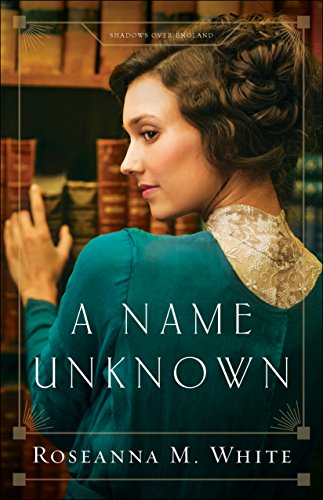
Book Review: A Name Unknown

In A Name Unknown by Roseanna M. White, Rosemary Gresham’s parents died when she was eight, and she found herself on London’s streets. Eventually she and similar children formed themselves into a makeshift family with the older ones taking care of the younger the best way they knew how: stealing. Rosemary’s many years of practice have honed her skill into an art, taking her from pickpocketing to mixing with and stealing from society’s upper echelons.

A mysterious Mr. V. asks Rosemary to do a job with the biggest payoff she’s ever seen: gain access to a Peter Holstein, a “rich bloke” who “has the king’s ear.” Holstein’s family roots are German. War is brewing with Germany. V suspects Holstein is a traitor and wants Rosemary to find solid evidence.

Fortunately, Holstein has just advertised for a librarian to organize his stacks of books and family papers, and Rosemary applies for the job.

Peter Holstein is aware that trouble is brewing over his name and associations. He is not in public much due to a stutter, but his absence is taken for aloofness. He has secrets of his own, but they don’t include espionage: he’s a best-selling author writing under a pseudonym. He prays God will guide him. Rosemary seems the answer to his prayers: hopefully she can help him find family journals and documents which will prove them loyal British subjects.

My thoughts:

I loved this book on many levels: the intrigue of Rosemary’s search and whether she’ll be found out; her prejudices about “rich blokes” being upended by what she sees in Peter; Peter’s frequent lapses into the work he’s writing and decisions over his plot; his awkwardness and trouble expressing himself orally; his efforts to live out his faith; her constant chatter and his need for quiet.

This is the first book in a Shadows Over England series, and I immediately bought the second book after finishing this one.

(Sharing with Booknificent Thursday, Carole’s Books You Loved)

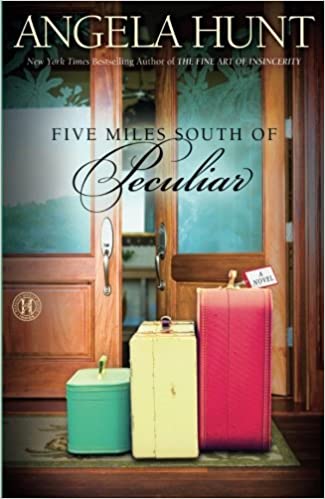
Book Review: Five Miles South of Peculiar

Five Miles South of Peculiar, Florida, there’s an estate known as the Sycamores. The man who built it set up an annuity for his descendants to live on. But fifty years after his death, the property will go to the county (I never quite understood why that would be the case).

The current residents of the Sycamores in this novel are two middle-aged sisters. Darlene is the oldest and the queen bee. She’s not only very domestic, but she’s on (and usually runs) several different committees in church and in town.

The youngest sister, Nolie (short for Magnolia), lives a quiet life with her dogs and garden, making unique aprons for anyone and everyone. She has never lived anywhere but the Sycamores and never wants to live anywhere else. She assumes the good townspeople will let the sisters keep their home when their time runs out.

One more sister, a Broadway singer named Carlene, lives in New York. Though she’s quick to tell everyone she’s not a star, the Peculiar residents think of her as a local celebrity. She doesn’t get back home often, but not because of her busy schedule. She and Darlene are twins and used to be close. But for most of their lives, they have gotten along better if Carlene keeps her distance.

But now, Carlene is coming home for a birthday celebration. She hasn’t told anyone, but a botched throat surgery has left her unable to sing. She’s not sure what her next steps should be and if she’ll even be welcome in her family’s home.

Further complicating matters, an ex-preacher named Erik shows up at the Sycamores looking for work. His church let him go after his wife left him, and he needs to support himself and decide what’s next.

Sparks don’t fly outwardly very often. Everyone keeps their opinions mostly to themselves. But that also means they don’t talk about their issues.

The point of view switches between the sisters, and it’s amazing how the same words or actions can be interpreted so differently. Each character has his or her own sorrows, Darlene, in particular, is apt to color a situation with her own inferences.

I loved the tag line of the book: “If these three sisters don’t change direction, they’ll end up where they’re going.”

You’d think a book about sibling issues would be depressing, but the snappy dialogue and comic asides keep things lively. A few samples:

She stepped off the plane and felt hot, humid air cover her like a damp blanket.

What if someone had been using a video camera? If anyone filmed her fall, she could be on the Zoo Tube, or whatever they called it, by nightfall.

You know how things are in a small town—your neighbor is known by his first name and his last scandal.

I thoroughly enjoyed this book and am going to look up more by Angela Hunt.

(Sharing with Booknificent Thursday, Carole’s Books You Loved)

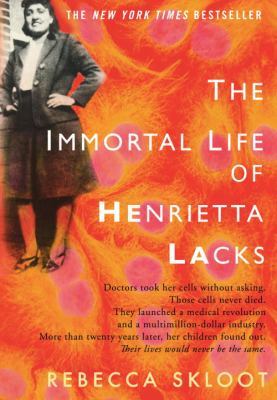
Book Review: The Immortal Life of Henrietta Lacks

In 1951, a thirty-year-old black wife and mother was being treated for cervical cancer at Johns Hopkins Hospital in Baltimore. Unbeknownst to her, the doctor took some of her healthy and cancerous cells for research purposes. This was routinely done before informed consent was common practice.

Like many doctors of his era, TeLinde often used patients from the public wards for research, usually without their knowledge. Many scientists believed that since patients were treated for free in the public wards, it was fair to use them as research subjects as a form of payment (pp. 29-30).

Researchers were trying to grow cells in culture from their samples, but the samples all died. However, Henrietta’s cancerous cells continued to divide over and over under the right conditions. Eventually the cells were used to test Jonas Salk’s polio vaccine on a large scale. They were involved in cancer and AIDS research, experiments in space, cloning, genetic mapping, and much more. The cell line became known as HeLa, using the first two letters of Henrietta’s first and last names.

Henrietta died at age 31 after a horrific battle with cancer. Her family knew nothing about her cells being used in research nor about whole factories being built to house and reproduce her cells. Twenty years later, the HeLa cells were so strong that they easily contaminated other cell cultures. The family began getting calls from researchers who wanted samples of their blood in order to determine the genetic markers of HeLa. Naturally, Henrietta’s family members were confused, not understanding how some part of their mother was alive. When they learned there was a whole industry that sprang up around their mother’s cells, they wondered why they  weren’t getting any of the benefits. Many of them could not even afford health insurance.

Rebecca Skloot first heard Henrietta’s name in a college class, but not much more was said about her. Rebecca wondered about the woman behind the HeLa cells. Ten years of research resulted in The Immortal Life of Henrietta Lacks.

There are several threads to the book. Part of it in Henrietta’s story: what’s known of her background, personality, family. Another thread is the development of the cell line, the scientists involved, the industry that sprang up. Yet another involves the ethics and arguments swirling about research, consent, and compensation. Another tells the story of Henrietta’s children and what became of them. And the final thread is the author’s journey to research the cells and to talk to the family who were, understandably, skittish about reporters by that time. Eventually, Rebecca became very close to Henrietta’s daughter, Deborah.

One of the most touching scenes in the book was when a scientist invited Henrietta’s two youngest children to a lab to see their mother’s cells. Deborah looked in wonder through the microscope and on the screen where the scientists enlarged the cells. She got to hold  vial of her mother’s cells and witness one of the cells on screen dividing.

In the history of cell culture development and cancer research, it was astonishing to read how some researchers would get caught up in the science and forget the human factor. One injected Henrietta’s cancerous cells into other patients without telling them to see if they “caught” cancer that way and to test how healthy and cancer patients fought off the cells differently. Guidelines had been set up after the Nazi experimentation during WWII, but the guidelines weren’t law then.

One patient caught on that something unusual was going on when his doctor kept calling him back for blood work even after the patient had moved away. He learned that his blood produced a unique protein, and the doctor was experimenting and hoping to patent a cell line. Unlike Henrietta, this man had the means to sue the doctor. The case went through several courts and appeals, but the patient finally lost. It was deemed that once your tissue leaves your body, it’s not yours any more. In an afterword, Rebecca said that there are storehouses for tissues and organs removed from patients. Most, I think, would not object to their cells and removed organs being used in study. But when money is being made off their parts, they naturally feel entitled to a portion of the proceeds. Rebecca’s afterword details the latest (at the time the book went to press in 2009) complicated considerations of the different sides of cell research, ownership, and profitability.

Objectionable elements: unfortunately, there are 4 instances of the “f” word and one graphic scene when Deborah, was being pursued by a cousin.

I had first heard of this book several years ago, but figured it would be too “science-y,” too much like a documentary. Then it came up on an audiobook sale, nicely read by Cassandra Campbell and Bahni Turpin. I’m glad I finally read it. I’m glad Henrietta’s story was finally brought to light, and the medical and ethical discussions were detailed clearly.

(Sharing with Booknificent Thursday, Carole’s Books You Loved)

Book Review: Sandhill Dreams

Sandhill Dreams: A WWII Homefront Romance by Cara Putnam is the second in her Cornhusker Dreams series. The first book, Canteen Dreams, was a fictional retelling of Cara’s grandparents’ love story. Sandhill Dreams features a friend from the first book, Lainie Gardner.

Lainie’s dream was to be a nurse and serve her country. She began her training but then contracted rheumatic fever. She recovered, but still experienced residual symptoms. She had to be careful about overdoing, stress, or anything else that might trigger a relapse.

Still, she wanted to do something to help during WWII. She traveled to Fort Robinson in Nebraska without any prior arrangements, figuring surely they’d find some use for her there.

Tom Hamilton had a serious accident involving a dog bite as a boy, and he’d been afraid of dogs ever since. He joined the Army hoping to work with horses, but the Army assigned him to the canine unit. He hopes he can successfully battle both his disappointment and his fear without any officers or soldiers noticing.

Lainie and Tom get off on the wrong foot. They both have issues to deal with. But perhaps they can help each other recover from their broken dreams and find new ones.

I like stories that aren’t just romance, but have the characters grow, overcome obstacles, etc. This book fit the bill. I thought it ended just a touch abruptly, but perhaps that’s because it’s the middle of a series, and the story is ongoing.

(Sharing with Booknificent Thursday, Carole’s Books You Loved)

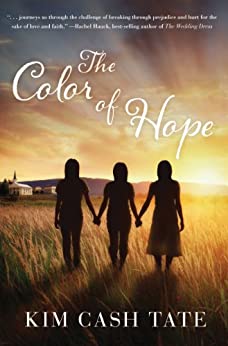
Book Review: The Color of Hope

The overarching story in Kim Cash Tate’s The Color of Hope is that of two different churches, one predominately while, the other predominately black, who try to meet together once a month. Many folks are for this occasional merging, but there’s a small but loud opposition.

But several other stories lines are woven together.

One woman runs into her old boyfriend at a reunion in Hope Springs, NC. She thinks sparks are still there, but in the time since they knew each other, he became a pastor and she walked away from God.

Another woman plans to leave the area, but is unexpectedly offered a position coaching in the high school. Could this be God’s sign that He wants her to stay—and is the assistant principal’s interest purely professional?

One couple lived away from Hope Springs but now feel drawn back to this town of the wife’s father’s roots. The wife misses her multi-ethnic church in the city and isn’t quite sure she’s going to be happy. But she’s asked to substitute teach in the high school and befriends a young outcast named Sam.

There are several subplots as well.

Some would want to know there is a rape and a suicide in the book. The descriptions are not explicit, but they might be triggers for some.

There are so many characters, the first few chapters were confusing trying to sort out who was related to whom, who was with whom, and who was interested in whom. But eventually all the relationships fell into place. Kim has a number of books about the people of Hope Springs, so readers of the series would be more familiar with the characters..

My one little quibble with the book is that, since it’s about primarily racial tensions between two churches, there was no indication for most of the book about which church and characters were what race. I just reread the first four chapters to see if I missed something, but there was only one mention of one girl being blond, which doesn’t really indicate anything. The young girl, Sam, is described as biracial and and feeling like she doesn’t fit in anywhere. Eventually all of that becomes clear, but it made me as a reader feel another layer of confusion trying to figure out the characters.

But, that one little complaint aside, I thought Kim did a great job weaving so many characters and stories and conveying the need to come together rather than pull apart. This book was published in 2013 but seems apropos to 2020.

(Sharing with Booknificent Thursday, Carole’s Books You Loved)

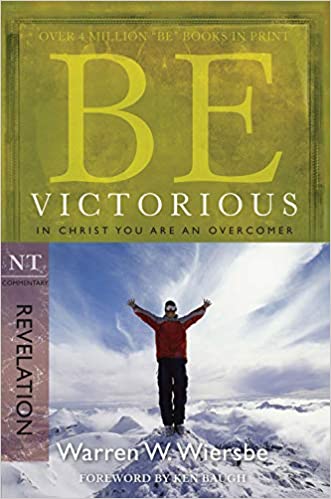
Book Review: Be Victorious

The book of Revelation in the Bible is a challenge for many reasons. Readers and interpreters argue about what’s literal and what’s symbolic, what the symbols mean, what’s going to happen when. In Warren Wiersbe’s brief commentary, Be Victorious (Revelation): In Christ You Are an Overcomer, he mentions “I have dozens of commentaries on this book, and no two authors completely agree on everything.”

But I like Wiersbe’s emphasis:
John’s prophecy is primarily the revelation of Jesus Christ, not the revelation of future events. You must not divorce the Person from the prophecy, for without the Person there could be no fulfillment of the prophecy.

In fact, Wiersbe says in his first chapter:

The word translated “revelation” simply means “unveiling.” It gives us our English word apocalypse which, unfortunately, is today a synonym for chaos and catastrophe. The verb simply means “to uncover, to reveal, to make manifest.” In this book, the Holy Spirit pulls back the curtain and gives us the privilege of seeing the glorified Christ in heaven and the fulfillment of His sovereign purposes in the world.

Although Wiersbe gives a more detailed outline of the book, this one emphasizes how Christ is pictured in each section:

In Revelation 1—3, Christ is seen as the exalted Priest-King ministering to the churches. In Revelation 4—5, He is seen in heaven as the glorified Lamb of God, reigning on the throne. In Revelation 6—18, Christ is the Judge of all the earth, and in Revelation 19, He returns to earth as the conquering King of Kings. The book closes with the heavenly Bridegroom ushering His bride, the church, into the glorious heavenly city.

Wiersbe suggests four reasons for the heavy use of symbolism in this particular book. At the time John wrote it, he was an old man exiled on the island of Patmos, a Roman penal colony. He might have used symbols as a kind of code, so the Roman officers wouldn’t pick up on what he was saying. Another reason: the symbols’ meaning and strength would last through the years rather than being specific to a certain time and culture. A third possible reason: “symbols not only convey information, but also impart values and arouse emotion. John could have written, ‘A dictator will rule the world,’ but instead he describes a beast.” Also, some of the symbols carry over from the rest of the Bible: the church as a bride, Jesus as a lamb. In fact, Wiersbe notes that “Nearly 300 references to the Old Testament are found in Revelation! This means that we must anchor our interpretations to what God has already revealed, lest we misinterpret this important prophetic book.” And he warns that we “must not conclude that John’s use of symbolism indicates that the events described are not real.”

Something that stood out to me this time around reading Revelation was the parallels between it and Genesis. Wiesrbe has a chart with the things that began in Genesis (heaven and earth created, day and night established, the curse for sin, death, people driven from Eden, beginning of sorrow and pain, marriage instituted) and were brought to completion in Revelation (new heavens and earth, no need of sun, no night, curse, death, sorrow, tears, people restored to paradise, marriage supper of the Lamb). I know these must have been pointed in in previous studies or sermon series through Revelation, but it it was like I noticed it for the first time. Maybe I had just forgotten.

I’m not going to get into the explanation and exposition of Revelation and the arguments over the whether and what and when of millennium—that would take too much time and space. Wiersbe presents the reasons for the different views but confesses to be a premillennialist. That’s what I was taught the majority of my Christian life. Our current church is the first we’ve been in that has a different view. I also read from my ESV Study Bible. The commentator there was also careful to explain the different views before stating which he thought was correct. Though he differed from Wiersbe regarding the millennium, they agreed on many other things. Good people can differ on these things. I don’t think different views of the end times are anything to argue or separate over. But, I agree that, as Wiersbe says, “no matter what ‘key’ a student may use to unlock Revelation, he cannot help but see the exalted King of Kings as He vindicates His people and gives victory to His overcomers.”

One good reason for reading and studying Revelation, besides the fact that it’s as inspired as the rest of the Bible, is that “When you have assurance for the future, you have stability in the present.” As more than one Christian has said, “I’ve read the end of the book—I know how it all turns out.” Plus, “A true understanding of Bible prophecy should both motivate us to obey God’s Word and to share God’s invitation with a lost world.”

Here are a few other quotes that stood out to me:

Labor is no substitute for love; neither is purity a substitute for passion. The church must have both if it is to please Him.

The church that loses its love will soon lose its light, no matter how doctrinally sound it may be.

The “overcomers” are not a “spiritual elite,” but rather the true believers whose faith has given them victory (1 John 5: 4–5).

No amount of loving and sacrificial works can compensate for tolerance of evil.

Unloving orthodoxy and loving compromise are both hateful to God.

The first step toward renewal in a dying church is honest awareness that something is wrong.

If men and women will not yield to the love of God and be changed by the grace of God, then there is no way for them to escape the wrath of God.

God’s Word will be there. “The word that I have spoken, the same shall judge him in the last day” (John 12: 48). Every sinner will be held accountable for the truth he or she has heard in this life.

It’s always challenging to go through the book of Revelation, But I am thankful for the help this book gave this time around.

(Sharing with InstaEncouragement, Booknificent Thursday, Carole’s Books You Loved)