God’s Back

I mentioned in my recent review of The Man Who Was Thursday by G. K. Chesterton one quote that stood out to me. While several of the characters are trying to figure out a conundrum, the main character, Syme, says, “Shall I tell you the secret of the whole world? It is that we have only known the back of the world. We see everything from behind, and it looks brutal. That is not a tree, but the back of a tree. That is not a cloud, but the back of a cloud. Cannot you see that everything is stooping and hiding a face? If we could only get round in front—.” The whole book has had a variety of interpretations since its publication, but I took this observation to mean that we don’t have the big picture. In trying to figure out the mysteries of the universe, even believing that God is at the helm and wisely and lovingly guides and provides, there are still things that don’t make sense to us.

In trying to understand the book better, I came across this article. It provided much food for thought though I am not sure I agree with every point. But I did take note of the connection it made between seeing the back of things with Moses seeing the “back” of God. After the disastrous incident of the golden calf, and that after all God had done to manifest Himself to His people, He is so angry that we wants to consume them. In Exodus 32 Moses intercedes, and God relents. In Exodus 33, God tells Moses to continue on with the people toward the land He had promised them, but God’s presence would not go with them. The people mourn and Moses intercedes again in one of my favorite passages, pleading with God for His presence with them.

When God promises to go with them, Moses responds in worship, “Please show me your glory.” God replies:

“I will make all my goodness pass before you and will proclaim before you my name ‘The Lord.’ And I will be gracious to whom I will be gracious, and will show mercy on whom I will show mercy. But,” he said, “you cannot see my face, for man shall not see me and live.” And the Lord said, “Behold, there is a place by me where you shall stand on the rock, and while my glory passes by I will put you in a cleft of the rock, and I will cover you with my hand until I have passed by. Then I will take away my hand, and you shall see my back, but my face shall not be seen.”

Then the next day:

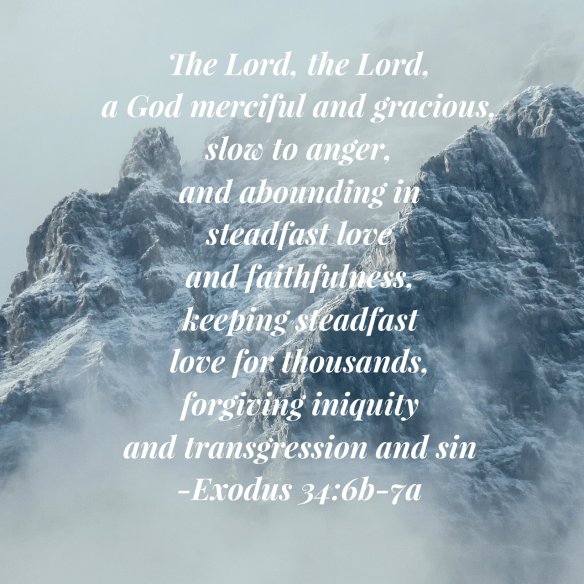
The Lord descended in the cloud and stood with him there, and proclaimed the name of the Lord. The Lord passed before him and proclaimed, “The Lord, the Lord, a God merciful and gracious, slow to anger, and abounding in steadfast love and faithfulness, keeping steadfast love for thousands, forgiving iniquity and transgression and sin, but who will by no means clear the guilty, visiting the iniquity of the fathers on the children and the children’s children, to the third and the fourth generation.” And Moses quickly bowed his head toward the earth and worshiped.

As I pondered these passages once again, this thought struck me:

If this is the back of God – merciful, gracious, slow to anger, abounding in steadfast love and faithfulness, keeping steadfast love, forgiving sin – what must the front be?

No wonder no one can see His face and live! We’d be overwhelmed!

Besides these verses that refer to His mercy, grace, love, and forgiveness, other passages of Scripture tell us about His wisdom, power, omnipresence, and so many other attributes.

I don’t know exactly what we’ll “see” of Him in heaven, but I do know this: I may not understand everything that happens, I may question why some things have to be and wonder why God does some things and doesn’t do other things, but what I do know to be true of Him helps me to trust Him for what I don’t understand.

IMG_0716

(Sharing with Inspire Me Monday, Literary Musing Monday, Glimpses, Tell His Story, Woman to Woman Word-filled Wednesday, Coffee for Your Heart, Porch Stories, Faith on Fire)

Laudable Linkage

img_0021

Here are recent reads that have captivated my attention:

Love Like Birch Trees.

How to Sit at the Table With Those Who Hurt and Offend You, HT to Linda. “Extending love to someone who offended you does not mean you’re accepting such treatment – it means you realize you cannot thrive in a place of anger and resentment.”

What to Say Instead of “I Know How You Feel” to Someone Who Is Struggling, HT to Linda. Sharing our similar experience in an effort to let someone know they’re not alone often just draws attention to ourselves and makes the other person feel unheard. This gives a helpful distinctive.

When Our Heroes Don’t Live Up to Their Theology, HT to Challies. How do we think about spiritual giants who were blind to the wrongness of slavery.

Helping Your Daughter by Being Her Emotional Coach, HT to Story Warren.

You Can’t Have Ethics Without Stories, HT to Story Warren.. “We often forget what the Bible actually is. If not a dictionary or an encyclopedia, what is it? The Bible is, among other things, he writes, ‘a faith-forming narrative.’”

Why Children’s Books Should be a Little Sad, HT to Story Warren.

How DNA Testing Botched My Family’s Heritage, and Probably Yours, too, HT to Challies.

And finally, this dog has a dedicated owner:

Happy Saturday!

(Links do not imply complete endorsement of sites or authors.)

What do you know?

I recently read about a young woman’s experience running into a beloved Sunday School teacher she’d had as a child. As her heart swelled with fondness and gratitude for this woman’s ministry in her life, she opined that it’s the relationships, not the instruction that matters.

While I rejoiced in the relationship this woman had with her teacher and the way it inspired her to teach her own students, I was saddened that she downplayed the lessons. Religious instruction matters very much. The epistles are replete with warnings about wrong doctrine and correction thereof. Yet relationships are important, too. They help flesh out the truth and get it from the head to the heart.

I’ve heard the acquiring of Biblical knowledge downplayed because “Knowledge puffeth up, but charity edifieth,” according to I Corinthians 8:1.  That’s an example of ripping a verse out of its context and not couching it in the overall setting of the whole Bible. Yes, the Bible warns us against becoming proud of our knowledge, but it doesn’t discourage us from gaining knowledge.

Creation reveals knowledge of God’s existence, wisdom and ways. “The heavens declare the glory of God, and the sky above proclaims his handiwork. Day to day pours out speech, and night to night reveals knowledge.” Psalm 19:1-2.

God was angry with Job’s friends because they had not spoken what was right about Him.

God asked Job, “Who is this that darkens counsel by words without knowledge?

Job was comforted by the truth of knowing that his “Redeemer lives, and at the last he will stand upon the earth.”

The psalmist asks, ‘Make me to know your ways, O Lord; teach me your paths. Lead me in your truth and teach me, for you are the God of my salvation; for you I wait all the day long.” Psalm 25:4-5

The psalmist urges people to “Give ear, O my people, to my teaching,” including “the glorious deeds of the Lord, and his might, and the wonders that he has done” – information about Him as a means to knowing Him – and to pass that knowledge down to the next generations.

The first few verses of Proverbs say that Solomon gave them, “to know wisdom and instruction; to perceive the words of understanding; to receive the instruction of wisdom, justice, and judgment, and equity; to give subtilty to the simple, to the young man knowledge and discretion. A wise man will hear, and will increase learning; and a man of understanding shall attain unto wise counsels.” By contrast, later in the chapter it says fools hate knowledge.

Paul prayed for people who had “a zeal for God, but not according to knowledge” (Romans 10:1).

See how many times in 1 Corinthians 6 Paul says, “Do you not know…?”

Paul told Timothy to “Avoid the irreverent babble and contradictions of what is falsely called ‘knowledge'” (1 Timothy 6:20).

Peter tells us to supplement our faith with virtue, knowledge, self-control, and other qualities.

That’s just a small sampling of passages that talk about knowledge. If we also look at passages that talk about leaching and learning, we see that God places great value on them.

I have also heard the argument that it is more important to know by experience than to just know facts: for instance, it is better to spend time interacting with a person than just learning about them. It’s true that many of those passages about knowledge are referring to this experiential type of knowledge. But isn’t it also true that in getting to know someone you learn facts about them, their likes, dislikes, preferences, etc.? Years ago I saw a comical card for a wife from a husband depicting various domestic scenes. I don’t remember the exact wording, but the gist of it was, “I may not do A, B, and C that you want me to, and I may do D, E, and F that you don’t want me to, but I sure do love you, honey!” But living with an utter disregard for a wife’s preferences is not a manifestation of love. If husbands are to dwell with their wives according to knowledge, how much more should God’s people seek to know what pleases and displeases Him?

God has given us His Word, among other reasons, that we may know Him. We learn about Him that we might think of Him correctly and know how to please Him. Yes, just learning facts about Him is not sufficient and doesn’t take the place of knowing Him. But knowing Him without learning His Word makes for a shallow relationship.

God wants us to love Him with not just our hearts and souls, but our minds, to be transformed by the renewal of our minds, to gird up the loins of our minds.

It’s true that knowledge can “puff up” with pride, but rather than avoiding gaining knowledge, we need to remind ourselves that If anyone imagines that he knows something, he does not yet know as he ought to know” (1 Corinthians 8:2), and we need to remind ourselves that the purpose of gaining knowledge is to better know the Lord and serve Him and others.

It’s true there are some things that surpass our ability to comprehend, like the love of Christ and the peace of God.

It’s true that if we have all knowledge, but have not love, we are nothing. But that doesn’t mean we abandon knowledge. That verse also says “if I have all faith, so as to remove mountains, but have not love, I am nothing.” We obviously don’t abandon faith. But we use knowledge and exercise faith in love.

We do have to be careful to keep things in balance and not become like the Pharisees, who were all academic knowledge and no heart and soul. We shouldn’t stop with just learning facts about God or think of knowledge as an end in itself, but we should acquire knowledge of God through His Word in order to learn to know Him better, to get to know Him experientially, and to show love to His people, our spiritual family, in a way that builds them up in truth, and to answer those who would pervert or distort the faith. Like Paul, we pray that our “love may abound more and more, with knowledge and all discernment” (Philippians 1:9) and that we might “[increase] in the knowledge of God” (Colossians 1:10b).

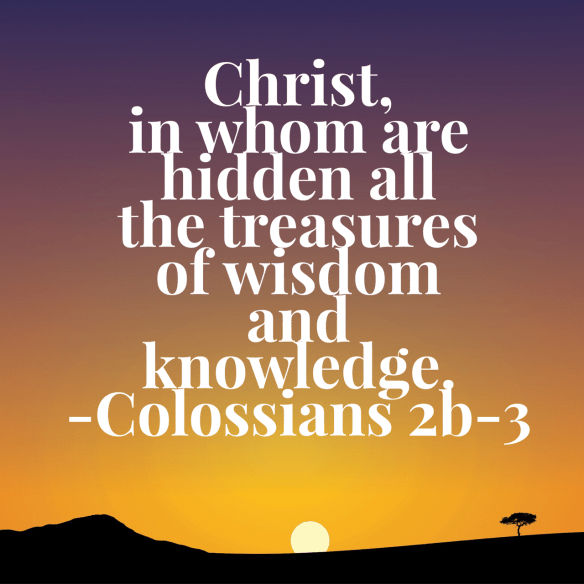
That their hearts may be encouraged, being knit together in love, to reach all the riches of full assurance of understanding and the knowledge of God’s mystery, which is Christ, in whom are hidden all the treasures of wisdom and knowledge. Colossians 2:2-3
(Sharing with Literary Musing Monday, Inspire Me Monday, Glimpses, Tell His Story, Woman to Woman Word-filled Wednesday, Coffee for Your Heart, Porch Stories, Faith on Fire)




Laudable Linkage

IMG_0195

I have a short but good list of thought-provoking reads discovered in the last week or so.

Freak Out Thou Not. This Means You.

On Being a Christian Woman in the Year of Our Lord, 2018, HT to Challies. A lot of good thoughts here, among them: “We must teach the women to act like Christian women, not door busters. We must teach them that the Christian life is not one of getting our way or forcing our plans or barging in––it’s one of dying daily, humble waiting, prayerful dependence, and unseen service where our right hand is ignorant of our left.”

Well-behaved Women Rarely Make History,” HT to True Woman. The article from which this statement was taken out of context actually lauded well-behaved, ordinary women. (On a side note, I have no idea what the author means by “God’s seven eyes” – I have never heard that before.)

Publicly, We Say #MeToo. Privately, We Have Misgivings, HT to Challies. “The fact that such unwelcome advances persist, and often in the office, is, yes, evidence of sexism and the abusive power of the patriarchy. But I don’t believe that scattershot, life-destroying denunciations are the way to upend it. In our current climate, to be accused is to be convicted. Due process is nowhere to be found.”

Logan Paul and Our Embrace of Two Minutes Hate, HT to Challies.

Boring Church Services Changed My Life. “The work of ministry is not so much about finding new, tantalizing ways to make people excited about Jesus, but about the timeless rituals that shape their hearts.”

Three Questions for the New Year. I like this: simple, but effective. Somehow I have never seen the first one on any goal-setting plan, and I am wondering why no one thought of this before?! Someone probably has and I just haven’t come across it til now. But I don’t know why I never thought of it. I do this with planning for a day but for some reason never thought about it when planning for the year.

This is not a new post, but an older one I return to occasionally: The New Year talks about setting goals rather than resolutions and considering all the different aspects of your life.

And a couple of funnies found on Pinterest:

To be fair, the instructions could have been clearer: Show your work, or Write and equation for this problem. But I love this answer from a very literal-minded child. I tend to be like that with math, too – I don’t know how I got it, I just figured it out.

*Eyeroll*

Happy Saturday!

When everything fails

I’m currently reading in the book of Isaiah, about 20 chapters in, to the part where God pronounces judgment on different nations. To be honest, it’s not a section I look forward to or revel in. In the past I probably would have summarized the chapters as:

Chapter 16: God judges Moab
Chapter 17: God judges Damascus
Chapter 18: God judges Ethiopia
And so on…

But this time, either because God is opening my understanding (something I have been praying for Him to do), or because I got a new ESV study Bible, or, more likely, those two factors are working together, I am seeing some things I never saw before.

It started with the footnote on chapter 18:4-6:

Working as silently as heat or dew, God frustrates human attempts at securing the world without him. He watches until the moment is right, and then acts. This is the truth underlying the appearance of human might in history. (ESV Study Bible, p. 1272).

Then I noticed a lot of things in chapter 19, focusing on Egypt.

In verses 1-4, the “idols tremble at his presence” and there is social unrest.
In verses 5-10, the Nile is dried up, affecting their economy and daily lives.
In verses 11-15, the wisdom of Egypt (which the ESV footnote says they were famous for) fails and “the wisest counselors of Pharaoh give stupid counsel.”

But this is not just dishing out judgment. It’s showing the futility of everything they trusted in, much like the plagues that occurred before the exodus of Israel from Egypt were not just random events but a triumph of God’s power over that of supposed deities. And why do that? Because that’s the only way they’d turn to Him, the one true God, the only One who could help them.

19 In that day there will be an altar to the Lord in the midst of the land of Egypt, and a pillar to the Lord at its border. 20 It will be a sign and a witness to the Lord of hosts in the land of Egypt. When they cry to the Lord because of oppressors, he will send them a savior and defender, and deliver them. 21 And the Lord will make himself known to the Egyptians, and the Egyptians will know the Lord in that day and worship with sacrifice and offering, and they will make vows to the Lord and perform them. 22 And the Lord will strike Egypt, striking and healing, and they will return to the Lord, and he will listen to their pleas for mercy and heal them.

All of the terrible things in the first part of the chapter were not just a matter of judgment, but they were an evidence of mercy, to open their eyes and bring them to Himself.

And someday, Egypt, once an enemy and an oppressor of God’s people, will take its place with Israel as a blessing:

24 In that day Israel will be the third with Egypt and Assyria, a blessing in the midst of the earth, 25 whom the Lord of hosts has blessed, saying, “Blessed be Egypt my people, and Assyria the work of my hands, and Israel my inheritance.”

A few take-aways I’ve gleaned from this section so far:

  • God is not only behind history, always observing and evaluating what’s going on, but often orchestrating it.
  • His purposes are mercy and redemption unless that mercy is spurned, and then there is nothing left but judgment. But God is patient and longsuffering, giving nations and individuals as much of a chance to repent as possible.
  • Sometimes awful things that happen are not just a matter of His judgment, but of His opening eyes to false hopes and saviors to the only true one.

What does this mean for us in our day?

If these things are true in Isaiah’s day, they’re still true now. I see a lot of people, especially young adults, despairing over the state of the world. Sometimes it seems like God is not at work. But He is. He’s doing things we can’t see with larger purposes and on a grander scale than we can take in. Some day wrongs will be made right. We can trust Him for that and for every day until then. That doesn’t mean we don’t pray, speak out, or act – God often uses those efforts. But our dependence is on Him.

Also, there are times when everything we look to or rely on is taken away or fails us. That’s an opportunity to look to Him. That was my situation when I was saved: my family was falling apart, my parents were divorcing, we moved from everything familiar to a large metropolis, I had no contact with friends for a while. I felt like the rug had been completely pulled out from under me. I’d had encounters with the gospel and believed to an extent, but at this time everything crystallized for me. I became aware of deep spiritual need and cast myself on God in a way I hadn’t before. It’s not that God orchestrates problems in our lives to create a need for Him: rather, He strips everything away to reveal a need that was already there that we couldn’t see or hadn’t paid attention to. Sometimes He has to show us that nothing else is sufficient to meet that need before we’ll turn to Him. It may seem terrible and confusing and unsettling, it may seem like God is absent or doesn’t care. But He’s very much there, He does care, and He is acting in wisdom and mercy. He’s more than sufficient to meet any need we have.

(Sharing with Inspire Me Monday, Literary Musing Monday, Glimpses, Telling His Story, Coffee for Your Heart, Porch Stories, Faith on Fire)

Laudable Linkage

IMG_0195

I’ve come across a lot of good reading already in 2018! Here is some that stood out to me in various ways:

How an Old Man Helped Save My Faith, HT to Challies.

I Couldn’t Call God “Father,” HT to Challies. A sweet testimony of an Iranian woman’s journey to Christian faith.

Show Me Your Endurance. “While church leaders dismissed my friend as unpolished and uneducated, I realized her experience was a part of my discipleship journey in ways that information acquisition and discipleship habits alone were not. I saw in her life what my own could look like as I trusted God to be there for my child and for me.”

These Hibernation Days, HT to True Woman. “Winter is a fallen seed, before it has sprouted again. It is God’s gift to us, to teach us of the value of rest, quiet, hiddenness, and death.”

Harsh Light, HT to Story Warren.

A few with the new year in mind:

Bible Reading Schedules. A couple of these I have seen before, a couple were new to me.

Preventing Spiritual Scurvy this Year: The Micronutrient Bible Reading Plan, HT to Challies.

Beginning of the Year Check-in Questions for Christians, HT to Challies. “Don’t leave your spiritual growth up to spontaneity. Make a plan. Now that we’re in 2018, here are some questions to ask as you formulate ways to grow.”

A Launch-Yourself-Forward Worksheet. If your resolutions or “one word” choices fizzle out sooner rather than later, this worksheet might help you implement those changes.

How (Not) to Read Next Year, HT to Bobbi.

They are our children, after all. When everything does not turn out all right in our children’s lives.

Clearing to Neutral: The One Habit That Stops You From Procrastinating, HT to Lisa.

What Sugar Does to Your Brain, HT to Challies. Not good news after the excess sweets throughout December.

And finally, many of us are in a very cold weather system right now. We haven’t had snow here except for about an hour one day. I hope those of you “snowed in” get some sunshine and warmer temperatures soon. Meanwhile…

Happy Saturday!

For God’s Glory

Recently I was reading a post from someone who had a child with a disability, and he mentioned that God did everything, including this, for His own glory.

While I agree with that statement, I think non-Christians and skeptics, and even some Christians, have trouble with the idea of God allowing what we would think of as bad to happen for His own glory. What kind of person does everything for his own glory, anyway?

Well, when humans seek their own glory, it’s usually self-motivating and undeserved. Sure, we’re to give honor to whom honor is due, and there may be times an authority has to demand the respect due their position. The latter is usually not for selfish motives, but to be able to enforce the authority they’ve been given to keep whatever order they’re in charge of. But if we say someone is seeking glory, we think of them as prideful and maybe even a bit immature and would probably be quick to think of their faults which would undermine any glory they think they deserve. Everyone wants significance, everyone wants to matter, but that’s different from seeking glory.

God, on the other hand, is perfect. He’s also the sovereign, almighty ruler of the universe. He’s the only One who deserves glory in that sense. But He’s not an egomaniac striving for attention. He is also good and kind and wise and loving.

He doesn’t seek glory because He “needs” it. He seeks it because we need it.

But we all, with open face beholding as in a glass the glory of the Lord, are changed into the same image from glory to glory, even as by the Spirit of the Lord. 2 Corinthians 3:18

It’s only when we see His glory that we see our own need and His sufficiency, that we get to know Him better and love Him more. It’s only by beholding His glory that we’re changed to be like Him.

What about those hard things that God allows for His glory, like a man who had been blind all his life, or a man who had been lame for 38 years, or the death of a beloved friend? I remember one time being especially troubled about the man lame for 38 years: maybe I was around 38 at the time and could not wrap my head around being lame for a lifetime. Why had God let him languish for so long before healing him? In each of these cases, the healing or resurrection magnified the Lord even more: their long duration (of the blindness or lameness) or difficulty proved that this wasn’t a trick, a set-up. If Jesus could heal such hard cases, that was a further evidence that He was God. But what about the poor people in such a state? 2 Corinthians 4:18:18 says:

So we do not lose heart. Though our outer self is wasting away, our inner self is being renewed day by day.  For this light momentary affliction is preparing for us an eternal weight of glory beyond all comparison, as we look not to the things that are seen but to the things that are unseen. For the things that are seen are transient, but the things that are unseen are eternal.

I had a friend one time get offended that God called the trial she was going through a light affliction when it was anything but light to her. It was heavy, weighty, burdensome. But He wasn’t “making light” of it: He was saying that our affliction would seem light compared to the “eternal weight of glory” being prepared for us. We can’t even imagine what that will be like!

What I think most people mean when they say God did or allowed something hard for His own glory is that somehow through those circumstances, people were drawn to Him or learned something of Him that they would not have any other way. Somehow in the least likely situations, suddenly they see Him clearly. Sometimes through someone else’s ministering to them, sometimes through unusual provision, sometimes in peace or a reminder of God’s love from His Word. But all of a sudden, a ray of light pierces the darkness. We see a glimpse of His glory, and then we’re assured of His love and power and ability to take care of anything we’re dealing with. More than that, we see His majesty and greatness, and we’re lifted out of our own fog and doldrums into pure worship.

And [Moses] said, I beseech thee, shew me thy glory.

And he said, I will make all my goodness pass before thee, and I will proclaim the name of the LORD before thee; and will be gracious to whom I will be gracious, and will shew mercy on whom I will shew mercy.

And he said, Thou canst not see my face: for there shall no man see me, and live.

And the LORD said, Behold, there is a place by me, and thou shalt stand upon a rock:

And it shall come to pass, while my glory passeth by, that I will put thee in a clift of the rock, and will cover thee with my hand while I pass by: And I will take away mine hand, and thou shalt see my back parts: but my face shall not be seen.

And the LORD descended in the cloud, and stood with him there, and proclaimed the name of the LORD.

And the LORD passed by before him, and proclaimed, The LORD, The LORD God, merciful and gracious, longsuffering, and abundant in goodness and truth…
Exodus 33:18-23; 34: 5-6

God’s desire for us to see His glory isn’t for egotistical reasons: it’s to show us His goodness.

May this be our prayer:

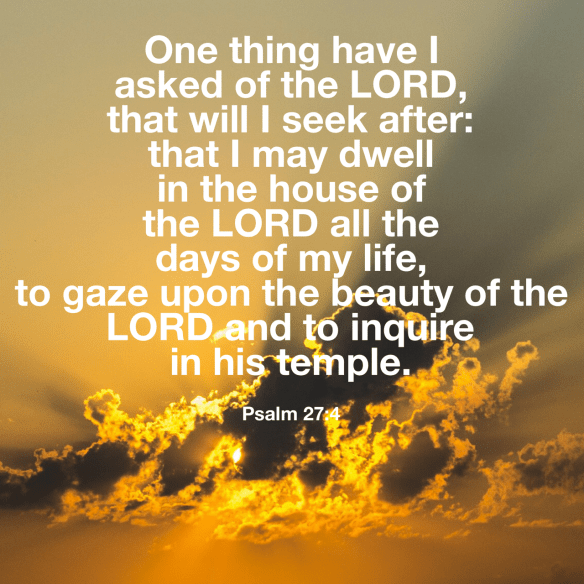
One thing have I desired of the LORD, that will I seek after; that I may dwell in the house of the LORD all the days of my life, to behold the beauty of the LORD, and to enquire in his temple. Psalm 27:4.

(Sharing with Inspire Me Monday, Glimpses, Literary Musing Monday, Tell His Story, Coffee for Your Heart, Porch Stories, Faith on Fire)
Laudable Linkage

IMG_0195

I don’t usually post these two weeks in a row, but I came across a number of good reads this week!

Answering Claims That the Bible Contains Errors, and Why It Matters That It Doesn’t, HT to Challies.

What Expository Preaching Is Not, HT to Challies.

God Has a Heart for the Vulnerable. Do you?

Feel the Love

Doing Church Away From Church Isn’t Church, HT to Challies.

Nine Questions to Ask Yourself to Prepare for 2018, HT to Challies.

100 Years. 100 Million Lives. Think Twice, HT to Challies. I’ve been quite alarmed in recent months to see young people lauding communism. “For many students, casually endorsing communism is a cool, edgy way to gripe about the world.” “Communism cannot be separated from oppression; in fact, it depends upon it. In the communist society, the collective is supreme. Personal autonomy is nonexistent. Human beings are simply cogs in a machine tasked with producing utopia; they have no value of their own.”

On Leaving Jerusalem. “While the media is great at capturing events, they are not so great (or so interested) at capturing context or proportion.”

Living Out Our Faith. Great ways to serve the Lord as a family.

Crying in Home Depot at Christmas.

Lastly, I don’t know anything about the speaker here or the film he talks about, so this is not an endorsement, but a friend shared this on Facebook and I found it interesting. I had never heard what he shared about the significance of Jesus being wrapped in swaddling clothes before.

Happy next to last Saturday before Christmas!

Laudable Linkage


IMG_0195

Here’s my latest round-up of thought-provoking, noteworthy reads discovered in the last few weeks.

Bibles are not talismans. It’s all about the words.

The Importance of Margins.

What Would Jesus Do About Transgender? HT to Challies.

13 Things a Pastor Should Never Say to a Congregation, HT to Challies. Yes.

7 Hard Truths About Retirement, HT to Challies.

Ban the bike! How cities made a huge mistake in promoting cycling, HT to Challies.

If you like writing about imagination, children’s literature, and families, you might be interested in writing for Story Warren: they’re looking for new contributors.

Finally, I was looking for this yesterday in talking about my young grandson’s imagination. I couldn’t find it then but found it later in the afternoon.

Happy Saturday!

Laudable Linkage

IMG_0195

My latest round-up of newly discovered noteworthy posts:

Doing Spiritual Warfare Without All the Weirdness, HT to Challies.

Dear Mormon – I Can’t Call You a Brother in Christ, HT to Challies.

A Beautiful Table and a Bitter Heart, HT to Challies. Good not just for Thanksgiving!

What Is Thanksgiving Anyway?

Dr. Martyn Lloyd-Jones on Obsession With Polemics, HT to Challies. It’s necessary but shouldn’t be the main thing. Some helpful considerations.

Which Are Better: Old Books or New?

The Last of the Iron Lungs, HT to Challies. A handful of people with polio still rely on them, but they’re not sold or maintained by the the manufacturers any more. Fascinating article. And, though this is not the main point of it, I was inspired by those who are trying to make the best of their circumstances, like the man who took his iron lung to college, practiced law for the few hours a day he could go without the iron lung, until he started needing it almost 100%. Now he’s writing his memoirs while encased in it.

I don’t mean to toot my own horn, but in case you missed it, I announced the Laura Ingalls Wilder Reading Challenge for February 2018 and included a long list of related books to consider for those who might want to read beyond just the Little House series.

Finally, I didn’t listen to all this, but overheard a good bit while hubby was listening. Press Secretary Sarah Sanders began the last press briefing before Thanksgiving asking the reporters to share something they were thankful for before asking their questions. What we found amazing was the way they whole atmosphere changed by doing that, from confrontational and adversarial to convivial!

Happy Saturday! It’s Christmas decoration day for us!