The Holy Spirit’s Activities

Some time ago I came across a post with a question something like, “Do you believe in the miraculous gifts of the Holy Spirit or do you believe He is inactive today?” I can’t remember exactly how it was worded, but I do remember it was presented as an either/or proposition: either you believe in what we call the “sign gifts” – speaking in tongues, miraculous healings, etc. – or you believe the Holy Spirit has been basically sitting on the sidelines since the first century.

But that’s an unfair proposition. The Bible presents a number of activities or ministries of the Holy Spirit.

He helps believers.

“And I will ask the Father, and he will give you another Helper, to be with you forever, even the Spirit of truth” (John 14:16-17a, ESV. KJV says “Comforter”).

“Nevertheless, I tell you the truth: it is to your advantage that I go away, for if I do not go away, the Helper will not come to you. But if I go, I will send him to you.” John 16:7.

He assures believers of their relationship with God.

For you did not receive the spirit of slavery to fall back into fear, but you have received the Spirit of adoption as sons, by whom we cry, “Abba! Father!” The Spirit himself bears witness with our spirit that we are children of God, and if children, then heirs—heirs of God and fellow heirs with Christ, provided we suffer with him in order that we may also be glorified with him. Romans 8:15-17.

By this we know that we abide in him and he in us, because he has given us of his Spirit. 1 John 4:13.

He helps us in prayer.

Likewise the Spirit helps us in our weakness. For we do not know what to pray for as we ought, but the Spirit himself intercedes for us with groanings too deep for words. And he who searches hearts knows what is the mind of the Spirit, because the Spirit intercedes for the saints according to the will of God. Romans 8:26-27.

He helps us to hope.

May the God of hope fill you with all joy and peace in believing, so that by the power of the Holy Spirit you may abound in hope.  Romans 15:13.

He pours God’s love into our hearts.

And hope does not put us to shame, because God’s love has been poured into our hearts through the Holy Spirit who has been given to us. Romans 5:5.

He teaches us.

But the Helper, the Holy Spirit, whom the Father will send in my name, he will teach you all things and bring to your remembrance all that I have said to you. John 14:26 (KJV says Comforter rather than Helper).

He guides us.

When the Spirit of truth comes, he will guide you into all the truth, for he will not speak on his own authority, but whatever he hears he will speak, and he will declare to you the things that are to come. John 16:13.

He glorifies Christ.

He will glorify me, for he will take what is mine and declare it to you. John 16:14.

He convicts.

Nevertheless, I tell you the truth: it is to your advantage that I go away, for if I do not go away, the Helper will not come to you. But if I go, I will send him to you. And when he comes, he will convict the world concerning sin and righteousness and judgment: concerning sin, because they do not believe in me; concerning righteousness, because I go to the Father, and you will see me no longer; concerning judgment, because the ruler of this world is judged. John 16:7-11.

He is involved in our salvation.

Jesus answered, “Truly, truly, I say to you, unless one is born of water and the Spirit, he cannot enter the kingdom of God. That which is born of the flesh is flesh, and that which is born of the Spirit is spirit.” John 3:5-6.

For we ourselves were once foolish, disobedient, led astray, slaves to various passions and pleasures, passing our days in malice and envy, hated by others and hating one another. But when the goodness and loving kindness of God our Savior appeared, he saved us, not because of works done by us in righteousness, but according to his own mercy, by the washing of regeneration and renewal of the Holy Spirit, whom he poured out on us richly through Jesus Christ our Savior, so that being justified by his grace we might become heirs according to the hope of eternal life. Titus 3:3-5.

You know that when you were pagans you were led astray to mute idols, however you were led. Therefore I want you to understand that no one speaking in the Spirit of God ever says “Jesus is accursed!” and no one can say “Jesus is Lord” except in the Holy Spirit. 1 Corinthians 12:2-3.

He baptizes us into the body of Christ.

For just as the body is one and has many members, and all the members of the body, though many, are one body, so it is with Christ. For in one Spirit we were all baptized into one body—Jews or Greeks, slaves or free—and all were made to drink of one Spirit. 1 Corinthians 12:12-13.

He gifts us for service.

Now there are varieties of gifts, but the same Spirit; and there are varieties of service, but the same Lord; and there are varieties of activities, but it is the same God who empowers them all in everyone. To each is given the manifestation of the Spirit for the common good. For to one is given through the Spirit the utterance of wisdom, and to another the utterance of knowledge according to the same Spirit, to another faith by the same Spirit, to another gifts of healing by the one Spirit, to another the working of miracles, to another prophecy, to another the ability to distinguish between spirits, to another various kinds of tongues, to another the interpretation of tongues. All these are empowered by one and the same Spirit, who apportions to each one individually as he wills. 1 Corinthians 12:4-11.

He dwells within us.

On the last day of the feast, the great day, Jesus stood up and cried out, “If anyone thirsts, let him come to me and drink. Whoever believes in me, as the Scripture has said, ‘Out of his heart will flow rivers of living water.’”  Now this he said about the Spirit, whom those who believed in him were to receive, for as yet the Spirit had not been given, because Jesus was not yet glorified. John 7:37-39.

And it is God who establishes us with you in Christ, and has anointed us, and who has also put his seal on us and given us his Spirit in our hearts as a guarantee. 2 Corinthians 1:21-22.

You, however, are not in the flesh but in the Spirit, if in fact the Spirit of God dwells in you. Anyone who does not have the Spirit of Christ does not belong to him. But if Christ is in you, although the body is dead because of sin, the Spirit is life because of righteousness. If the Spirit of him who raised Jesus from the dead dwells in you, he who raised Christ Jesus from the dead will also give life to your mortal bodies through his Spirit who dwells in you. Romans 8:9-11.

He seals us.

In him you also, when you heard the word of truth, the gospel of your salvation, and believed in him, were sealed with the promised Holy Spirit, who is the guarantee of our inheritance until we acquire possession of it, to the praise of his glory. Ephesians 1:13-14.

And do not grieve the Holy Spirit of God, by whom you were sealed for the day of redemption. Ephesians 4:30.

He fills us.

And do not get drunk with wine, for that is debauchery, but be filled with the Spirit. Ephesians 5:18.

He produces fruit in us.

But the fruit of the Spirit is love, joy, peace, patience, kindness, goodness, faithfulness, gentleness, self-control; against such things there is no law. Galatians 5:22-23.

And this isn’t even an exhaustive study! Some of these things take place once at salvation, some are continuing ministries until we get to heaven (I probably should have separated them into those categories, but this has already gotten much more involved than I planned. Perhaps I’ll come back and do that another time. I’ve come across several things I need to study more just in this brief study.)

My purpose here is not to go into which ministries or gifts of the Holy Spirit are still active today. The great majority of these are still active. The ones that are disputed (tongues, interpretations, healings, miracles. God does still heal and work miracles; the question is whether He uses healers or miracle-workers to do so) have been better handled by others elsewhere, and there is not time and space to deal with them right now anyway. I personally know dear people who love God with all their hearts on both sides of the issue.

My point, rather, is to call attention to all the other things the Holy Spirit does. He is quite active in our day. Why do we get so fixated on those few gifts? Are we just as happy to have the Holy Spirit guide us, teach us, work in us love and gentleness and self-control, glorify Christ in and through us? Or do we prefer the “flashier,” seemingly more exciting and unusual gifts?

Whatever you believe about the “sign gifts” of the Holy Spirit, don’t neglect to study and appreciate all of these other things He does in God’s children.

(Sharing with Inspire Me Monday, Literary Musing Monday, Wise Woman, Woman to Woman Word-filled Wednesday, Faith on Fire)


Laudable Linkage

img_0021

Once again, here are some of the reads I found thought-provoking this week:

How to Read the Bible For Yourself.

Walking in the Spirit. Probably the most helpful explanation I have seen of this. I had long ago noticed the similarities between being filled with the Spirit in Ephesians 5:18-33 and letting the Word of Christ dwell in us richly in Colossians 3, and wondered how that worked together. This is the first time I have seen it explained.

How Can I Forgive Myself, HT to Challies. “You do not need to supplement divine forgiveness with any self-forgiveness. Your forgiveness in Christ is complete. Receive it. Remember it. And rejoice in it. If your testimony is, ‘God has forgiven me,’ that is enough!”

For the mom who doesn’t have time to read her Bible. Love this. “Bible time is not only an hour at the crack of dawn, or an intense evening devotion, or a dedicated small group meeting.”

Michelangelo’s David and the Gift of Limitations, HT to The Story Warren.

Do Visitors From Your Church Really Feel Welcome? HT to Challies.

No Time For Widows, HT to Challies. The best part: “Every widow is an individual person. No one likes being lumped into a group and having assumptions made about them based on demographics. The only way to truly help a widow is to get to know her.”

Some questions I’m asking while off to my white evangelical church, HT to Challies.

An Open Letter to the Person Caring for a Loved One With Dementia, HT to True Woman. My own m-i-l was not one to “explode” in anger as is mentioned here, but I know some of you have dealt with that.

It’s Never a Good Time to Invite Kids In.

27 Things People Don’t Realize You’re Doing Because You’re a Highly Sensitive Person, HT to Lisa. I could easily identify with about half of these, and somewhat identify with more.

And a few words of wisdom from Pinterest:

Happy Saturday!

Save

Laudable Linkage

IMG_0195

Here’s some interesting reading discovered recently:

What Is Inductive Bible Study?

How To Be a Friend to Someone Who Has Breast Cancer. The tips here are great for a friend with almost any illness.

I Got Pregnant. I Chose to Keep My Baby. And My Christian School Humiliated Me. “My school could have made an example of how to treat a student who made a mistake, owned up to it, accepted the consequences, and is now being supported in her decision to choose life. But they didn’t.” This is a difficult situation. I understand Christian schools not wanting to appear to be condoning certain behaviors, but I think a girl in this situation needs to be affirmed for doing the right thing in having her baby rather than having an abortion.

A Theology of the Home, HT to Challies.

Check Your Privilege, HT to Challies.

A Patient Perseverance: a mother’s prayers for a wayward son.

And finally, this is me. 🙂

Or this is even more my style, minus the spa.

Happy Saturday!

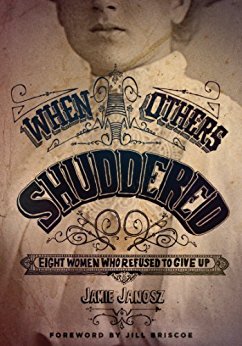
Book Review: When Others Shuddered

When Others ShudderedWhen Others Shuddered: Eight Women Who Refused to Give Up by Jamie Janosz contains eight short biographies of women who lived between 1820 and 1955 who influenced their world for God. They came from different walks of life: some single, some married, some wealthy, some former slaves. They were ordinary women except, as the title indicates, they didn’t “shudder,” they didn’t turn away from circumstances or tasks that many of us would have, and thus they can inspire us.

They are:

Fanny Crosby, who was blinded due a mistreatment to her eyes when she was six weeks old. Yet she later thanked God for this “gift,” feeling that it set the course of her life and made her more attuned to God working in and through her. Fanny determined to be optimistic, and her mother and grandmother tried to give her as normal a childhood as possible and teach her about God. She went to a blind school, taught there, married, was active in Christian work. She had always loved music and reading and composed poems since her girlhood, and that grew into hymn writing, many of her hymns well-known ones that we still sing today. The book shares her manner of hymn-writing and many of the incidences that led to hymns.

Emma Dryer was “a thinker, a dreamer, a girl who wanted more out of life” (p. 37). She loved and excelled at school and eventually became a teacher even though extra schooling was thought to “make women unfit for marriage and motherhood” (p. 37). She loved teaching and the orderliness of her life, but wondered if there was something more. A bout of severe typhoid fever hanged her life and made her want to give herself to Christian work. Visiting the growing city of Chicago, she was burdened with the needs of people, particularly women, there who came to the city to work but were often led astray. She felt “the Bible was the solution to the social problems” she saw there (p. 42). A meeting with D. L. Moody and the Great Chicago Fire of 1871 convinced her that she was needed in Chicago. Eventually Moody talked with her about a training school he wanted to establish, something right up Emma’s alley. Emma worked and planned toward that end, but Moody, distracted with his travels, meetings, and other work, didn’t get around the the school for some time. When Emma, who could be outspoken and confrontational at times, wrote strongly to him about it, he was offended and decided to leave Chicago and start a school in NY. But another letter and the urging of his wife and others led him to Chicago and the founding of the Moody Bible Institute.

Nettie McCormick was the wife of Cyrus McCormick, wealthy from his invention of a reaper. A number of her children died, she suffered several miscarriages, two of her children developed mental illnesses, and Nettie herself went deaf at age 34. She “struggled to see God’s hand” (p. 66) but wrestled in prayer and rested in Him. The McCormicks were always generous, giving to many good causes and works, and after Cyrus died, Nettie continued to give wherever she could, even to missionary schools in other countries. She wasn’t self-promotional and did much behind the scenes, but she didn’t stay behind her four walls: she traveled and even planted trees herself in front of a building she had funded. She was close friends with Emma Dryer and a major supporter of Moody and the Institute.

Sarah Dunn Clark grew up wealthy and privileged, but in her mid-twenties felt God’s urging to work in that which will last for eternity. She moved to Chicago and helped in many ways by visiting needy families and establishing a mission Sunday School. She met her husband there: they moved in the same social circles and had similar burdens. They visited slums and jails and opened a small rescue mission “in the heart of what people called ‘the devil’s territory'” (p. 80), which eventually eventually became the Pacific Garden Mission (which you may know of from the radio program Unshackled). George was called by some “the poorest preacher who ever tried to expound God’s Word,” but he was “deeply convicted and spoke emotionally about the condition of the lost” (p. 81). Sarah became the “mother of the mission,” ministering to people on a personal level. “In her quiet way, she extended respect and dignity to people regardless of their condition. It was this steadfast love that broke through many hardened hearts” (p. 87). The Clarks invested all of their money in the mission and lived simply and frugally.

Amanda Smith grew up the child of parents who were slaves at two different farms. Her father purchased his freedom, and the rest of the family was set free as the dying wish of the family’s daughter they tended. Her parents “believed in God,” “demonstrated a calm and steady faith” (p. 92) and were active helpers for the Underground Railroad. Amanda was only able to attend a short time of school and then began domestic work. Lonely one day, she decided to attend church, where the preaching and singing reminded her of home, and she felt God “wanted her, a poor, simple black girl, to serve Him” (p. 93). She wanted to be a “consistent, downright, outright Christian” (p. 99). Her first husband was a drunkard and died; only one of her children lived to adulthood; her second husband deceived her as to what kind of a man he was so she would marry him, deserted his family, and later died. She was invited to camp meetings, began to sing and testify at them, and soon people were paying her expenses to do so at other camp meetings. She had opportunity to travel to England, India, and Africa. She never asked for money, but prayed, and God sent her money that she then used to meet needs she saw in other places. She became active in the Christian temperance union, established an orphanage, and wrote a book about her life.

Virginia Asher became active in Christian work after her salvation, in time particularly drawn to “‘fallen women’ and the madams who ran houses of prostitution. She was often called in to read and pray with the sick, write letters to parents, dress wounds, and whisper words of peace to the dying” (p. 119). She helped care for their children: though she was unable to have her own, she “took in the world of lost souls and mothered them with divine love” (p. 122). She and her husband sometimes entered saloons and ask if they could put on a brief service for their customers – and they were allowed to. She established Business Women’s Councils.

Evangeline Booth was the daughter of William and Catherine Booth, founders of the Salvation Army in London, who “believed in the three ‘S’s while reaching those the rest of society rejected: soup, soap, and salvation” (p. 148). Evangeline remained single and eventually became the head of the Salvation Army in the US, and eventually led it internationally.

Mary Mcleod Bethune was born after the Emancipation Proclamation to parents who had been slaves. She thirsted for education and prayed earnestly for it. God answered through a local mission school and later through scholarships to other schools, eventually to Moody Bible Institute. She had a beautiful singing voice and toured with the choir. She wanted to be a  missionary in Africa, but God closed the door. She eventually established a school in Florida with the meagerest of supplies, in opposition to the white community and the KKK, which eventually joined with another college to become Bethune Cookman. She became an advisor to presidents, eventually taking the newly created position of administration of the Office of Minority Affairs for FDR and then other government posts, and established the National Council of Negro Women. She realized her dream of going to Africa when as a US representative she went to Liberia for the inauguration of their new president when she was in her seventies.

Along with more detail about the life and faith of these women, there are three chapters on “Woman and Education,” “Women in Missions,” and “Women in Politics,” detailing a bit of the history of the times in each of those areas. A final chapter wraps up “Being That Kind of Woman,” discussing some of the key features they had in common. None had a trouble-free life: some dealt with poverty, health issues, marital problems, deaths of children, opposition. None were faultless or flawless. But each sought to follow God in the way that He led them and relied on Him for what they needed to do so.

You may have noticed that most of them had some connection with D. L. Moody and/or the Moody Bible Institute. That’s because the author is a professor at Moody and her initial research into Emma Dryer’s life led her to a study of all these women.

If you like biographies, you will probably like this book. If you don’t like biographies but feel you might be able to take them in smaller doses, this book is worth a try. If you like hearing how God has worked in people’s lives and get inspired by them in your own – which is why I like biographies – you will glean a lot from this book.

(Sharing with Semicolon‘s Saturday Review of Books, Literary Musing Monday, and Carole’s Books You Loved)

Save

Save

Faithful in Obscurity

Many years ago, our former pastor preached a series of messages about Jesus’s 12 disciples. Several concentrated on Peter, naturally: he’s the one who is mentioned most often in the gospels and Acts and who also wrote two books himself. James and John, with Peter, made up the closest inner circle. We have memorable and telling scenes in the gospels with Matthew (aka Levi), Nathanael (also called Bartholomew), Philip, Andrew, and Thomas. And, of course, much could be observed about Judas. But there are several about whom we know little except their names and the fact that they were chosen of Jesus and were there in all the situations that involved the twelve.

My pastor pointed out that one lesson we can learn from them is faithfulness in obscurity. Their names might not be the ones everyone remembers: in fact, theirs might be the hardest to come up with in a trivia challenge. But they had their purposes and their duties.

Sometimes God has us “in the background” for a season. I’ve just been reading the first few chapters of 1 Samuel was was struck by how often it’s said that “Samuel was ministering before the Lord” or “Samuel continued to grow both in stature and in favor with the Lord and also with man” in contrast with Eli’s wicked sons. His time of more public ministry came later, and I’m sure he had no idea how far-reaching it would be. But he faithfully served God whether in the background or the limelight. Paul spent three years in Arabia, a section of his life we know little about, before becoming well-known.

Sometimes we’re in obscurity because our mission is to be the help and support behind the one out in front. Perhaps you’ve heard mention of Mr. Edward D. Kimball, perhaps not, but he is the Sunday School teacher who led D. L. Moody to the Lord. From what I have read of him, he faithfully served in that capacity for years, and his ministry in the life of each of his students is as valuable as the one that resulted in a world-famous evangelist. John Newton’s mother was only able to influence her son for Christ for under seven years before she died. But God took the seed sown, watered it, and brought it to fruition years later. I read once where C. H. Spurgeon credited much of the success of his ministry to those who prayed for him behind the scenes.

Some experience a time of seeming obscurity after a wide and public ministry. Philip experienced quite a successful ministry in the city of Samaria, but he was just as faithful and just as useful when called to speak to one man on a desert road. Amy Carmichael had a very busy ministry in India when an accident left her an invalid for the last several years of her life. She might have felt more obscure and less useful, but God used her writings after that time to influence multitudes for years to come. Paul, as well, might have felt pretty obscure in a Roman prison after years of missionary journeys and preaching to crowds, but what we know as the prison epistles were born in that scenario. As Elisabeth Elliot said, our limitations don’t hinder our ministry: they define our ministry.

But probably the great majority of us are like those few disciples in the background. Our name isn’t meant for the spotlight. Maybe we couldn’t handle it. Maybe that’s just not where God wants us to be. People might not ever see or know what we do. But God does. Faithfulness to Him and whatever ministry He has called us to are what matters.

Though this isn’t a post primarily about blogging, some years ago a blogging friend wrote of something that has stayed with me all these years. She was struggling with the desire for more readers. But God helped her with the concept of “feeding those at the table”: being faithful to those who were within her reach and trusting Him with the size of the audience.

In what we call “the parable of the talents,” different people were given different amounts of the master’s money to steward. We’re not told why different ones had different amounts. But the person with only three wasn’t to covet the ten given to another: he was to faithfully invest what was entrusted to him.

It’s not necessarily wrong to seek a wider audience, especially when we’re trying to convey truth and encouragement. And it’s wrong to avoid a larger sphere of ministry if that’s what God is calling us to. But we’re to be faithful whether we’re ministering to few or many, whether our opportunities are wide or seemingly narrow. What matters is doing whatever we do as unto Him, and “thy Father which seeth in secret himself shall reward thee openly” (Matthew 6:4, 6).

(Sharing with Inspire me Monday, Testimony Tuesday, Woman to Woman Word-Filled Wednesday)

Save

Save

Save

Laudable Linkage

img_0021

It’s been a little while since I’ve been able to share some interesting online reads with you. Here is my latest collection:

Behind on Bible Reading? Sometimes our Bible reading plans from January have fallen by the wayside by this time. This is some encouragement to pick back up where you left off: “The point of reading daily is to continuously stay in the Word so I might better know and worship the Lord, not to be legalistically bound to a calendar.”

5 Ways Porn Lies to You. Much of this is true for other sins as well.

God Is Much Greater Than Her Experience of Him.

It’s Not My Place to Judge.” What’s right and wrong with this sentiment.

Yes, You Can Please Your Heavenly Father.

God Will Open Doors For You to Serve.

Manoah’s Wife.

Blame Your Parents?

Parents, Take Time for the Tender Moments.

The Surprising Power of Little Things. HT to Challies.

No, “Saul the Persecutor” Did Not Become “Paul the Apostle.” I would have sworn this was wrong, until I read it.

When Should Christians Use Satire?

Solomon’s Twitter Guidelines.

No, Stay at Home Moms Do Not Waste Their Education, HT to Challies. I have felt this way but hadn’t put in into words quite like this. Very much agree that “Education is not just a synonym for job training” and “Education helps people do a better job at any task by helping them discover how to think, how to learn, and how to exercise the self-discipline necessary for achievement.”

A couple about missionaries:

5 Things Every Missionary Wants You to Know, HT to Kim.

Praying Biblically For Your Missionary: Clarity.

And a couple of funnies found on Pinterest:

Happy Saturday!


Save

Save

Save

Thoughts about women’s ministries

img_0065Every now and then I come across a blog post or article saying something like, “I’m tired of fluffy pink crafty ladies’ meetings. I want to be authentic and go deep.”

I often think, “OK…what exactly does that look like in a ladies’ meeting setting?” Many times the writers say that want Bible studies or opportunities to share that really speak to the core of their Christian walk, where they can share what they’re really struggling with and receive advice and help without being judged. They say they can get craft instruction anywhere; they don’t need it at church. They don’t need scrapbooking or cupcake-making get-togethers. They remind us that every woman is not married or a mother, not every woman is called to be a wife and mother, and we need to minister to the whole spectrum of women represented in our churches, not just wives and mother. They want to discuss and participate in activities to change the world.

And those are all good points.

I’d like to make a few observations.

1. Most women ministry leaders would love to hear suggestions about what ladies would like to do (or they should be. We need to be open to new ideas and not just do the same things we always have). I was a ladies’ ministry coordinator for 9 or so years, and sometimes we’d send out questionnaires to the ladies of the church (to be answered anonymously) asking what they liked, didn’t like, would like us to do. We got very little response from those. A handful of ladies came faithfully; a great many didn’t, and I didn’t know if it was because they didn’t have time, didn’t like what we did, didn’t like us, or what. Plus, sometimes I scrambled for ideas that were new and fresh and that might appeal to a number of ladies. So that kind of feedback would be highly valuable.

2. Make suggestions graciously. Some of these posts have been quite harsh, feeling like a slap across the face or as if the writer is saying, “You’re shallow and I hate everything you do.”

3. Remember different people like different things. If you have two or more people at a church or a meeting, you’re going to have differences of opinion on what and how things should be done. Some women like the fellowship and the crafty things. That doesn’t mean they don’t like Bible study or are shallow. Sure, you can take classes at Michael’s or watch a YouTube video or peruse Pinterest. But often we don’t get to see our friends at church except at church or at these other functions, and it’s fun to get together in that way.

4. Sometimes the crafty things can be a ministry. At one church, we had different ladies share things within their expertise, so it was a way for them to minister when they might not be comfortable leading a Bible study or teaching a lesson. Plus the gathering was not only a basis for forming or growing friendships, it was also a non-threatening venue to invite lost or unchurched friends to. And often at meetings like that, or inbetween meetings like that, we had a woman in the church share her testimony. I remember one in particular in which a woman shared much about her early walk with God and navigating through her young adult years, dating relationships, etc., and was so sad that more of our single young women weren’t there to hear that.

5. It doesn’t have to be either/or. A church or ladies’ group can have informal, fun meetings as well as more serious Bible studies and service projects.

6. Proverbs 31 and Titus 2 do cover more areas than Bible study, though that’s the most important activity. In an era when women might not receive instruction and examples in homemaking as they did years ago, a ladies’ group can help support and instruct along these lines. Most women have a home, whether they have husbands or children, so some of these skills and principles can be helpful to all and can be used to minister to others and glorify God (see Edith Schaeffer’s The Hidden Art of Homemaking.)

7. On the other hand, there is much in those passages applicable to women in any setting regarding character and reaching out to the poor, and much in Proverbs 31 that could be brought out regarding single and working women (business savvy, interacting with merchants, making good quality products, industriousness, dealing with employees, etc.). We do need to make sure every meeting isn’t centered on marriage and motherhood, and, Moms, don’t just call ladies without children only when you need a babysitter.

8. At a time when marriage and motherhood are devalued and under attack, wives and moms need the support, affirmation, and encouragement of the church, and especially other ladies. But we need to remember that single and childless women are under attack in different ways and support, affirm,and encourage them, too. We tend to gravitate towards those in like circumstances and seasons of life, but we can learn from and support each other even when our lives are vastly different. (see When the Message Isn’t For Me.)

9. Deepness can’t be manufactured. Some people, introverts in particular, do like to “go deep,” but would be uncomfortable with a “turn to your neighbor and bare your heart on command” approach. You can have a good Bible study and make every effort for people to feel free to share, but you can’t force it. For some, that inclination will take time to grow; for others, that will only happen with maybe one or two close friends, not in a group setting.

10. Maybe you should go to your church’s ladies’ meetings anyway, even if they’re not exactly what you’d prefer. One of the purposes for almost any ladies’ function is fellowship among the attendees. Maybe a conversation started there will blossom into a warm friendship or an informal mentoring relationship. There’s nothing wrong with formal mentoring, but in my own life, it’s happened informally alongside hospitality and ministry situations. One conversation with an older lady that shaped my thinking about my kids’ teen years took place while we put up a bulletin board in a church hallway. Just being with older women gives you an opportunity to observe, soak up some of their wisdom, and sometimes ask questions.

Something that should have been said first is to pray about it. God knows what kinds of ministries are needed in a given place and the best way to go about them. And consider that if something is on your heat, maybe He is directing you to minister in that way. If you see a need reaching out to the poor, the elderly, single women, etc., perhaps God has brought that to your attention for a reason, either as a function of the ladies’ group or a separate ministry. Though I prefer ladies’ functions when the ladies of the church are all together, there are occasions for a smaller group with a specific focus.

I am at a stage in life when I can’t attend as many of the ladies’ functions as I’d like. With my husband’s mother in our home, I already leave him to take care of her alone most Sunday nights, and I just don’t feel right doing that much more than I already do, plus his work often keeps him from coming home in time for me to go anywhere. I do interact with her caregiver, the hospice nurse, etc., and try to remember to be an encouragement even there. And I admit, it’s cozy staying home on a cold dark night rather than driving a ways and spending an evening elsewhere. But I do strongly believe in women’s ministries and hope to participate in them more in the future. I encourage women to look past their differences and find ways to learn from each other and love each other and encourage each other in the Lord.

See also:

Mentoring Women
Church Ladies’ Groups
Why Older Women Don’t Serve
How Older Women Can Serve
I’m An Older Woman…So Now What?
How Not to Become an Old Biddy
The Quiet Person in the Small Group

(Sharing with Inspire Me Mondays, Testimony Tuesday, Woman to Woman Word-filled Wednesday, Wise Woman, Thought-provoking Thursday)

Save

Save

Save

Save

Manufactured Spirituality

I’ve had this draft sitting here since last July, and had jotted some notes and spent a lot of thought on it even before that. I’ve (obviously) had a hard time bringing my thoughts into a cohesive and coherent unit. I thought about calling it form vs. function, or the mechanics of ministry, or using artificial means to accomplish spiritual ends. Finally what seemed most apt was manufactured spirituality.

I see this on three different levels:

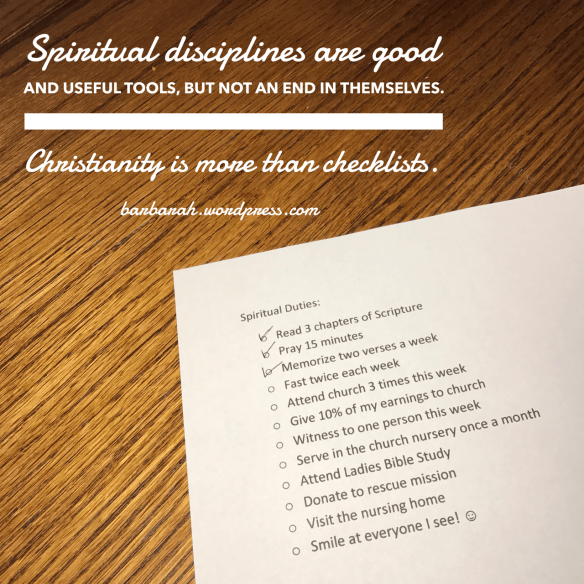
1. To try to be more self-disciplined, we establish habits to aid in godliness, like regular times of reading the Bible or prayer, church attendance, etc.  And that’s a good thing. But we all know what it is to have days when we’re just going through the motions, when our eyes are dragging across the page and we check “Have devotions” off your list of things to do for the day but haven’t really engaged with the text or been affected spiritually. Or we “feel spiritual” if we’ve crossed that duty off or don’t “feel spiritual” if we haven’t.

2. To try to minister more effectively as a church, we set up various programs or committees. But sometimes our routines and programs not only don’t accomplish the ministry for which they are intended, they can even hinder them. For instance, we’d all agree it’s a good thing for church members to greet visitors. But once when we were visiting a new church, no one spoke to us or even looked at us the whole time we were there – except at the hand-shaking time built into the service.They had squeezed all their greeting into that few moments, leaving visitors feeling awkward and not really greeted at all.

We can fall into the trap of thinking that when we show up for church visitation, then we’ve gotten our witnessing obligation in for the week, or because we have official greeters at church, none of the rest of us needs to greet new people, or because there is a committee to take care of x, y, or z, we don’t have to be involved.

3. We try to force results. For instance, we can feel that small groups would be good for the congregation to get to know one another better, and they work best if everyone participates. So we “make” the quiet person participate by putting undue pressure on them to say something, calling them out and putting them on the spot. Then we feel self-satisfied that the group went quite well today because everyone spoke, when we left the quiet person miserable and determined not to come back. Or, as happened to us once in a new church, whatever the pastor was talking about (I’ve forgotten now), at the end he asked everyone to break into family groups and discuss and pray right then and there about how to implement what he preached on. That seemed to my husband and me like forcing the issue or “making” people respond instead of letting God use His Word to convict and change. Another example: we want people to “go deep” in their conversations and relationships, so we have “turn to your neighbor and bare your heart on command” sessions instead of letting those opportunities arise in a more natural way. We’ve known people who made a profession of faith after a zealous Christian buttonholed them and would not back off until the person responded, yet there was no life change, no interest in the Lord afterward. By contrast, Jesus let people walk away sometimes.

Setting up good habits and routines and even programs can greatly aid us in our walk with God. But we have to keep in mind what they are for and not get lost in them for their own sake.

A book I read recently about getting more from our reading of God’s Word emphasized applying what we learn. That’s a good thing: we’re told to be doers of the Word, not just hearers. But his illustration went something like this: we need to apply God’s Word in measurable ways, not vague ones. So if, say, we come to a passage about prayer, instead of saying to ourselves, “We really should pray more,” according to this book, we should instead make plans to pray six minutes every day. As if God cared how many minutes we pray. The better approach, in my opinion, would be to stop and think about what I could and should be praying for. That in itself would generate a longer prayer list than I could probably keep up with (some people divide their prayer lists into categories over several days). Then the next step would be to study the prayers in the Bible, particularly in the epistles. Paul’s prayers in Philippians 1, Ephesians 1 and 3, and Colossians 1 are wonderful examples. Granted, that author probably intended that, if a person planned to pray six minutes and ran out of things to pray in three, that would lead him to these other ways of expanding his prayer life. But the emphasis on “measurable results” can lead to outward exercises without always the accompanying inward change. Similarly, if I read a passage and am convicted about needing to be more loving and less selfish, it might help to think of specific ways in which I need to do those things. But it would be wrong to check those off my list at the end of the day and think, “There! Done! Good work!” Sometimes instead I need to carry those thoughts with me all throughout the day and apply them in ways I couldn’t know I would need to when I first read them.

Years ago we were visiting my in-laws, and a couple of ladies from the church came by to visit my husband’s mother. I think it may have been her birthday, or maybe they were just visiting her as an “older” church member, but they brought a small plant, and, I believe, a card. She tended to be profuse in her thanks, and perhaps to counteract that a bit after she thanked them several times, one of them responded, “Well, you were on our list.” Wow, what a way to deflate any good feelings about someone coming to visit. She never said anything about it after they left, but it would have been understandable if she had thought, “They don’t really care: they just came because I was on ‘a list’ to visit.”

Our ministry isn’t boxed into a particular time, place, or group of people. Our programs don’t take care of all of our obligations. There is a sense in which we should always be “on,” always at the ready to serve. Even if there are official greeters at church, we can greet people when we see them or help a confused visitor find the right place. Even if there is someone designated to send cards to sick Sunday School class members, we can send one, too. If God has placed on our hearts that we need to help someone else in the church, we need to pray about how to do that rather than just dismissing it because our church has a benevolence committee to take care of those things.  If there is trash on the floor, we can pick it up instead of thinking, “There is a custodian for that.”

On the other hand, I’ve known women who felt terrible for not “serving” in church when their whole lives were ministering in “unofficial” ways. One lady would often apologize for not being more involved in our ladies’ group, but she lived next to and helped her elderly mother, cared for a disabled son, was the go-to baby-sitter for the rest of the family. She sang in the choir and took an interest in people, yet felt she wasn’t really being used of the Lord because she couldn’t plug into some of the ministries. Another had to step down from a position for which she was uniquely qualified, and I watched and was blessed as she found various other ways to minister: greeting newcomers, inviting ladies over for lunch, and other ways that didn’t fit in with any particular official ministry in the church, but ministered very well to the people involved.

Habits, routines, programs help greatly in organizing a ministry, and we need to use whatever systems are set up (reporting a plumbing problem to whoever is in charge, signing up for taking a meal to someone so she doesn’t receive two or three in one night or receive something she’s allergic to, etc.). And sometimes we do need those systems and routines because we don’t always “feel like” doing what we need to. A former pastor once said that the best time of prayer he ever has was when he didn’t feel like praying and had to confess that to the Lord right off the bat. Sometimes just doing what we should whether we feel like it or not is the first step to feeling like it.

But we should seek God’s grace to serve not just out of duty, and not to check off all the designated boxes, but with a right heart. The mechanics of ministry and spiritual disciplines are tools, but not the main focus, not the end-all of our efforts. Routines, habits, programs are an avenue of ministry, not an end in themselves, and ministry doesn’t take place only within those parameters. On the other hand, sometimes we can perfectly follow all of our routines, and our programs can seem to be going swimmingly, but we’re unaware that we’re missing something vital.

The simplicity which is in Christ is rarely found among us. In its stead are programs, methods, organizations and a world of nervous activities which occupy time and attention but can never satisfy the longing of the heart. The shallowness of our inner experience, the hollowness of our worship and that servile imitation of the world which marks our promotional methods all testify that we, in this day, know God only imperfectly, and the peace of God scarcely at all. If we would find God amid all the religious externals, we must first determine to find Him, and then proceed in the way of simplicity. Now, as always, God discovers Himself to “babes” and hides Himself in thick darkness. ~ A. W. Tozer, The Pursuit of God

God created whole systems of programs and routines for Israel in the Old Testament. But there were times He told them He hated their sacrifices and feasts – the very sacrifices and feasts He had commanded them (here, here, and here, for a few). Why? Sometimes because they harbored sin in their hearts even while performing their religious duties outwardly. Sometimes because they missed the main point, like those who kept the systematic observations but failed to minister on a personal level, or like Pharisees whose religious zeal was wrapped up in keeping not just God’s law, but their additions to it. God said to them through Hosea, “For I desired mercy, and not sacrifice; and the knowledge of God more than burnt offerings” (6:6). We’re no longer under those systems, but in the same way I think He would want us to implement whatever habits, routines, systems, or programs are helpful, yet not get lost or fixated on them for their own sake, and to keep in mind that the main point is to know Him and make Him known and minister to others in their need in His Name and by the power of the Holy Spirit.

And this is eternal life, that they know you, the only true God, and Jesus Christ whom you have sent. John 17:3

Not by the way of eye-service, as people-pleasers, but as bondservants of Christ, doing the will of God from the heart. Ephesians 6:6

img_0057

 (Sharing with Inspire me Monday, Testimony Tuesday, Woman to Woman Word-Filled Wednesday)

Save

Save

Save

Laudable Linkage

img_0021

This is later in the day than I usually post these, but, looking at my list, I wanted to go ahead and post what I had instead of waiting for a week and having a longer list. If you’re like me, the more there are, the more I get kind of lost in them and lose interest in looking. I found these all thought-provoking in one way or another: perhaps you’ll see something of interest as well.

Irritability. HT to Challies. This one hit me right where it hurts. “Life is never lived in the sterile confines of a sinless, utopian laboratory well-removed from the Curse’s numerous provocations. This side of heaven, we are either about to be provoked, being provoked, just having been provoked, or some combination of the three. Everything inside and outside of us has the potential to provoke in one way or another.”

When They Walk Away, HT to Challies.

Words Matter: Recovering Godly Speech in a Culture of Profanity

Synonyms For the Word of God. Have you ever wondered, especially in places like Psalm 119, what the difference was between a statute, testimony, precept, etc., or whether they were all just synonyms for God’s Word? This article explains the differences.

4 Things to Remember When Thinking About Curses in the Psalms, HT to Challies.

The Threat of Joy in Ministry – one time Jesus tells us not to rejoice.

Creating a Church Culture That Invites Children Into Worship.

Do Children Have a Financial Obligation Toward Parents?

The Craft and Courage of L. M. Montgomery. I was surprised to learn a few years ago that the author of Anne of Green Gables was not happy in her personal life, in contrast to many of her characters.  This was a good perspective.
My Oath of Office. Good no matter who is elected.

Frugal Grocery Shopping Strategy. I need to do better at this.

A couple about writing:

3 Simple Ways to Create Memorable Lead Characters

What Being an Editor Taught Me About Writing, HT to Challies.

And this is all too true these days:

free-speech

Have a great weekend!

Protection for wounded spirits

img_0052As many of you know, I broke and dislocated my little toe about ten days before Christmas. I had never broken any bone before, and this has left me feeling very glad that I hadn’t and hoping that I never will again. Even though it’s just a little toe, the pain, discomfort, and inconvenience have had an impact on me as well as the rest of the family.

The first week I was to stay off of it as much as possible and keep it elevated as much as possible. When I saw the doctor for a follow-up visit a week after the injury, I was hoping for some specific directions for the next weeks. But the doctor was rather vague. He said it should heal in six or so weeks, and if it hurt, that meant I should stay off of it a bit. I was hoping to avoid hurting it.

One thing the doctor did emphasize, though, was protecting the toe. I didn’t have to “buddy wrap” it to the next one like the doctor did the first week, but he gave me adhesive tape to wrap lightly around the foot to keep the toe in place and told me to continue wearing the boot I was given or a good walking shoe. Thankfully we’re coming up on the six week mark, when it should be fully healed.

The emphasis on protecting the broken toe while it heals caused me to think of other injuries or wounds that we don’t really associate with needing protection: spiritual or emotional hurts. The protection for a broken bone involves supporting the broken member so the bone heals correctly. For an open wound, protecting it not only keeps other things from bumping it and causing pain, but covering it keeps it from infection. But we don’t usually think about protecting those who have been wounded in non-physical ways, except perhaps the first few days. And how would we even go about that, anyway?

You might think the answer would be that Christian community should surround and support the wounded member. “Community” seems to be the popular, go-to solution for everything these days. And, yes, we are to “Bear one another’s burdens, and so fulfill the law of Christ” (Galatians 6:2) and “weep with those who weep” (Romans 12:15). Community can do much to help and aid.

But what if community is part of the problem?

When you’re single, longing for someone to love, and there are no prospects on the horizon, but at a wedding people ask, “So when is it going to be your turn?”

When you’ve had four miscarriages, with only the first made public, and someone asks, “So when are you guys going to start a family?”

When you’re mourning on the anniversary of a loved one’s death, and a friend says, “Shouldn’t you be over that by now?”

When years later your family is still suffering the effects of a trauma that, to other eyes, seems to be all over, and someone says, “Shouldn’t you have moved on from that by now?”

When you’re visiting a new church in a new town with some trepidation, and the members of your small group or class aren’t cliquish in the sense that they deliberately keep others out, but they have all been friends for so long that anyone new feels out of the loop. When an observer mentions aside to the leader that perhaps they could take pains to reach out to the new ones, the leader says, “Well, the Bible says if you want to have friends, you should be friendly. They need to extend themselves.”

When people say the wrong things, we need to extend grace and assume they meant well. Thank God for sensitive, Holy Spirit-filled and led people who truly know how to come alongside and help, who know how to comfort as they have been comforted. Lisa shared a wonderful post recently on Invisible Band-aids and the need to be alert and attentive to those wounds which don’t show.

But other people can’t be there all the time, and in a sense it’s true that, as the old hymn says, no one understands like Jesus.

The best protection and support for wounded hearts, minds, and spirits is God’s truth, whether we apply it ourselves or share it with someone else..

When Hannah was childless and her rival provoked her and her husband didn’t understand the full weight of her sorrow, she poured out her heart to the Lord, knowing He was the only one who could meet her need.

When Joseph was betrayed, lied about, and forgotten, he trusted that God was sovereign and meant it for good.

When David’s men blamed him when the Amalekites raided their camp and kidnapped their families, to the point that they were going to stone him, David encouraged himself in the Lord.

When the psalmists brought problems and trials and anguish before the Lord, they eventually reminded themselves of His character, power, and love.

Paul was “troubled on every side, yet not distressed; we are perplexed, but not in despair;  Persecuted, but not forsaken; cast down, but not destroyed; Always bearing about in the body the dying of the Lord Jesus, that the life also of Jesus might be made manifest in our body” (2 Corinthians 4:8-10).

All throughout the Bible, you see people in various troubles or problematic situations reminding themselves of what they knew to be true of God, staking their souls on what He said, no matter how things looked or felt at the time.

A few other parallels between physical and internal wounds came to mind. You often don’t realize what muscles are used where until something is injured. I didn’t realized my toes dug in to keep balance when I picked up something on the floor, or that I pushed off with my toes when reaching for something from a cabinet, or moved my toes when I stretched in bed, and I got some rude awakenings when I did those things. Years ago, recovering from an old-fashioned gallbladder surgery before they started doing them laparascopically, one of the things I had been told to hold off doing was vacuuming. I thought that was odd – vacuuming didn’t seem strenuous to me. But the first time I tried it, I discovered, wow, you do use abdominal muscles when you vacuum! Similarly, after the deaths of my parents, I was unprepared for being blindsided by waves of grief set off by the most innocent things.

Both of them passed away at Christmas time, so for the first few years, though we celebrated, rejoiced, and even laughed, we just weren’t into what a friend called the “froth” of the season. I remember thinking that I wished sometimes that we still wore mourning clothes for a season after the death of a loved one to let others know to be sensitive. With my “boot” now, or when I used a walker or cane after transverse myelitis, I’ve been glad that I had some way of conveying to others that there was a reason I was walking a little more slowly, and hoped those devices signaled them to be careful and not to jostle me. We don’t have any such signalers after a trauma or loss or heartbreak.

Even though the intensity lessens over time, that spot still may be tender for a very long time. One friend whose husband was in prison for several years is very sensitive to jokes about prisoners, or condescending stereotypical remarks about them, or things like baby onesies made to look like prison uniforms, and after her experience, I’m more sensitive to them, too.

We need to take appropriate measure to promote healing – setting a bone, resting, taking medicine for physical wounds; for spiritual ones, we might need to confront an offender, confess any wrong on our parts, forgive, and seek reconciliation. Both health and spiritual ills usually get worse when they are not dealt with. We do have to be careful that we’re not preventing healing or making things worse by nursing our wounds.

But we can no more tell someone with a broken spirit to “get over it” any more than we could someone with a broken limb. Healing takes time. Community can and should help. But ultimately we need to splint our souls to God’s truth, to prevent the infection of bitterness by resting in His love and care, to protect our broken hearts and spirits by trusting in His grace.

The Lord is near to the brokenhearted and saves the crushed in spirit. Psalm 34:18

He healeth the broken in heart, and bindeth up their wounds. Psalm 147:3

Remember your word to your servant, in which you have made me hope. This is my comfort in my affliction, that your promise gives me life. Psalm 119:49-50

Let, I pray thee, thy merciful kindness be for my comfort, according to thy word unto thy servant. Psalm 119:76

Unless thy law had been my delights, I should then have perished in mine affliction. I will never forget thy precepts: for with them thou hast quickened me. Psalm 119:92-93

The hymn “Still, My Soul, Be Still” has ministered to me since I first heard it, and the last couple of stanzas especially bring out the need to stake ourselves on God’s truth:

Still my soul be still
Do not be moved
By lesser lights and fleeting shadows
Hold onto His ways
With shield of faith
Against temptations flaming arrows

Still my soul be still
Do not forsake
The Truth you learned in the beginning
Wait upon the Lord
And hope will rise
As stars appear when day is dimming

God You are my God
And I will trust in You and not be shaken
Lord of peace renew
A steadfast spirit within me
To rest in You alone

~ Words and Music by Keith & Kristyn Getty & Stuart Townend

(Sharing with Inspire Me Monday, Testimony Tuesday, Woman to Woman Word-Filled Wednesday, Tell His Story, Thought-provoking Thursday)

Save

Save

Save

Save

Save