Be Dynamic: Experience the Power of God’s People

Warren Wiersbe has divided his commentary of Acts into two books, the first of which is Be Dynamic (Acts 1-12): Experience the Power of God’s People.

Wiersbe has commented on longer books than Acts in one volume. But I think he must have divided his notes on this book of the Bible because it is such a pivotal book.

Acts was written by Luke as a sequel to the gospel bearing his name. Both books are addressed to Theophilus.

At the beginning of Acts, Jesus had already died, been buried, and been resurrected. He spent 40 days teaching His disciples, then He ascended back to heaven. The last thing He told His disciples to do was to be His witnesses in Jerusalem, Judea, Samaria, and the end of the earth. He promised the power of His Holy Spirit would enable them to accomplish this task. The book of Acts tells the story of how that witness spread.

Perhaps another reason Wiersbe divided this commentary in two is that Peter is the main character in the first twelve chapters. Then the focus shifts to Paul.

Yet a third possible reason: there were so many changes over the course of Acts, some of which are confusing to people to this day. For one, Jesus’s ministry had been primarily to Jews, though He ministered to Samaritans and Gentiles as well. But when God used Peter to open the doors of the gospel to Samaritans and Gentiles (which most believe is what is meant by his being given the keys of the kingdom), many disciples were confused. But they couldn’t argue with the definite way God had led. Then came the whole question of what part the OT law had in the life of a NT disciple. They had to meet together and hammer out these issues, which some of the epistles go into further.

Another change was the coming of the Holy Spirit in Acts 2, as promised by Jesus in Acts 1:4-5 and 8. In the OT, the Spirit came upon certain people at certain times for specific tasks. After Pentecost, the Holy Spirit came to inhabit every believer all the time.

The filling of the Spirit has to do with power for witness and service (Acts 1: 8). We are not exhorted to be baptized by the Spirit, for this is something God does once and for all when we trust His Son. But we are commanded to be filled with the Spirit (Eph. 5: 18), for we need His power constantly if we are to serve God effectively. At Pentecost, the Christians were filled with the Spirit and experienced the baptism of the Spirit, but after that, they experienced many fillings (Acts 4: 8, 31; 9: 17; 13: 9) but no more baptisms (p. 35-36).

Another controversy has to do with Acts 2:44-45: “ And all who believed were together and had all things in common. And they were selling their possessions and belongings and distributing the proceeds to all, as any had need.” Some have said that this is a form of Communism. Wiersbe says it is not, because “the program was totally voluntary, temporary (Acts 11:27-30), and motivated by love” (p. 43).

One striking feature of this era is that the church took persecution for granted as part of life.

They did not pray to have their circumstances changed or their enemies put out of office. Rather, they asked God to empower them to make the best use of their circumstances and to accomplish what He had already determined (Acts 4: 28). This was not “fatalism” but faith in the Lord of history who has a perfect plan and is always victorious. They asked for divine enablement, not escape, and God gave them the power that they needed (p. 68).

In one of my favorite chapters in Acts, chapter 12, Peter is delivered from prison and goes to the home of Mary, where the disciples were praying. If you remember the story, Rhoda comes to the door and is so astonished to hear Peter that she forgets to open it. She runs back in to tell everyone, and no one believes her. Almost every sermon or lesson I’ve heard from this chapter ridicules the disciples for praying without faith. Here they were praying for Peter, yet they couldn’t believe God had set him free. Even Wiersbe takes this view.

But Dr. Layton Talbert (one of our former Sunday School teachers), in his book Not By Chance: Learning to Trust a Sovereign God, brings up a different viewpoint. We don’t know that they were praying for Peter’s deliverance from prison. Dr. Talbert points out that the text doesn’t say. James was killed by Herod earlier in the chapter: since he was not delivered they may not have expected Peter to be, either. “The only precedent we have for the church’s prayer under similar circumstances is in Acts 4:23-30. There, in the face of recent imprisonment, persecution, and renewed threats, the church made only one request. And it wasn’t for deliverance from prison or persecution; it was for boldness in the face of both (4:29)” (p. 203).

A few more quotes from Wiersbe:

Repentance is not the same as “doing penance,” as though we have to make a special sacrifice to God to prove that we are sincere. True repentance is admitting that what God says is true, and because it is true, to change our minds about our sins and about the Savior, (p. 52).

If Satan cannot defeat the church by attacks from the outside, he will get on the inside and go to work (20: 28–31) (p. 79).

God has no grandchildren. Each of us must be born into the family of God through personal faith in Jesus Christ (John 1: 11–13) (p. 108).

Luke summarizes the events up to this point in Acts 12:24: “But the word of God increased and multiplied.

As always, Dr. Wiersbe’s notes were very helpful in studying the Bible.

Focus Determines Direction

When we first started house-hunting in eastern TN, I observed that there were few totally flat lots here in the foothills of the Smoky Mountains. Some houses had driveways so steep, I knew I could never get up and down them on my own.

The hilly land had an effect on roads as well. Many streets had a significant drop-off on one side—with no guard rails. Most were not steep enough to be fatal if one ran off the road. But many would cause injuries or bang up a car pretty well. Some roads were pretty scary even with guard rails.

Naturally, I tried to watch the edge of the road in order to stay in my lane. But when I did, I found myself veering in the direction I was looking.

Sometimes I’d be so concerned about getting too close to the edge, I’d overcompensate and drift in the oncoming lane.

Driving some roads here was nerve-wracking for me unless I disciplined myself to watch the road ahead.

It’s natural that the rest of our body will be drawn to what our eyes are focused on.

It’s natural, too, that our hearts will be drawn toward what our thoughts focus on.

When we focus on our fears, we remain stuck in them.

When we focus on our weaknesses, we remain discouraged and defeated.

When we focus on a sin we’re trying to overcome, that’s all we can think about.

When we fill our thoughts with someone who hurt us, we remain wounded.

How do we move forward?

But we all, with open face beholding as in a glass the glory of the Lord, are changed into the same image from glory to glory, even as by the Spirit of the Lord (II Corinthians 3:18).

How do we behold Him?

In His Word:

And beginning with Moses and all the Prophets, he interpreted to them in all the Scriptures the things concerning himself. (Luke 24:27).

You search the Scriptures because you think that in them you have eternal life; and it is they that bear witness about me (John 5:39).

In His house:

O God, you are my God; earnestly I seek you; my soul thirsts for you; my flesh faints for you, as in a dry and weary land where there is no water. So I have looked upon you in the sanctuary, beholding your power and glory (Psalm 63:1-2).

One thing have I asked of the LORD, that will I seek after: that I may dwell in the house of the LORD all the days of my life, to gaze upon the beauty of the LORD and to inquire in his temple (Psalm 27:4).

In repentance:

If my people who are called by my name humble themselves, and pray and seek my face and turn from their wicked ways, then I will hear from heaven and will forgive their sin and heal their land (2 Chronicles 7:14).

In prayer:

The Lord is near to all who call on him, to all who call on him in truth (Psalm 145:18).

I sought the LORD, and he answered me, and delivered me from all my fears. They looked unto him, and were lightened: and their faces shall never be confounded. This poor man cried, and the LORD heard him, and saved him out of all his troubles. (Psalm 34:4-6).

When we’re driving, we have to glance around us and in our rear-view mirror sometimes. But to get where we’re going safely, our sustained focus needs to be on the road ahead.

In life, we can’t spend every moment in prayer or Bible reading. We have God-given responsibilities to families, communities, workplaces, dwellings. But a sustained focus on Him in His Word and prayer will help keep our sets set on Him in everyday life. Robert Murray McCheyne said, “For every look at yourself, take ten looks at Christ. He is altogether lovely. Such infinite majesty, and yet such meekness and grace, and all for sinners, even the chief!”

I have set the Lord always before me; because he is at my right hand, I shall not be shaken. Therefore my heart is glad, and my whole being rejoices; my flesh also dwells secure. . . .You make known to me the path of life; in your presence there is fullness of joy; at your right hand are pleasures forevermore (Psalm 16:8, 9, 11).

Looking to Jesus, the founder and perfecter of our faith, who for the joy that was set before him endured the cross, despising the shame, and is seated at the right hand of the throne of God (Hebrews 12:2).

The Lord bless you and keep you;
the Lord make his face to shine upon you and be gracious to you;
the Lord lift up his countenance upon you and give you peace (Numbers 6:24-26).

May we always respond like David when he said, “You have said, ‘Seek my face.’ My heart says to you, ‘Your face, Lord, do I seek'” (Psalm 27:8). We have His promise, “You will seek me and find me, when you seek me with all your heart” (Jeremiah 29:13).

(Revised from the archives)

(I often link up with some of these bloggers.)

Laudable Linkage

IMG_0195

Here are some noteworthy reads and a couple of listens discovered this week:

When Furrows Fight Back, HT to The Story Warren. This is timely, with Labor Day on Monday: God’s creation of work before the fall and redemption of work after the fall.

Navigating Cross-Cultural Relationships, HT to Challies. “It is becoming increasingly common that, wherever you live, you will find yourself relating with someone from another culture. This is true in workplaces, neighbourhoods and churches. When confronted with a different culture, there are three common reactions.”

On Divisions and the Kingdom, HT to Challies. “So are you growing in righteousness, and peace, and joy? All the things which we are absorbing, all the debates we are throwing ourselves into, all of our stances, all of our focus and attention on the things which divide, all of our talking points….are these bringing about righteousness and peace and joy? Maybe, then, they aren’t the stuff the kingdom is made of.”

How to Speak with Grace, HT to Lisa. “How do we ensure we heal rather than hurt? Compliment rather than crush? Encourage rather than extinguish? How on earth do we speak with grace?”

10 False Versions of Jesus People Are Falling For. “Our culture presents us with so many versions of Jesus, letting us make Him in our own image. Maybe you’ve come to depend on a false Jesus and didn’t even realize it. If you are struggling to find peace, read about these false Jesuses with an open mind. Consider what Jesus said about Himself and test your beliefs against the truth from Scripture.”

Preaching the Funeral Sermon I Once Dreaded, HT to Challies. Beautiful.

5 Things Special Needs Families Wish the Church Knew. “We expect the world to shun us for being different, but not the church. Youth and children’s ministers are missing an enormous blessing for themselves and rich experiences for everyone involved by ignoring this issue.”

The “Revive Our Hearts” radio program for women with Nancy Leigh DeMoss Wolgemuth is celebrating its twentieth anniversary. I read the blog, but I don’t hear the program—the Christian radio station I listen to doesn’t carry it. They have the episodes online, but I just don’t think to find and listen to them, unless I hear about something special like Valerie Elliot Shephard’s episodes about her parents, Jim and Elisabeth Elliot. But I enjoyed this “Birth Story” of the broadcast as well as On the Eve of Twenty Years for Nancy’s journal entries and prayers as she considered stepping out to start this ministry.

If you’re a podcast listener, ThinkBible for women has just started a new one with the same name. I’ve been reading their blog for a few months now. I was not familiar with the main blog owner/podcaster, but she used to have a list of contributing writers on the blog, and I knew a few of them personally. One of my favorite people of all time, Claudia Barba, is interviewed in the second podcast. I could not find the podcast on Apple podcasts, but it’s on Spotify and other venues and can be listened to on the ThinkBible website as well.

30 Creative September Activities for Kids, with a printable list, HT to The Story Warren.

This is interesting: time lapse of a dandelion over a month:

“Consider the lilies of the field, how they grow: they neither toil nor spin, yet I tell you, even Solomon in all his glory was not arrayed like one of these. But if God so clothes the grass of the field, which today is alive and tomorrow is thrown into the oven, will he not much more clothe you, O you of little faith?” (Matthew 6:28-30).

“The grass withers, the flower fades, but the word of our God will stand forever” (Isaiah 40:8).

Friday’s Fave Five

It’s Friday, time to look back over the blessings of the week
with Susanne at Living to Tell the Story and other friends.

I seriously don’t know where this week has gone. But let’s jump right in to the week’s faves:

1. New school arrangement for my grandson. My son and daughter-in-law switched to a different on-line program than they had been using, and the whole family likes it much better.

2. Telephone doctor visit. I know many health care providers now offer some kind of telephone or online Zoom-like way to talk to them, but this was the first time I used one. For some situations, I might prefer to see the doctor in person. But for this concern, being able to show the doctor the problem, find out what to do, and get a prescription for antibiotics, all over the phone, was a great time saver–and helped me stay out of his office during another uptick in COVID cases here.

3. One step closer to autumn. August is one of my favorite months, with my birthday and my oldest son’s visit for his birthday. But it is also our hottest month. Turning the calendar to September encouraged me that fall is on the way!

4. Mexican take-out. My husband said recently that he’s not crazy about any of the Mexican food restaurants in our area, and wasn’t even all that into Mexican food lately. I was raised in SE Texas, where Mexican food is a staple. 🙂 One night this week, my husband was away until about 9—so I took the opportunity to have Mexican food take-out delivered.

5. Family group texts. We have a running group text with all our immediate family where we share news, concerns, prayer requests, funny things we’ve seen, photos of culinary masterpieces, etc. I love being able to instantly share with and hear from the family.

How was your week? Hope it was a good one.

The Last Year of the War

The Last Year of the War by Susan Meissner opens with an elderly Elise Dove, who has just been diagnosed with Alzheimer’s. Elise calls her disease “Agnes” and describes her as “a sticky-fingered houseguest who is slowly and sweetly taking everything of mine for her own.”

As Elise mourns the memories she will some day lose, she thinks of a long-ago friend she met in an internment camp during WWII.

Elise was a teenager then, living like any American teenager in Iowa. One day Elise came home from school to find strangers rifling through their belongings while her German parents were seated at the table. Elise thought they were being robbed. In a way, they were. A few statements and actions of her father’s had been misinterpreted, and he was suspected of being secretly involved in Nazi activities. The whole family was eventually shipped to an internment camp in Crystal City, Texas.

There Elise met Mariko Inoue, a Japanese teen girl who sounded every bit as American as Elise. The two became friends for the eighteen months they were in the camp, and even beyond. But their families were repatriated to the parents’ home countries, and the girls lost touch for the next sixty years.

Now Elise’s housekeeper has taught her how to look people up on Google with her new iPad. Elise decides to fly out to the place where she thinks Mariko is, without telling her children about the trip or about “Agnes.”

The present-day Elise’s search is sprinkled with flashbacks of her family’s trials, time in the internment camp and then in Germany, and what happened to them after that.

I had known about internment camps, but didn’t realize German and Japanese Americans were interned together. I also thought of the camps like POW camps. But they were actually like small towns, with schools, stores, jobs, etc. However, there were also fences, barbed wire, and guards with guns.

Both the present and past narratives are compelling. Having had a mother-in-law with dementia, I was a little on edge during the older Elise’s travels, hoping she’d be okay. For that reason, the very end, the last couple of paragraphs, were disappointing. They fit in with a metaphor raised earlier in the book, but they left Elise hanging, which left me without a satisfying resolution. But the rest of the story was very good.

I’ve read Christian or inspirational fiction from Susan Meissner, but this is pretty much strictly historical fiction. The only mention of God I can recall is a passing statement. Sadly, there are a few bad words, which I was disappointed to see.

I very much enjoyed Kimberly Farr’s narration of the audiobook.

I’ve read lots of WWII fiction, but this is the first I’ve read that is partially set in an internment camp. How about you? Have you read anything about the camps?

August Reflections

Are you starting to see fall decorations posts all over the Internet? It’s still too hot and humid here to think about fall except in longing for cool breezes—but it will likely be several weeks before we get any.

Though I’m looking forward to fall, I like to savor the last bit of summer. When I was a child, school started right after Labor Day. So this stretch of time involved the last trips to the pool, the last days of sleeping in and freedom from homework.

When my kids were in school, I looked forward to having a bit more structure in our schedule while I simultaneously regretting the full calendar of a busy school year.

One of my favorite activities this time of year was getting new school supplies. Crayons and pencils in elementary school. Choosing just the right notebooks in high school. New clothes. I was in Target the other day with aisles full of college students loading up their carts with dorm and class necessities. There was an air of excitement that I missed.

But I’m also glad in this “empty nest” stage of life that our schedule will remain about the same until December.

Family

August is one of the best family months, because my oldest son comes home for his and my birthdays. My husband takes that week off and the other kids are here as much as they can be. We enjoyed lots of time together, talking and playing games. We had a couple of meals out. We missed having one big outing—bowling, if nothing else, or sometimes a visit to the Gatlinburg area. This year it was too hot to do much of anything outside, and an uptick in COVID cases here discouraged time in crowded areas. But the time was enjoyable for family togetherness.

I mentioned on a Friday’s Fave Five that we had my oldest son here for a few extra days due to Hurricane Henri’s heading toward his state. We changed his flights because we didn’t want him to get stranded at an airport between here and RI. It was good we did, because the second leg of his flights did indeed get canceled. He worked from our home for a couple of days and then flew back out with no trouble.

The guest room is coming along. I have a couple more things I’d like to do in there. The storage bench I wanted has been out of stock for ages, but I hope it will be available soon.

This week on a family group text, a couple of the guys posted family pictures from an app that converts people in a photo to a cartoon character. Seeing how everyone turned out and the comments along the way were so much fun.

Cards

I made just two this month. The first was for Jason and Mittu’s anniversary.

The little couple was made with the Cricut.

This was for Jeremy’s birthday.

He likes foxes. I got this idea from a Pinterest post about using animal faces and brown paper for gift wrapping. I found this template for a fox face to use for the whiskers.

Watching

My husband and I are going through The Mandalorian an episode or two at a time. Some of our kids have finished it and wanted us to see it. Pretty good so far. We also like watching America’s Got Talent, though we have to fast forward through a couple of the acts. I enjoyed the third season of Making It, a quirky craft competition show, as well as College Bowl.

Reading

Since last time I’ve finished (titles link back to my reviews):

Nonfiction:

Fiction:

  • Unconditional by Eva Marie Everson, based on a film by the same name which was based on a true story about Joe Bradford’s helping kids in his neighborhood even though he desperately needed a kidney transplant.
  • The Last Year of the War by Susan Meissner (audiobook), historical fiction about German and Japanese teen girls who meet and become friends in an interment camp during WWII. They’re each repatriated to their parents’ countries of birth, lose touch, and then one tries to find the other in her 80s while battling Alzheimer’s. Just finished this over the weekend and hope to review it in a day or two.

It’s unusual for me to read more nonfiction than fiction in a month!

I’m currently reading:

  • The Man Who Was Q: the True Story of Charles Fraser-Smith, the ‘Q’ Wizard of World War II by David Porter. I read Fraser-Smith’s memoir about his war-time activities in July. This is a biography covering his whole life.
  • Gentle and Lowly by Dane Ortlund
  • Be Dynamic (Acts 1-12): Experience the Power of God’s People by Warren Wiersbe
  • Tidewater Inn by Collen Coble

Blogging

Besides the weekly Friday’s Fave Fives and almost weekly Laudable Linkages and book reviews, I’ve shared these posts:

  • Under His Shadow. Thinking about what a shadow from the heat meant in Biblical times with no AC or fans and how God shelters and shades us.
  • Fifteen Favorite Posts from Fifteen Years of Blogging to celebrate my blogging anniversary.
  • Strengthening Others, inspired by places in Acts where it says the apostles strengthened people, exploring ways we can strengthen each other.
  • Why Aren’t Christians More Loving?
  • When the World Weighs Heavy. There’s a lot of hard news on several fronts, and it gets to be too much to bear. But that reminds us to give it all to the only One who can truly help.
  • Don’t Forget the Hope. “But this post isn’t primarily about modesty. It’s about remembering to share hope with our children, students, readers, those whom we’re discipling. Sometimes we’re so passionate about whatever we’re warning against that we forget to offer the hope that God extends to His people.”

Writing

Still not much going on there besides blog posts. I sketched out a devotional idea a while back that I want to finish it up and submit. Except for one more birthday and a couple of medical appointments, we have a bit of a lull before the busy holiday season. I’m hoping to carve out some time to work on the book then.

How was your August?

(I often link up with some of these bloggers.)

The Good Portion

Most of us don’t get terribly excited about doctrine. We don’t rub our hands together before opening the Bible eagerly, anticipating what doctrine we’ll encounter this time. We think of doctrine as dry and dusty, full of highfalutin polysyllabic words that go over our heads.

We think doctrine is boring.

But right doctrine is our bedrock. Knowing what we believe and why comforts us and keeps us on course.

If we’re feeling insignificant, lonely, unloved, we might be inspired by an Instagram meme or a friend’s compliment—for a little while. But what truly ministers to our hearts is the foundational truths that God is with us even if we don’t “feel” Him, that He loves us even when we feel most unlovable, that we matter to Him because He created us and redeemed us.

Almost every NT book encourages right doctrine and warns against false doctrine. Doctrine determines and directs our thinking and actions.

With that in mind, Keri Folmar wrote The Good Portion: Scripture: The Doctrine of Scripture for Every Woman “to shed light on the treasure and sweetness of the sacred Scriptures. The book attempts to summarize the doctrine of the Word of God in a way that keeps the relational nature of the Bible at the forefront. After all, the Bible is God speaking to us. It is God revealing Himself with words and calling us into relationship with Him.” The title comes from the example of Mary of Bethany, who chose “the good portion, which will not be taken away from her” (Luke 10:42) by sitting at Jesus’ feet and listening to His teaching.

The eight chapters cover how we can know God through His Word, the Bible’s inspiration, trustworthiness, authority, clarity (ability to be understood), necessity, and sufficiency. Keri does a wonderful job keeping ” the relational nature of the Bible at the forefront.” The chapters are not “dry” at all, and each feeds into knowing God better and developing our relationship with Him.

A few of the quotes I noted in the book:

God is not silent. He has revealed Himself. He will speak to us if we will take our Bibles off the shelf and taste and see His goodness. It is through regularly hearing God speak that we can know Him and enjoy relationship with Him.

Churches want ‘customers’, so they work hard not to offend. Pretty soon the cross is bloodless, and Jesus becomes merely a good example for some to follow. It all starts with sidelining the Bible. We are told, “Let’s not put God in a box or a ‘book.”’ The Bible may remain a “participa[nt] in all our conversations,” but it loses its authority as the Word of God—all in an attempt to make Christianity more palatable to modern sensibilities. But the apostle Paul would not have agreed. He preached to pagan peoples, using the pure Word of God, declaring, ‘We refuse to practice cunning or to tamper with God’s word’ (2 Cor. 4: 2). We should also refuse to tamper with God’s Word, not judging it to be obsolete, but letting it sit in judgment over us.

If we believe the Bible is universal truth, we should use it to interpret our experiences and circumstances, not the other way around.

God has communicated to us in a clear way, yet Paul tells Timothy to ‘rightly handl[e] the word of truth’ (2 Tim. 2: 15), implying that we can wrongly handle it. Our goal in reading, studying or teaching the Bible is to understand the author’s intended meaning. Hermeneutics can help us in this endeavor. Let’s look at several overarching principles or guidelines to interpreting the Bible.

Mary has chosen Jesus over completing her tasks. Mary has chosen Jesus over pleasing or impressing others with her clean house and good food. She has chosen Jesus over everything else that is tugging at her heart and her time. Mary knows what’s necessary. She wants to know Jesus.

Don’t miss the impact of this passage: Jesus was commending a woman, 2,000 years ago in the Middle East, for sitting under His teaching. He wants women to know Him and be grounded in the Scriptures. He wants women to be serious students of the Bible, studying it and hearing it taught. Godly women choose the good portion by going to Jesus in His Word. And Jesus says this good portion will not be taken away.

Keri writes as a pastor’s wife in Dubai. Her experience sharing God’s Word in another culture and dealing with people from other religions helps to illustrate the truths she shares.

This book is the first in a series of three. “This series of books on doctrine for women is an attempt to fuel your enjoyment of God by encouraging a greater knowledge of Him.” I’ve not read the others, but I greatly enjoyed and highly recommend this one.

(I often link up with some of these bloggers.)

Don’t Forget the Hope

The church we attended when my sons were teens wanted to emphasize the need for modesty among the young women. Speakers shared that women displaying too much flesh or too-tight clothes could cause men to lust. Men are aroused visually, we were told, and therefore women and girls should take care how they present themselves visually.

I didn’t realize until years later that this information created a problem for one of my sons. If he was aroused visually, how was he supposed to respond when immodesty came into view through no fault of his own? It’s not that he had an extraordinary problem with lust, but he felt bombarded by what he saw constantly on billboards, in stores and public venues, and yes, even at church. He felt like he was at the mercy of temptation in a world that didn’t value modesty. The battle seemed impossible to win.

He spent his college summers volunteering at a Christian camp. One year the camp had a new director who had previously been an evangelist. At one meeting with the counselors and staff, the director happened to share about a time when his plane landed in a tropical country. Women surrounded the disembarking passengers and placed leis around their necks. To this man’s astonishment, the women were topless.

One of his listeners asked, “What did you do?”

The evangelist replied, “I looked in their eyes.”

That one statement was a watershed moment for my son. When faced with temptation, there was a way out—just as the Bible said. “No temptation has overtaken you that is not common to man. God is faithful, and he will not let you be tempted beyond your ability, but with the temptation he will also provide the way of escape, that you may be able to endure it” (1 Corinthians 10:13).

Evidently previous youth leaders and pastors were so intensely concerned about modesty that they forgot to present the other side of the issue: that God can give men victory even when women are immodest.

It’s true that women should be modest. The Bible tells us so. The problem comes in defining exactly what that looks like. But women shouldn’t have the attitude, “I should be able to wear whatever I want, and men shouldn’t look.” If we had a friend we knew was trying to lose weight, we wouldn’t serve her doughnuts, would we? Or if a friend had credit card debt and spent money too easily, we probably shouldn’t invite them to a mall shopping spree. Yes, people are responsible for their own sin, but we don’t have to make it harder for them.

And there is a higher principle for women’s dress than not tempting others. We are daughters of the king. We should honor Him in how we dress. I’ve often thought that if our young people were encouraged more in their inner walk with the Lord, getting to know Him better in His Word, the outer standards would take care of themselves.

But this post isn’t primarily about modesty. It’s about remembering to share hope with our children, students, readers, those whom we’re discipling. Sometimes we’re so passionate about whatever we’re warning against that we forget to offer the hope that God extends to His people.

I attended church only sporadically until I was about sixteen. Then God led me to a Christian school and a good church where we were encouraged to read through the whole Bible.

I was not taught a works-based salvation or a performance-based Christian life or the eradication of our sin nature. But somehow I didn’t understand sanctification, though I’d heard the term. I was grieved to the core when I sinned. I knew I could confess my sin to God (1 John 1:9) and be forgiven. But then I’d sin again, either the same way or in a different way. I despaired of ever living a Christian life without “messing up.” I was almost afraid to step out and serve in some ways, because I knew I’d fail.

Maybe it just took a while before everything I was learning about the Christian life coalesced. But one year in college, a guest speaker preached a sermon on grace. Of course, I knew about grace: we were saved by grace and lived by grace. I don’t remember the details of the message, but I remember being so relieved. God knew I would “mess up.” He expected growth, but He knew I would continue to fall short until I reached heaven. “As a father shows compassion to his children, so the Lord shows compassion to those who fear him. For he knows our frame; he remembers that we are dust” (Psalm 103:13-14).

Sometimes the very weight of God’s requirements is what drives us to His grace. We realize we can never live the Christian life on our own, and we need His help. Some years later, I was praying for forgiveness for something, and told the Lord I didn’t deserve His forgiveness and was asking for His grace. Then the light dawned—my Christian life was dependent on His grace all along.

Another pastor taught the truth that we’ll always have a sin nature because what the Bible calls the flesh or the “old man” is still with us and will be until we get to heaven. I remember feeling deflated. You mean I am going to have to battle this all my life? This was a godly, balanced preacher, so I am sure he went on to share how to have victory. But I think I missed it because I was stuck on this point.

Then some time later, I came across 2 Peter 1:3-4:

His divine power has granted to us all things that pertain to life and godliness, through the knowledge of him who called us to his own glory and excellence, by which he has granted to us his precious and very great promises, so that through them you may become partakers of the divine nature, having escaped from the corruption that is in the world because of sinful desire.

All things that pertain to life and godliness. All things! It was then that I realized I could truly live for the Lord. Not a sinless life. But a victorious one.

I wish I had taught these things more to my children. I was still learning them myself. The big emphasis in Christian parenting books when I was a young mom was on teaching obedience. And that’s good and necessary. If children don’t learn obedience to their parents, they’ll never learn to obey God and other authorities. If they never learn to rein themselves in, they’ll be a slave to their own desires and will. But I wish I had talked more about God’s grace not only for forgiveness, but enabling. I know we taught them to ask God for forgiveness. I’m pretty sure we encouraged them to ask Jesus to help them. But I wish I had shared grace more.

Elisabeth Elliot wrote, “Choices will continually be necessary and — let us not forget — possible. Obedience to God is always possible. It is a deadly error to fall into the notion that when feelings are extremely strong we can do nothing but act on them” (from The Glad Surrender). Obedience is not always easy. But it’s possible, through His power and grace, by way of His Word and His Spirit.

The Bible is permeated with hope. Some of the sternest warnings of the OT prophets were accompanied by some of the tenderest expressions of God’s love and longsuffering and readiness to forgive. The New Testament is filled with encouragement to look to and depend on God’s promises to equip and supply us with everything we need to live for Him.

One of my college professors was known for encouraging a “positive faith attitude.” Not just a baseless positive thinking or a Pollyanna-ish optimism, but a positive trust in God’s presence, Word, grace, strength, and provision.

There’s every indication that life might get harder for Christians. The world is ebbing ever further away from a Judaeo-Christian ethic. Our flesh isn’t getting any weaker, and the enemy of our souls is ever persistent. But God is greater than them all.

And God is able to make all grace abound to you, so that having all sufficiency in all things at all times, you may abound in every good work (2 Corinthians 9:8).

(I often link up with some of these bloggers.)

Laudable Linkage

Here’s another list of good reads I cam across recently.

Gentle and Lowly Book Club. Linda is hosting weekly discussions of Dane Ortlund’s Gentle and Lowly: the Heart of Christ for Sinners and Sufferers from September 12 through October 3. I haven’t read the book yet, but I have heard many good things about it. Reading with others always enhances the experience and brings out more than I gleaned on my own.

Afghan Pastors Ask for Prayer, HT to Challies. “As Taliban forces have swallowed up Afghanistan and even now the capital city of Kabul, pastors in the country have been emailing and messaging me over the last few days, even hours, anxious for prayer.” See also Pray for Afghanistan.

The Situation in Afghanistan, and Ways to Pray and Help, HT to Challies. “Jesus is literally all they have left.”

What Does It Mean to Be Filled with the Spirit? It’s interesting that this post came up just after reading about the same topic in the ESV Study Bible notes and Warren Wiersbe’s “Be” commentary on Acts and a Bible study discussion at church on the first five chapters of Acts—and they all agreed.

Perfect Courtesy Toward All in the Worst of Times, HT to Challies. “Paul tells Titus to remind his flocks of seven important Christian virtues. Their need to be reminded implies a tendency to forget. Apparently, top-to-bottom cultural corruption creates a need for repeated conscience re-calibration.”

How to Experience Peace in Spite of Unsafe People. “We think if we can escape their presence and any reminders of them, we’ll have peace. My experience in Switzerland reminded me peace doesn’t come from distance from them but from closeness with Jesus.”

5 Ways to Reflect Christ’s Character in Contentious Conversations. “God tells us that we are to seek peace, not contention. Peace isn’t simply the absence of conflict, and it isn’t a passive act. We have to pursue it with an active and committed determination, searching for ways to maintain peace with others.” 

Mom Guilt and the God Who Sees, HT to Challies. “Mom guilt. Moms today are well acquainted with the term. We use it as a kind of shorthand to express an all-too-common feeling we face in the everyday events of mothering.”

Dear Next Generation. Though this is addressed to young people, the advise is good for any age. “I didn’t really think about the gospel all that much. At a young age, I believed that Jesus died on the cross for my sin, but that’s where the story ended for me. I had never considered that the gospel should impact my everyday life. Why would I need to hear the gospel anymore?”

This is interesting: four cellists play Ravel’s “Bolero”—on one cello. I wonder how many practices it took to coordinate without bumping into each other. I like the first comment on YouTube: “When everyone except the cellist forgets their instruments: It’s ok guys, we can make it work.”

Friday’s Fave Five

It’s Friday, time to look back over the blessings of the week
with Susanne at Living to Tell the Story and other friends.

It’s good to be back for a Friday’s Fave Five after last week’s break. We’ve had a full and busy couple of weeks with an overflow of blessings.

1. My oldest son’s visit and birthday. This was his first time to fly here since the pandemic: he had come by train the last couple of times. It’s wonderful to see him in person and not just on a screen.

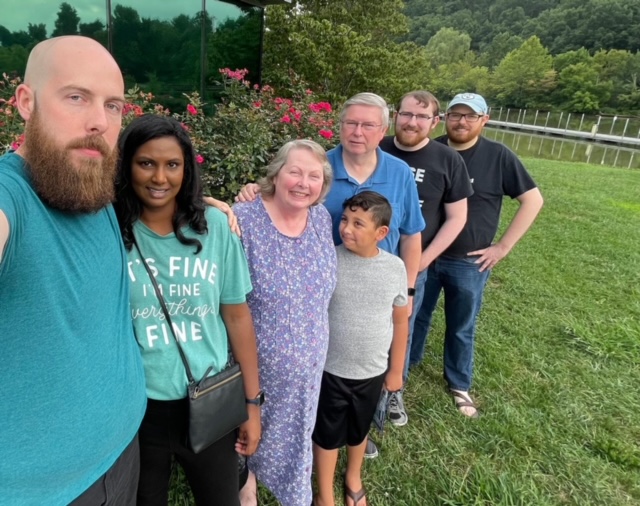
2. Family time. My husband took the week of the 16th-20th off so we had something of a “stay-cation.” while Jeremy was here. Jesse and Jason had to work but took off that Friday and came over several evenings. So we had a lot of family time, visiting, laughing, eating, and playing games. Mittu made great dinners a couple of nights, once at their place and once at ours. Jesse had us all over to his place one night for honey garlic salmon–his first time to host all of us.

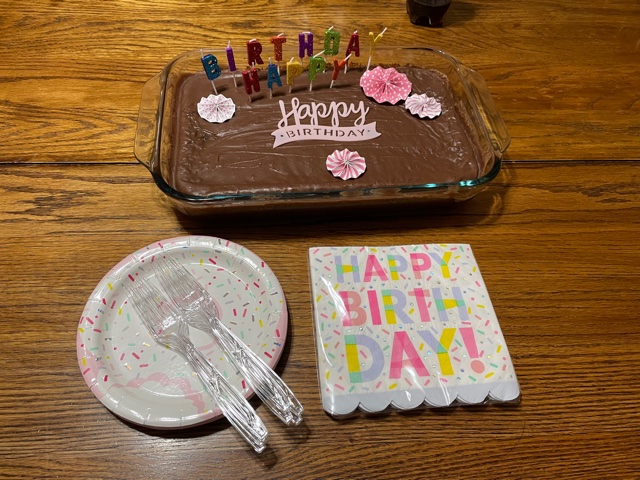
3. My birthday was last weekend. It’s nice when the dates work out that Jeremy can be here for both his birthday and mine. My daughter-in-law made lunch for us. We went out for dinner to one of my favorite restaurants on a lake. Then we went home for my annual Texas Sheet Cake that Mittu made and decorated and opened presents.

4. Safety and and new plans. Jeremy was due to fly back to RI on the 22nd, but the day before, Hurricane Henri was heading straight for RI. What we didn’t want to happen was for Jeremy to leave here on the first leg of his flight and then get stranded if the last flight was canceled. So Jim and Jeremy called the airline and got a very competent and friendly person and changed his flights to Wednesday. It turned out to be a good thing, because the second leg of his flight did indeed get canceled. He worked from our home Monday and Tuesday. The storm weakened and avoided a direct hit to his area after all, but we were happy to have a few more days with him here rather than having him have to hang out out an airport until it was safe.

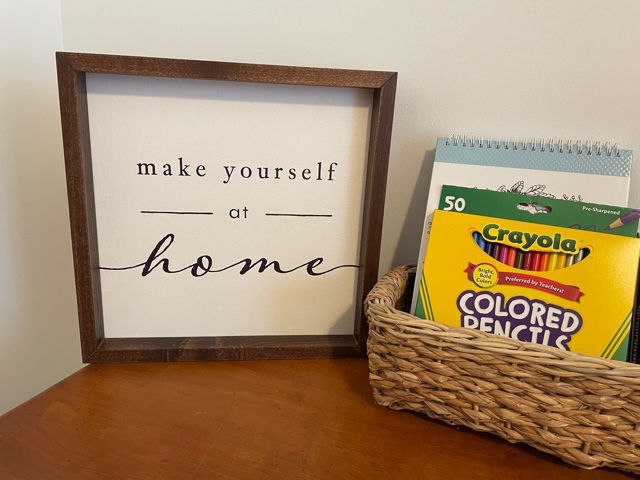
5. A new sign for the guest room. Jason gets a few credits every year for products from the place where he works and he generously let me use some for this sign for the guest room.

I hope you’ve had a good week, too!