Sons of Blackbird Mountain

In Joanne Bischof’s novel, Sons of Blackbird Mountain, Aven Norgaard is newly widowed in 1890 Norway. She had long corresponded with her husband’s aunt in Virginia, who now invited her to come help keep house for “the boys,” Aven’s husband’s cousins.

But when Aven crosses the sea and arrives on Blackbird Mountain, she finds that Aunt Dorothe has died and “the boys” are grown men.

The three Norgaard brothers invite her to stay. Aven has no other prospects, so she does.

The oldest brother, Jorgan is steady and wise and soon to be married. The youngest, Haakon, is energetic and mischievous. The middle brother, Thor, is deaf. He’s also addicted to the alcohol the brothers produce with their apple orchard. His last attempt to wean himself off the hard cider ended in disaster. But he is kind and considerate.

Thor and Haakon both find themselves attracted to Aven. She had not come thinking about getting married again, she doesn’t want to come between the brothers.

There are so many layers to this story. Thor, Haakon, amd Aven each carry their own private pain. Then there are conflicts with their nearest neighbors, the Sorrels, who head up the local Klan and threaten the Norgaards’ longtime housekeeper and the youths they hire to help at harvest. The fact that the Sorrels own the deed to the Norgaard orchard creates extra pressure.

The author includes a brief preface where she explained a bit about ASL (American Sign Language). I had not realized that the deaf don’t sign every part of a sentence. But it makes sense that they’d streamline their words while signing. So when Thor jots a note (since Aven doesn’t know sign language yet), his sentences are mainly subject and verb with no articles, because that’s how he thinks. The author shared in her afterword how she became interested in sign language and the challenges of having a deaf character who can’t express himself in the usual ways.

All of the characters are nicely drawn, but Thor was the most intriguing. I don’t feel I am doing this book justice, but I enjoyed it very much. I had never read Bischof before, but I am eager to read more from her.

(Sharing with Senior Salon, Carole’s Books You Loved, Booknificent)

Be Confident: Live by Faith, Not by Sight

Our church’s Bible reading program alternates between Old and New Testament books. After we finished Leviticus, our next book was Hebrews.

That was fitting, because Hebrews explains how the OT sacrificial system pictured Christ.

My companions through this reading were my ESV Study Bible notes as well as Warren Wiersbe’s Be Confident (Hebrews): Living by Faith, Not by Sight.

Hebrews was written to Jewish believers in Christ in the first century. Mention is made of the temple as if it were still in operation, and it was destroyed in 70 AD. So we know Hebrews was written before that time.

Jewish believers were facing persecution for varying from what their community practiced. Some were tempted to go back. But the author of Hebrews urges them to keep persevering and reminds them that what they have in Christ is far superior to what they had before.

In fact, the word “better” occurs repeatedly in the book. Jesus is show to be better than angels, Moses, and the priesthood. His once-for-all sacrifice was better than the repeated ones the priests offered. His new covenant was better than the old.

It’s not that the old covenant and practices were wrong: God gave them to Israel. But they were always meant to be temporary, picturing and leading up to Christ’s revelation and ministry.

There are also five major warnings in Hebrews, a couple of which have created confusion. Wiersbe demonstrates that these warnings don’t indicate one can lose salvation, but they do emphasize the need to be sure we’re in the faith and growing in the Lord. “Without faith it is impossible to please him, for whoever would draw near to God must believe that he exists and that he rewards those who seek him” (Hebrews 11:6).

Hebrews 11 is the “Hall of Faith,” sharing examples of those who walked with God through the centuries. Just as they “desire a better country, that is, a heavenly” (Hebrews 11:16), so readers are reminded that “here we have no lasting city, but we seek the city that is to come” (Hebrews 13:14). And in the meantime, the God of peace will “equip you with everything good that you may do his will, working in us that which is pleasing in his sight, through Jesus Christ, to whom be glory forever and ever” (Hebrews 11:21).

As modern Gentiles, we might not be tempted to go back to Judaism. But we need this book as well to appreciate what we have in Christ and to heed its warnings and benefit from its encouragements.

Here are just a few of the quotes that stood out to me from this book:

More spiritual problems are caused by neglect than perhaps by any other failure on our part. We neglect God’s Word, prayer, worship with God’s people (see Heb. 10: 25), and other opportunities for spiritual growth, and as a result, we start to drift. The anchor does not move; we do (p. 35).

What does Canaan represent to us as Christians today? It represents our spiritual inheritance in Christ (Eph. 1: 3, 11, 15–23). It is unfortunate that some of our hymns and gospel songs use Canaan as a picture of heaven, and “crossing the Jordan” as a picture of death. Since Canaan was a place of battles, and even of defeats, it is not a good illustration of heaven! Israel had to cross the river by faith (a picture of the believer as he dies to self and the world, Rom. 6) and claim the inheritance by faith. They had to “step out by faith” (see Josh. 1:3) and claim the land for themselves, just as believers today must do (pp. 49-50).

The Canaan rest for Israel is a picture of the spiritual rest we find in Christ when we surrender to Him. When we come to Christ by faith, we find salvation rest (Matt. 11: 28). When we yield and learn of Him and obey Him by faith, we enjoy submission rest (Matt. 11: 29–30). The first is “peace with God” (Rom. 5: 1); the second is the “peace of God” (Phil. 4: 6–8). It is by believing that we enter into rest (Heb. 4: 3); it is by obeying God by faith and surrendering to His will that the rest enters into us (p. 54).

The second conclusion is this: There is no need to go back because we can come boldly into the presence of God and get the help we need (Heb. 4: 16). No trial is too great, no temptation is too strong, but that Jesus Christ can give us the mercy and grace that we need, when we need it (p. 61).

The believer who begins to drift from the Word (Heb. 2: 1–4) will soon start to doubt the Word (Heb. 3: 7—4: 13). Soon, he will become dull toward the Word (Heb. 5: 11—6: 20) and become “lazy” in his spiritual life. This will result in despising the Word, which is the theme of this exhortation (p. 136).

God wants our hearts to be “established with grace” (Heb. 13: 9). That word established is used, in one form or another, eight times in Hebrews. It means “to be solidly grounded, to stand firm on your feet.” It carries the idea of strength, reliability, confirmation, permanence. This, I think, is the key message of Hebrews: “You can be secure while everything around you is falling apart!” We have a “kingdom which cannot be moved” (Heb. 12: 28). God’s Word is steadfast (Heb. 2: 2) and so is the hope we have in Him (Heb. 6: 19) (p. 23).

Faith is only as good as its object, and the object of our faith is God. Faith is not some “feeling” that we manufacture. It is our total response to what God has revealed in His Word (p. 144).

I enjoyed delving into Hebrews again, especially with the faithful, helpful companions I found in these aids.

(Sharing with InstaEncouragements, Grace and Truth, Senior Salon, Carole’s Books You Loved, Booknificent)

Do You Want a Fresh Word from the Lord?

I know what it’s like to wish I could look up and see God’s will sky written in the blue expanse. Or to wish I had I could hear from God personally and specifically. Or, I am sorry to say, to feel bored with a seemingly dry or familiar part of Scripture.

But we don’t need to long for something more or something different.

Peter tells us, “His divine power has granted to us all things that pertain to life and godliness, through the knowledge of him who called us to his own glory and excellence, by which he has granted to us his precious and very great promises, so that through them you may become partakers of the divine nature, having escaped from the corruption that is in the world because of sinful desire” (2 Peter 1:3-4).

We have “all things that pertain to life and godliness” “through the knowledge of him who called us” by “his precious and very great promises.” As we get to know Him more and more through His Word, we have everything we need to live for Him.

One former pastor used to say that the Bible is “divinely brief.” Of the multitude of things God could have told us, the sixty-six books contained in the Bible are what He chose to convey to us.

What are we doing with that special, God-given book?

No, God won’t tell us which job to take, which city to live in, or which person to marry in the Bible. But the Bible will teach us principles of walking with God and developing wisdom, and God promises to guide us in the way we should go.

Some times in the Bible are intensely personal. I don’t know how many times my scheduled reading for the day directly answered something I had been praying about or pondering.

When I was in the hospital before being diagnosed with transverse myelitis, I was scheduled for an MRI. The night before, nearly every nurse or aide who came in asked me if I was claustrophobic. I wasn’t sure. I was told the MRI sometimes made people feel uncomfortable because they slide you into this close-fitting tube and you have to be very still. They said they could give me a sedative if I thought I would need it. I wanted to avoid unnecessary medication if I could, so I declined the sedative.

The next morning, the Daily Light on the Daily Path reading, which is made up of just Scripture verses with no commentary, was about being still, being quiet, or resting in the Lord:

  • “Sit still, my daughter” (Ruth 3:18)
  • “Be still, and know that I am God” (Psalm 46:10)
  • “Take heed, and be quiet; fear not, neither be fainthearted” (Isaiah 7:4)
  • “In returning and rest shall ye be saved; in quietness and in confidence shall be your strength” (Isaiah 30:15)
  • “Commune with your own heart upon your bed, and be still” (Psalm 4:4)
  • “Rest in the LORD, and wait patiently for him” (Psalm 37:7)
  • “He shall not be afraid of evil tidings: his heart is fixed, trusting in the LORD. His heart is established” (Psalm 112:7-8)

Many of those verses were familiar to me, and throughout the MRI, I repeatedly went over them in my mind. They washed over my soul and quieted me.

Every meal we eat can’t be a Thanksgiving or an anniversary dinner at the steak house. But even the peanut butter sandwiches and tuna casseroles nourish us.

Every conversation with our spouse won’t be thrillingly romantic. The everyday “Can you pick up the dry cleaning?” and “Good dinner, thanks” weave together with the highlights to form the fabric of a strong relationship.

Every day isn’t fireworks and feasting. Most are quietly spent at home.

Every time in the Bible won’t be a mountaintop experience or warm and cozy.

But all our times in the Word help us get to know God better and strengthen us to live for Him.

We’ll never exhaust the Bible. There will always be something new to learn, no matter how many times we read it. But we also need the repetition of old truths so we don’t forget them.

If the Bible seems “old” or stale to us, maybe reading Psalm 119 will help the psalmist’s enthusiasm infuse our souls. Asking God to speak to us and give us understanding and a new appreciation for His Word helps as well. Aids like a good study Bible or commentary or study book can help open passages up to us.

Jesus said, “It is the Spirit who gives life; the flesh is no help at all. The words that I have spoken to you are spirit and life” (John 6:63). Psalm 119:24-25 says, “Your testimonies are indeed my delight; they are my counselors. My soul clings to the dust; give me life according to your word!”

Do you need a fresh word from the Lord? Pick up the old faithful Bible. Let God’s Word revive you.

(Sharing with Sunday Scripture Blessings, Scripture and a Snapshot, Hearth and Soul, Senior Salon, Inspire Me Monday, Tell His Story, InstaEncouragements, Recharge Wednesday, Let’s Have Coffee, Heart Encouragement, Grace at Home, Grace and Truth, Faith on Fire, Blogger Voices Network).

Laudable Linkage

IMG_0195

I’m way behind on blog reading, but here are some good ones I’ve come across the last couple of weeks:

So You Want to Be Relevant? “What does the Bible say about itself that will convince the reluctant and indifferent reader to dig in and spend time in the Word, to begin seeing biblical fidelity as the key to remaining relevant in every phase of life?”

Finding Repeated Words and Phrases in Bible reading. “Authors didn’t have bold and italics back then, so a common way to emphasize a point was to repeat it multiple times. It’s like saying, ‘Hey, don’t miss this!’”

Where’s the Lie, HT to Knowable Word. “Con artists don’t look shady. If a lie were obviously false, it wouldn’t be dangerous. Christians know that ‘the heart is deceitful above all things, and desperately sick’ (Jeremiah 17:9), and yet we regularly overestimate our ability to spot error. We need a consistent standard by which to compare every suggestion we hear. Because of God’s gracious provision, we have such a standard. The words God has already spoken are completely and always reliable.”

When It’s Time to Leave a Church, HT to Challies.

Bucking the Trans Trend, HT to Challies. I’ve been astounded at how far this trend has gotten with so little known about the effects. Thankfully, at least in England, it’s being questioned.

How Forgiveness Displays the Gospel to Our Kids, HT to The Story Warren. “And then it hit me. Only minutes before, I’d shown such little grace to my own daughter, but here I was showing mercy to myself for the very same mistake.”

Finally, I came across this quote this morning. Many of us don’t like change, and not all change is good. But much is necessary.

Have a great weekend!

Friday’s Fave Five

It’s Friday, time to look back over the blessings of the week
with Susanne at Living to Tell the Story and other friends.

It’s been a full week at the Harper household. Here are some of our blessings.

1. A used RV. My husband has been dreaming of this for years. We were originally thinking of getting an RV when he retired. He’s been researching them and looking at used ones for some time. We wanted one small enough to be easily maneuverable but big enough not to feel claustrophobic. When he found a good deal on this one in great condition, the time seemed right. We’re still figuring it out. They took him through a three-hour orientation, but it still takes going through the procedures on one’s own a few times to get the hang of it. We’ll probably try it out somewhere nearby at first. And then, who knows? One goal eventually is to visit our oldest son in RI.

2. Timothy’s birthday! Our little grandson is seven! And not so little any more! On his birthday, numerous Facebook memories popped up about his premature birth and God’s faithfulness to bring him and our family through that time.

3. Timothy’s birthday cake. My daughter-in-law is amazing. Timothy is into the Minecraft video game, so his birthday used that theme. This Minecraft-inspired cake used cake squares, Rice Krispie squares, and Jello squares.

4. A clear day. His parents had planned to have lunch at a park on Timothy’s birthday, and then his birthday party would be in the evening when everyone was off work. Rain was forecast that day, but it held off until later in the afternoon. I know there were multiple reasons for the weather beyond one boy’s birthday, but I was so thankful the rain was delayed.

5. Timothy’s other grandparents were able to be here from OK for a few days this week.

It’s been a beautiful spring week here in TN. Even with rain one day, the weather has been gorgeous, and so many trees are blooming. That makes for pollen and allergies . . . but nothing is perfect. 🙂 The weather this week has been pretty close to it, though.

How was your week?

Preparing for Easter with C. S. Lewis

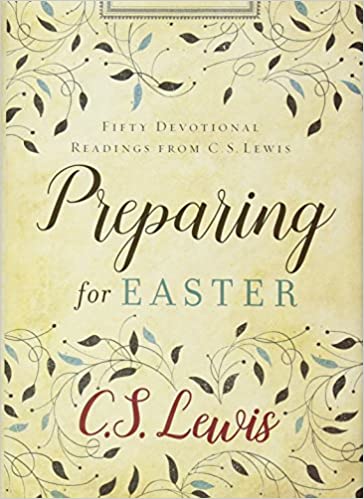
Preparing for Easter: Fifty Devotional Reading from C. S. Lewis. is a compilation of selections from his writings.

C. S Lewis is one of the most quotable Christians to have lived, maybe second to C. H. Spurgeon. In fact, I have a book titled The Quotable Lewis. So any book of quotes by him will have value.

By the title of this book, you’d expect an arc of quotations on the subject and application of Christ’s death, burial, and resurrection, leading up to Easter Day. If there was such an arc, I didn’t detect it. The book just seemed more like a random collection.

Of course, the death, burial, and resurrection of Christ touch everything in the Christian life, so, in one sense, any subject within Christendom could be related. Yet many selections in this volume didn’t seem to fit the theme. For instance, one had to do with the value of myths. Did the compiler feel that any part of the true Easter story was a myth? Or was he applying this quote to the bunnies and eggs part of Easter? I don’t know.

The book is set up to begin about six and a half weeks before Easter, with the last reading for Easter Day. The readings aren’t numbered in the book, but I numbered them in my notes. I was confused when I ended up with forty-seven. Then I remembered some day’s readings contained two short selections. So, as the title says, there are fifty readings, but not over fifty days. I started a week late, so I ended the Sunday after Easter.

Some readings are familiar quotes, such as those from the Narnia series or Mere Christianity. Others are from more obscure sources, like private letters. I’m always amazed at how literary Lewis sounds even in a letter. I wonder if he was a perfectionist who made several copies of a letter until it sounded just right? Or did such prose just flow from him? I remember reading somewhere that his books did not need much editing, so perhaps the latter is true.

Though some of the selections were easy to grasp, some suffered from the loss of their context.

I was also reminded that, though I love much of what Lewis wrote, I don’t agree with him on every little point of doctrine. I have several of those places marked, but I don’t think I’ll list them all here for the sake of time and space.

So, all told, I was more than a little disappointed in this volume. Nevertheless, as I said, there are always rich nuggets in his writing. Here are a few I found:

Our model is the Jesus, not only of Calvary, but of the workshop, the roads, the crowds, the clamorous demands and surly oppositions, the lack of all peace and privacy, the interruptions. For this, so strangely unlike anything we can attribute to the Divine life in itself, is apparently not only like, but is, the Divine life operating under human conditions (p. 7, originally from The Four Loves).

I think that many of us, when Christ has enabled us to overcome one or two sins that were an obvious nuisance, are inclined to feel (though we do not put it into words) that we are now good enough. He has done all we wanted Him to do, and we should be obliged if He would now leave us alone. As we say, ‘I never expected to be a saint, I only wanted to be a decent ordinary chap.’ And we imagine when we say this that we are being humble. But this is the fatal mistake. Of course we never wanted, and never asked, to be made into the sort of creatures He is going to make us into. But the question is not what we intended ourselves to be, but what He intended us to be when He made us. He is the inventor, we are only the machine. He is the painter, we are only the picture. How should we know what He means us to be like? (p. 14, originally from Mere Christianity).

We may be content to remain what we call ‘ordinary people’: but He is determined to carry out a quite different plan. To shrink back from that plan is not humility: it is laziness and cowardice. To submit to it is not conceit or megalomania; it is obedience (p. 15, originally from Mere Christianity).

A continual looking forward to the eternal world is not (as some modern people think) a form of escapism or wishful thinking, but one of the things a Christian is meant to do. It does not mean that we are to leave the present world as it is. If you read history you will find that the Christians who did most for the present world were just those who thought most of the next. The Apostles themselves, who set on foot the conversion of the Roman Empire, the great men who built up the Middle Ages, the English Evangelicals who abolished the Slave Trade, all left their mark on Earth, precisely because their minds were occupied with Heaven (p. 58, originally from Mere Christianity).

If I find in myself a desire which no experience in this world can satisfy, the most probable explanation is that I was made for another world. If none of my earthly pleasures satisfy it, that does not prove that the universe is a fraud. Probably earthly pleasures were never meant to satisfy it, but only to arouse it, to suggest the real thing. If that is so, I must take care, on the one hand, never to despise, or be unthankful for, these earthly blessings, and on the other, never to mistake them for the something else of which they are only a kind of copy, or echo, or mirage. I must keep alive in myself the desire for my true country, which I shall not find till after death; I must never let it get snowed under or turned aside; I must make it the main object of life to press on to that other country and to help others to do the same (pp. 60-61, (p. 58, originally from Mere Christianity).

If the new Self, the new Will, does not come at His own good pleasure to be born in us, we cannot produce Him synthetically (p. 72, originally from Present Concerns).

The world is so built that, to help us desert our own satisfactions, they desert us. War and trouble and finally old age take from us one by one all those things that the natural Self hoped for at its setting out. Begging is our only wisdom, and want in the end makes it easier for us to be beggars (p. 72, originally from Present Concerns).

God cannot give us a happiness and peace apart from Himself, because it is not there. There is no such thing (p. 80, originally from Mere Christianity).

Keep back nothing. Nothing that you have not given away will be really yours. Nothing in you that has not died will ever be raised from the dead. Look for yourself, and you will find in the long run only hatred, loneliness, despair, rage, ruin, and decay. But look for Christ and you will find Him, and with Him everything else thrown in (p. 212, originally from Mere Christianity).

One of the most poignant passages to me was a letter from Lewis to a Warfield Firor about facing the ramifications of aging (including compulsory retirement and rheumatism) and letting those “begin . . .to loosen a few of the tentacles which the octopus-world has fastened on one” and remind that “what calls one away is better” (pp. 138-139). (A portion of the letter is here.)

Though I doubt I’ll reread this book in coming Lenten seasons, I was blessed by some of its pages. I was also encouraged to reread Mere Christianity some time and to look up The Letters of C. S. Lewis.



When God Gives Up

When God gives up

God’s patience and longsuffering are some of the qualities I appreciate most about Him. He works and waits so patiently to draw sinful and resistant people to Himself. He picks us up a thousand times when we fall. He forgives us when we confess the same sin repeatedly.

But we can’t presume upon Him. We can’t put Him off, either for salvation or for obedience, for ever. We can’t expect Him to just wait in the wings until we get good and ready to come to Him.

God was patient with Israel’s complaining and unbelief when He first brought them out of Egypt. They had been captive slaves for 400 years. Surrounded by paganism, they probably had not been taught much about God and His ways. But after seeing His power displayed in the plagues, at the Red Sea, in providing for water and food in the middle of a desert, more of them should have started trusting Him. He even forgave them when they built a golden calf and worshiped it instead of Him.

But finally, when they refused to go into the promised land even with reassurances that God would help them conquer, that was enough. God deemed that they would wander around the wilderness for forty years until that generation died off. Then their children would be able to enter in.

God still loved them and worked with them. But they forfeited their opportunity to enter into their rest.

But my people did not listen to my voice;
    Israel would not submit to me.
So I gave them over to their stubborn hearts,
    to follow their own counsels.
Oh, that my people would listen to me,
    that Israel would walk in my ways!
Psalm 81:11-13

It’s sad to think that disobedience and unbelief could be so costly for God’s people. But it’s even scarier for those who refuse to believe on Him at all.

In Romans 1, Paul tells about God’s wrath against ungodly and unrighteous people who:

  • suppress the truth (v. 18)
  • did not honor God as God, even though evidence of “his eternal power and divine nature, have been clearly perceived, ever since the creation of the world, in the things that have been made” (vv. 19-21)
  • did not give thanks to him (v. 21)
  • “became futile in their thinking, and their foolish hearts were darkened” (v. 21)
  • “exchanged the glory of the immortal God for images resembling mortal man and birds and animals and creeping things” (v. 22) and “worshiped and served the creature rather than the Creator” (v. 25)

Three times in the next few verses, we’re told God gave them up.

  • “God gave them up in the lusts of their hearts to impurity” (v. 24)
  • “God gave them up to dishonorable passions” (v. 26)
  • “God gave them up to a debased mind” (v. 28)

This commentary says these were degrees: God gave them up (or over, some translations say) bit by bit until they ended up with a debased mind. That debased mind led to “all manner of unrighteousness,” which Paul expands on in the rest of the passage.

C. S. Lewis has said, “There are only two kinds of people in the end: those who say to God, ‘Thy will be done,’ and those to whom God says, in the end, ‘Thy will be done.'” (from The Great Divorce). When we insist on our own way long enough, God lets us have it. And the results are never good.

Because they hated knowledge
    and did not choose the fear of the Lord,
would have none of my counsel
    and despised all my reproof,
therefore they shall eat the fruit of their way,
    and have their fill of their own devices. Proverbs 1:29-31

Because God is longsuffering, He doesn’t usually give people up at the first rejection. But at some point, the door of opportunity will be closed. We don’t know how much time we have. It’s wise not to wait. “Behold, now is the favorable time; behold, now is the day of salvation” (2 Corinthians 6:2).

It’s also not wise to put off obedience or the next step of faith God wants us to take.

When I have been reluctant to obey God at some point, I’ve had to confess my unwillingness and ask Him to help me be willing. One person said, “I’m willing to be made willing.”

When I have felt my heart wasn’t right and my will was being stubborn, I’ve prayed with Jeremiah, “Turn thou us unto thee, O LORD, and we shall be turned” (Lamentations 5:21, KJV) and with the psalmist, “Will you not revive us again, that your people may rejoice in you?” (Psalm 85:6).

The psalmist and the writer of Hebrews used Israel’s disobedience to plead, “Today, if you hear his voice, do not harden your hearts” (Psalm 95:6-11; Hebrews 3:7-8, 15). May our hearts always be pliable in His hands.

if you hear His voice do not harden your heart

(Sharing with Sunday Scripture Blessings, Scripture and a Snapshot, Hearth and Soul, Inspire Me Monday, Senior Salon, Tell His Story, InstaEncouragements, Recharge Wednesday, Let’s Have Coffee, Share a Link Wednesday, Heart Encouragement, Grace and Truth, Faith on Fire, Blogger Voices Network)

Friday’s Fave Five

It’s Friday, time to look back over the blessings of the week
with Susanne at Living to Tell the Story and other friends.

The first week of April, 2021 is in the books. I hope yours was a good one. Here are some highlights from mine:

1. Easter. Though we think of the resurrection of Christ through the year, it’s special to focus on its meaning on Easter Sunday. And we enjoy the fun parts of Easter as well. All the family but my oldest were able to come, and we Facetimed with him. We enjoyed a good dinner and dessert, and the kids had fun with hunting Easter eggs. Then everyone left and Jim and I crashed. 🙂

2. Watching Timothy while his parents were getting their COVID shots.

3. My late package came in! I almost never have trouble getting Amazon packages, but three of them disappeared somewhere between Amazon and here recently. One contained a sewing machine cabinet I had ordered to replace the desk I’ve been keeping my machine on. I know none of the packages were delivered and then stolen because we have a camera on our doorbell and would have seen that—plus Amazon still shows the packages as out for delivery. I got refunds for the other two, but held out on the cabinet, hoping it would come in. It finally did Thursday afternoon!

4. Jim and Jesse being willing to put the cabinet together. We had already asked Jesse if he’d be willing to help put it together, and he was. Jim has said that Jesse is good at figuring out the instructions and multitudes of parts of projects like this. As I am writing now, Thursday afternoon, the plan is for Jesse to come over for dinner after work and then start on the cabinet. If they get it done tonight, I’ll take a picture.

Update: They did get it finished!

I don’t know why the carpet looks gold in the top photo: it’s beige. Anyway, I am looking forward to transferring my sewing stuff over.

5. A successful grocery trip. Though we’re not experiencing the shortages of early pandemic days, I often can’t find everything I’m looking for in stores. This week I had to go to two places, but found what I wanted.

What’s something good from your week?

The Incredible Privilege of Drawing Near to God

The privilege of drawing near to God

In Old Testament times, God’s people were aware of a great distance between themselves and God.

One of the first times God met with the Israelites after they came out of Egypt, the experience was scary: “a blazing fire and darkness and gloom and a tempest and the sound of a trumpet and a voice whose words made the hearers beg that no further messages be spoken to them. For they could not endure the order that was given, ‘If even a beast touches the mountain, it shall be stoned.’ Indeed, so terrifying was the sight that Moses said, ‘I tremble with fear’” (Hebrews 12:18-21).

Getting a glimpse of God’s holiness brought people to their knees and made their sin stand out all the more in contrast. Isaiah reacted by saying, “Woe is me! For I am lost; for I am a man of unclean lips, and I dwell in the midst of a people of unclean lips; for my eyes have seen the King, the Lord of hosts!” (Isaiah 6:1-7). Peter responded to Jesus, “Depart from me, for I am a sinful man, O Lord” (Luke 5:1-11). John, called the beloved disciple, “fell at his feet as though dead” (Revelation 1:9-19).

The children of Israel had to go through detailed rituals to have their sin forgiven. In Exodus they were instructed to build a tabernacle with an inner Holy of Holies which only the high priest could enter once a year. Leviticus had instructions for the different kinds of sacrifices. The tabernacles, sacrifices, and priesthood all carried wonderful symbolism of what Jesus would come to be and do. But at the time, the clearest message was that the people could not draw near to God without sacrifces and mediators because God was holy and they were not.

But even with all those rituals, “since the law has but a shadow of the good things to come instead of the true form of these realities, it can never, by the same sacrifices that are continually offered every year, make perfect those who draw near. (Hebrews 10:1).

But then Jesus came. The Savior, the Messiah promised ever since the first sin separated man from God. He fulfilled all the OT prophecies about Himself. His death was the reality pictured by the OT sacrifices for sin. At His death, the veil covering the Holy of Holies was torn open, signifying that the way was open to God.

Therefore, brothers, since we have confidence to enter the holy places by the blood of Jesus, by the new and living way that he opened for us through the curtain, that is, through his flesh, and since we have a great priest over the house of God, let us draw near with a true heart in full assurance of faith, with our hearts sprinkled clean from an evil conscience and our bodies washed with pure water. (Hebrews 10:19-22)

The OT sacrifices had to be offered continually because they were insufficient to take care of sin for ever.

But when Christ had offered for all time a single sacrifice for sins, he sat down at the right hand of God, waiting from that time until his enemies should be made a footstool for his feet. For by a single offering he has perfected for all time those who are being sanctified. (Hebrews 10:12-14)

The OT priests died and had to be replaced.

But he holds his priesthood permanently, because he continues forever. Consequently, he is able to save to the uttermost those who draw near to God through him, since he always lives to make intercession for them. (Hebrews 7:24-25)

Though Jesus was God, He was also man. He was holy, but He faced temptation and weakness and dread.

For we do not have a high priest who is unable to sympathize with our weaknesses, but one who in every respect has been tempted as we are, yet without sin. Let us then with confidence draw near to the throne of grace, that we may receive mercy and find grace to help in time of need. (Hebrews 4:15-16)

Jesus fulfilled the prophecies and symbolism given to the Jews. But what about the rest of us?

Remember that you were at that time separated from Christ, alienated from the commonwealth of Israel and strangers to the covenants of promise, having no hope and without God in the world. But now in Christ Jesus you who once were far off have been brought near by the blood of Christ. For he himself is our peace, who has made us both one and has broken down in his flesh the dividing wall of hostility by abolishing the law of commandments expressed in ordinances, that he might create in himself one new man in place of the two, so making peace, and might reconcile us both to God in one body through the cross, thereby killing the hostility. And he came and preached peace to you who were far off and peace to those who were near. For through him we both have access in one Spirit to the Father. So then you are no longer strangers and aliens, but you are fellow citizens with the saints and members of the household of God, built on the foundation of the apostles and prophets, Christ Jesus himself being the cornerstone, in whom the whole structure, being joined together, grows into a holy temple in the Lord. In him you also are being built together into a dwelling place for God by the Spirit.

How do we draw near? The verses above mention faith and cleansing: faith Jesus is who He claimed to be, faith that His atonement took care of our sins. This privilege is open to anyone willing to repent of sin and believe on Jesus as Lord and Savior.

And without faith it is impossible to please him, for whoever would draw near to God must believe that he exists and that he rewards those who seek him. (Hebrew 11:6)

If we say we have fellowship with him while we walk in darkness, we lie and do not practice the truth. But if we walk in the light, as he is in the light, we have fellowship with one another, and the blood of Jesus his Son cleanses us from all sin. If we say we have no sin, we deceive ourselves, and the truth is not in us. If we confess our sins, he is faithful and just to forgive us our sins and to cleanse us from all unrighteousness. (1 John 1:6-9)

We have the incredible privilege to draw near to God—for salvation, for cleansing, for fellowship, for grace and help.

What a privilege to come into God’s presence,
Just to linger with the One who set me free.
As I lift m eyes and see His awesome glory,
I remember who He is and bow the knee.

-Ron Hamilton

For more information, see 4 Conditions to Draw Near to God.

(Sharing with Scripture and a Snapshot, Hearth and Soul, Inspire Me Monday, Senior Salon, Tell His Story, InstaEncouragements, Recharge Wednesday, Let’s Have Coffee, Share a Link Wednesday, Heart Encouragement, Grace and Truth)

Laudable Linkage

A collection of good reading online

I had some ideas for a blog post about the results of Jesus’ resurrection. But when I began to research it, I found several posts that already did a better job than I could have:

Here are a few more good reads discovered this week:

It Is Finished. An imaginative account of what the betrayal, trial, and crucifixion of Jesus might have looked like from Satan’s point of view.

React vs. Respond. This was a helpful distinction.

A Few Short Truths regarding how teaching Biblical sexuality is not hate and does not incite to murder.

When America Put the Bible on Trial, HT to Challies. A look at the Scopes trial and its effects 100 years later. “Liberalism believes that you can hold on to cultural influence by compromising your convictions. And in so being and doing, it is a fool’s errand. For one, the world or culture is not interested in compromise. Nothing short of wholesale endorsement will suffice. Second, compromising the Bible’s truthfulness and trustworthiness destroys the foundation and the superstructure of Christianity itself. The church does not stand over God’s word. Culture or ‘progress’ does not have the final word on matters.”

Losing Forgiveness, HT to Challies. “It is apparently fine to be concerned about a deceased horse, while being part of a baying crowd that seeks to destroy a man. In our rush to virtue signal, or to vindicate our own omniscient appraisal of a situation, we lose perspective—we lose sight of the person.”

While I Was Still a Marxist Christ Rescued Me, HT to Challies. Wonderful account of the conversion of Marvin Olasky, editor in chief of World Magazine.

Leading in Prayer, HT to Challies. This is some good advice for when you’re asked to lead in public prayer. Though it’s for a particular slot in a particular church’s service, it has some good general principles for any gathering. I especially like the part about not making political points or preaching mini-sermons during prayer.

The Louvre Just Put Its Entire Art Collection Online, HT to The Story Warren.

I hope you have a wonderful weekend remembering the death, burial, and resurrection of Jesus Christ for you.