Silas Marner

In Silas Marner by George Elliot (aka Mary Ann Evans), Silas is a weaver active in a small congregation. One morning, after helping take care of a sick deacon through the night, Silas is accused of stealing the congregation’s money that had been stored in the deacon’s house. He is suspect not only because he was there, but also because his pocket knife was where the money should be. But Silas distinctly remembers loaning his knife to his best friend, William Dane. The congregation decides to draw lots to determine Silas’ guilt or innocence, and Silas believes God will show that he’s innocent. However, the lot does just the opposite and finds him guilty.

Feeling betrayed by both God and man, Silas packs up and moves away to a rural area. He finds business weaving again, but he interacts with people as little as possible.

He hated the thought of the past; there was nothing that called out his love and fellowship toward the strangers he had come amongst; and the future was all dark, for there was no Unseen Love that cared for him. Thought was arrested by utter bewilderment, now its old narrow pathway was closed, and affection seemed to have died under the bruise that had fallen on its keenest nerves.

Because he’s such a loner and the folks are quite superstitious, rumors swirl about him. Because he doesn’t go anywhere—not even church—or do anything, the money he makes multiplies to the point of his idolizing it, counting it every night.

And then the unthinkable happens. One foggy night while out on a quick errand, he comes home to find his gold all gone. He’s completely undone, but the situation opens his neighbors’ hearts to him.

Then on another dark and snowy night, a little child wanders into Silas’ home, changing his life.

Intersecting several times with Silas’ story is that of the Cass family. The older Squire Cass, leading citizen of the area, has several sons. The oldest, Godfrey, has a secret that could ruin him and prevent his marriage to the woman he loves. His brother, Dunstan, knows the secret and uses his knowledge to manipulate Godfrey. Dunstan is a selfish cad. Godfrey is weak-willed and indecisive. He keeps turning his problems over in his mind but never doing anything about them, assuming somehow everything will come out all right in the end.

Silas Marner was first published in 1861 but set a few decades earlier. Elliot always delves deeply into the psychology of her characters, so the main action of the story deals with what they are thinking and why. But she also explores other themes: religion, change, class differences and parallels.

This book is much shorter than her others, so it’s a good one to give Elliot’s writing a try.

Hope has mentioned the Literary Life Podcast. When I looked it up, I saw they were discussing Silas Marner, so I decided to give them a try. I was a little put off during the first episode because it was an hour and twenty minutes just to cover the first three chapters, it took fifteen minutes before they started talking about the author, and another sixteen minutes to get to the book. The only other podcast I have listened to regularly is the Christian Publishing Show by Thomas Umstattd, Jr. He dives right in and puts all his “commercials” at the end—which I appreciate. But once the folks at the Literary Life Podcast got into the meat of the book, I enjoyed listening to them. They brought our several things that I missed and added insights from the times and Elliot’s life. The podcast doesn’t advertise itself as Christian, but from the discussions, the participants seem to be believers. I’ve listened to the first two podcasts on Silas and am in the midst of the third.

Some years ago I heard a Focus on the Family Radio Theater production of Silas Marner that was quite well done. From that, I knew the basic story but had forgotten many details. And the book is a richer, deeper experience.

I don’t know if I’ll ever forgive the Little House on the Prairie TV series for making me think this would be a boring book. 🙂 In one episode, Albert mourns having to read it for school instead of doing something else he’s rather do. I had never heard of the book before that.

On the other hand, I’ve heard others say that they didn’t like it when they first read it, either. Maybe it’s one that doesn’t go over so well in high school? I don’t know. But I am glad I read it when I did, because I enjoyed it quite a lot. I listened to the audiobook very nicely read by Andrew Sachs but also looked up parts in the Kindle edition, which, at the time of this writing, is 60 cents.

I’m counting this book for the classic by a woman author for the Back to the Classics Reading Challenge.

Have you read Silas Marner? What did you think?

(Sharing with Booknificent, Carole’s Books You Loved)

Rejoice…with Trembling?

Worship includes awe

What defines worship for you?

Many associate worship with the singing time at church, although that’s not the only time and way we worship. But, even within that context, I think many would say they “feel” worshipful when their heart has been touched and they feel warm, cozy, loved, affirmed.

In our church’s reading through Leviticus this week, we came across quite a different worship experience:

The glory of the Lord appeared to all the people. And fire came out from before the Lord and consumed the burnt offering and the pieces of fat on the altar, and when all the people saw it, they shouted and fell on their faces. (Leviticus 9:23b-–24)

It’s not clear in the ESV translation above, but other translations say the people shouted for joy and fell face down.

What was the occasion of this reaction? Israel had left Egypt not long before, where they’d been for 400 years with only oral traditions of their faith, surrounded by pagan religions and cruelty. God was very patient with their grumbling and lack of faith at first. But after several manifestations of His power during the plagues in Egypt, His parting of the Red Sea for their deliverance, His provision of food and water and everything they needed, it sure seemed like they’d start trusting and obeying.

Instead, while He gave His law to Moses on the mountain, the people built a golden calf to worship.

God dealt with their idolatry severely. Now He had them camp for a while to teach them more about who He was and how He wanted to be worshiped. He gave them instructions to build a tabernacle with deeply symbolic accoutrements. He designated the priests and detailed their attire. Now He instituted the sacrificial system by which they could be forgiven, express their dedication, and fellowship with Him.

People had been sacrificing animals since the time of Noah. But now God designated specific rules and rituals that symbolized the coming Lamb of God, who would take away the sin of the world.

In Leviticus 9, the newly inducted priests offered the very first offerings under the new system.

God responded by manifesting His glory and sending fire to consume the offering.

The people responded by shouting for joy and falling on their faces.

I can understand shouting and falling face down. I’d likely be startled out of my wits by such a display. But joy? Shouting for joy and falling face down in awe seem like opposite reactions. But the Greek word for shout here indicates both being overwhelmed and joyful.

In Warren Wiersbe’s short commentary on Leviticus, Be Holy (Leviticus): Becoming “Set Apart” for God, he says of this verse:

The paradoxical response of the people helps us better understand the experience of worship, for they were both joyful and overwhelmed. There was joy in their hearts that the true and living God had deigned to dwell among them and receive their worship, but there was also fear as the people fell on their faces in awe. The two attitudes balance each other. “Serve the LORD with fear, and rejoice with trembling” (Ps. 2: 11). Paul saw this as a desirable and normal experience in the local assembly (1 Cor. 14: 23–25). If our ministry doesn’t glorify God, then God can’t bless it and use it to help others and win the lost.

“Serve the LORD with fear, and rejoice with trembling.”

This is not the only time where people fell on their faces in awe in the Bible.

Feeling warm and loved are wonderful parts of our relationship with the Lord. But I think we sometimes miss the awe, or we avoid it because we’d rather feel cozy.

But perhaps a sense of awe generated by a glimpse of God’s glory and power might do our souls better sometimes. Awe would encourage us to avoid sinning against such a holy God. It would assure us that God is more than able to take care of any need we have. It would remind us how small we are. And we would rejoice in His holiness, in His power, His care, and His gracious love to us.

Someone at my college used to say that worship is worth-ship—ascribing to God His worth. The more we come to know Him for who He truly is, the more we can worship Him in spirit and in truth.

Echoing the scene in heaven in Revelation, the last two stanzas of Charles Wesley’s hymn invite is to join in awe-filled worship:

“Salvation to God, who sits on the throne!”
let all cry aloud, and honor the Son;
the praises of Jesus the angels proclaim,
fall down on their faces and worship the Lamb.

Then let us adore and give him his right:
all glory and power, all wisdom and might,
all honor and blessing with angels above
and thanks never ceasing for infinite love.

Worship God with joy and awe

(Sharing with Hearth and Soul, Sunday Scripture Blessings, Selah, Scripture and a Snapshot, Senior Salon, Tell His Story, Legacy Link-Up, InstaEncouragements, Recharge Wednesday, Let’s Have Coffee, Heart Encouragement, Grace and Truth, Faith on Fire,
Blogger Voices Network)

Laudable Linkage

IMG_0195

Here are some thought-provoking reads discovered this week.

Regeneration, HT to Challies. “We’ve dropped being born again from our vocabulary as evangelicals as it smacks of being American from the 1950s and yet the doctrine of regeneration couldn’t be more vital. If you’ve not been born again/regenerated you cannot enter the kingdom of God (John 3:3,5 which fulfils Ezekiel 36:25,26). If you don’t understand regeneration you will misunderstand the whole of the gospel.”

The Race. I could identify with this both as a mother watching a child race and as someone who will never cross any finish line first. “I have a feeling that it isn’t only the Olympic gold medalists who bring God pleasure when they run, limp, or crawl across a real finish line.”

Rescued, Resilient, and Resisting—Even in a Pandemic. I love this post from Michele about riding out the end of the pandemic with a “Resolve to finish well. Foiling Satan’s attack on our human tendency to ‘yield just when … relief was almost in sight,’ let us rather lean in to the struggle against impatience or petulance.”

On the Question Every Heart Asks: Why? HT to The Story Warren. “It is comforting to know that even Solomon in his wisdom, also asked why.”

The Counsel and Care of the Elderly, HT to Challies. “Society feeds the pride of young men and women by telling them that they can change the world–regardless of God-given giftings, intellect, upbringing, associations, providential encounters, guidance, or hard work. Society tells us that the elderly are a burden to progress. While there is nothing new under the sun (Ecclesiastes 1:9), ours is an increasingly narcissistic culture. This is nowhere more evident than in our disdain and disregard of the elderly.”

The Risky Upside of Missionary Biographies. And some advantages. I shared some others a few years ago in Why Read Biographies?

When Amazon Erased My Book, HT to Challies. Scary.

There were a number of posts on emotions this week:

Dealing with Anger. “Most of us will agree that when we get angry we lose much more than our temper. We say or do terrible things that we regret later, and we wish we could take them back.”

Engaging Our Emotions, Engaging with God, HT to Challies. “God doesn’t call us to avoid or squash our emotions (as Christians often suppose). Neither does he call us to embrace them unconditionally (as our culture often urges). Rather, he calls us to engage them by bringing our emotions to him and to his people.”

Lament Is for Little Ones, Too, HT to The Story Warren. “These psalms typically follow a threefold structure: tell God how you feel; ask for help; respond in trust and hope. We can use this pattern to help our children learn to lament to God all that they are feeling.”

Friday’s Fave Five

It’s Friday, time to look back over the blessings of the week
with Susanne at Living to Tell the Story and other friends.

It has been a fairly good week. Here are some of the highlights:

1. Lunch and haircuts. My daughter-in-law has graciously taken on the family haircuts since the pandemic started (except for Jesse’s—my husband still cuts his). It had been a while—December for Jim and some months before that for me. But they just moved, so we didn’t want to ask until they got settled in. Saturday Mittu invited us over for lunch and haircuts. We always enjoy visiting, and it felt good to get our hair shaped up.

2. Reading with Timothy. I don’t get to read to Timothy as much as I would like—he’s usually too interested in other things. But he asked me to read a book about grandmothers. My husband said that at first Timothy looked a little aloof, then got interested. He ended up snuggled against me. I love it!

3. Eye doctor visit. It had been more than a year since I had seen the eye doctor. I had a couple of concerns, but everything checked out okay.

4. Cookbook purge. I have some cookbooks I don’t use at all and a few that have only a couple of recipes I use. I’m not one to throw things out willy-nilly. I figured I spent time, thought, and money acquiring these things, so I need to evaluate them before getting rid of them. I’ve started going through them in the evenings while we watch TV and flagging anything I think I might seriously make. If there’s only a handful of recipes flagged in one book, I’m photocopying those, putting them with the recipe notebooks I made a few years ago, and donating the book.

5. Unexpected visit and mini donuts. Jason and Mittu asked to borrow our mini donut maker, and when they came to get it, they brought either a blueberry muffin or blueberry pancake mix and used it to make a round of blueberry donuts.

What’s something good from your week?

Nicholas Nickleby

When Nicholas Nickelby’s father died, Nicholas, his mother, and his sister, Kate, had to cast themselves on the mercies of their uncle, Ralph Nickleby.

Ralph had become a rich but hardened and unprincipled man. He only wanted to do the minimum for his poor relations. He got Nicholas an assistant’s position with Wackford Squeers, the one-eyed superintendent of the Dotheboys School in Yorkshire. As Nicholas prepares to leave, he is given a letter by Ralph’s odd assistant, Newman Noggs. Noggs offers Nicholas help if it is ever needed.

Nicholas finds that the Dotheboys school is a place of cruelty and injustice. Squeers and his wife take money for the boys’ education and use it for themselves, giving the boys very little to eat. They take the boys’ clothes and adapt them for their own son, Wackford, Jr. Squeers mistreats all the boys, especially a young man named Smike who has been abandoned at the school and become an unpaid servant to the family. Nicholas “hoped that by remaining where he was, he might do some good, even there; at all events, others depended too much on his uncle’s favour, to admit of his awakening his wrath just then.” But Nicholas fights Squeers while intervening to keep Smike from being beaten, and he and Smike leave the school.

Nicholas has little money and has not been trained for any work. After meeting up with Newman Noggs, Nicholas and Smike attempt to find work on a ship, but are disappointed. Nicholas meets up with an acting troupe, and he and Smike are taken on.

Meanwhile, back in London, Ralph puts Kate and her mother in an old slum that he owns. He sets Kate up in a dressmaker’s shop. He invites her to a dinner with other businessmen, hoping to use her to draw in the young Lord Verisopht further into his debt. All the men are lewd and crude, and Kate flees the scene. But she has attracted the notice of an older man, Mulberry Hawk, who sets his sights on her.

When Newman Noggs alerts Nicholas that Kate is in danger, Nicholas speeds back to London, removes his mother and Kate from their uncle’s house, and tells Ralph they want nothing more from him.

But now with the weight of his family’s support, Nicholas needs to find respectable work. At his lowest point, Nicholas runs into a benevolent businessman named Charles Cheeryble. Charles is so kind and forthcoming that Nicholas can’t help but spill his story. Charles hires him on the spot.

But the Nickleby trials aren’t over yet.

Nicholas Nickleby is Charles Dickens’ third novel. It was published in serialized form 1838-1839. Dickens is a master of creating chapter endings that stir up anticipation for the next chapter. I was glad I didn’t have to wait a month between installments like the original readers.

As usual, Dickens employs a plethora of memorable characters, some quite eccentric. I love how the names fit many of them so well.

Though Nicholas is honest, noble, devoted to his family, and well-intentioned, he’s also immature. According to Wikipedia, Dickens said of him, “If Nicholas be not always found to be blameless or agreeable, he is not always intended to appear so. He is a young man of an impetuous temper and of little or no experience; and I saw no reason why such a hero should be lifted out of nature.”

As much as I love Dickens, I had never read this book. I thought I knew the story from a film, but I only remembered the evil schoolmaster and the dressmaker. So I must have seen the beginning of a miniseries.

Some of my favorite lines:

“Good-night—a—a—God bless you.” The blessing seemed to stick in Mr. Ralph Nickleby’s throat, as if it were not used to the thoroughfare, and didn’t know the way out.

The day wore on, and all these bright colours subsided, and assumed a quieter tint, like young hopes softened down by time, or youthful features by degrees resolving into the calm and serenity of age. But they were scarcely less beautiful in their slow decline, than they had been in their prime; for nature gives to every time and season some beauties of its own; and from morning to night, as from the cradle to the grave, is but a succession of changes so gentle and easy, that we can scarcely mark their progress.

She began to think, too, that Sir Mulberry was not quite so agreeable a creature as she had at first supposed him; for, although a skilful flatterer is a most delightful companion if you can keep him all to yourself, his taste becomes very doubtful when he takes to complimenting other people.

Among men who have any sound and sterling qualities, there is nothing so contagious as pure openness of heart.

In unequal marriages, the rich party is always supposed to make a great sacrifice, and the other to get a good bargain!

One of my favorite parts was near the end when one older, unlikely character proposes to another by saying, “Let’s be a comfortable couple, and take care of each other! And if we should get deaf, or lame, or blind, or bed-ridden, how glad we shall be that we have somebody we are fond of, always to talk to and sit with! Let’s be a comfortable couple. Now, do, my dear!”

One bothersome feature of this book is a couple of characters’ overuse of various forms of the word “damned”

I don’t think Nicholas will rank with David Copperfield and A Tale of Two Cities as my favorite Dickens novels. But I am glad to be acquainted with the story now, and some of the characters are especially touching. I listened to the audiobook superbly read by Simon Vance. I enjoyed reading parts online here and looking at the illustrations.

I’m counting this book as a new-to-me classic written by a favorite author for the Back to the Classics Reading Challenge.

Have you read Nicholas Nickleby? What did you think?

(Sharing with Carol’s Books You Loved, Booknificent)

Putting Ourselves Forward

When should we put ourselves forward?

Some years ago, a former pastor was speaking about the “selfie generation,” drawing parallels between self-promotion, self-interest, self-centeredness, etc. He mentioned in passing our youth pastor, a young man not long out of college who was very active on Facebook. The older pastor didn’t use the younger as a negative example. I think he just mentioned feeling a little awkward speaking about Facebook with one who knew how to use it so well.

It didn’t take long for the younger pastor to reduce his FaceBook presence. The only times he or his wife post anything any more is when they have a new baby. Of course, a growing family and ministry may have lessened his online time as much as the older pastor’s comment. But I miss hearing how the family is doing and seeing their updates. I suppose I could have, and should have, emailed or written them.

This is not a post for or against Facebook or selfies. Neither is sinful in itself. But incidents like these have caused me to wonder when talking about ourselves goes too far.

We’ve probably all known people who post more than we want to know or see on FaceBook.

On the other hand, we can’t help but speak about ourselves, our thoughts, opinions, etc. We can share examples of what other people have said, but mostly we can only share from our own frame of reference.

Sharing ourselves is part of being human, being a friend, ministering to others. 2 Corinthians 1: 4 tells us to “comfort those who are in any affliction, with the comfort with which we ourselves are comforted by God.” What we write, speak, and share would sound clinical if we don’t put ourselves into it.

In my Christian college, each person in the dorms had to take turns sharing a devotional with the other members of their “prayer group,” which consisted of three rooms that met every evening. One particular roommate always struggled with what to share. Once she said, “I know what God has been teaching me, but how do I know if that’s what others need?” Well, we can only share out of what God has been teaching us. He’s probably showing us those things not only for our benefit, but also for those with whom we interact.

Once when a guest speaker was invited to speak at our church, he was in the middle of research for a book. He quipped, “If you want me to provide the meal, you’ll have to eat what’s cooking on my grill”—another way of saying he could only share what was primary in his own heart and mind at the time.

In Write Better by Andrew T. Le Peau, he suggests sharing something personal with one’s audience as a way to make a connection. But he acknowledges the difficulty:

Writing is a tightrope because on the one hand we are told as Christians not to think more highly of ourselves than we ought, and on the other we are told that as writers we should talk about ourselves so audiences can identify with us. By being vulnerable we can draw readers in and so help them benefit from our life and work (p. 190).

Here are some principles that I need to keep in mind.

God promises wisdom when we ask for it. I clearly need wisdom.

Do I listen before I respond? James says, “let every person be quick to hear, slow to speak, slow to anger” (James 1:19). We’ve probably all had the experience of someone telling us what we need to do when they clearly don’t understand the issue. Few things are more frustrating. I shouldn’t assume. Maybe I don’t even need to answer; maybe I just need to provide a listening ear or shoulder to lean on.

Do I show interest in others? I have one friend who asks lots of questions. After one time we were together, I realized that we had spent most of our time talking about what was going on in my life. Sure, I was mostly responding to her queries. But I neglected to ask about how she was doing. I have tried to rectify that in our subsequent visits.

Am I the star of my own narrative? Am I, in my own mind, the hero, the one who came up with the right answer or best solution and saved the day?

Now, sometimes we did come up with the best solution, and it’s not wrong to say so. Thomas Umstaddt, Jr. tells the story of Dr. Barry Marshall’s work on the cause and treatment of ulcers. His research led to a different theory than that of prevailing medical opinion. He was denied permission to conduct human trials. So he experimented on himself to prove his theory that ulcers could be treated with antibiotics. Thomas makes the point that it would have been wrong of Marshall to hold back his discovery because he didn’t want to put himself out there and promote his own work. He helped others by sharing his research.

In the apostle Paul’s writings, he had to stand fast on the truth and oppose false doctrine. He did so not because he couldn’t tolerate anyone else’s opinions, but because God’s glory and people’s souls were at stake.

So sometimes it’s right to share my research or solutions or whatever. But I need to make sure I don’t view every opinion or solution of mine in that way.

What is my motive? Am I seeking God’s glory or mine? Am I seeking to minister to people or seeking attention?

Am I operating from humility? As Andrew Le Peau stated above, the Bible does tell us, “For by the grace given to me I say to everyone among you not to think of himself more highly than he ought to think” (Romans 12:3). That doesn’t mean we put ourselves down. The verse goes on to say, “but to think with sober judgment, each according to the measure of faith that God has assigned.” I like what C. S. Lewis said about humility: a truly humble man will “not be thinking about humility: he will not be thinking about himself at all.” Part of humility is acknowledging that all our gifts, talents, experiences, and the truth we know all comes from God.

Can I help? I have an inner, competitive, over-eager student who would squirm in my chair saying, “PIck me! Pick me!” if I weren’t so self-conscious. So, to combat that tendency, I often don’t answer in a group setting. But sometimes the poor teacher asks a simple question that she wants a quick answer to, and we’re all holding back because we don’t want to put ourselves forward. So going ahead and answering–as long as I am not monopolizing the conversation—is sometimes the best help to the situation. Or a hostess asks for people to help themselves to a buffet, but no one wants to go first. And we’re all holding up the evening’s activities and letting the food get cold. Sometimes it’s more self-forgetful in those situations to just do what’s needed. And sometimes God lays a burden to say something or brings a situation to our attention because He does want us to pitch in or share our perspective.

Some of us are like Peter: quick to jump in or to speak. Others of us are more like Moses or Gideon: we need a little convincing before we step out or speak up.

I’m drawn back to Matthew 5:16: “Let your light shine before others, so that they may see your good works and give glory to your Father who is in heaven.” Letting our light shine involves letting others see us and what we do. But our motive is that they might see Him, not glorify us.

I’m sure there’s much more that could be said on the subject of when and whether to put ourselves forward. But these are the thoughts I have at this time.

How about you? Have you wrestled these issues? What principles help you?

(Sharing with Hearth and Soul, Sunday Scripture Blessing, Selah, Scripture and a Snapshot, Inspire Me Monday, Senior Salon, Tell His Story, InstaEncouragements,
Recharge Wednesday, Let’s Have Coffee, Share a Link Wednesday,
Heart Encouragement, Grace and Truth, Blogger Voices Network)

Laudable Linkage

A collection of good reading online

Here are a few of the good reads discovered this week:

Why Biblical Literacy Matters. “Such artistry of language—from simple words that convey powerful truth to overarching patterns that direct our interpretation and application—reveals a God who communicates to us carefully and meaningfully through His words.”

Self-Talk and Sanctification, HT to Challies. Have you ever been confused by the thoughts in your head, wondering which are God’s which are your own, and which are Satan’s? This gives some helpful distinctions.

The Character of the Christian: Gentle. I think of gentleness as the forgotten fruit of the Spirit.

Tally On, Dear Writer. Though this is within the context of writing, it’s good in any area to frame goals in an encouraging way.

We Need Balance When It Comes to Gender Dysphoric Kids. I Would Know. HT to Challies. This is not written from a Christian viewpoint. But the writer makes an important point. There’s a downside to transgender treatment. “There is no structured, tested or widely accepted baseline for transgender health care. . . . It is not transphobic or discriminatory to discuss this—we as a society need to fully understand what we are encouraging our children to do to their bodies.”

On Boiling Goats, HT to Challies. Have you ever wondered about that odd prohibition in the OT about not boiling a goat in its mother’s milk? Here are some possible reasons behind it as well as tips on how to view passages like this.

A Bible Reading Plan Generator. Now you can customize your Bible reading plan!

Have a great weekend!

Friday’s Fave Five

It’s Friday, time to look back over the blessings of the week
with Susanne at Living to Tell the Story and other friends.

Here we are at the last FFF of February already! Let’s jump right in to this week’s highlights:

1. My daughter-in-law’s birthday. It’s always fun to celebrate her special day.

2. Lunch with my son and daughter-in-law. One of our gifts to my d-i-l would not fit in their car, so we brought it over Sunday afternoon in my youngest’s truck. Mittu invite us for a lunch of chili and cornbread, and we also brought over the leftover birthday cake: flourless applesauce cake. Good stuff.

3. Closing on our rental house. We were looking forward to this last Friday, and now the deed is officially done. What a relief. There were a lot of good memories the years my son and d-i-l and grandson lived there. But now they are making new memories in their new house.

4. A celebratory dinner. While we were out for the closing and then ran a couple of errands, my son and daughter-in-law dropped off at our house a dinner of Costco shepherd’s pie and rolls, roses, and a sweet card. That was totally unexpected, and I so appreciated their thoughtfulness. We had already ordered pizza while on our way home, so we put the shepherd’s pie and rolls in the freezer and enjoyed them later in the week.

5. Flowers. For a few days this week, I had four containers of flowers on the counter! I should have taken a picture of them all together. The roses my husband gave for for Valentine’s Day were still there until recently, plus a plant of mini pink roses Jason and Mittu had given me for Valentine’s Day. Then we had the roses they brought for the house closing. And our realtor had given us an arrangement along with a card and gift card to a restaurant at the closing. I especially love having something pretty and growing inside when the landscape is barren.

Bonus: Cancer free eight years. My husband had surgery to remove a cancerous kidney eight years ago on my daughter-in-law’s birthday. Thankfully he has remained cancer-free. Kidney cancer isn’t likely to spread, but it can, so we don’t take being cancer-free lightly.

That’s our week. How was yours?

February Reflections

February seems to have flown by—and not just because it’s a shorter month. It’s been a busy month, but a good one.

Valentine’s Day is always a fun for us with some special treats. We celebrated our daughter-in-law’s birthday last weekend. We closed on the rental house that my son and daughter-in-law had been renting. My husband is so relieved not to have an extra property to take care of. My youngest son found an apartment and will be moving next month. I’m excited for him but also facing the reality of an empty nest.

February is also the time of year when winter starts getting to me: the sky is often grey, the cold seeps into my bones, and I long for spring. Thankfully we’ve had some sunshine and temperatures in the 60s this week. We still have several weeks of winter, but each day brings us closer to spring! My daffodils are blooming already!

Creating

February is a big card month for us!

Early in the month we celebrated my youngest son’s 10,000th day of life. This was the card I made for him:

It took me a while to figure out what to do—I haven’t seen any other 10,000th day cards to get ideas from. 🙂 I printed off a February calendar and had a stencil with the shape for the saying.

Then I made a card for each family member for Valentine’s Day. I had seen several variations of this idea on Pinterest and knew I just had to use it since my husband is a scientist.

I cut out the beakers using Cricut. I tried various background papers, but they made the card look too cluttered.

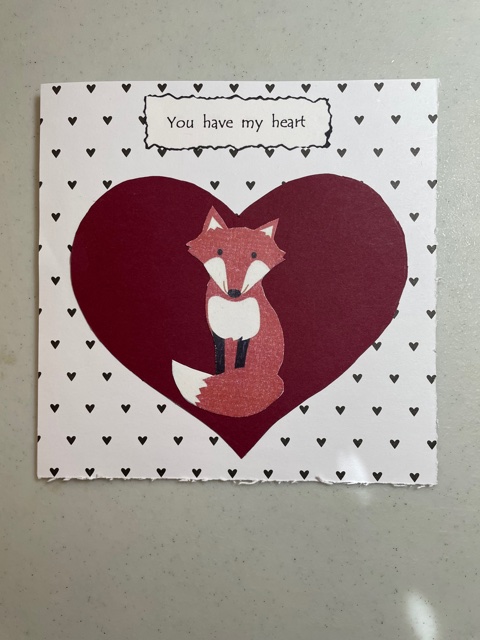
This was for my oldest son, Jeremy, who likes foxes:

I used a stencil for the heart. I printed off the sayings or captions and inside sentiments from the computer since my handwriting is not good. I cut out this one with decorative scissors and then outlined it in black. I had the hardest time finding the right fox. I have several stickers and looked up clip art, but none of them looked just right. I had some wooden cutouts, but I wasn’t sure if the glue would be strong enough to keep it on, especially as this one had to go through snail mail. Finally I got the idea to scan the fox cutout and print it, and that worked pretty well.

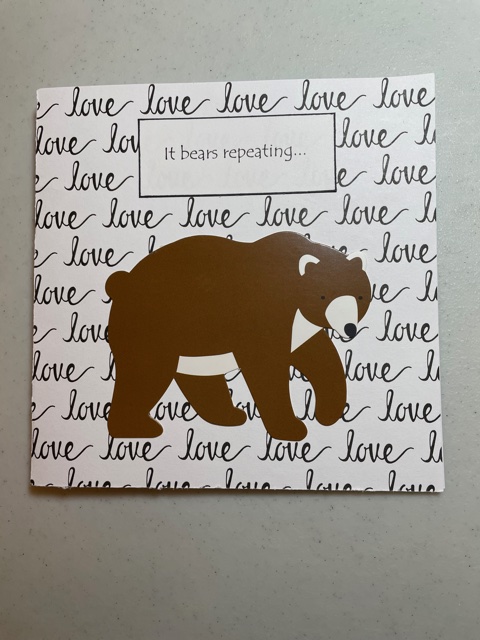
This was for Jason:

The bear was from a scrapbooking paper collection.

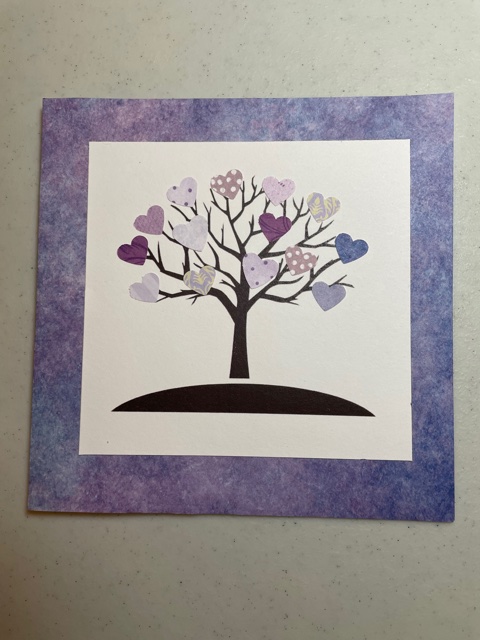
This was for my daughter-in-law, Mittu, who likes purple:

I printed out the tree from some free clipart I found online, then used a paper punch on various scrapbooking papers for the hearts.

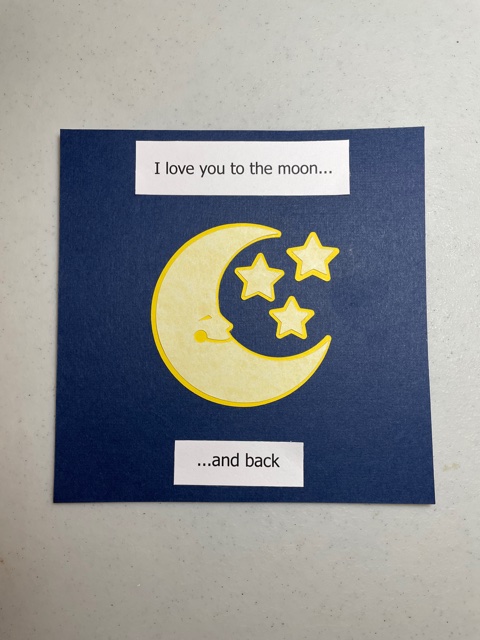
This was for Timothy, my grandson:

I had seen an idea using the moon on Pinterest, and then saw this moon and stars design on the Cricut.

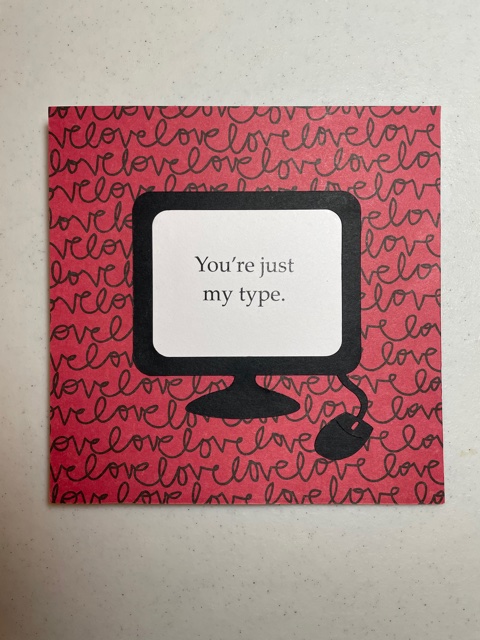
And this was for my youngest son, Jesse:

I had seen several variations of this idea on Pinterest using typewriters. But since he types via computer, I used that. I cut the computer out with the Cricut and positioned the caption behind the computer “screen.”

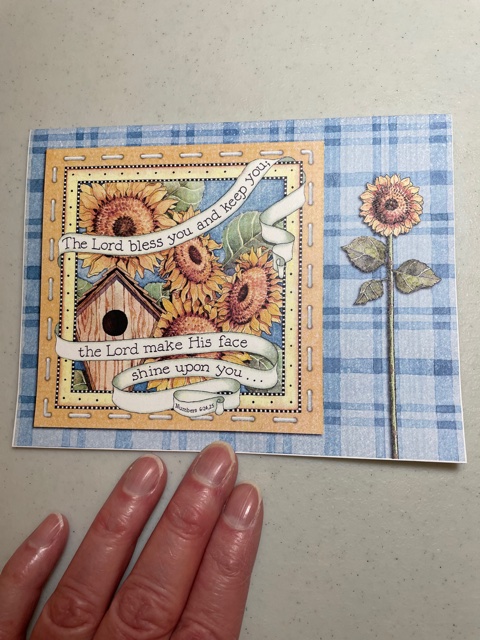
And finally, my daughter-in-law also likes sunflowers, so I was looking to use them somehow for her birthday card. In looking for something else on the computer, I stumbled across a file that I had purchased on sale some years ago from Karla Dornacher using sunflowers. Since Mittu also has blue in her home, this seemed perfect. So it wasn’t exactly handmade, except that I printed it off and cut it out. But I liked it, and I think Mittu did, too.

I just checked Karla’s site, and she doesn’t seem to carry this exact collection any more. But she did use the sunflower design in this printable card set.

I made one more birthday card for a friend. But when I double-checked to make sure I had the right date, I discovered her birthday was in June! I thought I saw somewhere recently that it was in February. Oh well—the card is now safely tucked away until June.

Watching

I’m still working my way through the Lark Rise to Candleford series while using my exercise bike. Jim and I really enjoyed the new PBS series of All Creatures Great and Small. I was sorry to hear the story had been changed from the original—but we did like this version.

Reading

Since last time I completed:

I usually read much more fiction than nonfiction, but that hasn’t held true this month.

I’m currently reading:

Blogging

Besides books reviews and almost weekly Friday Fave Fives and Laudable Linkages, I’ve shared on the blog this month:

As we turn the calendar page to March in a few days, we’ll have a busy couple of weeks with my husband’s birthday and my youngest son moving. But life should settle down a bit after that. I hope. You just never know.

How was your February? Any signs of spring yet?

(Sharing with Grace and Truth, Faith on Fire,Hearth and Soul,
Senior Salon, InstaEncouragements, Shannan’s What I’m Into)

Book Review: Write Better

In every writer’s conference, writer’s blog, or book about writing I have encountered, writers are told to continually improve their craft. Wherever we are on our writing journey, we need reminders, encouragement, and instruction. We can too easily grow complacent. Plus, changes in what’s acceptable can occur so quickly, we need to keep on top of current trends.

At the last writer’s conference I attended virtually, one industry professional said she read a book about writing or speaking every month. I thought I was doing good to read one a year!

Last year, several people recommended Write Better: A Lifelong Editor on Craft, Art, and Spirituality by Andrew T. Le Peau. Blogger and author Tim Challies said, “It is every bit the book many Christians need as they consider writing, and every bit the book many Christian writers need as they attempt to grow in their skill.” Literary agent Steve Laube called it the “book of the summer” of 2020.

Mr. Le Peau worked for InterVarsity Press for over forty years, spending much of that time as the associate publisher for editorial. He’s also written several books and Bible studies. So he knows what he’s talking about.

He also writes from and for a distinctly Christian point of view.

Le Peau divides his book into three parts: Craft, Art, and Spirituality.

Craft deals with the “nuts and bolts” of writing: creating good openings, endings, and titles, the craft and character of persuasion, narrative nonfiction, etc.

Art goes into creativity, tone, metaphor, restraint, and more.

Spirituality discusses calling, voice, authority, courage, and stewardship.

Several appendices cover platform, editors, coauthoring, self-publishing, and copyright.

I agree with the high praise that others have given this book. Le Peau not only writes well and has heaps of experience: he reads extensively and gives multitudes of examples of what he’s teaching. He writes professionally but without lapsing into academese.

I have many more places marked than I can share, but I wanted to note a few points that especially stood out to me.

After observing that “persuasion is part of almost every piece of nonfiction” (p. 37), Le Peau encourages writers to be honest persuaders.

If we want to be honest persuaders, we will be on the lookout for and stay away from hasty generalizations, false analogies, demonizing opponents, avoiding or sidelining the central issue (that is, using red herrings), and more. Honesty means respecting the truth as best we can know it, respecting contrary viewpoints, giving due credit, and using logic (p. 44).

He points out that “presenting the arguments for these other viewpoints in as strong a form as possible” (p. 55) is not only honest, but doing so actually strengthens our own arguments and the solutions we offer.

Even though this book primarily covers nonfiction, Le Peau encourages using stories. Stories pull us in and touch the heart. Stories “are bound to stick with us long after the information has been forgotten” (p. 60).

His chapter on creativity helped diffuse some of its mystery: “Essentially, creativity isn’t concocting something entirely unprecedented. Rather it is bringing together two things that have been around for a while but previously hadn’t been combined. Innovation almost always involves building on the past” (p. 117).

A few other quotes:

Grammar has one—and only one—purpose: to facilitate clear, effective, powerful, artful communication (p. 129).

Metaphors, similes, and analogies sharpen the sword of our writing. They allow us to cut quickly through the fat to the meat of our purpose (p. 146).

When we are too focused on readers getting our point, we can become didactic and perhaps preachy, engaging only one dimension—perhaps just the mind or just the will. Art engages the whole person—will, heart, soul, mind, and strength (p. 158).

Regardless of what we are writing, however, we must treat our readers with dignity. Don’t announce that you are going to tell a funny joke or story. Give readers the dignity of deciding for themselves if it is humorous. Besides, doing so makes it less funny because you have given away the element of surprise. Don’t say a story will be sad or happy or startling. That inoculates the reader against sadness or happiness or shock. Just tell the story (p. 159).

The goal of writers is not complete originality but to take the past and give it a shake, a fresh look that helps us see  reality differently and better (p. 185).

Criticism is not just something to be endured. It is something to help us grow and improve (p. 214),

Though all the book is valuable, perhaps the most valuable part of it is the last section on spirituality, having the right perspective whether in success or failure, remembering we’re stewards of God’s truth and the talents He gave us. “Remember, my identity is in Christ. I am not defined by what I write. I am not defined by the praise or criticism or sales of my book or the number of hits on my blog. My identity is in Christ, who loves me with an everlasting love, who made me, who put the urge to write in me, and who helped me get it out” (p. 225).

I wish I could read a book like this and keep all of its information readily accessible in my mind. Since I haven’t figured out how to do that, I should plan to reread this one every year. Highly recommended.

You can read more from Mr. Le Peau at his blog, Andy Unedited.

(Sharing with Carol’s Books You Loved, Booknificent)