Book Review: Be Loyal

In Be Loyal (Matthew): Following the King of Kings, Warren Wiersbe notes that we don’t have any recorded words of the apostle Matthew in any of the gospels. Even in his own book, he didn’t write about himself: he wrote about “Jesus Christ, the son of David, the son of Abraham” (Matthew 1:1).

Matthew was one of the twelve disciples of Jesus. He had been a tax collector when Jesus called him to follow. Wiersbe comments, “Being accustomed to keeping systematic records, Matthew gave us a beautifully organized account of our Lord’s life and ministry” (p. 18).

I don’t think I had considered before that “Matthew’s gospel is the bridge that leads us out of the Old Testament and into the New Testament” (p. 17), but I see it now.

The Old Testament is a book of promise, while the New Testament is a book of fulfillment. . . .“God promised a Redeemer; and Jesus Christ fulfilled that promise. Fulfilled is one of the key words in the gospel of Matthew, used about fifteen times.

One purpose of this gospel is to show that Jesus Christ fulfilled the Old Testament promises concerning the Messiah.

Matthew used at least 129 quotations or allusions to the Old Testament in this gospel (p. 18).

Matthew wrote topically rather than chronologically. He gave the history and heredity of Jesus in His birth and genealogy and then laid out His credentials. “He recorded at least twenty specific miracles and six major messages” (p. 19). He related Jesus’ character, principles, and power. He shared how Jesus taught and trained His disciples and how He was betrayed, suffered, died, and rose again in victory.

A few more quotes that stood out to me:

Jesus also fulfilled the law in His teaching. It was this that brought Him into conflict with the religious leaders. When He began His ministry, Jesus found the Living Word of God encrusted with man-made traditions and interpretations. He broke away this thick crust of “religion” and brought the people back to God’s Word. Then, He opened the Word to them in a new and living way—they were accustomed to the “letter” of the law and not the inner “kernel” of life” (p. 49).

In Matthew 6: 22–23, Jesus used the illustration of the eye to teach us how to have a spiritual outlook on life. We must not pass judgment on others’ motives. We should examine their actions and attitudes, but we cannot judge their motives—for only God can see their hearts. It is possible for a person to do a good work with a bad motive. It is also possible to fail in a task and yet be very sincerely motivated. When we stand before Christ at the judgment seat, He will examine the secrets of the heart and reward us accordingly (Rom. 2: 16; Col. 3: 22–25) (p. 66).

This dramatic incident [in 8:28-34] is most revealing. It shows what Satan does for a man: robs him of sanity and self-control; fills him with fears; robs him of the joys of home and friends; and (if possible) condemns him to an eternity of judgment. It also reveals what society does for a man in need: restrains him, isolates him, threatens him, but society is unable to change him. See, then, what Jesus Christ can do for a man whose whole life—within and without—is bondage and battle. What Jesus did for these two demoniacs, He will do for anyone else who needs Him. Christ came to them, and even braved a storm to do it. This is the grace of God! He delivered them by the power of His Word. He restored them to sanity, society, and service (p. 79).

Why compare God’s Word to seed? Because the Word is “living and powerful” (Heb. 4: 12 SCO). Unlike the words of men, the Word of God has life in it, and that life can be imparted to those who will believe. The truth of God must take root in the heart, be cultivated, and be permitted to bear fruit. It is shocking to realize that three-fourths of the seed did not bear fruit (p. 108).

“Why did Jesus walk on the water? To show His disciples that the very thing they feared (the sea) was only a staircase for Him to come to them. Often we fear the difficult experiences of life (such as surgery or bereavement), only to discover that these experiences bring Jesus Christ closer to us (p. 124).

Many Christians have the mistaken idea that obedience to God’s will produces “smooth sailing.” But this is not true. “In the world ye shall have tribulation,” Jesus promised (John 16: 33). When we find ourselves in the storm because we have obeyed the Lord, we must remember that He brought us here and He can care for us (p. 128).

As we look into the Word of God, we see the Son of God and are transfigured by the Spirit of God into the glory of God (p. 150).

“Come and see!” was followed by “Go and tell!” (p. 266).

As always, Dr. Wiersbe’s commentary was a great companion through Matthew.

(Sharing with Carol’s Books You Loved, Booknificent)

Where Bible Reading Plans Go To Die

Our church uses a Bible reading plan that takes us through the whole Bible in about four and a half years. We discuss the week’s reading each Sunday morning. The man making the announcements last Sunday mentioned that we’d be starting Leviticus this week, “where Bible reading plans go to die.”

It’s true, isn’t it? How often have we begun January in Genesis with good intentions of reading the Bible, only to get bogged down by the time we get to Leviticus.

So we tell ourselves all those regulations don’t apply to us any more since the sacrificial system and feast days were fulfilled in Christ, and we move on to something more interesting. That is, if we haven’t given up our reading plan completely.

But there are several reasons New Testament Gentile Christians should still read Leviticus.

It’s inspired of God. 2 Timothy 3:16-17 says, “All Scripture is breathed out by God and profitable for teaching, for reproof, for correction, and for training in righteousness, that the man of God may be complete, equipped for every good work.” God gave it to us and it’s profitable for us even though we don’t observe all the rituals in it.

It’s instructive. “For whatever was written in former days was written for our instruction, that through endurance and through the encouragement of the Scriptures we might have hope” (Romans 15:4).

The New Testament quotes from Leviticus and refers to it over 100 times according to Warren Wiersbe in Be Holy (Leviticus): Becoming “Set Apart” for God.

Key biblical truths are better understood with Leviticus as a foundation. Imagine growing up repeatedly bringing sacrifices for sin to the tabernacle or temple. Then imagine being stunned by this news:

And every priest stands daily at his service, offering repeatedly the same sacrifices, which can never take away sins. But when Christ had offered for all time a single sacrifice for sins, he sat down at the right hand of God, waiting from that time until his enemies should be made a footstool for his feet. For by a single offering he has perfected for all time those who are being sanctified. (Hebrews 10:11-13)

Or imagine reading that the lamb for a burnt offering had to be perfect and without blemish and then finding that “you were ransomed from the futile ways inherited from your forefathers, not with perishable things such as silver or gold, but with the precious blood of Christ, like that of a lamb without blemish or spot” (1 Peter 1:18-19).

Or imagine having the whole burnt offering in Leviticus 1 in mind when reading Romans 12:1: “I appeal to you therefore, brothers, by the mercies of God, to present your bodies as a living sacrifice, holy and acceptable to God, which is your spiritual worship.

Sure, we can get some of these concepts in the New Testament on their own, but we get a fuller picture and a deeper appreciation when we understand the background of them.

It emphasizes holiness. Dr. Wiersbe writes in Be Holy, “The word holy is used 93 times in Leviticus, and words connected with cleansing are used 71 times. References to uncleanness number 128. There’s no question what this book is all about.”

A seminary professor taught a class on Leviticus. One assignment was to try to keep the regulations in Leviticus for a week and journal about the experience. One student wrote:

Every day, I found myself focused on thinking about ritual purity and impurity. Partway through the week, I realized that I was thinking about these things all day long and in every aspect of my life, and that’s when it hit me: God cares a lot about our purity and holiness. Not just from a ritual perspective, but also from a moral perspective. All day long and in every aspect of life, the Lord wants me to pursue purity in my heart, in my life, in my actions. He wants me to reflect his holiness in all that I do. I have been treating holiness way too lightly! O Lord, help me to be holy!

It underscores the pervasiveness and seriousness of sin. We take sin too casually these days, maybe because we seem to be able to receive it easily. But we forget what it cost.

It encourages thankfulness and appreciation of Jesus’ sacrifice. We not only appreciate all that He went through, but we’re thankful for His deliverance. Jay Sklar, the seminary professor mentioned earlier, said that after teaching Leviticus, he could hardly sing a hymn about Jesus’ sacrifice without tears of thankfulness.

Israel’s feasts helps us understand our Christian celebrations. The ESV Study Bible’s introductory notes to Leviticus say:

The festal calendar of Israel enumerated in Leviticus (Lev. 23:1-44) has strongly shaped the Christian church’s traditional calendar. The three main national pilgrim feasts of Israel are the Feast of Unleavened Bread, the Feast of Harvest, and the Feast of Booths. For those churches that follow the traditional calendar, these celebrations find their climax in Good Friday,  Easter, and Pentecost. To fully understand the Christian celebrations, one must see their initial purpose in the OT (p. 213).

It teaches love for neighbors. Did you know that the first instance of the phrase “love your neighbor as yourself” occurs in Leviticus 19:18? We see justice tempered with mercy in the regulations in Leviticus. Justice and fair treatment at large begins with justice and fair treatment on a personal level to our neighbors and acquaintances.

In Mark 12, a scribe asked Jesus which was the most important commandment. Jesus answered, “The most important is, ‘Hear, O Israel: The Lord our God, the Lord is one. And you shall love the Lord your God with all your heart and with all your soul and with all your mind and with all your strength.’ The second is this: ‘You shall love your neighbor as yourself.'” The scribe responded, “You are right, Teacher. You have truly said that he is one, and there is no other besides him. And to love him with all the heart and with all the understanding and with all the strength, and to love one’s neighbor as oneself, is much more than all whole burnt offerings and sacrifices.” “And when Jesus saw that he answered wisely, he said to him, ‘You are not far from the kingdom of God’” (Mark 12:28-34).

Many hymns refer back to concepts in Leviticus, like “Is Your All on the Altar?” and “Whiter Than Snow.”

Sure, there are some difficulties in Leviticus. Some of the regulations or restrictions that seem most odd to us are thought to have connections with the pagan worship in Egypt that the Israelites had lived with for 400 years. There are a few passages that are hard to understand.

But by and large, Leviticus sheds light on much gospel truth. OT Israel practices these things looking ahead to Christ’s sacrifice, seeing much of it in symbolic form. As the NT church, we look back on the symbols and object lessons to more fully understand.

I’m approaching Leviticus this time with eager anticipation.

(Sharing with Sunday Scripture Blessing, Selah, Scripture and a Snapshot,
Hearth and Soul, Inspire Me Monday, Senior Salon,
Remember Me Monday, Tell His Story, InstaEncouragements,
Recharge Wednesday, Let’s Have Coffee, Share a Link Wednesday,
Heart Encouragement, Grace and Truth, Faith on Fire, Blogger Voices Network)

Laudable Linkage

IMG_0195

Here are some thought-provoking reads discovered this week.

Now Ravi, Too? “Sin on the level that Christianity Today describes does not happen all at once. It grows gradually over a long period of time as sinful behavior builds layer upon layer. It starts by justifying small indiscretions and then multiplies until we find ourselves surrounded by a wall of hypocrisy. As I read the Zacharias story it prompts me to examine my own life for the ‘little’ sins that I am excusing.”

The Best and Worst of Bible Reading Plans. “In my commitment to continue to read through God’s Word, I’ve borrowed and developed various Bible reading methods and tips. Some worked well and others . . . flopped. In this article, I’ll share my greatest successes and biggest flops along with the single best advice I’ve discovered for faithfully reading and enjoying the Bible.”

You Are Going to Hate It, HT to Challies. “You know that country you’ve been dreaming about? The one that you have been praying over and researching? You’ve been talking about it endlessly these days, building a team who will support you when you move there. You are ready to uproot your family, your job, your entire life to pour your soul into the place you love so much. Call me a party pooper, but today I’m here to tell you something important: Shortly after you finally arrive in that country, you are going to hate it.” True for missionaries, but I think also for almost any calling. It’s not all sweetness and light. There will be times when “Perseverance is the whole battle.”

There’s Something About Your Faithfulness, Sister, HT to Challies. A word of encouragement for everyday faithful believers.

Why Read Full-Length Historic Christian Biographies? HT to Challies. Yes! My thoughts on this as well in a past post: Why Read Biographies? Christian biographies have helped my Christian walk immensely.

Have a great Saturday!

Friday’s Fave Five

It’s Friday, time to look back over the blessings of the week
with Susanne at Living to Tell the Story and other friends.

Winter is making itself felt in full force. But thankfully we’re staying warm and cozy inside. Here are a few favorites from the week.

1. Valentine’s Day is one of my favorite holidays. We had our traditional “meat hearts,” cheesy potatoes, and salad, and heart cupcakes and exchanged cards. Jim got me pink roses and Jason and Mittu brought us candy and flowers and coffee. A fun night!

2. Good tools. I make cards for the immediate family (I’ll share my Valentines in my end-of-month post). My little paper cutter has needed a new blade for ages, but I just kept forgetting about it. And then, I haven’t been in Hobby Lobby since the pandemic started. I just went last week and got a new blade plus a better glue stick than I had. They made such a difference!

3. Warmth and electricity. My step-father, two sisters, and a nephew live in TX, and they were all without power at different times during the winter storms there this week. Thursday I heard that they all had power back. I hope and pray it stays on.

4. Jesse’s apartment. My youngest found an apartment this week and is moving next month! He’s been looking forward to this for ages. We are excited for him! But it’s also hitting me that he really is moving out and our nest will be thoroughly empty then. We’ve had him home for longer than usual, though, so that’s been a blessing.

5. Jim shopping. Jim asked me what I wanted for Valentine’s Day, and I asked him if he’d go to the store. 😀 With the extra card-making and baking, it was a big help. Then, yesterday at lunch I was revising my grocery list, and he offered to go after dinner. ♥

Bonus: We’re scheduled to close on the sale of our rental house this afternoon! My husband is so excited not to have the responsibility of a second property any more.

That’s our week. How was yours?

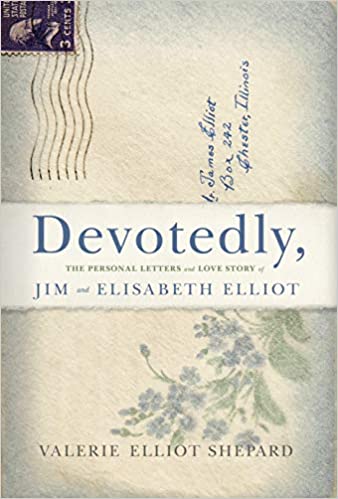
Devotedly, The Love Story of Jim and Elisabeth Elliot

If you’ve read here long, you know Elisabeth Elliot is a heroine of mine, a mentor from afar.

If you’re not familiar with Elisabeth, her husband and four of his colleagues were killed by a tribe they were trying to reach in the Ecuadorian jungle in 1956. She told the men’s stories in Through Gates of Splendor. Then, a few years later, she and her young daughter and the sister of one of the men went to live with the tribe in the jungle. A few years later, Elisabeth brought her daughter back to the US and became an author and speaker.

Jim and Elisabeth’s love story is unusual because they both thought God was going to send them to the mission field single. Jim was Elisabeth’s brother’s roommate in college and spent one Christmas vacation at their home. Then they had several classes together and began to study together.

They were different in personality. Jim was outgoing and spoke freely and easily (a little too freely sometimes). “The same bold, aggressive temperament that served him well as a daring disciple of Christ could sometimes come across as harsh and abrupt, even meddling, especially when dealing with a woman” (p. 258). Elisabeth was intellectual and reserved. But they thought alike on many subjects and began to find themselves drawn to each other.

Elisabeth seemed willing to take this development as from the Lord much sooner than Jim was. He had taken to heart Matthew 19:12 about some making themselves “eunuchs” for the kingdom of God (remaining single, unattached) and 1 Corinthians 7 about people being better able to serve God without distraction if they are single. He had given other guys in college a hard time about dating. He knew God was calling him to a pioneering field which would include rough living conditions. He didn’t feel he could ask a wife into that situation.

On top of everything else, he wrestled in his journal with the thought that if he loved a woman, it would mean that Jesus wasn’t enough for him. Somehow he missed that God Himself said “It is not good for man to be alone” when He created woman.

But for him, the thought of being romantically involved was a complete paradigm shift. It wasn’t something he could change his mind about in a short time. Plus, as they both graduated from college, each was not sure where God would have them. They worked at different jobs and helped in different ministries until they both felt led to go to Ecuador.

Elisabeth had told their love story in Passion and Purity and used it as a springboard to talk with young people about dating issues. She gave her letters and journals to her daughter, Valerie, to go through “when she had time.”

As a mother of eight, Valerie only recently had time. After reading the letters and journals and rereading her mother’s books, she felt she needed to share her parents’ love story. There was too much to copy entirely, so Lifeway helped her decide what to share. The result is Devotedly, The Personal Letters and Love Story of Jim and Elisabeth Elliot.

Valerie tells the story, interspersing the narrative with excerpts from her parents’ letters and journals. At times she adds a word of explanation, a little further insight, her thoughts on different points, or how her parents influenced her own story.

We’re so used to hearing the mature Elisabeth, who did most of her writing and speaking after decades of walking with the Lord. It’s interesting to read her young adult thoughts.

They spent a great deal of their relationship apart, so they got to know each other through letters. They went through the same difficulties as everyone else, with one person taking something the wrong way, the other having to explain, etc. They had no problem taking each other to task when they disagreed, but they did it as kindly as they could.

But mostly they encouraged each other to draw close to God and be and do all He wanted them to.

When they struggled with whether they should even be corresponding, they concluded that “what they shared together, even knowing the possibility they would spend their lifetimes apart, was more than worth it” (p. 42).

Valerie says they handled their love “with extraordinary sacredness” and “modeled—not perfectly, but persistently—the way God intends us to handle love, steward it, and keep it continually under His guidance” (pp. xiv-xv).

It’s interesting (and fun) to note the change in Jim’s writing from wrestling to acceptance that his love for Elisabeth was from God. He found that these two loves enriched each other rather than detracting from each other.

A few other thoughts that stood out to me:

Valerie noted that In the earliest pages of her mother’s journals, the words “though punctuated, of course, with the typical cares and crises of any young woman’s life—would never shift from this due-north orientation. God was first; God was supreme; God was all” (p. 1).

I thought this principle was a good one: comparing Christian life to a railroad, Jim wrote about decisions, “A block signal—a crisis—is lighted only where there is a special need. I may not always be in sight of a ‘go’ light, but sticking to the tracks will take me where the next one is” (p. 109).

Though we consider both Elliots stalwart examples of faith today, they each had their discouragements. Valerie wrote, “When you hear my mother at twenty-two saying she feels ‘useless’ and ‘fearful’ and ‘ashamed,’ recall what she went on to become in life by God’s grace and power. Think what our Father is capable of doing, encouraging you to press into Him, as she did, for His glory” (p. 66). As Elisabeth “grew older in Christ,” she realized she enjoyed “having the floor” and saw her tendency to want to “have the last word” and “straighten people out.” “She could be cut to the quick at times by her own insensitivity towards others who were speaking to her, and she wanted to become more gracious to those who didn’t have their words or facts straight” (p. 104).

Elisabeth had a nice singing voice and was often asked to sing in meetings. She wrote:

Oh, sometimes I wonder if I should not abstain from singing altogether until I know that Christ is my motive. Truly I do desire that my voice, as well as my life and will, be wholly given to His praise. But the flesh is ever with me—it manifests itself in the most singular forms sometimes. I discover that self-effacement, springing wholly from selfish motives, taints my very highest aspirations to act of God’s glory. So I am driven once again out of myself, for I am all unprofitable. . . I am but a branch, and without Thee can do nothing (pp. 138-139)

In Becoming Elisabeth Elliot, Ellen Vaughn mentions almost in passing an article someone had written proposing that perhaps Jim’s strong friendships with other men, his aversion to marriage, and his long wrestling over his relationship with Elisabeth meant that perhaps he was really homosexual at heart. One can’t read much of his writing without rendering such a possibility ridiculous. He wrote often of struggling against lustful thoughts, even more so the closer they got to their wedding. After one such entry, Valerie noted, “Let’s not pretend that my father was above the temptation. Yet, in response to it, he did what all godly men (and women) must do when accosted by strong, unholy thoughts. He called them out, considered it war, and made impassioned pleas that God would be his strength to endure” (p. 164). Even before, his teenage relationship with girls “warned me that my affections go out very easily and are jealously tenacious. Recognizing this fact, that I would lose my heart at every turn if I didn’t discipline myself carefully, I withdrew from dating and even close associations with girls whom I knew attracted me, or to whom I was somehow attractive” (p. 53).

Jim also wrestled with feeling inferior to Elisabeth and feeling “I can never be all she ought to have in a husband” (p. 192).

So we see that neither of them was perfect. That’s an encouragement to me, because I’m not, either. I wrestle with some of the same things they did. Sanctification is a lifelong process. But God’s grace is available every step of the way.

We miss a lot by not writing letters today. These letters are not only deeply spiritual, but they’re often poetic and literary as well. I’d love to include some of the more lyrical entries, but this is too long already.

Some years ago a philosophy started going around Christendom that God did not have a specific will for people regarding life work, location, spouse, etc.; He left it up to individuals to do what they wanted. That never set well with me, for too many reasons to go into here. But I saw anew one reason through these letters and journals: the sanctifying affect that waiting for and trying to discern the will of God could have. Near the end of the book, Valerie records her father’s words: “I have sought slowly the will of God, and the slowness has brought strength into the conviction of it, and joy in the realization of it” (p. 233).

Jim wrote, “The Lord has a certain slow dignity about His movings which constantly shames my fretting unbelief” (p. 163).

It touched my heart that they chose for their wedding verse Isaiah 25:9: “Lo, this is our God; we have waited for Him.”

Valerie shares that “If I could express my one hope for compiling this book, my prayer is that these entries of theirs would call us to search faithfully for God in His Word. And upon discovering His unchanging, faithful, merciful, and loving character, I pray we would be more fully moved in obedience to Him that we too might leave a lasting legacy of faith as my parents did” (p. 45).

The Elliots’ writing does encourage me in my walk with God and continues to spur me on to seek Him in His Word and find and do His will.

(By the way, last year, Revive Our Hearts did a series of interviews with Valerie about her parents’ story and writing the book here. I enjoyed listening to them then, and they have the transcripts up now.)

(Sharing with Grace and Truth, Hearth and Soul, Senior Salon,
InstaEncouragements,Carol’s Books You Loved, Booknificent)

Book Review: The Invitation

In Nancy Moser’s The Invitation, four ordinary people in different areas of the country receive a mysterious, hand-delivered invitation to come to Haven, Nebraska, on August 1. The invitations didn’t list a host or organization name or any other information except a Bible verse about faith as a mustard seed and a drawing of a mustard plant.

One of the invitees was an ex-governor. The others were a TV news producer, and wife and mother in an unhappy marriage, and a single young aspiring writer. Some are curious, but most are dismissive of the invitation at first. There’s not enough information and it all seems too weird.

But one by one, events occur that convince them to go. And even though some arrive without an invitation—a homeless stowaway, a disgruntled husband, and a thief—they are all expected and planned for.

Some are confronted with issues in their lives—some more than others. Some are nudged to use their gifts and talents in new ways. The faith of all is tested. Lives are changed.

I can’t say much more than that without giving away too much of the story. It doesn’t take long to figure out who the ultimate host is and who the mentors in Haven are. Because the visitors to Haven are confronted to varying degrees,at times the mentors come across as more didactic than we usually see in fiction. But it works because of the nature of the story.

I don’t know if I have ever read a story quite like this. Nancy Moser says in her afterword that she’s never written a story quite like this. But this story was on her heart.

It would be nice in some ways if there was such a place to go (or send people . . . ) where someone could put their finger exactly on what was wrong in your life, tell you what to do about it, and tell you what your next step should be. It doesn’t usually work like that, though. God uses His Word and prayer and the ministry of the church to guide us in less direct ways. But, still, the premise makes for an interesting imaginative tale.

And I love Nancy’s main two takeaways: that God has invited each of us to participate in His work, and He uses people with faith as small as a mustard seed.

(Sharing with Carol’s Books You Loved, Booknificent)

God’s Part, My Part

“Lord, change me.”

Do you ever pray that? And do you ever get frustrated with the slowness of change? Or even the lack of change?

I do. I pray for God to fill me with the fruit of His Holy Spirit, and not an hour later get impatient. I pray for victory over anger, and then lose my temper over something trivial. I pray for help with self-control, and then convince myself it really is okay to eat another cookie.

I can’t do anything without God’s help, so it’s good to ask for it. But sometimes He doesn’t want us to stop there. He wants us to take action—not by ourselves, but with Him.

Walk by the Spirit, and you will not gratify the desires of the flesh. (Galatians 5:16)

If we live by the Spirit, let us also keep in step with the Spirit. (Galatians 5:25)

Abide in me, and I in you. As the branch cannot bear fruit by itself, unless it abides in the vine, neither can you, unless you abide in me. (John 15:4)

And we all, with unveiled face, beholding the glory of the Lord, are being transformed into the same image from one degree of glory to another. (2 Corinthians 3:18)

But put on the Lord Jesus Christ, and make no provision for the flesh, to gratify its desires. (Romans 13:14)

Do not be conformed to this world, but be transformed by the renewal of your mind. (Romans 12:2a)

So flee youthful passions and pursue righteousness, faith, love, and peace, along with those who call on the Lord from a pure heart.

Put off your old self, which belongs to your former manner of life and is corrupt through deceitful desires, and to be renewed in the spirit of your minds, and to put on the new self, created after the likeness of God in true righteousness and holiness. (Ephesians 4:22-24)

The Bible is full of action verbs. We don’t do any of these things to earn God’s love or favor, We’re saved by grace through faith. He loved us when we were His enemies. He already loves us abundantly—He’s not going to love us more if we get our act together.

Nor do we sanctify ourselves or make ourselves Christlike. He does that.

But He asks us to obey. To abide. To behold Him. To be transformed by renewing our mind with His truth. To participate. To respond. To cooperate.

1 Timothy 4:7 says to “train yourself for godliness.” Other translations use “discipline” or “exercise.” What happens when we exercise? We expend energy and effort to the point of aching and sweating. Paul goes on to say “For to this end we toil and strive,” not in order to earn God’s favor, but “because we have our hope set on the living God, who is the Savior of all people, especially of those who believe” (1 Timothy 4:10). He tells the Corinthians, “I discipline my body and keep it under control, lest after preaching to others I myself should be disqualified” (1 Corinthians 9:27). According to a note here, the Greek word translated “discipline” means “pummel”: “I pummel my body.” Grace doesn’t mean passiveness or a lack of effort.

I’ve spent a great deal of time wondering what’s God’s part and what’s my part in the Christian life. Someone once said, “Pray as if everything depended on God and work as if everything depended on you.” I don’t know if that’s quite it. It helps me more to think of man with the withered hand or the paralyzed man whom Jesus told to rise, take up his bed, and walk. He told them to do exactly what they couldn’t do. But in taking Him at His Word and obeying, they were given grace and power to do what He said.

Maybe it doesn’t matter exactly where the lines are. Maybe it’s not a formula: God does those steps and then I do these. In many of those verses listed, God’s part and our part go hand in hand. We abide in Him, He abides in us, He produces fruit. We behold Him, He transforms us.

Do I abide in prayer, or do I race through a prayer list? Do I behold Him in His Word, or do I run my eyes down the day’s reading? Do I look for the promised escape from temptation or for an excuse to indulge?

So I pray. And by faith I abide, behold, renew. And I trust Him to transform. And I remember a walk is a series of steps to a destination. And I remember bearing fruit is a long process of growth.

(Sharing with Selah, Scripture and a Snapshot, Hearth and Soul, Senior Salon,
Inspire Me Monday, Remember Me Monday, Tell His Story, InstaEncouragements,
Recharge Wednesday, Let’s Have Coffee, Grace and Truth, Blogger Voices Network)

Laudable Linkage

A collection of good reading online

Here are some good reads discovered this week.

The Bored-with-Reading-the-Bible Antidote, HT to Challies. “As one who’s been at this awhile, I hope you’ll indulge me as I share some thoughts with every intention of encouraging your pursuit of God.”

The Onliest Way, HT to Challies. “What seals our lips shut when the voice of the Lord echoes in our minds while we talk of snow and coffee and the kids? Why do we press Him back to the corner when we know He is the only way for our friends and acquaintances to be saved?”

The Character of a Christian Writer. “We can’t offer what we don’t have. If we’re not allowing God to continually transform us, our writing cannot have that effect on others. The first person God should change through my writing is me.”

4 Pitfalls of Writing Bible Studies. This is good advice for blog posts and devotionals, too.

Faith Over Fear, HT to Challies. “‘Faith over fear.’ It’s one of those Christian slogans that is undeniably true, and, at the same time, less helpful than it may seem.”

5 Things About Family Devotions I Learned the Hard Way, HT to The Story Warren. They rarely look or feel inspirational, but they accomplish much.

Inside Planned Parenthood’s Gender Factory, HT to Challies. It’s alarming that powerful hormones are given to teens with little evaluation or explanation.

If your Apple Watch was a person. Funny, and not far from the truth. I turned off almost all my notifications on my watch and phone a long time ago because I couldn’t stand them.

Have a good Saturday, and Happy Valentine’s Day tomorrow!

Friday’s Fave Five

It’s Friday, time to look back over the blessings of the week
with Susanne at Living to Tell the Story and other friends.

This hasn’t been the greatest week due to grey, rainy skies and a series of minor frustrations. But taking a moment to count blessings helps us change perspective and see God’s hand at work. Here are a few from my week:

1. My husband had to take care of some caulking that had chipped off around our shower. Part of the process was cleaning the area he was going to caulk. He took the opportunity to clean the whole shower plus the sink. That saved me a lot of time and effort that day. Plus he does a much better job of it than I do! We have hard water here and have to fight lime build-up. I can’t always get it off in spite of multiple cleaners and much scrubbing, but he can. It was so nice to step into a sparkling clean shower the next day. Much appreciated!

2. Take-out food. Due to the pandemic, we had not been getting take-out except for an occasional pizza. Some of you know that getting food out is one of my favorite things, one of the times I truly feel like I’m getting time “off.” So I have missed it. My son and daughter-in-law texted to ask about coming over Friday night and offered to bring something. We got Asian food from a place they like that we hadn’t tried yet. So good!

3. Movie night with the family. My son and daughter-in-law suggested watching Ferdinand together, an animated movie about a bull that doesn’t want to fight in the bullring. It was cute and funny.

4. My son and daughter-in-law’s kitchen makeover. My son sent this before and after photo:

They really brightened it up and modernized it!

5. A word in due season. One of the writing blogs I follow had a post I particularly appreciated this week. A few days after reading it, I realized this post was the answer to some earlier musing about my own writing. I don’t remember if I had consciously prayed about it, but I had sensed a need to adjust how I expressed myself a bit. Then it dawned on me that this post laid out how handle the very concerns I had been pondering. God is so good!

What’s a blessing from your week?

Do You Read More than One Genre?

Reading different genres

Do you read primarily one main genre? Or do you read several?

My favorite is contemporary Christian fiction along the lines of the Mitford series by Jan Karon. I love to hear about everyday people, their encounters with problems and neighbors and loved ones, and how God works in and through them. I have learned from and been deeply affected by Christian fiction..

But I also read a lot of historical fiction and a fair amount of suspense. I am not a big fan of romance. Most fiction has a love story, but I like books that have more to them than that. I don’t care for westerns or Amish fiction, but I have read some of each. I enjoyed some fantasy or speculative fiction. I wouldn’t read horror or erotica.

I love biographies and memoirs. Some biographies have had a profound influence on my life.

I read a lot of Christian nonfiction and enjoy it, but I have to make myself start and keep going with most of it. I gravitate more to stories.

I also like many classics. Someone once said “A classic is a book that has never finished saying what it has to say.” Classics still speak to us today even though writing styles and society customs have changed.

I read a little from non-Christian sources. Unfortunately, much secular fiction has a lot of language, sexuality, or gratuitous violence problems, which I don’t want to read. And you have to keep on guard against wrong philosophies. But some of it is still beneficial.

One reason I ask is just because I am interested. I love to talk books and reading interests.

But I am also curious. I’ve heard and read that authors should write primarily one genre so readers know what to expect from them. If they write in another genre, they’re told they’ll need to search for another audience. Some go so far to say that authors should use pen names if they write in two different genres.

That makes sense. If a writer is known for Amish fiction, it would be jarring to her readers to get that author’s latest work and discover it’s a gruesome murder mystery.

On the other hand, I have followed authors over to a different genre from what I have read from them before. In fact, I am more likely to try a different genre if an author I like has written in it, if only to see how they handle it. I wouldn’t want a favorite author to use a pen name for a different genre, unless they make it known that they’re doing so, because that makes it harder for fans to follow their work.

So I can see the wisdom of not disappointing readers who come to expect a certain kind of story from an author. And it’s probably wise for those just getting started to stay with one genre until they get established.

But I think sometimes a genre crossover can work.

What do you think? Would you follow an author from one genre to another? And what’s your favorite genre? Do you read more than one?

(Sharing with Grace and Truth, Hearth and Soul, Senior Salon,
InstaEncouragements, Booknificent)