Friday’s Fave Five

It’s Friday, time to look back over the blessings of the week
with Susanne at Living to Tell the Story and other friends.

Time keeps ticking by, no matter what we’re doing. Here we are at another Friday and halfway thorough April already! I enjoy these weekly pause to note the best parts of the preceding week.

1. Easter. Though our Easter was different from usual, it was still good. We enjoyed a good church service via Zoom, and a great meal and dessert. The night before, we had a three-way FaceTime call with all the kids, and later my son sent us videos of my grandson unpacking his Easter basket from us and then hunting for Easter eggs. So all in all, a good day.

2. Food swap. We had made ham and cheesy potatoes, and my daughter-in-law had made lasagna. Later in the day my son dropped by for a food swap—we shared some of our Easter leftovers with each other.

3. My favorite candy. I usually make, not Easter baskets, but little metal spring buckets for the kids with Easter candy in them. Timothy’s basket is bigger, with little toys and such. I don’t always make one for my husband, but we usually have enough extra candy for both of us to have some. I did make one for him this year, though. And I was surprised that he had bought me a bag of my favorite milk chocolate Lindt Lindor truffles. He doesn’t usually get them for Easter, so that was a treat. And I also love the small Reese’s eggs.
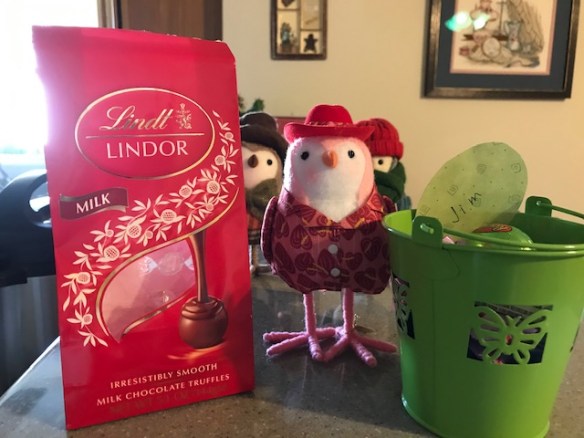
Yes, by the time I took the picture on Thursday, most of the truffles were gone. I’ve been rationing them out two a day. 🙂

4. Timothy’s birthday. Original plans had been to have a camp-out for my grandson’s birthday. Not only did social distancing throw a wrench in, but the weather was chilly. My son and daughter-in-law rearranged their living room to set up Timothy’s little play tent and their inflatable air mattress for a few days. Then on his birthday they set up a tent in the yard just to play in for a bit. We had another three-way FaceTime call to watch Timothy open presents and sing happy birthday to him. The next afternoon, my son dropped some birthday cake slices off for us.

camping cake

My daughter-in-law did an amazing job on that adorable cake!

5. Shakespeare’s sonnets. Sir Patrick Stewart has been reading one a day with his wonderful accent on his Instagram account. I’m not familiar with most of them, and I haven’t caught all of them, but I’ve enjoyed the ones I have taken the time to listen to.

I hope you’re still doing well this week! I feel we especially need to pray for our leaders now as decisions are made about reopening businesses and easing social distancing.

Book Review: A Portrait of Marguerite

In A Portrait of Marguerite by Kate Lloyd, Marguerite Carr’s only son is about to leave for college, and she feels lost. Her best friend drags her to an art class, just to get out of the house and do something fun. Marguerite had been an art major in college but had set art aside when she married and then had her son. She’s reluctant to let art back into her life, but she lets her friend talk her into the art class.

There she meets two people who will have an impact on her future: the instructor, Henry, and an older fellow student, Emily. Unfortunately, Henry is a friend of Marguerite’s ex-husband, Phil, which doesn’t raise him in her estimation.

We learn later in the book that Marguerite is weighed down by a secret from her past. As the story progresses, everyone that she holds in high regard is found to have faults and failures, even her beloved father. And her ex-husband, wonder of wonders, seems to have changed for the better.

I’m usually not one to infer symbolism where it’s not intended, but I do think Marguerite’s painting journey, from reluctance to dabbling to freedom, parallels her inner journey as she learns to forgive and accept herself and others.

The spiritual undercurrent, mainly from Emily, is subtle but realistic.

While this wasn’t the most riveting read, I enjoyed it. I’d give it a 4 out of 5.

(Sharing with Carole’s Books You Loved, Booknificent Thursday)

Book Review: Be Rich (Ephesians) Gaining the Things That Money Can’t Buy

Warren Wiersbe’s Be Rich commentary on the book of Ephesians does not a promote the “prosperity gospel”—insert prayers and gifts to televangelists and receive health and wealth. No, as the subtitle goes on to say. “Gaining the Things That Money Can’t Buy.”

Ephesians 1:3 says God “has blessed us in Christ with every spiritual blessing in the heavenly places.” Just some of those blessings:

  • Chosen in Him (verse 4)
  • Adopted as sons (verse 5)
  • Redemption through his blood, the forgiveness of our trespasses (verse 7)
  • An inheritance (verse 11)
  • Believers are “sealed with the promised Holy Spirit, who is the guarantee of our inheritance until we acquire possession of it, to the praise of his glory” (verses 13-14).

Wiersbe says, “‘In Christ’ is the most frequently used phrase in the book of Ephesians, and the point is clear: If you’re in Christ, you have everything.”

Another theme in the book is unity. Not a unity that ignores truth, but unity based on truth. Paul, the author of the letter to the Ephesians, says God’s plan was “to unite all things in [Christ], things in heaven and things on earth” (1:10). The first half of chapter 2 tells how we can be reconciled with God; the second half says that God, through Christ, broke down the barriers between Jew and Gentile. “For through him we both have access in one Spirit to the Father. So then you are no longer strangers and aliens, but you are fellow citizens with the saints and members of the household of God … ” (2:18-19). Chapters 4-6 share practical ways that unity in Christ is worked out in the church community, in the home, and in the workplace.

I’ve got dozens of quotes marked, but here are a few:

The Bible is our guidebook; the Holy Spirit is our Teacher. As we search the Word of God, we discover more and more of the riches we have in Christ.

Salvation is a gift, not a reward. Salvation cannot be “of works” because the work of salvation has already been completed on the cross. This is the work that God does for us, and it is a finished work (John 17: 1–4; 19: 30). We can add nothing to it (Heb. 10: 1–14); we dare take nothing from it.

By His death and resurrection, Christ overcame the world (John 16: 33; Gal. 6: 14), and the flesh (Rom. 6: 1–6; Gal. 2: 20), and the Devil (Eph. 1: 19–23). In other words, as believers, we do not fight for victory—we fight from victory! The Spirit of God enables us, by faith, to appropriate Christ’s victory for ourselves.

The Christian life is not based on ignorance but knowledge, and the better we understand Bible doctrine, the easier it is to obey Bible duties. When people say, “Don’t talk to me about doctrine—just let me live my Christian life!” they are revealing their ignorance of the way the Holy Spirit works in the life of the believer. “It makes no difference what you believe, just as long as you live right” is a similar confession of ignorance. It does make a difference what you believe, because what you believe determines how you behave!

Of course, there’s much more to Ephesians and Wiersbe’s book.

Ephesians contains two of my favorite Biblical prayers that I sometimes pray for myself and others. I’ll leave you with those

For this reason, because I have heard of your faith in the Lord Jesus and your love toward all the saints, I do not cease to give thanks for you, remembering you in my prayers, that the God of our Lord Jesus Christ, the Father of glory, may give you the Spirit of wisdom and of revelation in the knowledge of him, having the eyes of your hearts enlightened, that you may know what is the hope to which he has called you, what are the riches of his glorious inheritance in the saints, and what is the immeasurable greatness of his power toward us who believe, according to the working of his great might that he worked in Christ when he raised him from the dead and seated him at his right hand in the heavenly places (1:15-20).

For this reason I bow my knees before the Father, from whom every family in heaven and on earth is named, that according to the riches of his glory he may grant you to be strengthened with power through his Spirit in your inner being, so that Christ may dwell in your hearts through faith—that you, being rooted and grounded in love, may have strength to comprehend with all the saints what is the breadth and length and height and depth, and to know the love of Christ that surpasses knowledge, that you may be filled with all the fullness of God. (3:14-19).

(Sharing with Worth Beyond Rubies, Carole’s Books You Loved, Booknificent Thursday)

Book Review: The Women of Easter

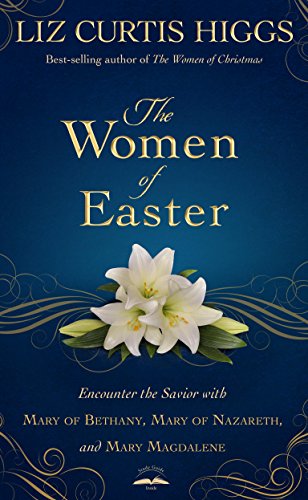
Women of Easter book The Women of Easter: Encounter the Savior with Mary of Bethany, Mary of Nazareth, and Mary Magdalene by Liz Curtis Higgs, as the title suggests, tells the story of Jesus’ death and resurrection through the eyes of these three Marys.

Liz lays out the narrative in eight chapters. I chose to read one a week most of the weeks leading up to Easter.

We learn about each of the the Marys. Mary of Bethany and the famous incident with her sister, Martha, the death and resurrection of her brother, Lazarus, and her anointing the feet of Jesus with expensive ointment, wiping them with her hair. Mary of Nazareth, the mother of Jesus. Mary Magdalene, out of whom Jesus cast seven demons (Luke 8:2) (and who is never called a harlot or prostitute in the Bible, though movie writers like to depict her that way).

Liz seamlessly weaves their stories in with the last several days Jesus spent on earth, using multitudes of Scripture references in different translations and snippets from commentaries. I can’t imagine all the study she did before writing this book.

Here are just a few quotes:

When Jesus “no longer moved about publicly among the people of Judea” (John 11:54) because people were after Him:

Jesus was neither afraid of them nor avoiding them. He was simply acting according to His Father’s will. Whenever my prayers are answered with a firm directive to wait, I remind myself that even Jesus had times of waiting, and more than once He did so in a desolate place.

Of Mary of Bethany’s wiping Jesus’ feet with her hair:

This devout follower, this beloved sister, used her long hair to dry a man’s feet—the “lowest job for the lowliest servant.” … Her perfume wasn’t the only thing she sacrificed. Mary laid her whole being before Him: her pride, her reputation, her social standing, her clean hands, her pure heart. She asked nothing of Him, sought no sign of approval, begged for no favors. Confident of His love and acceptance, she simply gave, expecting nothing in return.

When the disciples (not just Judas) rebuked Mary for her extravagance:

They didn’t just wag their fingers at her. They “scolded” (CEB) and “criticized” (GNT); they “censured and reproved” (AMPC). With no concern for her feelings, “they told the woman what a bad thing she had done” (ERV). Poor Mary of Bethany! To share something holy and then to be treated cruelly, not by strangers, but by those who knew her and claimed to know Christ.

Jesus offered a rebuke of His own, aimed not at Mary but at the disciples. “Leave her alone,” Jesus replied. John 12: 7

During the triumphal entry (Palm Sunday):

Worship isn’t a task. Worship is a response.

In preparation for the Passover:

Part of trusting God is letting go of our need to know and refusing to fret over the who, what, when, where, and why. When the time comes, the Lord will inform us, just as He did His disciples.

In a passage about Jesus being beaten:

During Lent it’s tempting to hurry toward Easter morning, eager to declare, “He is risen!” Yes, He certainly is. But reminding ourselves what came before His glorious victory over death is how we remain humbled by His sacrifice and grateful for His mercy. We were “bought at a price.” This was the cost.

On the way to the cross …

Jesus stopped to speak to the women. He sees us, beloved. He values us. He cherishes us. On that day He spoke a word of prophecy to these daughters, preparing them for even harder days to come.

When Jesus was buried:

“The women who had come with Jesus from Galilee followed Joseph and saw the tomb and how his body was laid in it.” Luke 23:55. Really, have you ever seen such perseverance? They stayed and they stayed and they stayed. This is one of the most important lessons these women teach us. Wherever He leads, follow Jesus. Whatever pain you are enduring, keep your eyes on Jesus. Even when hope seems gone, stay close to Jesus.

After the resurrection:

Woman. The first word spoken by the risen Christ, meant for all His daughters throughout eternity. Woman. An assurance that we matter to Him, that we count for His kingdom. Woman. A term of respect. The very word He used when addressing His beloved mother from the cross. Woman.

There were just a couple of places where I put a question mark, not sure if her observation or comment was exactly right. But I don’t recall that those points were anything major.

This book was a great way to prepare for Easter week. I’m sure I will use it again in the future. But, of course, it’s good reading year round since Christ’s death and resurrection affect us every day.

(Sharing with InstaEncouragement, Worth Beyond Rubies, Let’s Have Coffee,
Grace and Truth, Global Blogging, Senior Salon, Hearth and Soul, Happy Now,
InstaEncouragement, Carole’s Books You Loved, Booknificent Thursday)

Waiting in Hope

IMG_2165?ver2

Bible people spent a lot of time waiting. Some waited well. Others, not so well.

Abraham waited 25 years between the promise that God would make of him a great nation (Genesis 12:1-3) and the arrival of the son of that promise, Isaac. Though he believed God despite the advanced ages of himself and his wife, he sometimes tried to manipulate the circumstances and “help God.” He suggested his servant could become his heir. Then he had a son by another woman. But this child was not the son of promise.

Moses “supposed that his brothers would understand that God was giving them salvation by his hand” (Acts 7:25) when he defended one of them by killing his Egyptian attacker. Instead, Moses ended up fleeing for his life to Midian. He apparently put thoughts of his people behind him. Some 40 years later, God had to have a long conversation with Moses to convince him of God’s call and enablement. (Exodus 3).

The children of Israel waited over 400 years before they were delivered from captivity in Egypt. The people welcomed news of their deliverer at first (Exodus 4:29-30), but complained through much of their way and even wanted to go back when things got hard.

David humbly waited from the time he was anointed king to the time he could actually claim his kingdom. He showed respect to God’s anointed and never marched into the throne room declaring his “rights.”

Mary’s waiting was interrupted. While dreaming and planning of her upcoming wedding to her betrothed, she received the most startling news that she was to be the mother of the Messiah. Her response: “Behold, I am the servant of the Lord; let it be to me according to your word,” (Luke 1:38), even though she didn’t know how her fiance or others would respond or what it would cost her.

Simeon “was righteous and devout, waiting for the consolation of Israel, and the Holy Spirit was upon him,” and Anna “began to give thanks to God and to speak of him to all who were waiting for the redemption of Jerusalem” (Luke 2:25-38). These were blessed to see and recognize the Son of God in His infancy.

The disciples waited three days between the crucifixion and resurrection. But they had forgotten or never quite understood the promise that Jesus would rise again in three days. Imagine what sorrow, despair, regret they felt.

Hebrews 11 mentions many who “died in faith, not having received the things promised, but having seen them and greeted them from afar.” Even though they didn’t receive their answers in their lifetimes, they looked ahead to that “better country, that is, a heavenly one” (Hebrews 11:13-16).

So there are right and wrong ways to wait. We can manipulate our own answers or go back on, or forget, God’s promises. Or we can wait humbly and faithfully even when circumstances seem to go against everything we hope for.

Who knows how long we’ll have to wait in isolation before covid-19 is conquered. There are plenty of things to do while we wait.

Many of the psalms give us encouragement while waiting. Here are just a few:

Indeed, none who wait for you shall be put to shame; they shall be ashamed who are wantonly treacherous. Make me to know your ways, O Lord; teach me your paths. Lead me in your truth and teach me, for you are the God of my salvation; for you I wait all the day long …

My eyes are ever toward the Lord, for he will pluck my feet out of the net.Turn to me and be gracious to me, for I am lonely and afflicted. The troubles of my heart are enlarged; bring me out of my distresses. Consider my affliction and my trouble, and forgive all my sins.

Oh, guard my soul, and deliver me! Let me not be put to shame, for I take refuge in you. May integrity and uprightness preserve me, for I wait for you. (Psalm 25:3-5, 15-18, 20-21).

I believe that I shall look upon the goodness of the Lord in the land of the living! Wait for the Lord; be strong, and let your heart take courage; wait for the Lord! (Psalm 27:13-14).

From Lamentations 3:24-26:

The Lord is my portion,” says my soul, ‘therefore I will hope in him.” The Lord is good to those who wait for him, to the soul who seeks him. It is good that one should wait quietly for the salvation of the Lord.

Paul shares in Romans 8:18-19, 22-25:

For I consider that the sufferings of this present time are not worth comparing with the glory that is to be revealed to us. For the creation waits with eager longing for the revealing of the sons of God ... or we know that the whole creation has been groaning together in the pains of childbirth until now. And not only the creation, but we ourselves, who have the firstfruits of the Spirit, groan inwardly as we wait eagerly for adoption as sons, the redemption of our bodies. For in this hope we were saved. Now hope that is seen is not hope. For who hopes for what he sees? But if we hope for what we do not see, we wait for it with patience.

Other passages give us instruction:

… Be like men who are waiting for their master to come home from the wedding feast, so that they may open the door to him at once when he comes and knocks. Blessed are those servants whom the master finds awake when he comes (Luke 12:36-37a)

Therefore, beloved, since you are waiting for these, be diligent to be found by him without spot or blemish, and at peace (2 Peter 3: 14)

I hope our waiting in isolation is not long. But meanwhile, “I wait for the Lord, my soul waits, and in his word I hope; my soul waits for the Lord more than watchmen for the morning, more than watchmen for the morning (Psalm 130:5-6).

(Sharing with Inspire Me Monday, Global Blogging, Senior Salon, Hearth and Soul,
Purposeful Faith, Tell His Story, Happy Now, InstaEncouragement,
Recharge Wednesday, Worth Beyond Rubies, Anchored Abode,
Let’s Have Coffee, Heart Encouragement, Faith on Fire,
Grace and Truth, Blogger Voices Network.


Songs to Celebrate the Resurrection

songs to celebrate the resurrectionI wrote a post a few years ago about “The Perfect Christmas” and how disappointed we are when our celebration doesn’t meet whatever criteria makes it perfect in our estimation. I compared that to the first Christmas, which was so different from ours: a tired couple, a crowded city, no decorations, no Christmas cookies, unexpected unusual visitors. Yet that first Christmas produced our Savior.

I feel the same about Easter this year. For most of us, this Easter is a stripped-down version of our usual celebrations. What’s usually one of the most special services of the year will be on Zoom or YouTube. We probably won’t wear new clothes for it. We’ll have a good dinner and Easter baskets, but without extended family.

Yet, as As Gretchen Ronnevik tweeted, “Maybe huddling together as a small group of disciples in a home, wondering what God is doing, and what will happen next, and where do we go from here… is the most Easter-y of all Easter things to do.” I don’t think there’s anything wrong with the way we celebrate Easter now, but they didn’t have all those things the first Easter. Yet that Easter changed the world and the ones who first heard and told of it. Maybe our circumstances this year will help us refocus our attention on the reality, the miracle, the joy of it all.

Music is one my my main ways of feeding my soul truth. I shared some of my favorite songs about Christ’s death for us a few days ago, and I wanted to share some of my favorite Easter songs today.

For decades now, The Majesty and Glory of the Resurrection CD by Tom Fettke and Billy Ray Hearn has been has been my Easter morning breakfast-making companion. I love using that time to think about what the day means and to prepare my heart for the service. I like the mix of old and new and the majestic way they handle the music. The songs cover the death of Christ as well the big picture of Who God is. I think if you click here, the whole album automatically plays. But the individual tracks are on YouTube, and the album is available on iTunes.

This is one of my favorites from that album, especially “The Strife Is Over” and the second “I Know That My Redeemer Lives.”

This is a medley of four different hymns:

I never heard “The Easter Song” by Annie Herring until I found it on the end of the above medley, and I was struck by the pure joy of it. I’m glad the Eversons recorded the whole thing:

“Weep No More,” to the tune of the folk song, “Down By the Sally Gardens,” is on the Pettit’s CD Higher Ground:

“The One Who Lives Again is a new one by Matt Collier and Matt Taylor of the Wilds Christian Camp (words here):

He Is Risen is also on the Wilds Camp’s “Risen” CD, but I can’t find who wrote it.

“Christ Is Risen, He Is Risen Indeed” by Keith & Kristyn Getty:

Many songs cover both the crucifixion and resurrection. “Mercy Tree,” mentioned last time, is one.

And, of course, there are multitudes more.

I hope you can celebrate the resurrection of Jesus and all it means whether alone in your kitchen, with your family, and/or virtually with your church.

Happy Easter! He is risen!

(Sharing with Inspire Me Monday, Global Blogging, Senior Salon, Hearth and Soul,
Happy Now, Tell His Story)

Laudable Linkage

Here my latest round-up of good reads online. Many are about the pandemic, but a few are not.

On Easter. I had never seen this poem by John Updike before, but I really like it.

Celebration of the Resurrection’s Not Canceled. “We may forfeit long-celebrated Easter activities and traditions. But if we miss celebrating the resurrection, we end up missing the greatest celebration of all time. He is risen!”

Corona Virus Could Kill Consumer Christianity. “Because coronavirus has rapidly taken away the excesses of church, all the bells and whistles, all the nice-to-haves we’ve come to see as must-haves. What remains are bare essentials: Jesus, the Word, community, prayer, singing. What remains is the reality that the church can never be vanquished: we are Christ’s body and will live eternally with him. Things are suddenly spartan in how we do church—but what we are remains as vibrant as ever.”

What Might God Be Doing With the Coronavirus? Lots of good possibilities listed.

Along the same lines, Do We Really Want to Go Back to Normal? HT to Challies. “But the truth is, whatever will become ‘normal’ on the other side of the coronavirus crisis will not be the old normal. It will be something new. We are not going back. So here’s the question I hope we will begin to ask instead: Do we really want to go back to normal? Was the old normal good?”

100 Days that Changed the World, HT to Challies. A timeline of how quickly the virus spread.

Hard Times Are Coming. “We can trust God and be completely convinced that what He does is good and right, yet still hope to avoid tragedy, pain, suffering, hard times. The real testing of our faith comes when those hard times hit.”

We’re All Children Now, HT to Challies. A recent tragedy reminded the writer how little control we have in life. But that helps us acknowledge our need, like the children Jesus said we should be like to come into His kingdom.

The Art of Remembering How Good You Really Have It.

A Strong Conscience or Immaturity? HT to Challies. It’s hard to tell sometimes. But the person who doesn’t do a questionable thing is not always the “weaker brother.”

The Record Keeper. I love this picture of Matthew using his gift of record-keeping to tell others about Christ. I don’t know why I never made the connection between his record-keeping as a former tax collector and his gospel account.

Remember the Wonders. A neat way God answered a young son’s prayer.

Covid-19: Anxious About Money? “‘Your heavenly father knows that you need them [life’s essentials].’ Since you are especially valuable to your Father, he knows and remembers what you need. Your needs are impressed on his heart.”

And along the same lines, HT to The Story Warren, this is a sweet song inspired by Matthew 6:

Friday’s Fave Five

It’s Friday, time to look back over the blessings of the week
with Susanne at Living to Tell the Story and other friends.

I’m not sure how long we’ve been practicing social distancing and isolation now, but we continue to plug away. Counting the good things is a way to express thanksgiving to God as well as help our mental health.

1. Spring and Easter decorations. I usually have them up before now. I wasn’t sure I was even going to bother this year. But then I reminded myself I never decorate just for show or for when people come over: I do it because I like celebrating the different seasons and holidays. So I pushed out of my malaise and set most everything out last Saturday. They do brighten up the place, break up the monotony, and cheer my heart.

2. Meat. My son and daughter-in-law subscribe to a meat delivery service. They had a bit more than they could use a few weeks ago, so they asked if we could do a food swap: they’d bring over some meat for us and then raid our freezer for some gluten-free items I keep on hand for them (my d-i-l and grandson are gluten-intolerant). They brought some cuts of beef we don’t often buy. Then my husband saw a note on a local Facebook group that a nearby wholesale meat processing plant was selling some of their wares to the general public for a few hours. Their ground beef was much cheaper than the grocery store’s and they had meatloaf frozen and already seasoned and ready to cook. So not only was the gift and sale appreciated, but the variety of new things to try was exciting.

3. My husband’s grilling. A while back, my husband used the sous vide cooker my oldest son made to make his teriyaki chicken, finishing them off on the grill. Last Saturday he did the same with hamburgers. Good stuff.

4. Stump removal. Longtime friends may remember our saga of 50 diseased trees a few years ago. The people who cut them down didn’t get them cut as close to the ground as we would have liked. We checked on businesses that do stump removal, and that would have been expensive, especially for that many. We checked on different processes to remove them ourselves, but they were all either complicated or time-consuming. So we covered them up with a layer of dirt and mulch. But with erosion, they’re popping back up again. My husband was poking around them recently and discovered they are rotted and dried out enough that he could dig some of them out with a crowbar as a lever over a piece of wood. For the rest, he built a contraption that helped him get them out. He worked on them mostly bit by bit in the evenings and finished them when he took Thursday off. As soon as we’re able, we’ll fill the holes with dirt. It will be so nice to spend time on the patio or look out the window without seeing stumps. Hopefully soon we’ll be able to start planting there. I appreciate all his hard work.

Before: most of these were sticking several inches up from the ground.

After: He’s going to gather them up and burn them today.

5. Another distanced visit. My son texted one afternoon to ask if they could come over and just hang out with us outside for a bit. So they sat in the grass about twelve feet away while we sat on the patio and Timothy ran around. It was good to see each other in person again. I miss our hugs and head bonks and dinners and outings together—but hopefully we can resume those soon.

Bonus: Good Friday and Easter. Yesterday I shared some of my favorite songs about Christ’s death on the cross for us. Our Easter this year will be different, maybe more subdued than usual. But I’m wondering if that will cause us to think about the first Easter and what it means a little more. We have cause for immense joy no matter the outward circumstances.

That’s our week! How was yours? Happy Easter!

Songs About Christ’s Death for Us

IMG_2157?ver2One of the best ways to mediate on what this time of year means is by listening (and maybe singing along to!) Scripturally-based songs about the cross.

The song, “See the Destined Day Arise came up on my phone a few weeks ago, and I made a note to share it around Easter. The day Christ died on the cross was the day destined from before the foundation of the world.

This hymn was originally written by Venantius Fortunatus in 569 and was paraphrased or translated by Richard Mant in 1837. The original lyrics are here. In the past few years it has been reworded a bit and a chorus added by Matt Merker.

See the destined day arise! See a willing sacrifice!
Jesus, to redeem our loss, hangs upon the shameful cross;
Jesus, who but You could bear wrath so great and justice fair?
Every pang and bitter throe, finishing your life of woe?

Hallelujah! Hallelujah! Lamb of God for sinners slain!
Hallelujah! Hallelujah! Jesus Christ, we praise your name!

Who but Christ had dared to drain, steeped in gall, the cup of pain,
And with tender body bear thorns, and nails, and piercing spear?
Slain for us, the water flowed, mingled from your side with blood;
Sign to all attesting eyes of the finished sacrifice.

Holy Jesus, grant us grace in that sacrifice to place
All our trust for life renewed, pardoned sin, and promised good.
Grant us grace to sing your praise, ‘round your throne through endless days,
Ever with the sons of light: “Blessing, honor, glory, might!”

Another favorite about His sacrifice is “It Was For Me” by Dave Bolling (words here).

“What Wondrous Love Is This,” author unknown, words here.

“Face the Cross” by Herb Fromach, words here.

“The Power of the Cross” by Keith Getty and Stuart Townend, words here.

There are old and new versions of “Beneath the Cross of Jesus.” The first one was written in 1868 by Eliz­a­beth C. Cle­phane (words and background here. A few more stanzas than are normally sung today.)

The second was written more recently by Keith and Kristyn Getty, titled just “Beneath the Cross” (words here).

“Mercy Tree” by Krissy Nordhoff and Michael Neale, words here.

Of course, once you start thinking of songs about the cross, too many come to mind to name: “The Old Rugged Cross,” “Jesus Paid It All,” “At Calvary,” “Calvary Covers It All,” “When I Survey the Wondrous Cross,” and so many more.

On Sunday I’ll share favorite songs about the resurrection.

What are some of your favorite songs about the death of Christ for us?

(Sharing with Grace and Truth, Faith on Fire)

Book Review: Lark Rise

Lark Rise is the first book in a semi-autobiographical trilogy by Flora Thompson about her childhood in an English hamlet in the later 1800s. She writes some forty years later, looking back on a quiet, pastoral life that was later marked by great changes. Nowadays, the three books (Lark Rise, Over to Candleford, and Candleford Green) are usually published together under the title Lark Rise to Candleford.

This first book has no real overarching plot. It’s more a series of vignettes about life in those times: how the women kept house, traveling visitors from puppeteers to peddlers, how the squire and rector and their families were viewed, harvest traditions and celebrations, how school was conducted, etc. Often one individual or family’s story would be told as an example of the topic being described. Throughout the book we see some scenes or stories though the eyes of Laura, a young girl based on Thompson.

Thompson does not paint the village, the people, or the times as idyllic. The folks were poor but proud, hard-working, and mostly unsentimental. But they had their foibles, individually and collectively.

One aspect that was particularly interesting to me was that most families had several (as many as ten or twelve) children in a two-bedroom house. To ease the food supply and create more space, young girls were sent to “service” in another town as young as eleven. Mrs. Thompson detailed how girls began and then rose through the ranks from the lowest maid, sending home much-needed money and cast-off clothing from their employers (which meant hamlet fashion was just a season or two behind the cities, but the ladies didn’t mind).

One sad story had to do with a older man who was so ill, he could no longer live alone. His neighbors helped as much as possible, sending him food and such. But their houses were full and the coffers empty. The only option was the workhouse infirmary. “But they made one terrible mistake. They were dealing with a man of intelligence and spirit, and they treated him as they might have done one in the extreme of senile decay.” The doctor made arrangements without consulting the man, and came to his house to take him for “a drive.” “As soon as he realized where he was being taken, the old soldier, the independent old bachelor, the kind family friend, collapsed and cried like a child” and died six weeks later.

I enjoyed hearing how some of the women worked to brighten up their poor homes: “A well-whitened hearth, a home-made rag rug in bright colours, and a few geraniums on the window sill would cost nothing, but make a great difference to the general effect.”

The villagers, sadly, didn’t value “book learning” much. What little I’ve found about Thompson says she was largely self-taught. “She [his mother] hoped Edmund would not turn out to be clever. Brains were no good to a working man; they only made him discontented and saucy and lose his jobs.”

This aptly described an acidic postman: “So he went on, always leaving a sting behind, a gloomy, grumpy old man who seemed to resent having to serve such humble people.” Haven’t you known people like that, who always “leave a sting behind”?

This book wasn’t riveting, except for a few of the stories. But overall was a pleasant read. I hope the next two books have more of a plot to them, but I look forward to finding out more about Laura either way. I think the next book takes her to her first employment in a post office. After I read all three, I look forward to viewing the series made for TV based on the books.

I’ve had the trilogy bound together into one hefty volume for some years. But I listened to the audiobook nicely read by Karen Cass and dipped back into the book to look more closely at some of the quotes.

I’m counting this as my Classic with a Place in the Title for the Back to the Classics Reading Challenge.

(Sharing with Carole’s Books You Loved, Booknificent Thursday)