Friday’s Fave Five

fall FFF 1It’s Friday, time to look back over the blessings of the week with Susanne at Living to Tell the Story and other friends.

It’s the last FFF of October already! Times a-flyin’! Here are some favorite parts of the last week:

1. Lasagna. I had gotten all the ingredients and was just waiting for a time when the kids would be here and I had the time and inclination. That all came together last Saturday!

2. Central heat. It finally got cold enough to turn on the furnace. I’m so glad I can just push a button and don’t have to deal with bringing in wood or cleaning out ashes (or having everything smell like wood smoke).

3. Clearing out things to give away. I have a box in the pantry for the purpose of tossing things I want to get rid of. That had expanded to more than one box, plus Jesse had a stack of clothes on top of his dresser that didn’t fit any more, plus a few other things had caught my eye. There was no major going-through of closets and such this time around, which was nice since I didn’t really have time for that, and it had been done earlier in the year anyway. But pulling out the things that had caught my eye did lead to a bit of sorting in cabinets and on shelves here and there. I’ve almost got it ready to take down to the thrift store. It’s nice to clear stuff out and get it to someone who can use it.

4. Having plans for the weekend. We’re not big goers and doers. Jim usually has something to do on the weekends (grass to cut, projects to work on, etc.), and I like spending them at home most of the time. But sometimes it’s nice to have something different to look forward to!

5. Bright blue skies after a few days of rainy and/or overcast ones. We needed the rain, and thankfully I didn’t have to get out in it, but it does my heart good to see blue out my window rather than grey.

Happy Friday!

Save

Book Review: The Sea Keeper’s Daughters

Sea Keeper DaughterIn The Sea Keeper’s Daughters by Lisa Wingate, Whitney Monroe has successfully opened, run, and sold several restaurants, but now she’s run into big trouble. She has one successful restaurant in Michigan, but their second location is near failure due to a constant “war against crooked county commissioners, building inspectors taking backroom payoffs, deceptive construction contractors, and a fire marshal who was a notorious good ol’ boy,” all in “cahoots” with a local business enemy who wants their location and doesn’t want their competition.

Right in the middle of this crisis, Whitney learns that her estranged step-father has fallen ill. They’ve not spoken since he raved at her after her mother’s funeral years earlier. He lives in an old historic hotel on the North Carolina coast that had been passed down from her formidable grandmother. She doesn’t want to go to him, but his sons won’t go, so she decides to make the trip and see if she can gather up some family mementos to keep as well as anything of value to sell to help out her restaurant.

The first floor of the hotel is occupied by a variety of businesses, and one of the business owners in particular gets off on the wrong foot with Whitney, thinking she has come to sell the building and boot them all out. Her reunion with her step-father doesn’t fare any better.

As Whitney starts to sort through items that have been collecting dust on the second floor, she makes a couple of interesting discoveries: an unusual necklace, and a number of letters torn in pieces from her grandmother’s twin sister, which Whitney never knew existed. Piecing the letters together, Whitney discovers that her grandmother’s sister, Alice, was a widow with a young child who started working as a writer for FDR’s Federal Writer’s Project, which sent people through the US to write about different areas and the people who lived in them. Among the people Alice discovered was a young pregnant mixed-race Melungeon girl who needed a safe place to stay, and though they encounter racial opposition along the way, Alice determines to see the girl to safety. But Whitney was mystified as to why the letters were in pieces, and why had Whitney never heard of Alice.

The unique necklace and Melungeons appeared in the previous novels in Lisa’s Carolina Heirloom series, and I enjoyed seeing how the story all came together and how it impacted Whitney’s own story. It was also quite interesting to learn about the Federal Writer’s Project.

There seems to be a theme of sisterhood as well throughout the series: several of the major characters have one or more sisters who play pivotal roles, and Sandy (based on Lisa’s real Aunt Sandy) of Sandy’s Seashell Shop (which shows up in several of the books) forms a “sisterhood” of friends.

The series has novels and novellas, but each of the novels involves a woman with problems of some kind coming back to a place from her childhood and finding writings of someone from the past which impact her present life in some way. At first I was confused about which story came when. Lisa has them in order now on her web site, but I don’t know if they were configured that way when I was first trying to figure it out – when I first looked, some of them were in a Carolina Chronicles series but it looks like they’ve all been compiled in the Carolina Heirlooms one (much less confusing now!) I think the fact that some were novellas, sequels, and prequels confused me further, so early on I made a list of the publication date of each so I could read them in order (and even then I mixed up the last two, but it all worked out in the end). I’ve linked the titles to my reviews.

Sea Glass Sisters (novella prequel to The Prayer Box): July 2013
The Prayer Box: August 2013
Tidewater Sisters (novella sequel to The Prayer Box): June 2014
The Story Keeper: Aug. 2014
Sandy’s Sea Shell Shop Christmas (novella): Dec. 2014
The Sandcastle Sister (novella sequel to The Story Keeper): May 2015
The Sea Keeper’s Daughters (September 2015)

I read the first two out of order as well, and read the Christmas one during the Christmas season, but none of that hindered my understanding of the story line. I think any of the books could be read as a stand-alone novel, but the unfolding of the overarching story line makes the most sense if at least the three novels are read in order.

Overall I thought the series was very good and enjoyed it quite a lot.

(Sharing with Semicolon‘s Saturday Review of Books,
Literary Musing Monday, Carole’s Books You Loved)

Save

Save

Book Review: The Sandcastle Sister

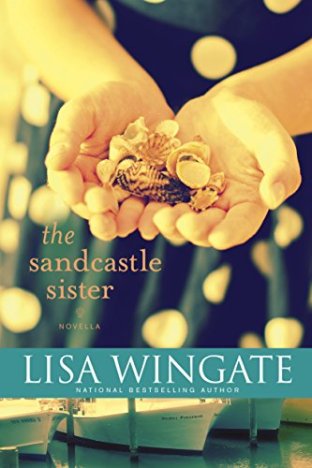
Sandcastle SisterThe Sandcastle Sister by Lisa Wingate is a novella sequel to The Story Keeper, and both are part of the Carolina Chronicles series.

In The Story Keeper, Jen Gibbs had escaped an almost cultish group in the Appalachian hills of NC to go to college and then work in publishing. An old unsigned manuscript led her back to her roots, to a reclusive author, and to a discovery of a people called the Melungeons.

In this book. the reclusive author, Evan Hall, writes a bestseller about the Melungeons and Jen serves as his editor. They develop a relationship, and when the book comes out, Evan insists that Jen accompany him on the book tour, which takes them across Europe. When he wants to tie the knot in Paris, Jen pulls away. An urgent situation with her sister brings her back to the States.

Her youngest sister, Lily, had come out from the same group that Jen had, but without burning her bridges. She wants to become a pharmacist and go back to man the only pharmacy in the area she comes from. But along the way she researches her family history, trying to find out whatever became of the mother who left the family years ago, and discovers a half-sister that no one in the family knew of. Lily is determined to look up this sister, and Jen decides to accompany Lily for her safety and protection. They end up in the Outer Banks of NC (the setting for the first book in the series, The Prayer Box), and come across some of its characters. While searching, Jen wrestles with her reasons for hesitating to marry Evan and wonders if she can overcome them. But what they find in the Outer Banks changes their lives in many ways.

I enjoyed this little book. It was fun to see what became of the characters from The Story Keeper and to see the tie-ins with the other books. The faith element is not quite as obvious in this one, but it’s there. I actually ended up reading the last book in the series out of order before this one, so I’ll discuss it tomorrow.

(Sharing with Semicolon‘s Saturday Review of Books, Literary Musing Monday, Carole’s Books You Loved)

Save

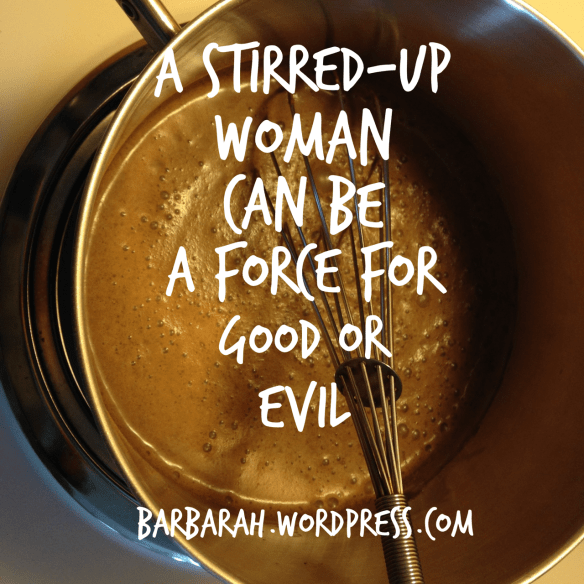
A Stirred-up Woman

I keep a section in my “notes” app on my phone for jotting down things that strike me that I want to look into further, either for my own study or perhaps to develop into a blog post. In deleting some old notes recently, I came across a notation that said “The danger of a stirred-up woman: Acts 13:50.” In the KJV this passage says: “But the Jews stirred up the devout and honourable women, and the chief men of the city, and raised persecution against Paul and Barnabas, and expelled them out of their coasts.” Some other translations use the word “stirred”; some say “incited.” In this chapter, Paul and Barnabas had come to Antioch and shared the gospel, and many believed. “But when the Jews saw the crowds, they were filled with jealousy and began to contradict what was spoken by Paul, reviling him,” verse 45 (ESV), and then by verse 50 they stirred up others to expel the preachers.

I know the passage refers to men as well, but it struck me both as a woman reader and as someone who has seen the results of a stirred-up woman both in others and in myself.

I looked up the Greek word translated as “stirred” or “Incited” in this verse and found it is only used here. So I looked up other verses using the English word “stir.” An interesting study! One can be stirred up in a bad way (all ESV unless otherwise noted):

All day long they injure my cause; all their thoughts are against me for evil. They stir up strife, they lurk; they watch my steps, as they have waited for my life. (Psalm 56:5-6).

Deliver me from those who work evil, and save me from bloodthirsty men. For behold, they lie in wait for my life; fierce men stir up strife against me. For no transgression or sin of mine, O Lord, for no fault of mine, they run and make ready. (Psalm 59:2-3)

Deliver me, O Lord, from evil men; preserve me from violent men, who plan evil things in their heart and stir up wars continually. (Psalm 140:1-2).

Hatred stirs up strife, but love covers all offenses. (Proverbs 10:12).

A soft answer turns away wrath, but a harsh word stirs up anger. (Proverbs 15:1).

A hot-tempered man stirs up strife, but he who is slow to anger quiets contention. (Proverbs 17:18).

A greedy man stirs up strife, but the one who trusts in the Lord will be enriched. (Proverbs 28:25).

A man of wrath stirs up strife, and one given to anger causes much transgression. (Proverbs 29:22).

And they stirred up the people and the elders and the scribes, and they came upon him [Jesus] and seized him and brought him before the council (Acts 6:12).

 Then all the city was stirred up, and the people ran together. They seized Paul and dragged him out of the temple, and at once the gates were shut. And as they were seeking to kill him, word came to the tribune of the cohort that all Jerusalem was in confusion. (Acts 21:30-31). (There are several passages in Acts about people being stirred up after the apostles preached.)

As for a person who stirs up division, after warning him once and then twice, have nothing more to do with him, knowing that such a person is warped and sinful; he is self-condemned. (Titus 3:10-11).

…Or in a good way:

And they came, everyone whose heart stirred him, and everyone whose spirit moved him, and brought the Lord‘s contribution to be used for the tent of meeting, and for all its service, and for the holy garments. (Exodus 35:21).

And every skillful woman spun with her hands, and they all brought what they had spun in blue and purple and scarlet yarns and fine twined linen.  All the women whose hearts stirred them to use their skill spun the goats’ hair [for the tabernacle] (Exodus 35:25-26).

And Moses called Bezalel and Oholiab and every craftsman in whose mind the Lord had put skill, everyone whose heart stirred him up to come to do the work. (Exodus 36:2).

Then rose up the heads of the fathers’ houses of Judah and Benjamin, and the priests and the Levites, everyone whose spirit God had stirred to go up to rebuild the house of the Lord that is in Jerusalem. (Ezra 1:5).

 Let us hold fast the confession of our hope without wavering, for he who promised is faithful. And let us consider how to stir up one another to love and good works, not neglecting to meet together, as is the habit of some, but encouraging one another, and all the more as you see the Day drawing near. (Hebrews 10:23-25).

Wherefore I put thee in remembrance that thou stir up the gift of God, which is in thee by the putting on of my hands. (2 Timothy 1:6, KJV).

Therefore I intend always to remind you of these qualities [in verses 3-11], though you know them and are established in the truth that you have. I think it right, as long as I am in this body, to stir you up by way of reminder…(2 Peter 1:13).

This is now the second letter that I am writing to you, beloved. In both of them I am stirring up your sincere mind by way of reminder,  that you should remember the predictions of the holy prophets and the commandment of the Lord and Savior through your apostles. (2 Peter 3:1-2).

Furthermore, “stirring” can be done by God, by ourselves, by other people, and by situations.

Sometimes we need stirring. Hosea speaks of sinful people “like a heated oven
whose baker ceases to stir the fire” (7:4b). But sometimes we’re stirred up to the point of getting out of hand, and sadly, it’s usually the negative kind of stirring that does this the quickest.

So when i feel “stirred up,” I need to ask myself:

  • What is stirring me up? Is this from God, from myself, from others?
  • What emotions are stirred up? Anger, spite, selfishness, jealousy? Or love and compassion?
  • Am I being stirred up to a mindless, destructive frenzy or to purposeful usefuless?
  • What am I stirred up to do? Lash out? Exact vengeance? Harm? Put someone in their place? Use my gifts to help others? Serve? Love?

My initial thought of “the danger of a stirred-up woman” is only partially accurate. After this study, I’d instead refer to “the power of a stirred-up woman,” for evil or for good. Self examination in the light of God’s Word will help me understand whether that stirring is something I need to yield to or to confess and repent of.

(Sharing with Inspire Me Monday, Literary Musing Monday, Glimpses, Soul Survival, Wise Woman, Tell His Story, Porch Stories, Coffee For Your Heart, Faith on Fire)

Friday’s Fave Five

FFF fall backgroundIt’s Friday, time to look back over the blessings of the week with Susanne at Living to Tell the Story and other friends.

Well, we’re more than halfway through October already – more like 2/3 of the way! Here are some favorite parts of the last week:

1. Lunch with my aunt and uncle who live across town. We’ve been keeping in touch via email and trying to make plans to get together. They’re very busy and travel a lot. But it finally worked out last week. I always love time with them.

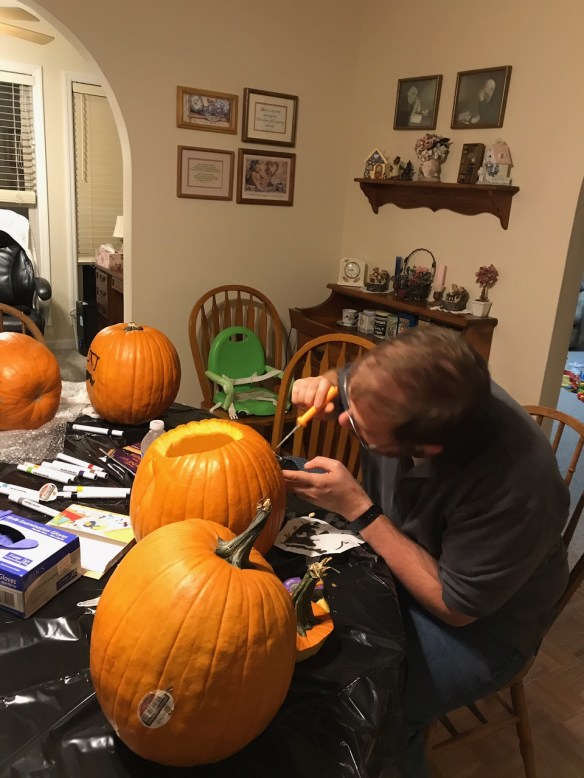
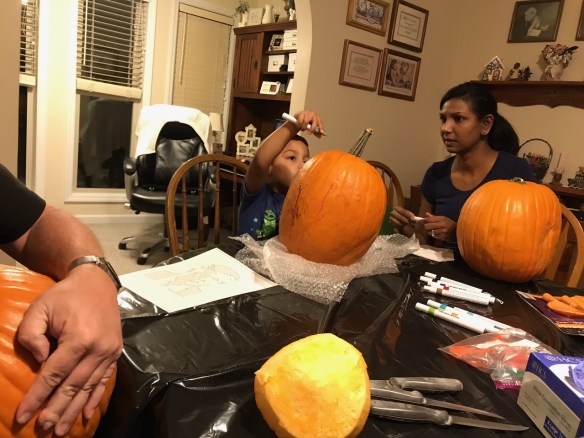
2. “Punkin time!” as Timothy called it, getting together to decorate pumpkins. I wrote more about it yesterday.

A bonus with this one was having apple cider. I don’t have it often – usually just at our pumpkin-decorating time plus sometimes if an outdoor festival is serving it. But at those times it really hits the spot.

3. Timothy’s first “Boo in the Zoo.” The event itself was a disappointment in some ways (the animals weren’t out! I thought seeing them was the main point of having this at the zoo. Plus different areas had very loud raucous music going on, not something kids who are already ramped-up need. Mittu said that everyone coming out of one area like that was agitated, parents and kids alike.) But it was fun to see the kids in costumes and to see Timothy’s reaction.

4. Ticking things off the to-do list, especially after feeling like I wasn’t getting anything accomplished last week.

5. Hearing from a couple of long-time blog friends after an extended blog absence – within a couple of days from each other.

Our cool fall weather is back, and that’s a delight as well.

Happy Friday!

Save

“Punkin Time!”

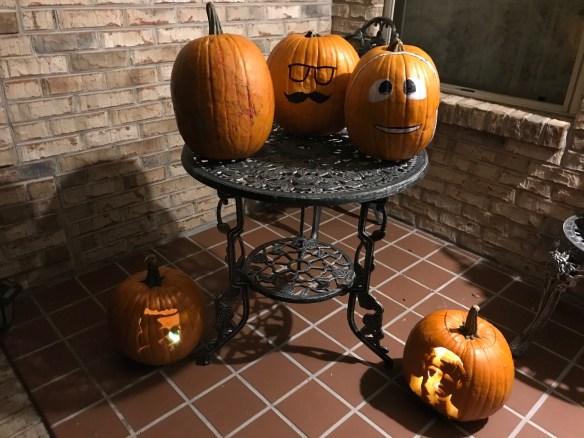
When Timothy saw my fall decorations out, after he had squeezed or thumped all the pumpkins, he asked if it was “punkin time.” I was surprised he remembered decorating pumpkins – he’s only 3. But we hadn’t made plans for it yet and had to explain for about a week or so that we didn’t have pumpkins. Finally last Saturday we did!

Last year Jim arranged the pumpkins out in the bushes in a little “pumpkin patch” for Timothy to find, and then they put them in the wagon to bring to the house, so he did that again this year. We were eating pizza and forgot about it getting dark earlier this time of year, so it was right at dusk when we went out. But Timothy enjoyed using his little flashlight to find the “punkins.”

So we brought them inside and got to work:

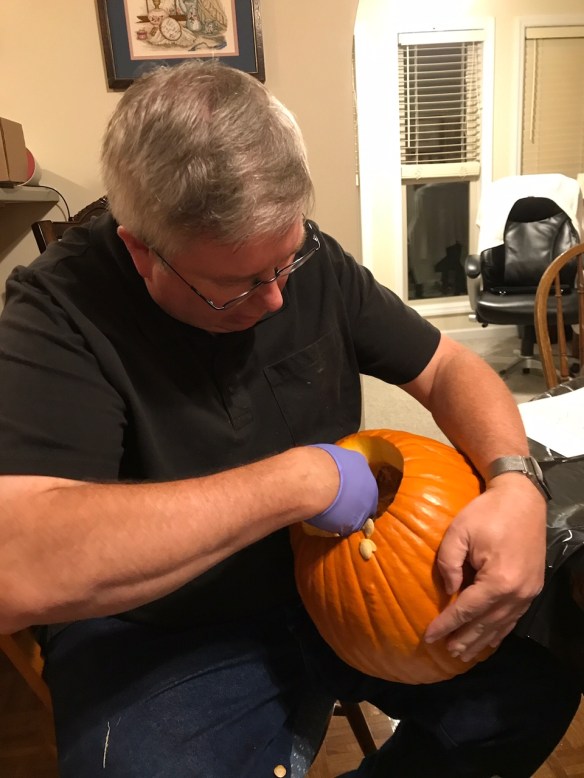
The yucky part!

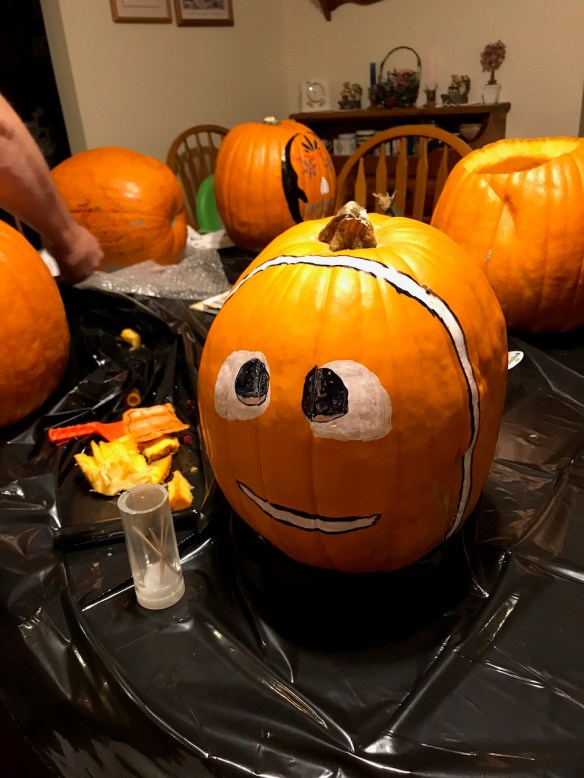
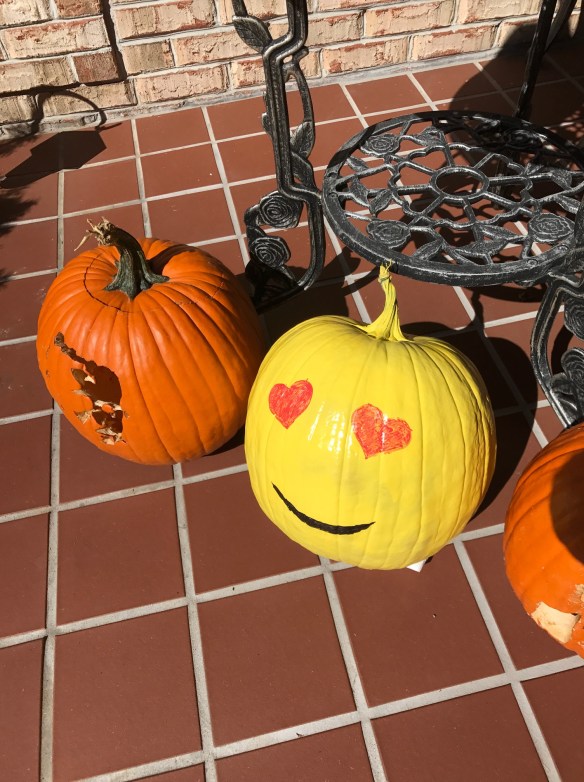
Timothy painted his, because of course he’s too young to handle a blade. Mittu has painted hers the last couple of years so Timothy wasn’t the only one painting. I like the designs of the carved pumpkins and the light shining through them – but I am not very good at it. The last couple I’ve done didn’t come out as I had planned and had to be fixed in some way – last year Jim held it together with toothpicks for me. So I decided to paint this year, too. It’s much easier and faster! And the painted pumpkins last longer than the carved ones. But I do still miss the carved design. I was going to paint one based on an emoji, but discovered my yellow paint was too dried up to use, so I opted for another design I’d seen that is supposed to look like Nemo.

Mittu painted one side of hers like this…

…and the other like this.

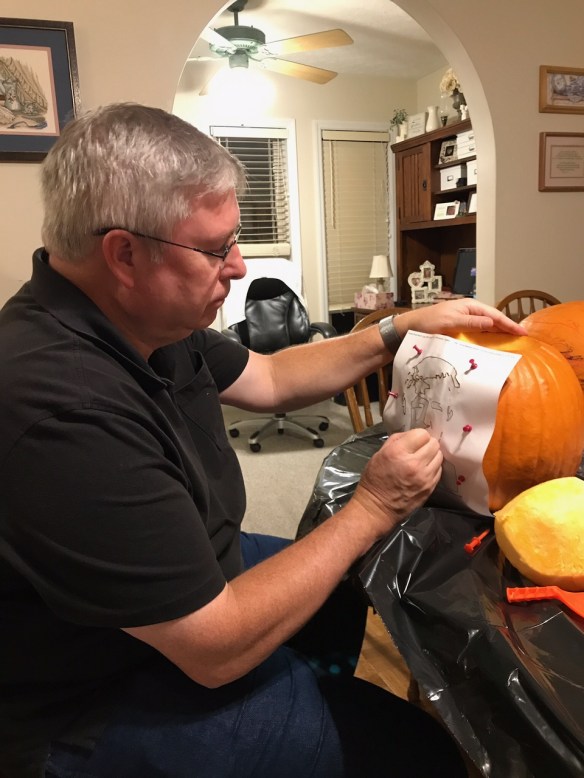
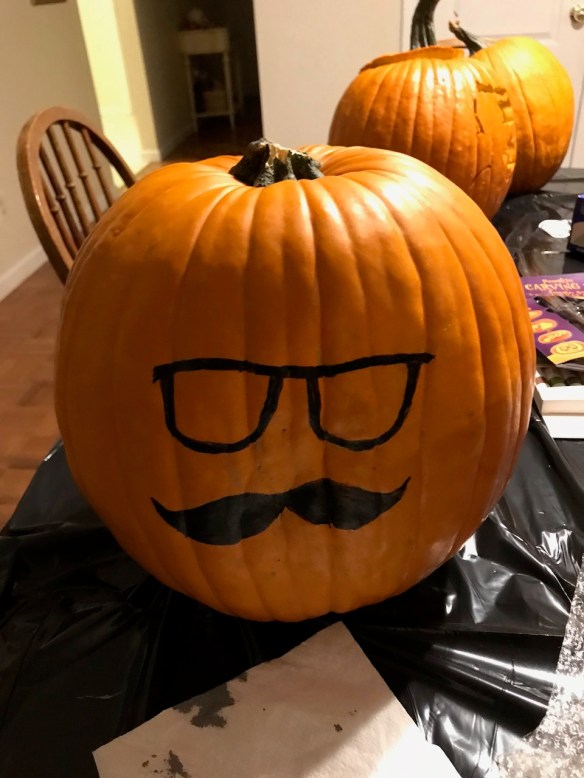
Jim chose Trump (in previous years he has done Barack and Michelle Obama and Hillary Clinton). He didn’t like how it turned out, but the rest of us thought it was a good resemblance. Jason made his own template from a photo he had taken of Timothy. I thought it turned out really well!

We had an extra pumpkin because Jesse didn’t want to do one, so when I had a chance to get some more yellow paint, I tried my original idea:

I’m thankful my daughter-in-law suggested starting this tradition a few years ago. Neither my husband nor I grew up with it, so we never even thought about doing it when our kids were little. Plus I was concerned about all the evil origins of everything then, but decided in more recent years that these kinds of things aren’t generally associated with anything evil in this time and in this country.

It made for a fun evening! Best of all was when Timothy cuddled up to me later in the evening and said, “I like punkin time!”

Save

Book Review: Me, Myself, and Bob

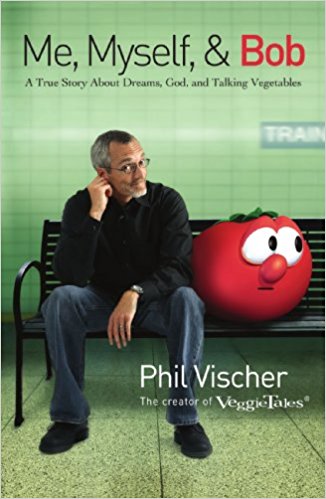
Our family was never hugely into Veggie Tales, but we saw and enjoyed enough of them to be able to sing along with the theme song, “Where Is My Hairbrush,” “Barbara Manatee,” and others. I wasn’t too crazy about their adaptations of Bible stories: I didn’t think building a silly plot around them served them well. But I enjoyed the stories that dealt with life issues that kids face, like being afraid of the dark. I was sad to see the decline of the company, Big Idea. Some years ago I read an interview with Veggie Tales creator, Phil Vischer, about what had happened, which motivated me to get his book, Me, Myself, and Bob: A True Story About Dreams, God, and Talking Vegetables,when I saw it on sale for the Kindle.

Me Myself and BobPhil goes into his background as a shy, nerdy kid with a quirky sense of humor and interests in filming and computers which dovetailed when computer animation began to be possible. Watching MTV videos, he was enthralled with the filming but appalled at the morals (or lack of them) in many of the videos. Years later in a media conference he heard a Viacom chairman share “how he intended to hook kids with Blue’s Clues, then lead them through Nickelodeon straight to MTV.” Phil wanted to make films that God could use. “I knew God wanted me to tell stories that promoted biblical values, and I wanted to do that through any available means.”

He dropped out of college, married, worked for a computer animation company, and experimented in his spare time. I didn’t always quite follow some of the few technical parts, but I got enough to know that, with the animation equipment and software at the time, he needed characters without arms, legs, or hair. He started with a candy bar until his wife commented that moms probably wouldn’t appreciate a candy bar being the hero of the stories, so he switched to vegetables. His wife (the voice of Junior Asparagus!) and a few friends joined him in working on the idea, and eventually Veggie Tales was born. The whole process of how it came to be and then grew is pretty fascinating. Fun fact: they were aiming for moms who bought videos for their kids, but the only marketing that was done was a cardboard cutout in bookstores, which didn’t seem to draw much interest. Veggie Tales was launched into the public eye by young adults and college students working in Christian bookstores who got bored with the same videos playing on display, popped Veggie Tales in, loved it, and recommended it.

Once Veggie Tales caught on, they experienced a meteoric rise in popularity and the company grew exponentially (becoming at one point “the best-selling Christian videos series in history, and the number two kids’ videos series in the world at that time, trailing only Pokemon”), but that turned out to be its downfall. Enthusiastic hiring, too much and too quickly, drove expenses up far beyond income. A lack of vetting allowed new employees who weren’t on the same page, even among the upper management, creating dissension within. Some of the experts they brought in specialized in packaged goods, which seemed plausible since Veggie Tales was sold as videos, but no one had experience in the entertainment industry. The company landed in bankruptcy, the final nail in the coffin being a lawsuit involving an unsigned contract (unsigned yet precisely because they had not yet come to mutually agreeable terms), which, inexplicably, was ruled in favor of the other company. The ruling was eventually overturned, but by that time the company had been sold. I had been dismayed to see Veggie Tales on network TV without its Biblical underpinning, but Phil explains that by that time, the company was in other hands. He was asked to stay on to provide voices and some help with animation, and was led to believe that the program would be the same, minus a specific Bible verse, but eventually learned that no religious content would be allowed.

As Bob the tomato so often wrapped up a Veggie Tales video discussing what we’ve learned today, Phil’s last few chapters discuss handling the crushing death of a dream, a dream that seemed to have been given by God and was being used by Him. Why didn’t He “rescue” Veggie Tales? While we don’t know the exact answer to that, one thing Phil learned was the difference between driving oneself for God and being led by Him. Though the whole book is fascinating, this is where the gold is.

Rather than asking God directly, I spent a lot of time thinking about what my work for Christ might be. Missionary conferences pitched mission fields at us kids like travel agents pitching vacation packages. Watch the slides—make a commitment. But overseas missions didn’t seem right for me, so I kept looking. Eventually, I found a place where my storytelling gifts seemed to line up with a need that was tugging at my heart–a need to express God’s Word through popular media. And that would be my work for Christ!

“If God gives you a dream, and the dream comes to life and God shows up in it, and then the dream dies, it may be that God wants to see what is more important to you–the dream or him.”

Rather than finding my identity in my relationship with God, I was finding it in my drive to do “good work.” The more I dove into Scripture, the more I realized that I had been deluded. I had grown up drinking a dangerous cocktail–a mix of the gospel, the Protestant work ethic, and the American dream.

I started to get it. The Christian life wasn’t about running like a maniac; it was about walking with God. It wasn’t about impact; it was about obedience.

What is “walking with God?” Simple. Doing what he asks you to do each and every day. Living in active relationship with him. Filling your mind with his Word, and letting that Word penetrate every waking moment.

The God who created the universe is enough for us–even without our dreams…God was enough for the martyrs facing lions and fire–even when the lions and the fire won. And God is enough for you.

The impact God has planned for us doesn’t occur when we’re pursuing impact. It occurs when we’re pursuing God.

I very much enjoyed Phil’s story, the behind-the-scenes look into how Veggie Tales came to be, learning what happened to it and to Phil, and what God taught him through the whole process.

(Sharing with Semicolon‘s Saturday Review of Books, Literary Musing Monday, Carole’s Books You Loved)

Save

Reading the Bible Literally

Some years ago I read something scoffing at Christians for taking the Bible literally. One example the author used was the Bible’s speaking of the sun rising and setting, because of course we know that the Earth revolves around the sun: the sun itself doesn’t rise and set. Yet meteorologists use the terms sunrise and sunset every day. We understand in the English language what those terms mean while not taking them literally.

Taking the Bible literally means we don’t interpret it as myth or stories, even though it contains a few stories in it. But we understand the Bible uses different expressions of literature which are not strictly literal without detracting from an overall literal approach to the Bible. What are some of these literary devices?

Idioms. Terms like sunrise and sunset, as mentioned, or phrases like “kick the bucket,”  a somewhat slangish euphemism for dying. Making a “bucket list” capitalizes on that idiom to mean having a list of things one wants to experience or accomplish before dying. On a side note, I was amused recently to see someone take that a step further in an article on “my bucket list for the summer,” apparently not knowing the significance of the bucket in that phrase.

A couple of Biblical idioms:

  • The land of Canaan “flowing with milk and honey.” We understand that to mean plenty, not literal rivers of milk and honey.
  • To be “stiff-necked” or to stiffen the neck indicate stubbornness, not a need to see a chiropractor.

Metaphors. A simile compares two things using the phrase “like” or “as”: “Her smile is as bright as a summer day.” A metaphor does the same thing but without “like” or “as.” In Shakespeare’s As You Like It, we have this famous metaphor: “All the world’s a stage, And all the men and women merely players.”

A few Biblical metaphors: ‘Behold, you are beautiful; your eyes are doves” (Song of Solomon 1:15b. “You are the salt of the earth (Matthew 5:13a).

Anthropomorphism attributes human characteristics to something not human. “The flower lifted it face to the sun.” “The wind roared.”

Biblical examples: “For you shall go out in joy and be led forth in peace; the mountains and the hills before you shall break forth into singing, and all the trees of the field shall clap their hands” (Isaiah 55:12). The Bible says that “God is a spirit” (John 4:24) and as such does not have body parts as we know them. Yet to communicate with us in ways we can understand, the Bible speaks as if He does. “ And the Egyptians shall know that I am the Lord, when I stretch forth mine hand upon Egypt, and bring out the children of Israel from among them” (Exodus 7:5). Psalm 17:6 says, “I call upon you, for you will answer me, O God; incline your ear to me; hear my words.” Deuteronomy 33:27 says, “The eternal God is your dwelling place, and underneath are the everlasting arms.” We understand that to mean that God’s care is just as real as if He were literally holding us in his arms.

Personification is closely related to anthropomorphism, meaning to treat something abstract or inanimate as if it was human. One of Emily Dickinson’s poems personifies death: “Because I could not stop for Death,/He kindly stopped for me;/The carriage held but just ourselves/And Immortality.”

Biblical example: “Wisdom cries aloud in the street, in the markets she raises her voice; at the head of the noisy streets she cries out; at the entrance of the city gates she speaks: “How long, O simple ones, will you love being simple? How long will scoffers delight in their scoffing and fools hate knowledge? If you turn at my reproof, behold, I will pour out my spirit to you; I will make my words known to you” (Proverbs 1:20-23).

Hyperbole exaggerates something for effect. “I’m so hungry I could eat a horse.”

Biblical examples: “You blind guides, straining out a gnat and swallowing a camel!” (Matthew 23:24). “The cities are great and fortified up to heaven” (Deuteronomy 1:28b).

Poetry uses many of these devices, but poetry itself is often phrased in a non-literal way. To quote Emily Dickinson again:

Hope is the thing with feathers
That perches in the soul,
And sings the tune without the words,
And never stops at all.

Biblical examples: “You yourselves have seen what I did to the Egyptians, and how I bore you on eagles’ wings and brought you to myself” (Exodus 19:4). God didn’t actual send in giant birds, a la The Lord of the Rings, but His care of them was just as if He did. “If I take the wings of the morning and dwell in the uttermost parts of the sea, even there your hand shall lead me, and your right hand shall hold me” (Psalm 139:9-10).

Parables are very short stories with a moral or religious meaning, like “The Boy Who Cried Wolf.” They differ from fables in that they have human characters and are plausible, whereas fables use animals, sometimes inanimate objects or nature, and are usually obviously fanciful.

In the Bible, Jesus’s teaching abounds with parables: the prodigal son, the lost sheep, the sower, the good Samaritan, etc. But there are parables in other parts of the Bible as well, especially among the prophets, like the one Nathan told that convicted David of his sin with Bathsheba.

Symbols involve an item being used to represent something else, like a newscaster referring to the White House and meaning the government: “The White House issued a statement today…”

Revelation is full of symbols. The dragon and the beast, for instance, are not animals but evil people whose characters are represented by those beings. There has been argument over the elements of communion, or the Lord’s supper, or the Lord’s table, for years, but it makes the most sense to believe that the elements of bread and wine are symbolic rather than actually containing the body and blood of Christ. One indication of this is the reaction of the disciples as they listened. They were not above questioning and even arguing with the Lord, but no one batted an eye at His statements at the last Supper, indicating that they didn’t think He was advocating cannibalism.

When we listen to the news, read nonfiction, or hear a speech, we can easily discern these literary devices, and we don’t dismiss everything else the speaker or writer says as symbolic or untrue because they use anthropomorphism or an idiom or a metaphor. We’re able to discern from the context whether certain phrases are literal or figurative, usually without even thinking about it, and we get the message the communicator is trying to convey.

I, for one, am glad the Bible uses different literary genres of devices rather than just giving us lists of facts and truths and teachings. Many of us “get” truth in different ways – some prefer it plainspoken, some benefit from a story or illustration. Hearing the same truth in the law, in a parable, in poetry, in prophecy, in an epistle, reinforces that truth to us.

The Bible uses these devices, but the Bible is not wholly a story or parable or fable. There are some who interpret the first two chapters of Genesis or all of Genesis or even the greater part of the Old Testament as myth. But much of the OT is literal history.

The better way to read the Bible is in an ordinary way like you would any other nonfiction, taking it as meaning what the words would ordinarily mean unless the context indicates it is figurative speech. For instance, there is nothing in the Genesis 1 and 2 accounts of creation that indicate anything is meant other than normal 24 hour days. Sure, Peter says “with the Lord one day is as a thousand years, and a thousand years as one day,” but that doesn’t mean every time you see the word “day” in the Bible that it could possibly mean 1,000 years.The ordinary reading of this passage would indicate that creation took place in the span of a week. That’s certainly not beyond God’s power to do. Good people differ on this, and I don’t think anyone’s salvation hinges on whether they think the days in Gen. 1 and 2 are 24-hour days or eons. But I have read accounts where this is taken as mythic or symbolic that then skew other parts of the Bible to mean something quite different from what a more literal reading would indicate. Though good people can differ here and there on some of the fine points, overall a literal approach (except where obviously figurative) is the best.

And by saying that we read it in an ordinary way, I am not discounting that we need the Holy Spirit’s help to open our understanding. The Bible is a supernatural book and we need God’s help to understand it rightly. I just mean that we read it as literal unless it’s obviously figurative.

There is much more that could be said about this, but I am way past the time I allowed for this post, and it’s plenty long already.

A couple of other helpful articles are Taking the Bible Literally (though I’d disagree with him on a couple of points, like hell) and Do Faithful Christian Take the Bible Literally?

(Sharing with Inspire me Monday, Literary Musing Monday, Glimpses, Soul Survival, Tell His Story, Faith on Fire)


Laudable Linkage

IMG_0195

Here are more good reads discovered in the last week or so:

The Transgender Matrix: It’s Time to Choose the Red Pill, HT to Challies. From a man who had transgender surgery on why it didn’t solve his problems and facing reality. He had other issues, but those weren’t even dealt with before his psychologist approved him for surgery.

A Three-step Strategy for Fighting Sin, HT to Challies. Probably one of the most helpful articles I have seen on the subject. On the same topic from the same blog: 20 Practical Ways to Kill Sin.

5 Ways to Pray for Persecuted Saints, HT to Challies.

You Were Created for More Than Motherhood.

The Neglected Stepchild of the Bible, Ecclesiastes. There are some weird approaches to this book, and this article helps rightly divide it.

Do Christians Have to Care About Everything? HT to Challies. “You’re not Christ. You’re part of His body. And there is a difference.”

Happy Saturday!

Friday’s Fave Fives

FFF delicate leavesIt’s Friday, time to look back over the blessings of the week with Susanne at Living to Tell the Story and other friends.
I’m a little late today – it’s been one of those mornings with a number of interruptions. I often write the bulk of my FFF post on Thursday afternoons, but that didn’t happen this time. But – we’re here now, so here are some of the favorite parts of the week!

1. Leaves changing. I’ve been saying for a couple of weeks that they had only just started to change, and here in our neighborhood, that’s still true. But we were out in a different area of the city on Sunday and saw lots of fall color. Lovely!

2. Late bloomers. My hydrangea had gotten big and bushy but hadn’t bloomed all summer – until now! Maybe because of those big spots on the leaves – any idea what those are and what to do about them?

IMG_0412

Even my geranium looks like it might have another round of blooms.

IMG_0413

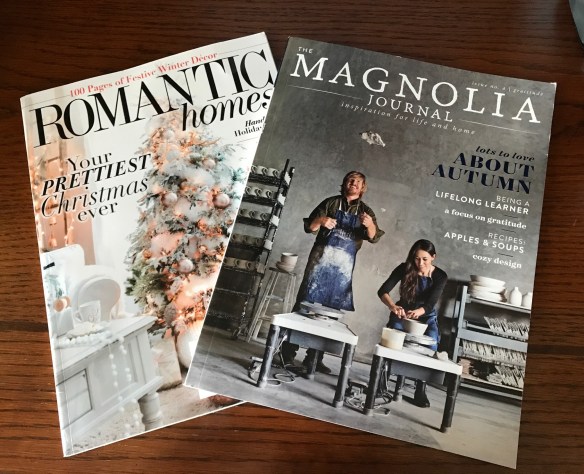
3. Magazines. Like many people, I’ve gotten away from magazines with all that’s available on the Internet. But there’s still something nice about curling up on the couch with the latest edition. I received gift subscriptions for these two for my birthday, and their first issues recently arrived.

IMG_0410

4. Meals I didn’t cook. My daughter-in-law made dinner here last Sunday, we ate takeout from MacAlister’s Deli and a barbecue place a couple of different evenings, and I met a friend for lunch at IHOP this week.

5. A Timothy funny. Recently as he was coming up to our front door, he said, “I big now. I have hairy legs.” 🙂

Happy Friday!