Even more stray thoughts…

I don’t usually post “rambling” posts too closely together, but I forgot some things last time. 🙂

  • On the health front: Since going off one of the medications I was put on post-afib surgery, I have not had any more major episodes lasting hours. They said it would be rough going off of it, but instead it’s been the best I’ve felt since the surgery. (Thank you, Lord!) I’ve had some little flutters lasting just a few seconds at a time – they seem to come in clusters for a bit during they day, but then nothing the rest of the day. But that’s MUCH better than 2-6 hours!


  • Since I was doing so well, I was hesitant to start the new medication. I read the information that comes with a prescription – something I don’t usually do because they tend to make me not want to take the medicine – and, yep, this made me not want to take it. I know they have to include everything that could possibly happen, and most of the time when I go ahead and take it, I don’t experience any of the dire potential side effects. But this, first of all, said it is usually given in the hospital under a doctor’s supervision. Yikes! Nothing was said to me about that, and I am assuming since they sent me home with it, it’s a low enough dose to be ok. But that definitely is scary. There were a few other things that make me reluctant to take it, but that was the main one. I can’t decide whether to call the doctor’s office and ask if I can avoid taking it, since I am doing so well – or whether I should just not take it and then talk about it at my next appointment. Probably the first course is the better one, but I don’t want to get into a position of him saying yes, I should take it, and then me deciding I don’t want to after all, and then having to explain that. 🙂


  • Things I’ve seen that make me wonder:

  • Why do they charge delivery charges if that doesn’t go to the driver? Well, this doesn’t say it doesn’t go to the driver, but that’s what I assumed. Maybe it’s like waitresses: they get paid a little but less than they would normally and the rest is made up in tips. But by the time you had a delivery charge and a tip, that’s a significant amount – and one of the reasons we don’t often have food delivered.
  • I was rummaging around for some dental floss in the back of the bathroom drawer (trying to get better about flossing) and found one that had come from the dentist’s office a while back. It had an expiration date from a year ago. Dental floss has an expiration date? I don’t know why it would. It would make sense if it had a flavoring on it – I’ve seen some with a minty taste. But this didn’t have that. I don’t think it would shred or fray in just a year’s time. My husband thinks it’s a scam to make people buy more floss. 🙂
  • A note on prescription information insert from the drugstore: “For faster refills, call 24 hours in advance.” That does not seem faster to me. 🙂


  • I don’t think I have shared the most recent birthday cards I have made yet. Jason had a “milestone” birthday this year, and in looking for ideas for his card, I came across several listing things that had happened during his birth year. I ended up doing this one on the computer – I told him that even though it wasn’t hand-made, it was Mom-made. 🙂

Jeremy likes foxes, and I was aiming for a design that didn’t look childish.

Jesse is an avid video gamer, so this seemed appropriate for him.

  • I mentioned last time being frustrated with complicated issues being reduced to zinging tweets and snarky memes in public forums. I’ve been thinking that we ought to bring back forensic debating in schools. Not the farces that we call presidential debates during election season. When I was in college, one of the regular commencement week activities was the championship debate, a culmination of different groups who had been debating a particular topic all through the school year, and the top two teams debated the final round before the entire school body. At the time, I am sorry to say, I found it quite boring. But now I wish more people were educated in this kind of logical thinking, giving out and responding to facts rather than conjecture, name-calling, and shouting each other down. I hope school debates are still conducted like this. I know some schools still have them, but I think more should and they should receive more emphasis.


  • I have also been alarmed to see more and more anti-capitalist rhetoric in recent months. Some equate capitalism with greed and oppression when it should be equated with opportunity (the little guy who pursues a big idea, the family restaurant that grows into a national chain). I lived through the Cold War and helped pray people out of Soviet prisons: believe me, you really don’t want communism. Talk about oppression. There is no perfect economic system: every one has its flaws. And because we’re sinners, there are people who are going to exploit the flaws in any system for personal advantage, so there needs to be safeguards in place. This is an area requiring study and thought, not just sound bytes.


  • Our family is currently going through some major changes. My husband was asked to take on a different position at his company. He’s had to turn down a few of those requests before because they involved travel, and he felt he couldn’t be away more than a couple of days at a time due to his mom being in our home. She tends to get a little more disoriented when he’s away for very long. But that’s also out of consideration for me, so I don’t have the bulk of her care, and I appreciate that. This position will not require that kind of travel, so that helps. It’s an area he has been partially involved in for years, so I hope being in it full time is enjoyable for him. Right now they are still in a transition phase.


  • Another big change is that we have decided to leave the church we have attended for seven years and look for a new church home. There really isn’t any one major issue, but my husband has been unhappy there for some time. We talked it out and decided it was time to move on. We didn’t visit around various churches when we first came here because we knew the pastor at this church (who has since passed away) and knew from the start that’s where we would attend. So we’re going through that visiting-around process now, which is always…interesting. This is the first time we have ever left a church for reasons other than moving away, so it feels a little awkward in many respects. I always feel a little homeless without a church family, but I do have a sense of excitement to see what the Lord has in store for us.

And that wraps it up for today!
Save

Thoughts on the MacArthur ESV Study Bible

MacArthur ESVI mentioned in my last Nightstand post that I had finished reading the ESV version of the MacArthur Study Bible but wasn’t planning to review it. How do you review a Bible, after all? But one friend said she’d like to hear my thoughts about it. So here goes.

I’d like to discuss it in two parts: the ESV version and then MacArthur’s notes.

The subject of Bible versions can be touchy and whole books have been written on them – I can’t possibly go into everything concerning them here. The best book I know of on the subject is From the Mind of God to the Mind of Man: A Layman’s Guide to How We Got Our Bible. A former pastor, someone whose exposition I trust more than anyone else I’ve heard or read, is one of the contributors, I knew one of the others in college, and I have heard a couple of others speak. That doesn’t mean these men are infallible, of course, but I have heard and read enough of them to generally trust them, and I have read enough elsewhere that supports what they say. Probably the biggest issue for those who are “King James Only” is the manuscripts that the different version or translated from. I think this book handles that ably, and I have read and heard enough to feel assured about reading version like the NASB (New American Standard Bible) and ESV (English Standard Version), as well, as, of course, the KJV and NKJV. (If you differ with me on this, that’s your prerogative, but I really don’t want to get into any arguments about it here. I have known some KJO people to think less of other Christians who use different versions, or even to break fellowship with people who don’t use the KJV. I think that is definitely going way too far.)

If you’ve read much about Bible translations, you’ve probably come across different theories or processes. No translation of anything from one language to another is going to be word for word exactly, literally, like the original. There are differences in syntax: for instance, Spanish puts the adjective after the noun while English usually puts it before: Casa Blanca for White House. One language may not have the exact word equivalent for every word in another language, and so on. If you’ve ever looked at a Greek interlinear New Testament, which has the Greek words and then the corresponding English above or below them, you’ll get some idea of the difficulty. (Take a look at Luke 2, for example.) Translators fall into two camps: those who try to translate word for word, staying as close as possible to the original while making ti understandable in another language, and those who translate thought for thought. The thought-for-thought translations are usually the most readable, but the least accurate.

Forgive the excess background material, but I felt I needed to go into that to explain that I think the ESV is probably my favorite translation. The KJV will always hold a special place in my heart, and I tend to think in King James, after having used it and read it for over 40 years now. But the ESV seems to me to best combine accuracy and readability.

Now on to MacArthur’s notes. I think this is the first time I have ever read through a study Bible, and I found the bulk of the notes very helpful. At the beginning are sections called Introduction to the Bible (kind of an overview), How We Got the Bible, How to Study the Bible, a preface to the ESV explaining the philosophy and style that went into this transition, an explanation of the features, especially the cross references and footnotes. Before each of the Testaments are introductions, chronologies, overviews, etc., and even the intertestamental period gets a few pages. Each book is introduced with a few pages discussing authorship, date, background and setting, historical and theological themes, interpretive challenges, and an outline. I found this especially very helpful to read before beginning a particular book. Throughout the book are applicable maps, charts, and diagrams and footnotes on most of the verses. At the end are appendices on The Character of Genuine Saving Faith, an Overview of Theology, a plan to read through the Bible in a year, an index to key Bible doctrines, Monies, Weights, and Measures, and a concordance.

The book is too bulky to carry to church, almost a little hard to handle while sitting on the couch, where I usually do my Bible reading. The print in the notes especially is very small, but if it was any larger, more pages and therefore more bulk would be required. So the size of both the print and the book itself are probably the best compromise.

I did not know much about MacArthur before reading this. I had found him to be a little terse in what things of his I had read, and that seems to come through here, but then again, that’s the nature of the verse-by-verse notes. Sometimes something I had a question about wasn’t addressed, or at least not to the extent I’d like, but I had to remind myself that this wasn’t a commentary, and the notes needed to be limited to a degree.

At first it was a little distracting to read a verse and then read the corresponding notes, but after a while it didn’t seem to be. It did help to reread or at least skim through the chapter again after reading it verse then note then verse, to put it all together.

I have multitudes of places marked, much more than I can share here, but here are a couple:

It helped to realize that Chronicles was not just a repeat of Kings, but was written when the Jews were returning to Israel after 70 years of exile to a land far different from their “glory years” of David and Solomon.

The chronicler’s selective genealogy and history of Israel…was intended to remind the Jews of God’s promises and intentions about: 1) the land; 2) the nation; 3) the Davidic king; 4) the Levitical priests; 5) the temple; and 6) true worship, none of which had been abrogated because of the Babylonian captivity. All of this was to remind them of their spiritual heritage during the difficult times they faced, and to encourage them to be faithful to God (p. 557).

Of Exodus 20:5-6, which speaks of God “visiting the iniquity of the fathers on the children to the third and the fourth generation of those who hate me,” MacArthur says:

Moses had made it clear that children were not punished for the sins of their parents (Deut. 24:16; see Ezek. 18:19-32), but children would feel the impact of breaches of God’s law by their parents’ generation as a natural consequence of its disobedience, its hatred of God. Children reared in such an environment would imbibe and then practice similar idolatry, thus themselves expressing hateful disobedience. The difference in consequence served as both a warning and a motivation. The effect of a disobedient generation was to plant wickedness so deeply that it took several generations to reverse (p. 123).

Re the imprecatory prayers in the psalms: “As God’s mediatorial representative on earth, David prayed for judgement on his enemies, since these enemies were not only hurting him, but were primarily hurting God’s people. Ultimately, they challenged the King of kings, the God of Israel” (p. 734).

There were a few places I disagree with him, some minor, such as whether David was wrong to mourn Absalom in the way he did (MacArthur thought it was “melancholy,” “weak, ” and “unwarranted zeal for such a worthless son”; I thought it was perfectly natural to deeply grieve not only his loss of life but his state at the end of it). Some differences were major, particularity a Calvinistic bent which I had not known he possessed.

Calvinism is another issue too large for one blog post. I agree with parts of it but seriously disagree with other parts. But for just one example, one of the ares where I most disagree with it is with the “I” in the TULIP” acronym: Irresistible Grace, the idea that if God calls you to salvation, you can’t say no. One passage that particularly counteracts that idea, in my opinion, is where Jesus laments, ““O Jerusalem, Jerusalem, the city that kills the prophets and stones those who are sent to it! How often would I have gathered your children together as a hen gathers her brood under her wings, and you were not willing!” (Matthew 23:37 and Luke 13:34). That sounds pretty much like they resisted His overtures and attempts to gather them to Himself. Here’s what MacArthur says of the Matthew passage:

God is utterly sovereign and therefore fully capable of bringing to pass whatever he desires (cf. Isa.46:10)–including the salvation of whomever he chooses (Eph. 1:4-5). Yet, he sometimes expresses a wish for that which he does not sovereignly bring to pass (cf. Gen. 6:6; Deut. 5:29; Ps. 81:13; Isa. 48:18). Such expressions in no way suggest a limitation on the sovereignty of God or imply any actual change in him (Num. 23:19). But these statements do reveal essential aspects of the divine character: he is full of compassion, sincerely good to all,  desirous of good, not evil–and therefore not delighting in the destruction of the wicked… (p. 1403).

This passage makes sense to me if Christ is lamenting that people turned away from His attempts to draw them, because He knows what it will ultimately mean for them (if you turn away from Him, there is nowhere else to go. If you won’t accept his grace, there’s nothing left but wrath). But it doesn’t make sense if He is saying, “I didn’t elect you, and you don’t have any chance, but I feel bad about that.”

The Bible itself is inspired by God: no man’s notes and commentaries are. But someone else’s intense study of the Word of God can be greatly beneficial to us in our own study, and, though I disagreed with MacArthur in a few places here and there, I was greatly helped by the majority of his notes.

(Sharing with Literary Musing Monday,
Semicolon‘s Saturday Review of Books,
Carole’s Books You Loved)


Save

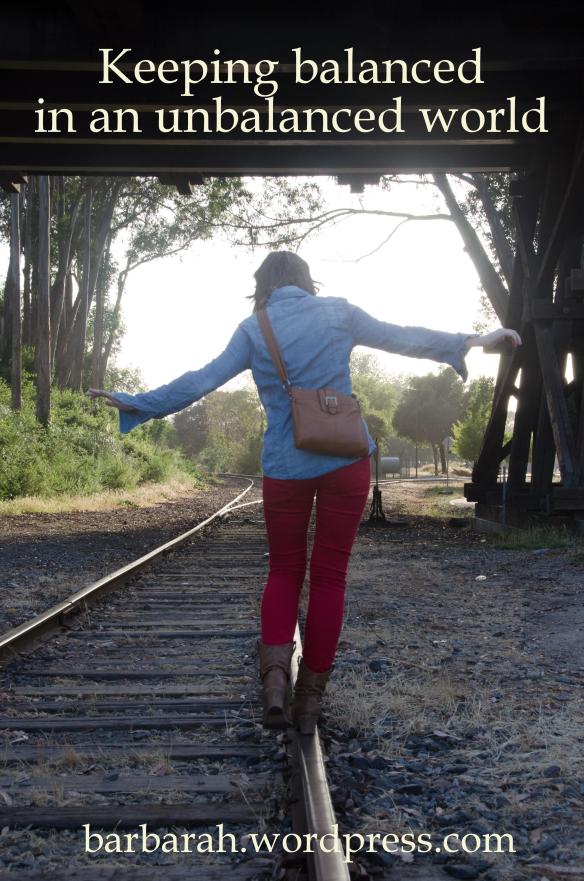
Balance

(Photo courtesy of https://morguefile.com/)

22 years ago a virus attacked my spine, and my body, in an auto-immune response, attacked the myelin sheath around the nerves as well as the virus. This is called transverse myelitis, which I wrote about more extensively here. The main symptom, from a whole laundry list of them, was that I couldn’t walk on my own. With physical therapy and a lot of prayer, I progressed from a wheelchair to a walker to a cane to wobbly and then more firmly walking on my own.

Among the symptoms still remaining are lack of full feeling in my left hand and lower legs, weird nerve signals, and balance problems that are worse when I am standing still. One of the early exercises my physical therapist had me do was to stand on a pillow, close my eyes, and lean as far as I could in different directions. We did this in front of my bed so that I’d have a safe place if I fell backwards, and she promised to catch me if I fell forward. But she was a tiny little thing and I was afraid of crushing her! Thankfully that never happened.

Though the balance issues are much better than they were 20-22 years ago, they are still a problem. I’m not sure what makes them worse some days than others. But the one thing that helps most is touching something stationary, if I am standing, or firm if I am walking. Just touching something firm keeps me steady. Sometimes that means taking someone’s arm, or leaning against a wall or chair. When I was in choir, it used to be that the back of my calves touching the chair behind me was sufficient, but I had to quit when that no longer was enough to keep me steady. Even while standing and singing in the congregation, I’m usually touching or leaning against the pew in front of me. If my eyes are closed in the shower, I often have to touch the wall or the caddy holding the soap and shampoo. Stairs are almost an impossibility if they don’t have a handrail. Uneven or rocky ground requires an assistant.

Feeling unbalanced is disorienting, even scary sometimes, occasionally paralyzing. Balance is an essential part of walking. It’s hard to move forward if you’re constantly fearing a fall, but even aside from fear, without stability your mind and body can’t process moving forward.

~~~

It’s easy to feel disoriented, unstable, and even fearful in this world today. So many problems, so many issues, so many arguments without simple resolutions. The hymn echoes what Paul said, “fightings and fears within, without.”

Where can we find balance, safety, and stability? Where is something firm to lean on to hold us steady and help us move forward?

 Uphold me according unto thy word, that I may live: and let me not be ashamed of my hope. Hold thou me up, and I shall be safe: and I will have respect unto thy statutes continually. Psalm 119:116-117.

For you have delivered my soul from death, yes, my feet from falling, that I may walk before God in the light of life.  Psalm 56:13, ESV.

For thou hast delivered my soul from death, mine eyes from tears, and my feet from falling. I will walk before the Lord in the land of the living. Psalm 116:8-9.

But as for me, my feet were almost gone; my steps had well nigh slipped…Until I went into the sanctuary of God

Nevertheless I am continually with thee: thou hast holden me by my right hand. Thou shalt guide me with thy counsel, and afterward receive me to glory. Whom have I in heaven but thee? and there is none upon earth that I desire beside thee. My flesh and my heart faileth: but God is the strength of my heart, and my portion for ever. Psalm 73:2, 17a, 23-26.

“Believe God’s love and power more than you believe your own feelings and experiences. Your rock is Christ, and it is not the rock that ebbs and flows but the sea.” ~  Samuel Rutherford

(Sharing with Inspire Me Mondays, Literary Musing Monday, Glimpses, Soul Survival, Tell His Story, Wise Woman, Faith on Fire)

Save

Save

Laudable Linkage

img_0021

I have kind of a longish list today, but found all of these noteworthy or thought-provoking in some way. Hope you find something you like!

Where Is God in a Mass Shooting? HT to True Woman.

Letter to a Church Member (Or a Letter to Myself). “Your church is here, not to give you a good self-image, but to give you a true self-image.”

Exegesis Without Embarrassment, HT to Challies. The first of a series dealing with why God would command the destruction of the Canaanites.

Ten Things You Should Know About Temptation, HT to Challies.

God Is With You in Your Panic Attack.

Let’s Get Real About Women’s Discipleship, HT toChallies. “If Instagram is any clue, most Christian women think discipleship is limited to hosting thoughtfully curated Bible studies in tasteful homes where shrieking children and dirty dishes don’t exist. This glossy ideal sits like a yoke on many women’s shoulders rather than spurring them onward in Christ’s Great Commission.”

The Holiness of Small Things.

Worship Isn’t About Feelings, HT to Challies. “Sometimes I serve my neighbor out of obedience to Christ, and love for Christ follows. Sometimes I am filled with love for Christ, such that I look for an opportunity serve my neighbor.

When You Don’t Need God’s Guidance, HT to True Woman. “We don’t need to seek guidance where guidance has already been revealed in Scripture. How easy it is to convince ourselves we’re “confused” about what we should do when we’re reluctant to do what we know is right. It helps us feel better to label questions of morality “complicated” when they require us to pick up a cross or suffer rejection. The serpent’s ancient whisper—Did God really say?—trips off the tongue when God’s commands are costly.”

Heroes, Hagiography, and Villainy. I’ve been thinking for some time now about writing a post concerning flawed heroes. This says some of the things I have been thinking.

Four Reasons to Read Slowly. “The Information Age isn’t slowing us down, but subtly and constantly pressuring us to speed up. As we browse, surf, and scroll, we’re training ourselves to quickly see new facts and then look for the next figures, rather than feel the weight of what we read.”

Advice for Reading the Bible when a learning disability makes it hard.

Benny Hinn Is My Uncle, But Prosperity Preaching Isn’t For Me.

Theological imagination.

I Stopped Praising My Kids for a Week: This Is What I Learned, HT to Story Warren.

Some years ago I was wandering around the local library’s video collection looking for something to watch and saw the 10th anniversary production of Les Miserables. I decided to get it and see what all the fuss was about – and that started a love affair with the musical and then the book. Since the particular singers there were the first I heard, and though I have seen some wonderful clips of a variety of singers singing some of the songs, this cast will always embody the characters for me. Recently I stumbled across this video of Philip Quast, who played Inspector Javert, telling how he approached one of the solos. I had no idea such thought and intention was involved behind every word. In the song he’s discussing, Javert has just had an encounter with ValJean, the man he has been trailing all his adult life. ValJean has just carried a wounded Marius through the sewer system when he runs into Javert and begs Javert to let him see Marius to safety. Previously ValJean had held Javert’s life in his hands, and let him go. Javert can’t compute this: he upholds righteousness and The Law, and in his mind, once you’ve fallen, there is no mercy or grace. “Once a con, always a con” is his mindset. So how can it be that this man no longer acts like a con and even shows mercy and compassion?  I’ll post the video of this song from the musical after this interview:

A couple of other things I love about this: Javert’s previous solo was about the comfort he found in the stars as “sentinels” of God’s order in the world. But here, “the stars are black and cold.” Also, there is so much parallelism between this song and Valjeans’s soliloquy when when the bishop shows him an undeserved kindness: the same tune there and here, similar phrasing about “allowing this man” to have an influence, an offer of freedom, “I am reaching, but I fall…,” escaping the world of Jean ValJean, but in two different ways. Although ValJean had to wrestle with it, he accepted the bishop’s grace. Javert either thought he didn’t need it, since he was always in the right in his own eyes, or he couldn’t accept it from this man. When his entire worldview was turned on its ear, instead of adjusting, he could only escape. Grace accepted saves and changes a person. Grace rejected leaves one out in the cold darkness.


Save

Friday’s Fave Five

FFF delicate leavesIt’s Friday, time to look back over the blessings of the week with Susanne at Living to Tell the Story and other friends.

And just like that we’re a week into October already! Our cool mornings are back but it’s still a little in the afternoons. A few more leaves have changed, but we still haven’t seen the blaze of color that’s coming. In the meantime, here are some high points of the last week:

1. Being prayed for. The chaplain from hospice that comes out to see my mother-in-law brought a “chaplain in training” this week. As they were winding down their visit, I almost asked the chaplain to pray for a specific concern of my own. But I didn’t – whether because it was a little harder to get a word in with two of them here, or perhaps I just didn’t feel as comfortable sharing with a new person there, I don’t know. But when she asked him to close in prayer, she said, “And pray for Barbara as well” – I can’t remember if she mentioned health issues in particular. I think she did mention health, because I was touched at the Lord’s working in that way and leading someone to pray for me in a specific way even without my asking.  Then I struggled over whether to share a prayer request on Facebook, but was blessed that so many people responded.

2. Safety. My husband was cutting up parts of some fallen tree branches at my son and daughter-in-law’s when the chainsaw slipped, and…

Thankfully the saw didn’t reach his toes!

3. Puttering is what I call getting some little jobs done that tend to pile up when life is busy – cleaning out some files, cleaning out my receipt drawer (where I stash receipts when I am wrapping presents), tidying my desk, straightening here and there, changing over from an old purse to a new one, etc.. Always a nice feeling to get that kind of thing done.

4. Getting my fall decorations out. Now it feels more officially like fall.

img_1890

img_1887

img_1891

The last photo is from a couple of years ago – because my kitchen window currently has some gunk on it from some suction cups.:)  I wasn’t able to get it off with just washing the window so will need to go do some more intense scrubbing. Anyway – our tree is not to that stage of color yet, but should be in the next couple of weeks!

5. No major afib in a week! Even being off one medication! Praying that continues! I mentioned yesterday that I’d several occurrences in one week, and they wanted to put me on a new medicine, but first I’d have to get one of the old ones out of my system over five days. I was afraid this would be a really bad week in that regard, but so far it has been a great one!

Happy Friday!

Save

Save

More stray thoughts…

IMG_0406

I have a couple of posts percolating in the back of my mind but haven’t had the opportunity or the mindset to work them out, so for now I thought I’d just share the other odds and ends floating around there. 🙂

  • I feel like people must be getting sick of me talking about the ablation surgery and atrial fibrillation by now. I’m getting sick of it myself. “Shouldn’t that be all over with?” Well, that’s what I would have thought. Recently I had four different afib episodes in the space of a week, from 2-6 hours each. I’m not sure why – I was at rest when most of them started, even dozing when one began. I contacted my doctor, and he wants to put me on a different medication, but first I have to go off one of the ones I am on for five days so it is out of my system before I start the new one. They told me I might feel a little “rough” during the days without the medicine I am going off of. But I am about halfway through that five-day period, and so far there have been a few little ripples, but no major episodes, for which I am very thankful to God. I’m three months past the surgery, so I hope we’ve turned a corner and I won’t have any more major episodes, especially as the rest of this medicine gets out of my system before starting the new one. If I don’t have any more major afib episodes between now and then, I’m even toying with the idea of asking if I can avoid taking the new one. But we’ll see.
  • When I first heard they wanted me to go off one of the medications for five days, I was alarmed, thinking that surely without the medicine I’d have even more episodes. I have this tendency to run through all the possible “what if” scenarios I can come up with.

anxious

But one thing this experience has helped me with is that I decided I just could not live every day fearing I might have afib (and that it might not go away on its own and then I might have to go to the hospital and then we’d have to make arrangements for Jim’s mom, or it might cause a blood clot, etc., etc., etc.). I prayed about it, asked other people to pray about it, and just decided to go on about my business, and we’d deal with whatever happened when and if it happened. I’ve had to go through this all again in my mind a few times, but overall it’s much more restful to live this way! Who knows, maybe learning this is one reason God allowed all this to happen.

  • I had a clear birdfeeder that attached with suction cups to the kitchen window so i could watch the birds a little more closely. But not long ago we had a little mouse in there! I wish I had caught a good photo of it. I took the bird feeder down — I don’t want any more uninvited guests there! I think this is the first mouse I have seen or even seen any evidence of since we moved here seven years ago.
  • We’ve been hearing some kind of creature scurrying around the attic, larger than the little mouse in the birdfeeder, so my husband put a trap up there, the kind that will catch it but not kill it so he can release it in some woodsy area away from the house. It kept getting the peanut butter out but evading the trap. Reasoning that maybe the trap was too small to close on it, my husband got a larger one. But after several resets with both peanut butter and peanuts, we kept getting the same results: missing food, but no trapped animal. So finally Jim hot-glued some peanuts to the metal plate where the food goes, thinking that when the animal tried to pull it off, that would trigger the trap door. This is what he found the next time he checked it:

IMG_4760(1)

He said the paint on the trap was getting a little sticky from the heat in the attic, so he sprayed it with WD-40. But it may be time to go to a mouse-trap type trap sized for a larger animal – as well as writing some manufacturers about their failed traps!

  • Do you have a process for reading blogs? I have all the blogs I read on Feedly, and I usually start looking through them while I am eating breakfast. I guess because I am eating and not in a mode to comment on them, I tend to go through first and eliminate some I’m not interested in reading. For instance, I follow some recipe blogs, but if I can tell by the title I’m not interested in a particular recipe, I delete it.  I follow some craft and card-making blogs, but this time of year when there is a lot of Halloween stuff, I delete those, too. Maybe it also makes me feel like I am putting a dent into my blog-reading if I eliminate a few right off the bat. 🙂 Next there are a few blogs I read but don’t comment on, usually bigger blogs with a significant following who get several comments a day already. I figure they don’t really need my two cents, so I don’t comment unless a post has particularly meant a lot to me or unless I feel I can add something to the discussion. Then there are some bloggers who are friends now and I comment on almost all of their posts, so I go on to those next, and if a particular post needs an especially thoughtful comment, I usually save that for last, sometimes coming back to it later in the day. Often some time in the middle of that I have to go run errands or accomplish something, so sometimes I finish blog reading in the afternoon. I usually avoid it in the evening so as not to be off on the computer while my husband is home.
  • How do you feel about “tweetables,” those sections of a blog post specifically designed for someone to tweet a line from your post? Some will even be labeled “Click here to tweet.” When I first saw that, I thought, “Wow, the audacity!” It seemed a little too self-promotional to me. But then I saw someone ask a blogger for those – I guess she wanted to promote the post but clicking on something like that was easier than copying and pasting. So now I am caught between wondering if it comes across as a push to promote or as a service to readers. It’s difficult because bloggers want readers – otherwise we’d just be writing journals. And I always appreciate when someone shares my post on social media in some way. But it’s hard to know how far is too far to go. I guess it’s not that much different than the little buttons I have at the bottom to share a post somewhere.
  • This will sound awful, but I get frustrated when missionaries put you on their mailing lists without asking. I DO believe in supporting missionaries and reading their prayer letters (carefully!) and praying for them, and I have signed up for several prayer letter lists. But when you rediscover someone you used to know 30+ years ago on an online forum or social media and then all of a sudden you start getting their prayer letters – it shouldn’t bother me, but it does. It’s always better to ask than to assume to let the person ask the missionary so he or she doesn’t feel put on the spot. Maybe because I do want to treat them carefully and pray for each one, it’s easy to feel overloaded. But then, it’s doesn’t take all that much time to read through a prayer letter, pray for the requests immediately, and then delete it, and it’s a ministry to them. And, obviously, if I have time to blog and watch TV and do other things, I am not so pressed for time that I can’t spend a few minutes reading about and praying for someone. So why am I complaining? I don’t know. I guess my inner curmudgeon is coming out.
  • Like everyone else in the country, I was horrified and deeply saddened by the LA shooting a few days ago. I haven’t felt inclined to write a separate post about it – probably anything I could say has already been said somewhere. But I am saddened as well by the hateful rhetoric following the shooting, especially the backlash against people offering “thoughts and prayers” instead of doing something. Well…as this post says, thinking of and praying for someone is “doing something.” That doesn’t mean some kind of action doesn’t need to be taken as well. But what that action should be is a big and complicated question. I do believe in citizens having guns if they want them – but do they need machine guns and the like? Are there not laws currently in place for whatever this man was doing? Lots of people have had guns for centuries without doing something like this – is there something else to consider? Mental illness, perhaps? And what should be done about that opens another whole set of complicated questions. I haven’t heard whether anyone has ascertained a motive for the shooter. Was it just hate? Or a warped sense of fun? What do you do about that? I’m probably making a mistake opening up this can of worms at the end of a post like this when I need to stop in a minute and get some other things done, but I’m just trying to convey that there are a number of issues involved that are not simple, and a differing opinion is not in itself a stupid one. It doesn’t do a lot of good to rail against the hatred out there and then treat people hatefully within our own sphere of influence. I don’t want to throw this out as a cliche, but, truly, the gospel is the only thing that is going to change people’s hearts in the long term. May God give us wisdom and grace in how and when to share it and live it out, and soften people’s hearts to be receptive to it.

Book Review: Jane Austen: Christian Encounter Series

Jane AustenBiographers of Jane Austen have a difficult task because Jane’s sister, Cassandra, destroyed much of her correspondence. But Peter Leithart endeavors to give us a sense of her in Jane Austen, part of publisher Thomas Nelson’s Christian Encounter series. He draws from what letters we do have from her as well as others’ writings and remembrances of her. In his introduction he writes:

In the brief compass of this biography, I have tried to capture the varied sides of Austen’s character. Early biographers often turned her into a model of Victorian Christian domestic femininity, and emphasized her Christian faith in an evangelical idiom she never used. In reaction, many more recent biographers all but ignore her faith. Both of those extremes distort Austen’s life and personality. I have tried to depict accurately the depth and sincerity of her Christianity, as well as her Anglican discomfort with religious emotion, but without losing sight of the other sides of her complex character –her playfulness, her satiric gift for ridicule, her ‘waspishness,’ her rigid morality. I have attempted to capture Jane Austen in full.

I particularly enjoyed these observations:

The best marriages in Austen’s novels are marriages of minds and temperament, marriages that make both husband and wife more fully themselves.

Austen believed there was a moral dimension to social behavior. Manners and morals do not exist in separate realms of life. Manners are a moral concern, and morals take specific shape in the gestures of manners.

Jane…was satirizing Romanticism before Romanticism existed.

Sir Walter Scott wrote of Austen’s “exquisite touch which renders ordinary common-place things and characters interesting from the truth of the description and the sentiment.”

This being part of a Christian Encounter Series, part of it focuses on her faith. This was what particularly drew me to this book, because some kind of faith is evident in her books, but I wasn’t sure if it was a general, surface faith or a heartfelt personal one.

In his biographical sketch of his sister, Henry described her piety: “Jane Austen’s hopes of immortality were built upon the Rock of ages. That she deeply felt, and devoutly acknowledged, the insignificance of all worldly attainments, and the worthlessness of all human services, in the eyes of her heavenly Father. That she had no other hope of mercy, pardon, and peace, but through the merits and suffers of her Redeemer.” Jane never used such Evangelical language, preferring the more formal cadences of prayer-book Anglicanism, but that doesn’t falsify the substance of Henry’s characterization.

The Austens’ Christianity was not the excitable Christianity of Bunyan or John Newton, but a cooler, more rational and more ethically focused Christianity, which expressed itself chiefly in acts of charity.

Despite her comparative reticence and her careful avoidance of moralizing, Austen’s faith was sincere and deep.

Biographers minimize Austen’s Christianity mainly because they cannot believe that her acerbic, sometimes childishly cruel wit, her satires of the clerical imbecilities of Mr. Collins and Mr. Elton, and her playful silliness are compatible with deep Christian faith…the assumption that Christian faith is incompatible with a satirical spirit is entirely wrongheaded.

Long-time readers here know that I generally love biographies, but, although I hate to do so, I must admit this is not a favorite. First of all, Leithart begins by going into great detail about a plethora of Jane’s relatives. That section got quite confusing and, though some of that information was necessary to understand Jane in context, to me the bulk of it detracted from rather than enhanced focus on her. Secondly, Leithart insists on calling her “Jenny” at least half the time, if not more, without documenting that she was ever called that. In my search to discover whether she was actually ever called Jenny, I came across this review of this book which mentions that her father spoke of her as “Jenny” to his sister shortly after Jane was born. But that hardly qualifies it as a permanent nickname, especially since none of the other correspondence or memorials of her call her Jenny. To make it worse, Leithart speaks of “Jenny” as if she were the “real” Austen. He evidently used the name to emphasize her child-likeness.

Childlikeness might not strike us an apt description of a “serious” novelist like Austen, but this only highlights how pretentious we are about art and artists. Anyone who spends her life making up stories has got to have more than her fair share of whimsy, and nearly all Austen’s virtues, personal and artistic, as well as nearly all of her vices, are those of a woman who, at the center of her soul, remained “Jenny Austen” all her life.

She recognized her own smallness, and she achieved artistic greatness because she recognized her limitations and joyfully worked within them, because she refused to outgrow being Jenny.

Quotes like these samples seem to imply that she was conscious of “being Jenny” when her “being Jenny” seems to me to be an implication only of Leithart.

Leithart comes across to me as pretentious in other ways as well: in his coining of his own word for Jane Austen mania (“Janeia”), in his criticism of other Austen biographers, and in what seems to me to be his mischaracterizations of her (“In another age, Austen might have written for Saturday Night Live.”)

There is an odd mix-up of characters from different books when Leithart says “Fanny Price is ignored and lost within the constant din of domestic life. She feels liberated when Frank Churchill shows up to take her into the open air.” Fanny is from Mansfield Park and Frank is from Emma.

While I don’t know that Leithart accurately “captured” Austen, this book does present a compact overview of her life, times, and career.

(Sharing with Semicolon‘s Saturday Review of Books, Literary Musing Monday)

Save

Save

For His Name’s Sake

It happened Thursday morning that my reading from Daily Light on the Daily Path intersected with my Bible reading. The Daily Light passage for September 28 is as follows:

They shall put my name upon the children of Israel; and I will bless them. Numbers 6:27.

O LORD our God, other lords beside thee have had dominion over us: but by thee only will we make mention of thy name. Isaiah 26:13. We are thine: thou never barest rule over them; they were not called by thy name. Isa. 63:19.

All people of the earth shall see that thou art called by the name of the LORD; and they shall be afraid of thee. Deut. 28:10. The LORD will not forsake his people for his great name’s sake: because it hath pleased the LORD to make you his people. I Sam. 12:22

O Lord, hear; O Lord, forgive; O Lord, hearken and do; defer not, for thine own sake, O my God: for thy city and thy people are called by thy name. Dan. 9:19. Help us, O God of our salvation, for the glory of thy name: and deliver us, and purge away our sins, for thy name’s sake. Wherefore should the heathen say, Where is their God? Psalm 79:9,10. The name of the LORD is a strong tower; the righteous runneth into it, and is safe. Prov. 18:10.

Obviously, what those verses all have in common is God’s name, and there are multitudes more in the Bible. We may be somewhat familiar with the last one, but have we ever prayed for forgiveness, as Daniel did, or help, as Asaph did in Psalm 79, for God’s sake, for the sake of His name, for His glory? I have to admit, most often my focus is on my own need and wanting it resolved as soon as possible.

Part of my Bible reading was in Psalm 79 on this same day, which is quoted in this day’s Daily Light. According to my MacArthur Study Bible, this psalm was probably written after Nebuchadnezzar’s destruction of the temple in Jerusalem. He comments that in that time and culture, defeat of a nation was taken to mean the defeat of its god as well. Maybe that’s one reason God manifested Himself to Nebuchadnezzar later on – to show him that He had not been defeated, as well as to show him his need of Him.

Knowing those things magnifies the poignancy of OT saints being concerned for God’s name and, in sense, His reputation. God associated His name with Israel in a particular way. But what of NT saints, especially NT Gentile saints? What is our relationship to His name?

Are we called by His name?

Simeon hath declared how God at the first did visit the Gentiles, to take out of them a people for his name…That the residue of men might seek after the Lord, and all the Gentiles, upon whom my name is called, saith the Lord, who doeth all these things. Acts 15:14, 17.

 For this cause I bow my knees unto the Father of our Lord Jesus Christ, Of whom the whole family in heaven and earth is named… Ephesians 3:14-15.

Nevertheless the foundation of God standeth sure, having this seal, The Lord knoweth them that are his. And, let every one that nameth the name of Christ depart from iniquity. 2 Timothy 2:19.

What benefits do we receive through His name?

But as many as received him, to them gave he power to become the sons of God, even to them that believe on his name. John 1:12.

And such were some of you: but ye are washed, but ye are sanctified, but ye are justified in the name of the Lord Jesus, and by the Spirit of our God. 1 Corinthians 6:11.

I write unto you, little children, because your sins are forgiven you for his name’s sake. 1 John 2:12.

For where two or three are gathered together in my name, there am I in the midst of them. Matthew 8:20.

And in that day ye shall ask me nothing. Verily, verily, I say unto you, Whatsoever ye shall ask the Father in my name, he will give it you. Hitherto have ye asked nothing in my name: ask, and ye shall receive, that your joy may be full. John 16:23-24.

Do our actions reflect on His name?

And this was known to all the Jews and Greeks also dwelling at Ephesus; and fear fell on them all, and the name of the Lord Jesus was magnified. Acts 19:17.

For the name of God is blasphemed among the Gentiles through you. Romans 2:24.

For God is not unrighteous to forget your work and labour of love, which ye have shewed toward his name, in that ye have ministered to the saints, and do minister. Hebrew 6:10.

Do not they blaspheme that worthy name by the which ye are called? James 2:7.

Does His name influence our actions?

 And Jesus came and spake unto them, saying, All power is given unto me in heaven and in earth. Go ye therefore, and teach all nations, baptizing them in the name of the Father, and of the Son, and of the Holy Ghost: Teaching them to observe all things whatsoever I have commanded you: and, lo, I am with you always, even unto the end of the world. Amen. Matthew 28:18-20.

Whosoever shall receive one of such children in my name, receiveth me: and whosoever shall receive me, receiveth not me, but him that sent me. Mark 9:37.

But the Lord said unto him, Go thy way: for he is a chosen vessel unto me, to bear my name before the Gentiles, and kings, and the children of Israel. Acts 9:15.

By whom we have received grace and apostleship, for obedience to the faith among all nations, for his name: Among whom are ye also the called of Jesus Christ. Romans 1:5-6.

Because that for his name’s sake they went forth…3 John 7.

I know thy works, and thy labour, and thy patience, and how thou canst not bear them which are evil: and thou hast tried them which say they are apostles, and are not, and hast found them liars: And hast borne, and hast patience, and for my name’s sake hast laboured, and hast not fainted. Revelation 2:2-3.

I know thy works, and where thou dwellest, even where Satan’s seat is: and thou holdest fast my name, and hast not denied my faith…Revelation 2:13a.

I know thy works: behold, I have set before thee an open door, and no man can shut it: for thou hast a little strength, and hast kept my word, and hast not denied my name. Revelation 3:8.

What might it cost us to bear His name?

Then shall they deliver you up to be afflicted, and shall kill you: and ye shall be hated of all nations for my name’s sake. Matthew 24:9.

If ye be reproached for the name of Christ, happy are ye; for the spirit of glory and of God resteth upon you: on their part he is evil spoken of, but on your part he is glorified. 1 Peter 4:14.

I hope these verses encourage you, as they do me, to enlarge my vision in my prayers, my life, and my actions to concern for His name.

And in his name shall the Gentiles trust. Matthew 12:21.

Wherefore also we pray always for you, that our God would count you worthy of this calling, and fulfil all the good pleasure of his goodness, and the work of faith with power: That the name of our Lord Jesus Christ may be glorified in you, and ye in him, according to the grace of our God and the Lord Jesus Christ. 2 Thessalonians 1:11-12.

(Sharing with and Literary Musing Monday, Inspire Me Monday, Glimpses, Soul Survival, Wise Woman, Tell His Story, Woman to Woman Word-filled Wednesday, Faith on Fire)

Save

Save

Friday’s Fave Five

FFF delicate leavesIt’s Friday, time to look back over the blessings of the week with Susanne at Living to Tell the Story and other friends.

The first official week of fall has felt more like summer, but I’m trusting we’ll get back to those cool temperatures sooner or later. Here are some highlights of the last week.

1. A good visit with my daughter-in-law’s mother who was in town for a few days. We had them over for dinner one night and then all went to what we call “the little zoo” on Saturday and had a picnic lunch there.

2. Patient portals. Two of my doctors have these, where you can log in online and see lab results or notes from your last visit or send a message. I like being able to see the lab results, and I’d much rather write a message than say one over the phone.

3. A helpful nurse. One of my cardiologist’s nurses is just exceptionally easy to talk to, “gets” what I am saying, doesn’t brush me off like she’s in a hurry, listens and talks to me instead of sounding like she’s reading from a script, and explains things very well. I am always encouraged when I see her in the office or when she responds to a note in the Patient Portal.

4. Reese’s candy bars. My d-i-l brought me one this week. It is probably not a good thing for me that I know these are in the world now. 🙂 I found I like them much better than Reese’s cups, but for that very reason I need to avoid keeping them in the house. But it was good while it lasted!

5. The fall TV season. We don’t follow many TV shows, but I’ve enjoyed getting back into the ones we do watch with new episodes this week.

Bonus: My son and daughter-in-law came over and made dinner twice this week!

Happy Friday!

Save

Book Review: God Is Just Not Fair

Not FairWhen Jennifer Rothschild was 15 years old, she was blinded by Retinitis Pigmentosa, effectively killing her dreams of becoming an artist and cartoonist. Then, several years later, she experienced a time of deep depression which, as she put it, tore holes in her blanket of faith.

In God Is Just Not Fair: Finding Hope When Life Doesn’t Make Sense, Jennifer Rothschild explores from her Bible study and personal experiences the questions that often come up when experiencing some sort of trial or trauma: Does God care? Why did He allow this? Why did this person experience healing but I didn’t?

That last question, not only of unanswered prayer on my part, but of the very same prayer being answered in someone’s else’s life, can bring up questions of God’s fairness. Fairness doesn’t mean He does the exact same thing in every person’s life. We’re not robots or cookie cutter Christians: God works in our lives individually according to what He wants to do in us and how He wants to grow us and show Him forth in our own circumstances and sphere of influence. And Jennifer turns this around to ask if it’s fair that we receive mercy and blessings instead of wrath for our sin. If we got what we truly deserved, we’d all be in trouble.

But Jennifer doesn’t tell us to therefore stifle our questions. She encourages us to bring them to light. We might not find answers to all of them, but we will for a few, and for the rest we can trust Him. Where He doesn’t give answers, He gives Himself.

There is so much good teaching here, it’s hard to sum it up. But I’ll give you a few examples:

If God allows you to wrestle with him, it is not so there will be a winner and a loser. He doesn’t need to prove he is stronger and you are weaker. No. The point of wrestling with God is to give you an opportunity to cling to him. God wants you to hang on to him no matter what — and the result will be blessing. You are blessed when you bring your hurts and questions to God and struggle with them in his presence. In that divine wrestling match, you may feel wounded, but you will also receive a blessing you couldn’t have received any other way.

He sometimes allows something bad in our lives to prevent something far worse in our lives. That is a wondrous work of God I cannot even see, because sometimes I have no idea how God is working on my behalf.

Being willing to thank God doesn’t mean you ignore what bothers you. It just means you are willing to look beyond what bothers you and see the good in a situation also.

Paul positioned gratitude as a choice, not a feeling. My friend, even when we don’t feel grateful, we can still be grateful.

Your difficulty can be hard enough, but the resentment or anger you drag along with it can be even more debilitating than the difficulty itself.

When we are enduring hardship, perhaps the better questions to focus on are not about the whom of suffering but about the how: • How will God use this redemptively in my life? • How will he use this loss for my gain? • How can I cooperate with my loving God’s master plan through this current suffering? • How can this possibly help me grow or change? The why of suffering is sometimes never answered. But to ask the how of suffering allows us to begin to see the beautiful redemption of what God can do in and through our suffering.

God’s ways may seem strange to us, but his ways do not have to live up to our standards or our analysis. He is who he is, and we are who we are. He is beyond error, perfect in all his ways. If his ways confuse or disappoint you, guard against the temptation to re-create him into a god you like better. You and I are to humble ourselves before him and seek to conform to his standard, not the other way around. He is sovereign and good, compassionate and merciful. If we do not accept God in his wholeness, we will never experience our own.

Ultimately, I trust God’s will to be best. He knows more, sees more, and loves more than I do.

Faith is the evidence of things unseen; instant response is not the evidence.

Unanswered prayers and prayers with disappointing answers can be greater gifts that getting what we thought we wanted.

He may allow your suffering to remain because he is using that hard thing to protect you from something far worse, preserve you for something far better, or provide for you what you don’t even realize you need. His apparent inactivity is not a sign that he is forgetful or lacks compassion, but rather an indication of his deep compassion and higher purpose for you.

God allows you to struggle, even though his power could prevent it, because his wise and compassionate authority knows that the benefit of your struggle far outweighs the comfort you may experience from his rescue.

God delivers us in different ways. Sometimes he protects us from awful things so we never have to endure them. Other times God delivers us by rescuing us or healing us. Sometimes God brings us through hard things —that’s also a form of God’s deliverance. But then there are the times that God, out of his great care for his children, delivers us out of the horror and into glory.

Thomas’s questions and doubts could have led him away from the Christ he loved and away from his friends who followed the Christ. But what a loss that would have been. Your questions and doubt can take you many places if you let them. They can take you down a road of cynicism, despair, or loneliness. But, my friend, what a waste of your doubts and questions! When you are full of questions and doubt, might you respond like Thomas? Might you stay connected with your friends who follow Christ? Will you take whatever faith or curiosity you have and channel it toward Christ himself? He welcomes questions, and he welcomes the questioner. He already knows your questions, but ask him anyway. Jesus won’t just give you the lesser gift of an answer; Jesus will give you himself because he is the answer…It was in the midst of Thomas’s honest struggles that Jesus revealed himself to Thomas. He will do that for you, too.

Being too self-focused makes every sorrow deeper, every problem bigger, and every slight more personal. It harms us and makes us forget God and others.

Never stop seeking; never stop walking with and toward him. Jesus invites us to keep taking steps toward him, even if every stepping-stone is in the shape of a question mark. As you continue to seek, don’t let theological information become a substitute for faith. Don’t let knowledge become a substitute for wisdom. And don’t seek God only for the answers he gives —seek God himself. Pursue an encounter with the God who loves you. Don’t settle for mere answers, my friend. Be satisfied with nothing less than God himself.

Every difficult, confusing season in life offers a choice. You can either surrender your questions and sorrow to God so he can use them, or you can surrender to bitterness and the enemy of your soul, who will use them against you. Don’t give him the weapons to hurt you.

The only quibble I noted or can remember is one phrase near the end of the book about “forgiving God if you need to.” God does no wrong, so He has no need of our forgiveness, and whenever I see that thought, it strikes me as a little pretentious. But what I think Jennifer is getting at is, don’t hold whatever God has permitted in our lives against Him. She speaks in the rest of this paragraph of trusting Him, being patient, and humbling ourselves before Him. As Jesus said, “And blessed is he, whosoever shall not be offended in me” (Matthew 11:6).

Because Jennifer has gone to the mat with these questions and wrestlings in her own life, her words are authentic rather than empty platitudes. And because she has sought the Scriptures and bases what she shares there, she can offer the only real hope we have: that God loves us, has a reason for everything He allows, will use it to develop us, and will give us the grace to go through it.

(Sharing with Semicolon‘s Saturday Review of Books, Faith on Fire, Literary Musing Monday, Carole’s Books You Loved), Wise Woman, Tell His Story, Woman to Woman Word-filled Wednesday)