Friday’s Fave Five

FFF spring2

It’s Friday, time to look back over the blessings of the week with Susanne at Living to Tell the Story and other friends.

It’s been a very good and productive week! Here are the highlights:

1. Easter. Wonderful morning at church, great food, and a fun time with the family.

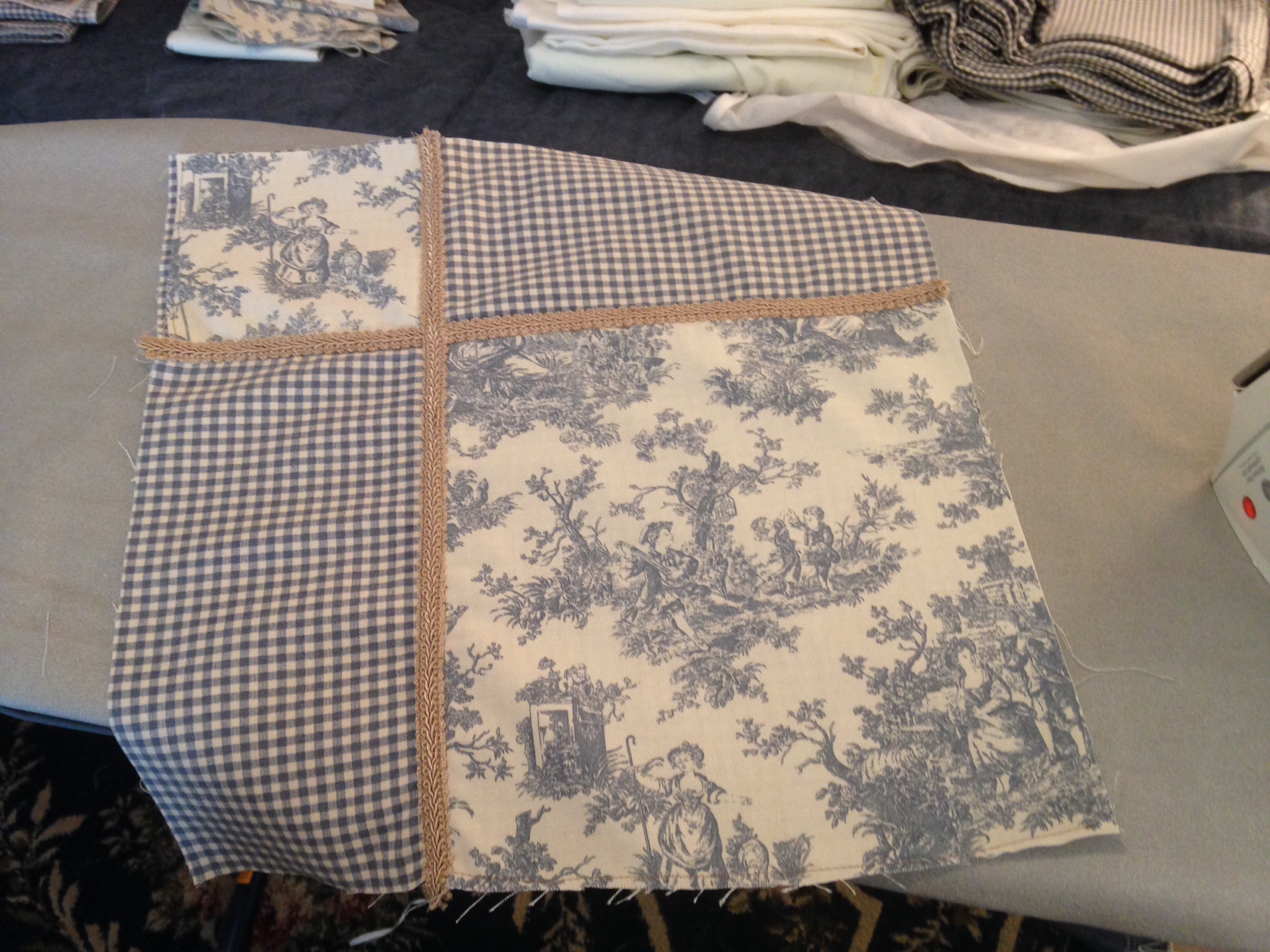
2. Finished projects. I wrote here about completing some window valances that have been on my to-do list for way too long and got a couple of pillows  done as well. Love how they change the room!

IMG_1136

3. Swiss-Ham-Ring-Around, one of my favorite ways to use ham leftovers.

cimg0311.JPG

4. Dogwoods blooming! One of my favorite parts of spring! There’s another tree with airy lavender blooms along the roadsides here – I’ve asked what they are before but have forgotten. But it makes for pleasant scenery while driving!

5. Anticipation! My oldest son comes in this weekend for a few days, and we’ve been preparing for our little grandson’s first birthday next week. Can you believe it has been a year already?!

Happy Friday!

Finished Projects!

Some of you who have been here for a while may remember some years ago my showing this fabric that I had gotten for curtains and asking advice about them.

CIMG2048

I am ashamed to say how many years that has been, but it was before we moved to this house {blush}. Thankfully the family room here had the same number of windows similarly sized.

My biggest holdup in any kind of project is deciding what to do. My inspiration for using toile and check came from seeing the combination at a friend’s house years ago. I knew I wanted a valance that used both but had trouble deciding how to do it: toile on top, check on top, which pattern to use, trim or not, etc. After thinking about it every which way I possibly could, I finally decided on what I was inclined to do in the first place.

First I’ll show you the valances that were here when we moved in:

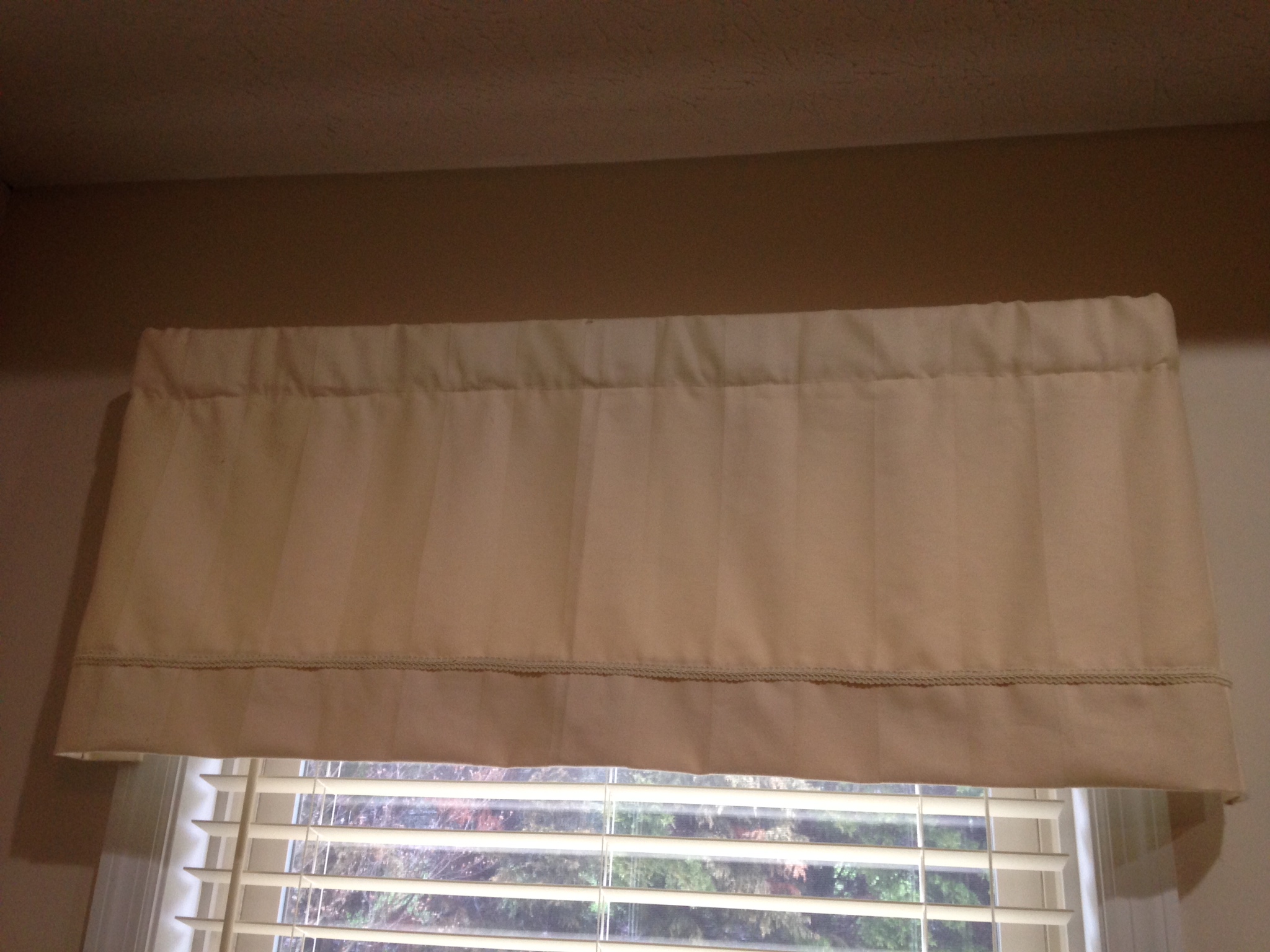
BEFORE: Old Valance

BEFORE: Old Valance

BEFORE: Old valance

BEFORE: Old valance

I apologize for the lighting in all of these. It was an overcast day, and even with all the lights on I couldn’t get the lighting right, then my phone camera kept wanting to focus on the window. These valances were all right – in fact, up close they had a lot of nice detail. But it was lost there on the window, and the beige valance on beige walls was pretty blah.

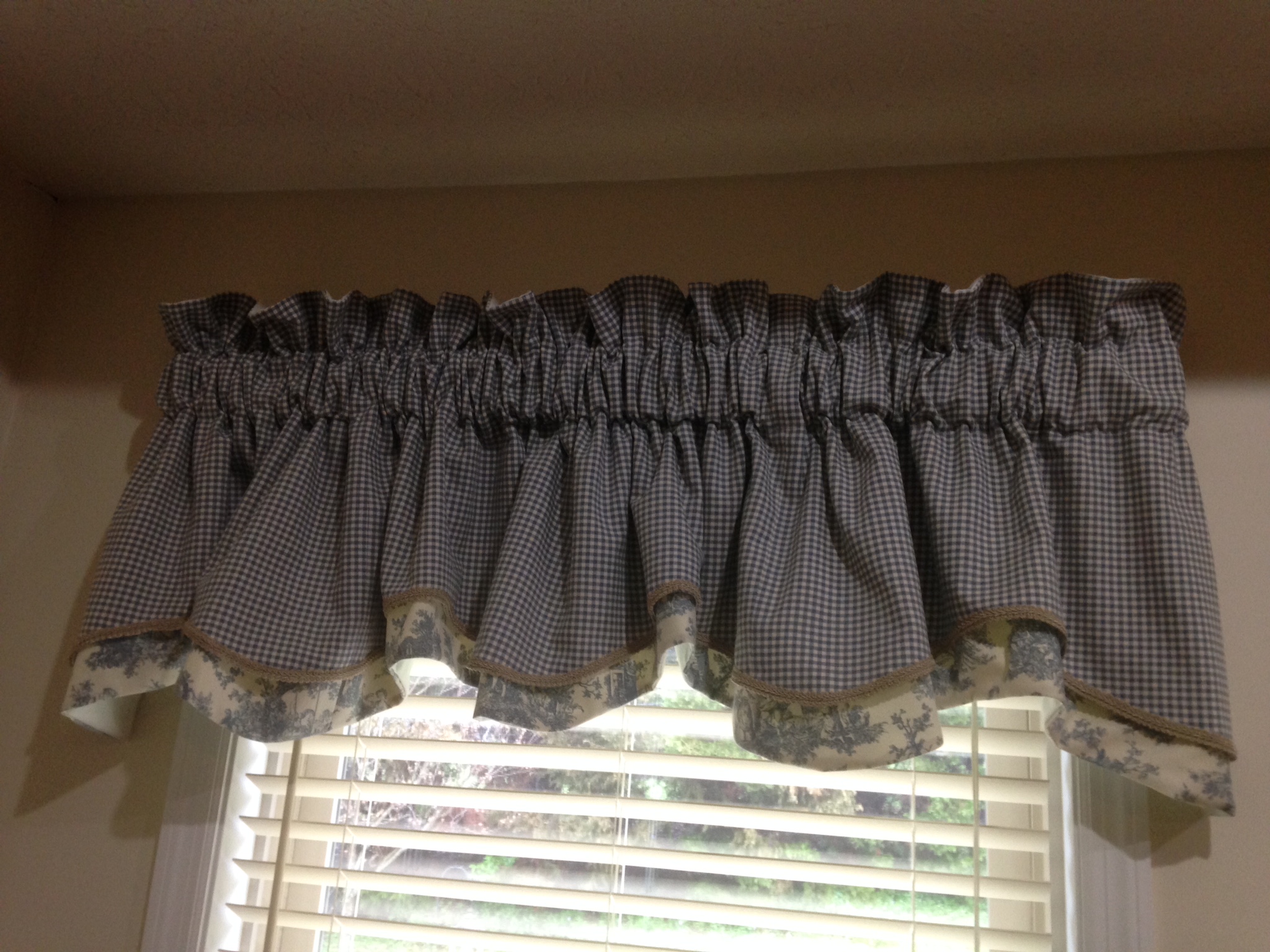
So this is what I came up with for the new valances:

AFTER: New valance

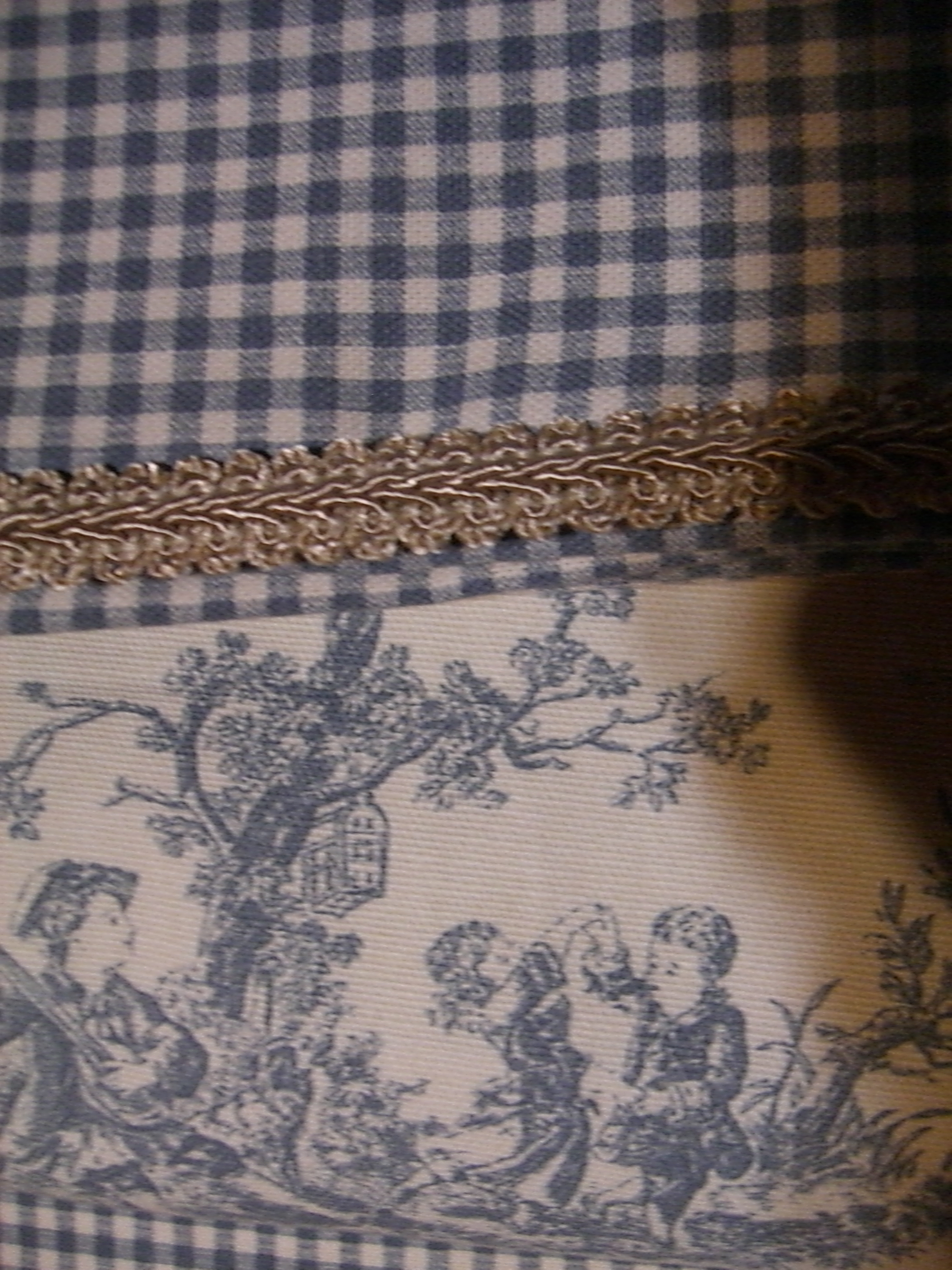
AFTER: New valance

AFTER: New valance

AFTER: New valance

IMG_0008(1)Eventually I want to make curtain panels as well. But I need to make a date with my husband to hang the rods for that. 🙂 This was a good stropping place for now.

I used this McCall pattern. I gave some thought to just adding a strip of the toile to the bottom of the check fabric rather than making the double valance that was called for, and in some ways I wish I had: even though these were attached, it was like making four valances rather than two. I did lengthen them a couple of inches from what the pattern specified.

When my dear husband was helping me hang them, he asked if I had ever thought about making them professionally. I thought to myself, “Oh, my dear, if you only knew….” I make way too many mistakes to sew professionally. I tend to do the dumbest things when I sew. For instance: the pattern called for a 1/2 inch seem. So instead of placing the fabric to the left of the 5/8″ guide mark on my machine, I placed it to the right, and then thought that seemed like an awfully wide seam allowance that was just going to be cut off. Then I realized my mistake, thankfully before I had gotten too far. There is a pretty major mistake with the lining on one, but since it was the lining and not in front and not obvious, I left it. But I did know what to watch for when I made the second one.

Seam ripper

I won’t bore you with all the flaws, but there are plenty. Thankfully they came out looking relatively well for all that.

At one point I wished I had the buffalo check that’s so popular these days, but since I already had this on hand, I felt like I should use it instead. But then, I told myself, if the buffalo check is trendy now, it might not be a few years from now, and the regular toile and check combo is fairly classic. Yet when I got these done I thought they looked more country-ish, which I am trying to get away from, rather than classic. But I am telling myself that’s just my imagination and they do look classic. 🙂

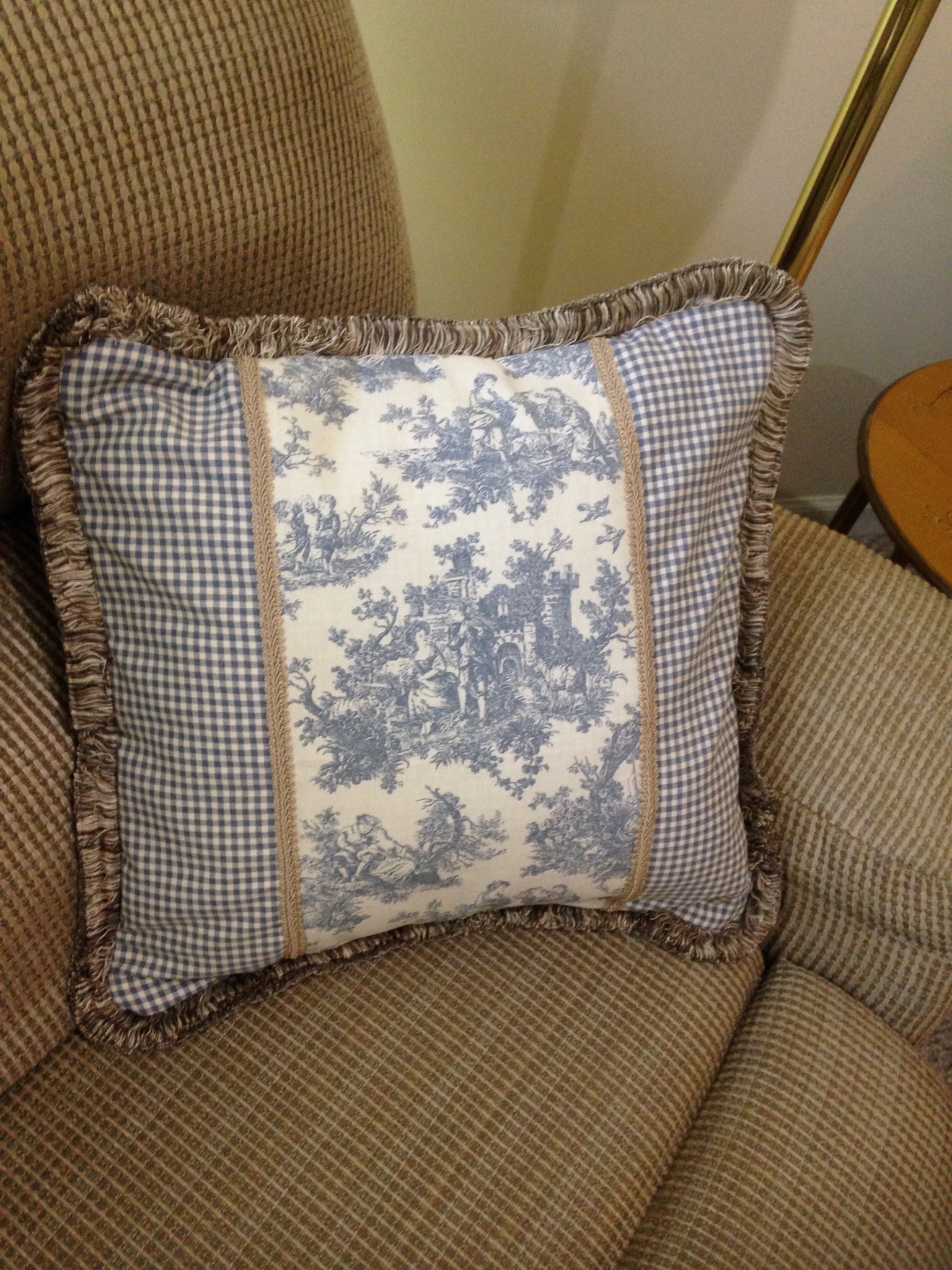
I also wanted to make a couple of pillows, mainly to tie the room together but also because I have a couple of old ones that are about ready to be retired. I got the idea for this one from here as well as instructions for making an envelope pillow.

IMG_0009

I really liked doing an envelope cover rather than stuffing  a pillow! I went back and forth with whether or not I liked this as much as I thought I would, but it does accomplish its purpose in tying the room together, I think.

IMG_0004

I also made the front and back for another one, based on this one seen on Pinterest (I found the other one originally on Pinterest as well). I was originally going to add lace like that one has, but decided I liked this design:

IMG_0010

I’m trying to decide whether I want to put cording around the edges or not. I’m going to see what Hobby Lobby has and then decide from there. But it shouldn’t take to long to finish up either way.

I love the trim, which I learned is called gimp, and thought it would be the easiest part to deal with, but I found it’s a little hard to keep in place – it kept wanting to pull over while I was sewing. And I did learn not to stretch it while sewing! I did that in a couple of places on one pillow, which made the fabric look a little puckered, but thankfully it evened out with pressing.

There’s one more I’d like to do, as well as the longer curtain panels, but this is a good stopping place for a week or so. My oldest son is coming in this weekend, and a very special grandson is having his first birthday next week, so I need to turn my attention to other pursuits just now. 🙂 With trying to get these done I haven’t been to visit you all like I normally would, and I hope to catch up soon.

Camouflaging Dirt

Photo courtesy of morguefile.com

Photo courtesy of morguefile.com

Years ago when my youngest was still a baby and we were moving to another state, a house we looked at had all white cabinets, flooring, and appliances in the kitchen. I thought to myself, “This will never work with three boys.” But that is the house we ended up buying, and a funny thing happened. Because everything was white. I noticed streaks and smudges right away and cleaned them up as I noticed them. That kitchen was probably cleaner than any of my kitchens with darker floors and wooden cabinets mainly because I don’t notice dirt and smears against the wood as easily as against white. I was shocked recently to open a wooden cabinet door and notice when the light hit it just right that it was covered in dust that I had been totally unaware of. Sometimes I think I have dusted the wooden end tables or swept the parquet floor thoroughly — until the sunlight comes through the windows at just the right angle, and then I see spots I missed.

We used to have stovetops that had metal (aluminum, I think) removable burner pans that would catch all the gunk and spills, which would then get encrusted and hardened with the heat from cooking. I tried to keep on top of the spills, but eventually I had to do something with the burner pans. When I could find cheap replacements, I’d just buy those and toss the old ones. When the replacements got too expensive, I came across a tip to put the burner pans in a big pan of water with some baking soda, bring it to a boil, and then just let them sit in the hot water for a while. Somehow that did make them easier to clean even the caked-on stuff. But it was tedious. My stovetop now is totally while and doesn’t have removable burner pans, so, because the spills are more obvious, I clean them as I go and rarely have to do a major cleaning there.

Sometimes when we’re looking for furniture, appliances, or flooring, we want something that doesn’t show dirt. I still think that way in some areas. I wouldn’t want a totally black or white car: the black shows up pollen and dust, the white shows up everything else.

But I’ve come to prefer white in a kitchen, partially because it makes the room lighter, brighter, and more open and airy, but also because I like to be able to see and keep on top of the dirty stuff rather than wonder what I am going to discover with a closer look.

One church we were in had flooring in the kitchen/fellowship area that looked dirty all the time. It wasn’t unclean: it was just that the color and pattern made it look grimy. Recently we went looking for flooring for our bathroom, which came with carpeting, which is gross in a bathroom. A lot of the vinyl flooring we looked at had the same feature: a swirly pattern looked to me like smudges, and dots looked like something had spilled that needed to be cleaned up. I guess the designers figured that’s one way to hide dirtiness: camouflage it so it always looks dirty anyway.

And then sometimes we can’t see dirt when our eyesight fails. I was cleaning a windowsill recently and thought I was done until I put on my reading glasses, and then the windowsill didn’t look very clean at all. One of the signs of my mother-in-law’s aging was that she didn’t see things that weren’t clean. She had always been very industrious, but the older she got, the more we found areas that were sticky or covered in dog hair that she would have clean if she had realized, but she just didn’t see it.

I’ve often thought, when I see sunlight showing up the dust I missed, that I should probably dust or sweep at that time of day so I can see better and do a better job in that light. I’ve also thought that it was a good analogy of the need to shine the light of God’s Word on my life. Everything may look okay to me, but my spiritual sight may need adjustment. My human dimness may have camouflaged an unkind thought as justifiable or missed a selfish motive. And I need to compare myself not to my fellow creatures with their own smudges, but to the blazing holiness of the Son of God. Why would we do that when none of us can come close at all, when we look so shabby and dingy in that light? Because that’s the best way to see what needs to be taken care of. And instead of fearing to come to that light, we can have confidence that “If we confess our sins, he is faithful and just to forgive us our sins, and to cleanse us from all unrighteousness” (1 John 1:9) and we can have assurance that we can “come boldly unto the throne of grace, that we may obtain mercy, and find grace to help in time of need” (Hebrews 4:16).

One of our sons, when he was very little, used to have a hard time admitting he had done anything wrong. Often we took him to Proverbs 28:13: “Whoever conceals his transgressions will not prosper, but he who confesses and forsakes them will obtain mercy.” “If we say that we have no sin, we deceive ourselves” (I John 1:8a). As long as we cover, camouflage, excuse, or miss seeing our sins, faults, and flaws, we’re stuck with them. But if we see, acknowledge, confess our sins to the Lord and forsake them, He will cleanse us.

Sometimes when we discover a mess we had missed, we can be discouraged at the work needed to clean it up. Sometimes when I start to clean one area, I notice five others that need work, and it can be discouraging. But spiritually, Jesus has done all the work. He took all of our sin and all of God’s wrath towards it on Himself on the cross. When we believe on Him, our sinfulness is exchanged for His righteousness. Though we still have to battle sin in this life, we can be cleansed, and in heaven we’re given white robes, the Bible says. I sometimes joke that I can’t wear white til I get to heaven because of my propensity to spill or brush against something messy and end up with a spotted garment. What a joy it will be in that day to have sin totally removed so it can’t touch us any more. But what a joy in our day that though our “sins be as scarlet, they shall be as white as snow” (Isaiah 1:18).

Search me, O God, and know my heart: try me, and know my thoughts: And see if there be any wicked way in me, and lead me in the way everlasting. Psalm 139: 23-24

Create in me a clean heart, O God; and renew a right spirit within me. Psalm 51:10

Book Review: Songs of the Morning: Stories and Poems for Easter

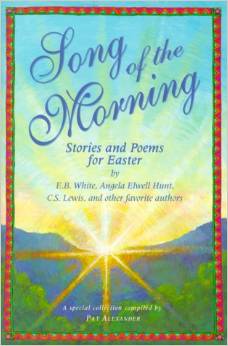
Song of the MonringSongs of the Morning: Stories and Poems for Easter was compiled by Pat Alexander and includes excerpts from the writings of C. S. Lewis, E. B. White, Dickens and others, some (mostly poems) written by children. I had bought it ages ago from a clearance section, put it on my shelf, noticed it it off and on through the years, and kept forgetting about it at Easter time. Finally this year I remembered to pull it out in the weeks preceding Easter. I like to read something devotional pertaining to Easter during that time, and while this wasn’t that exactly, it was both pleasant and beneficial.

I don’t think I realized, or I had forgotten, that it was geared primarily to children, probably the same age as those who would be able to read the Narnia series. But adults can gain from it, too.

I like that it couches the Easter story within historical context. The first section is “How It All Began” and begins with a short excerpt from a children’s Bible about God creating the world and sin entering in (Pat Alexander also wrote The Lion’s Children’s Bible, which I had not heard of before this, so I don’t know how well it expresses Biblical truth, but the excerpts I read here were fine). Then there are Narnia excerpts about the founding of Narnia and the White Witch and a couple of other sources to further illustrate those truths.

Other sections follow a similar pattern and focus on the birth of Christ, the triumphal entry on Palm Sunday, the crucifixion, and the resurrection. There’s also a section of “The Greatest Love,” with several historical and story illustrations of sacrificial love (like Sydney Carton’s in A Tale of Two Cities and a story about a boy’s dog risking its life to save the boy’s), one called “It’s All Right,” dealing with how new life in Christ should affect our lives in practical terms, like forgiveness of others, and a final one called “A New Beginning.”

The stories come from a variety of countries. Some are old, some are new. Some are from adults’ work, some from children’s books. Some are fun, some are serious. Pat did a fine job putting all these sources together. It doesn’t look like the book is in print any more, but there are copies that can be purchased online, or perhaps you can keep an eye out for it at library sales and such.

(This review will also be linked to Semicolon‘s Saturday Review of Books.)

Laudable Linkage

Here are some noteworthy reads from the last couple of weeks:

Shine Like Stars: Give and Rejoice {Philippians 2:17-18}. What it means for our lives to be poured like like a drink offering. Hit me right where and when I needed it.

10 Things We Don’t Want Our Kids to Learn From Church.

What these ladies did to turn a friend’s day around, and what they received in return. Loved this!

Why Can’t Christians Intelligently Discuss Current Events. “I suspect that by yelling so loudly about nearly everything, we’re obscuring the big thing (Matt. 12:36).”

Responding to the Increasingly Short Shelf-Life of Worship songs, HT to Challies. Songleaders/music pastors/worship leaders have an abundance of songs to choose from, and being able to project the words for all to see enables us to sing more than just what’s in the hymnbook. That’s good in many ways but complicates things in other ways. Though this was written to song leaders and such, it helped me to see what  big job it is to choose songs from the multitude we have available. I especially appreciated his caveat that some songs are for just a season. It used to bother me that we heard some songs often for a while and then not at all – kind of like a current “hit” – but then I realized that even the older hymn-writers wrote many songs that we know nothing about now, so that must have happened then, too.

This is a  neat overview of the Bible for kids, showing how it all points to Christ:

https://vimeo.com/123430346

Have a good weekend!

Friday’s Fave Five

FFF spring2

It’s Friday, time to look back over the blessings of the week with Susanne at Living to Tell the Story and other friends.

It’s been a busy week, and I haven’t been able to work any more on my “project” I’ve been talking about lately, but I should have it done next week. Meanwhile, here are some highlights of this week:

1. Sweet and Spicy Bacon Chicken. I was looking through my Pinterest recipes for something simple yet flavorful that I could toss in the oven, and this fit the bill nicely. I sprinkled bacon bits on it rather than wrapping a bacon slice around it, and sprinkled brown sugar instead of rolling it in it. This one’s a keeper. I didn’t think to take any pictures of my own.

2. Froyoz frozen yogurt. I don’t usually run errands in the evening, but one night I had a prescription I needed to pick up and had run out of time earlier in the day when I was out. I took the opportunity to stop by Froyoz to get Chocolate Milk and Creamy Peanut Butter flavored frozen yogurt topped with chocolate covered peanuts and a small bit of brownie. Good stuff.

3. Blooming trees. Several flowering trees are in bloom this week. Our neighbor’s trees turned white overnight – I don’t know what they are, but I’ve always called them popcorn trees because that’s what the round, white blossoms look like to me from a distance. After the colorlessness of winter, I love to see color springing up all over this time of year.

4. The Hobbit:The Battle of the Five Armies. Enjoyed watching this with the family. I know the films have been maligned and added elements that weren’t in the book, but I still enjoyed it, especially Bilbo and Bard.

5. Thinking about the death and resurrection of Christ. I knew one blogger who felt that putting spiritual things on a favorite’s list trivialized them, but I disagree. Though in one sense we celebrate the resurrection every Sunday, and the death of Christ is applicable every day, I especially appreciate the focus this time of year, the reminder of all He went through so that He could offer us salvation, His great love for us, and the joy resulting from His resurrection.

I hope you have a wonderful Easter!

When the message isn’t for me

Courtesy offreedigitalphotos.net

Courtesy of freedigitalphotos.net

A week or two ago I came across a blog post that got me to thinking about how we respond when a meeting, church service, or even a Bible passage seems to apply to someone other than myself. When there is an ordination service or a Mother’s or Father’s Day message or children’s program, do I skip them because I am not a part of any of that?

I don’t think so. Here’s why:

1. “All scripture is given by inspiration of God, and is profitable for doctrine, for reproof, for correction, for instruction in righteousness: That the man of God may be perfect, thoroughly furnished unto all good works.” II Timothy 3:16-17. It is all profitable for me in some way even if the particular passage doesn’t seem to apply to me.

Some years ago the pastor of the church where we were at the time read a few verses from Exodus with instruction about oxen. He asked, “Do any of you own an ox?” No one raised their hands.

He then asked, “How many of you have even seen an ox?” One or two raised their hands.

“So,” he said, “We should just turn the page and skip this passage, right?” No, we didn’t think so, but what do we do with that passage?

He then brought out several applications from the passage. For instance, someone who owned an ox that was known for trying to push people with its horn was more liable if it injured someone. So if we have, say, a dog with a tendency to bite, we are even more responsible to keep it from people it could hurt. Or, to apply it further, if our tail lights are out on our car, we’re liable if someone crashes into us because they didn’t know we were stopped or slowing down to turn, so it behooves us to keep up with those things.

2. It helps us understand our brothers and sisters in the Lord. I may not be a pastor or a husband or a mother, but the passages that talk about them help me understand their roles, not so I can form a checklist and note when they’re not getting it right, but so that I can pray for them, understand their problems, needs, and temptations, and encourage them. The Bible says the church is the body or Christ, and “If one member suffers, all suffer together; if one member is honored, all rejoice together.” (I Corinthians 12:26).

3. Their position is under attack. Satan is not omnipresent, but he does get around, and he seeks to undermine everything God calls good. Any role or function within the church, home, or family as designed by God is under attack in some way or another. The blog post I mentioned at the beginning was complaining, in part, that the focus on married women and mothers in some women’s ministries left single ladies out. I do think that is a valid point: not all women are called to be married, not all mothers are able to stay home, and we need to find ways to minister to the whole scope of womanhood. However, there are particular ways marriage and motherhood are being particularly attacked and undermined in the world today, so we need to help support those roles.

4. I can learn something that applies to me even though the particular focus of the passage or sermon is for someone else. Loving one another as Christ loved the church is something that applies to us all, not just husbands, so I can take an illustration that may be particularly about husbands and learn something I need in loving others. Years ago in college we were encouraged to read a particular book about leadership which I gleaned a lot from even though I was not a leader at the time (and still don’t naturally feel inclined to be now).

This is not to say that I should attend every focus group within the church since we’re all part of the body of Christ. Some of those were created to handle specific concerns in a smaller group setting. But when a Bible passage or sermon or ladies’ meeting seems to apply to someone else, there is still much I can learn and benefit from if I have ears to hear and a heart to receive.

Book Review: A Million Little Ways: Uncover the Art You Were Made to Live

Million Little Ways

When you disagree with a foundational statement eighteen pages into a book, it’s hard not to let that color the rest of your reading. But I tried to give it my best effort. More on that in a moment.

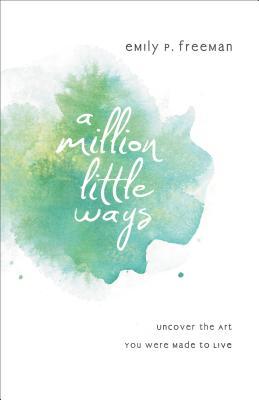
I got A Million Little Ways: Uncover the Art You Were Made to Live by Emily Freeman because I enjoyed her Grace For the Good Girl so much. The title sounds like it might be about finding ways to be more creative or finding time to express yourself artistically. However, though that is involved, that’s not exactly what the book is about, at least not in the way you might be thinking at first glance. The basis of the book is taken from Ephesians 2:10: “For we are his workmanship, created in Christ Jesus unto good works, which God hath before ordained that we should walk in them.” Other versions use “handiwork” or “masterpiece” in place of “workmanship,” and the Greek word they are translated from is poiema, from which we get our English word poem.

Being his workmanship doesn’t mean we are all poets. It means we are all poems, individual created works of a creative God. And this poetry comes out uniquely through us as we worship, think, love, pray, rest, work, and exist.

Jesus reminds us we are art and empowers us to make art.

There isn’t one right way to do the job of glorifying God. There are many ways, a million little ways, that Christ is formed in us and spills out of us into the world.

Knowing you are a poem doesn’t confine you to be artsy, it releases you to be you (p. 29).

So the art she is talking about our creating isn’t writing or painting or sculpture – unless we’re called to that – but rather finding the purpose for which God made us, that which makes us most “fully alive” (a phrase she uses often), and then doing that by the enabling of God and for His glory, whether it is being a doctor, a mom, a janitor, a hostess, or whatever. But she is not talking primarily about our occupation, though that’s a big part of it:

I don’t believe there is one great thing I was made to do in this world. I believe there is one great God I was made to glorify. And there will be many ways, even a million little ways, I will declare his glory with my life (p. 40).

So we can express God’s glory whether we’re listening to a friend’s troubles, making dinner for our family, playing an instrument, or whatever else is a part of our day.

Part of uncovering what we are uniquely called to do is examining our desires. “Our passions aren’t the goal, but they are the signposts, like arrows pointing to our center” (p. 60).

Could it be possible that the thing the thing you most long for, the thing you notice and think about and wish you could do, is the thing you were actually made and equipped to do?

Could it also be possible that somewhere along the way you got the message that to follow desire would be selfish, when, really, it would be the opposite? (p. 47)

A couple of chapters discuss the ins and outs of that in greater detail, including redeemed desires (not everything we desire is something we should pursue). Other chapters discuss the need to do all leaning on God’s power and enabling, realizing we can’t do it on our own, handling criticism (I especially appreciated the thought that criticism has a purpose even when unfounded), waiting on God’s timing, learning when to say “no.” Probably my favorite chapter was “Wonder.” A close second would be the one on waiting, from which this favorite quote came:

The Spirit came over Mary in a moment, but it took nine months for him to grow. Jesus waited thirty years to begin what we cal his earthly ministry. But really, wasn’t he always being God in the world, from his first breath to his last? He was crucified and waited until day three to resurrect. Don’t lose hope on day two (p. 155).

Another favorite quote came neat the end: “One masterpiece is the work of ten thousand rough drafts” (p. 195).

So what was it I disagreed with so strongly at the beginning? A statement on page 18 that “God is not a technician. God is an artist.” My immediate thoughts ran something like this:

God is a technician AND an artist! When He creates a beautiful sunset, He doesn’t just throw colors in the sky: there is science behind it, and it’s not the less wondrous for that. When you think of the marvels of human biology, the mathematical properties in the universe that enable space travel, and so many other factors involved in his creation, it’s impossible not to see that He is a master technician. (My kids used to have a book titled God Thought of It First, showing that many of man’s inventions were based on properties in creation, like the similarity between how a submarine and a chambered nautilus works). My husband was a physics major and has worked for most of his career in the science of color, first in textiles and now in plastics. He can’t just say, “Hmm, this looks a little too blue” and add a dab of another color until it looks right, like an artist might do on a canvas: there are formulas involved which enable them to get the right color not just for the moment, but to be able to reproduce it in massive quantities for carpet fiber, plastic bottles, and even paint in artist’s tubes.

I think Emily would agree that God is a God of detail, engineering, and technology as well as artistry and creativity. But that’s not really what she is talking about when she says God is not a technician. She precedes that statement with these thoughts:

Is he only a God of right answers and right angles and acceptable behavior? Have we exalted the will of God and the plans of God above God himself?

He does not manage us, to-do list us, or bullet-point us. He loves us. Is with us. And believing him feels impossible, until we do, like a miracle, like lukewarm water turning merlot red right there in the cup. And hope sprouts new, because God doesn’t give us a list. He invites us into the story (p. 17).

Actually He does give us a list or two, like this one and this one. But, yes, I do get the point she’s making that we’re not saved or sanctified by keeping lists or commandments. It’s possible to keep commandments and totally miss God, as the Pharisees did.  We’re saved by grace through faith and sanctification and service come about the same way. Or, as she says later, when discussing Jesus washing the disciples’ feet and then instructing them to do likewise, “Maybe Jesus is inviting them into a relationship of do as I do rather than pointing to a list and saying, Copy me” (p. 75).

So once I understood where she was coming from, I could agree, but I still had to fight against that feeling when similar statements were made: “Technicians don’t move us. Artists do” (p. 14); “When a poet writes a poem, he isn’t writing a technical manual or a how-to book” (p. 26); “Are you living like a programmer instead of a poet?” (p. 135).

The bulk of the book is written from a right-brained, creative, artsy vantage point, which will appeal to that kind of thinker but not so much to the more left-brained, literal, logical one (I know the whole left vs. right-brained theory has been labeled incorrect now, but you know what I mean.) Although I struggled with that at times, and I wouldn’t agree with every little sub-point, overall I appreciated the message of the book, was inspired and challenged, and gleaned a lot from it. I’ll close with a section which I think sums it up:

 What if we approached the critic, our jobs, the kids at our table with the same wonder and anticipation an artist has when she approaches the canvas? What if we decided our purpose in this world really is to reflect the glory of God?

Would we begin to see ourselves as wildly free to approach the universe – the meal plan, the work project, the yard sale, our neighbor, the roof leak, the doctor appointment, the eternal destiny of our children – to approach it all with a wide-eyed wonder, with an edge-of-your-seat breath, with an expectation that any minute God will show himself in a way we have not yet seen? And he’ll likely do it through us?

When we embrace the beauty of our design, when we recognize that he has made us to be the unique expressions of himself, when we receive the gifts he has equipped us with and have the courage to pour them out, we worship. What else would it be? (pp. 188-189).

(This review will also be linked to Semicolon‘s Saturday Review of Books.)
Friday’s Fave Five

FFF spring2

It’s Friday, time to look back over the blessings of the week with Susanne at Living to Tell the Story and other friends.

This has been another good week – busy, but different. Here are some of the best parts of it:

1. An outdoor lunch. Great-grandma’s caregiver couldn’t come Tuesday due to having a sick child, so Jim worked from home partly to help take care of her and partly to work on something that he could do better at home without all the interruptions at work. It was a beautiful day, so we took GG (as we shorten her name in texts) in her wheelchair out on the back patio and the three of us had lunch together. It was just the perfect temperature to do that, and Jim and I don’t eat lunch together during the week very often, and I had brought Chick-Fil-A back after a trip to the store, so it was a treat all around.

2. Putting away winter clothes. Even though it’s supposed to get into the 20s again this weekend. 🙂 We still have some sweaters and jackets handy in the front closet if we need them.

3. Greening and pinking of some of the bushes and trees in the yard. More signs of spring!

4. Progress on the project I mentioned last week. I had hoped to be done with it in time to show you today, but these things almost always take longer than expected.

5. Timothy crawling! He’s been working on it for some time, though we almost wondered if he was going to skip crawling and go straight to walking, as he seems to be trying to figure out ways to pull up on the furniture and can stand a few seconds at a time without help. But somehow Tuesday night it all clicked, and he took off! And now I need to buy outlet covers and put some items out of reach. 😀

Timothy standing

Happy Friday!

P. S. I am having a giveaway for the excellent book She Is Mine: A War Orphan’s Incredible Journey of Survival by Stephanie Fast. Leave a comment on my review of the book to enter – the drawing is Monday.