Friday’s Fave Five

 It’s Friday, time to look back over the blessings of the week with Susanne at Living to Tell the Story and other friends.

Wow, it’s been another whirlwind week. Hopefully next week will be a “normal” one. But overall it has been a good week, and here are five favorite parts of it:

1. More progress for Timothy. I decided to go ahead and share my grandson’s name, since his dad has on his blog (he has some helpful posts there about dealing with life in the NICU). He turned one month old this week! The first part of the week was rough, with more heart-rate drops than I think he’d had in a day to date, but as of yesterday he was having only 1 or 2 a day and he is in a crib now instead of an incubator.

2. Jesse’s graduation from Community College with an Associate’s degree.

photo 1

photo 3

Plus, we’ve been planning a graduation party for him this coming weekend, so we didn’t have any kind of celebration planned for graduation night, but Jason and Mittu brought over a cake and balloon and made some goodies. It was just the right touch to celebrate on his actual graduation night.

3. Mother’s Day. My family always makes it a special day, especially my husband. Grilled steaks, baked potatoes, corn on the cob, and some sweet and thoughtful gifts, as well as having the family all together (my son in RI was there via Face Time), made for a great day.

4. Projects done. For some time now I’ve been wanting to make a DVD for Jim’s mom of a slide show of photos set to music, something I’d never done before (either the slide show to music or the DVD), and I decided to try to do it for Mother’s Day. I thought seeing the photos bigger on the TV screen would be helpful to her. Somehow (thank God for His help and direction!) I was able to figure out the film part, and Jim was able to burn it to a DVD. Then I had wanted to make a scrapbook of Jesse’s school portraits and class photos for his high school graduation two years ago, but wasn’t able to, so I decided to try to do that for a graduation party we’re having for him tomorrow. Got it mostly done last night (now just to clean house and make food for it!).

5. Found gift cards. Jim had given me a couple of gift cards for Michael’s at Christmas, but I haven’t been able to find them. I just came across them this week.

I apologize for not being around much this week, either here or on your blogs. Between regular life, caring for Jim’s mom, hospital visits to see Timothy, graduation, Mother’s Day, and these projects, as well as preparing for Jesse’s party tomorrow, my time at the computer has only come in small bits lately. But after tomorrow there are no extra events on the calendar for a while, and no new projects to do (at least that I know of right now), so hopefully I’ll be able to catch up with you then.

Happy Friday!

Laudable Linkage

Here are a few interesting reads discovered in the last couple of weeks:

The Cheerleader. If something can be heartbreaking and heartwarming at the same time, it is this testimony of a mom injured in the tornadoes that took her home and children.

“God’s Not Dead” and the Angry Atheist Professor: That Was Not My Experience, HT to Challies. I’ve not seen the movie, but Ann has a review of it here. She says as well that the atheists in the movie tended to be typecast as stereotypical meanies, and the film has some issues, but overall it has a good message.

Before We Die and After, Too. Things we want to accomplish before we go may not be the typical “bucket list” experiences.

How Can Moms Deal With the Distractions of Social Media?

What to Do in Those “I Can’t Handle It” Moments.

The Church and the LGBT Community: Is There a Way Forward?

Happy Saturday!

Fridays Fave Five

 It’s Friday, time to look back over the blessings of the week with Susanne at Living to Tell the Story and other friends.

It’s been a whirlwind week. Here are five favorite parts of it:

1. Progress for my little grandson in the NICU. I’m going to have to come up with a nickname for him! I hope you don’t mind hearing about him every week, because that’s likely to continue. 🙂 He is still having episodes of his heart rate dropping and forgetting to breathe, but not as many as last week. They’ve been lowering his oxygen and yesterday removed his nasal cannula completely. They’ve been lowering the temperature in his incubator to see if he can regulate his own body temperature. His weight has been up and down but he has gained 8 ounces since birth 3 weeks ago. He can wear clothes now! And they may start trying to feed him a little by mouth next week to see how he does. Plus he gets cuter every day, in my unbiased opinion. 🙂 It’s really cute to see him smiling in his sleep and sometimes even when he is awake. We know that’s probably just a reflex right now, but we’ll take it as a sign that he is happy. Please do keep praying – they say the journey with preemies is one of ups and downs rather than steady progress. Thanks so much for your care and concern and prayers so far!

2. Baby gifts. Our church usually does a baby shower for expectant moms, but my grandson came the week before his. Since his mom was still recovering and going to the hospital to be with him as much as possible, what the church decided to do was go ahead and gather presents for him, in case they needed them soon, and then some time in the future they’ll have a brunch and maybe a diaper shower or something. We brought home some of the presents that had accumulated so far and my son and daughter-in-law came over one evening and opened them here. It was fun to see them, and we so appreciate people’s thoughtfulness.

3. BBQ burgers. I love grilling season. 🙂 My husband tried the sous vide for them this time so he could do some thicker burgers than he could with just the grill.

4. A new hose. Sometimes it’s the little things. 🙂 With planting flower beds and pots a few weeks ago, we’re watering more, and rediscovered that one garden hose was in bad shape, spraying from several places besides the opening. I kept forgetting about it completely when I was at stores where they sold such things, and finally got one this week, along with a nozzle that I can change from a shower for the plants to a stronger stream when rinsing pollen and dust off the porch.

5. Dusting. Not one of my favorite activities per se, but I do like the results. It had really piled up with all the busy-ness of the last few weeks, to the point where I was embarrassed. When the house is unkempt, I feel unkempt, and it was a good feeling to tackle that this week.

Just yesterday I didn’t think I’d have five “faves” to share today, until I started jotting some down last night. That’s one blessing of doing this weekly: what we think of as an average, “not much happening” kind of week turns out to be a very blessed one when we stop to think about it, and that in turn reminds us to thank the Lord for those blessings.

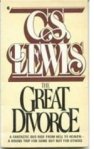
Book Review: The Great Divorce

the-great-divorceI first picked up The Great Divorce by C. S. Lewis some years ago when I found it on sale in a bookstore. I wasn’t sure what kind of divorce the title was talking about, and the description on the front about a bus ride from hell to heaven seemed really weird, but it was Lewis and it was on sale, so I got it. But it sat around for all these years unopened. The TBR challenge of reading things that have been unread on our shelves spurred me to work this book in this year.

Lewis explains in the preface that the title and concept came in response to William Blake’s book The Marriage of Heaven and Hell. Lewis explains that there can be no such marriage.

“We are not living in a world where all roads are radii of a circle and where all, if followed long enough, will therefore draw gradually nearer and finally meet at the centre: rather in a world where every road, after a few miles, forks in two, and each of those into two again, and at each road you must make a decision. Even on a biological level life is not like a river but like a tree. It does not move towards unity but away from it and the creatures grow further apart as they increase in perfection. Good, as it ripens, becomes continually more different not only from evil but also from other good.”

“Evil can be undone, but it cannot ‘develop’ into good. Time does not heal it.”

To illustrate some of those fork-in-the-road choices as well as the opposite directions of heaven and hell, Lewis developed this fantasy of a group of people on a bus ride from hell to visit heaven. When they arrive, they are surprised to find that they are transparent and that contact with solid objects is painful (“It will hurt at first, until your feet are hardened. Reality is harsh to the feet of shadows.”) They are called ghosts, whereas the inhabitants who come to meet them are called Solid People or Spirits. Most of the people decide not to stay for various reasons, despite the Spirits encouraging them to put away whatever is holding them back and enter into joy.

The cleric who does not believe in absolutes refuses to believe in them still: “For me there is no such thing as a final answer. The free wind of inquiry must always continue to blow through the mind, must it not? ‘Prove all things’…to travel hopefully is better than to arrive.” The Spirit speaking with him, a friend he knew in life, responds, “If that were true…how could anyone travel hopefully? There would be nothing to hope for.” The artist prefers his painting to reality. “Every poet and musician and artist, but for Grace, is drawn away from the love of the thing he tells, to the love of the telling till, down in Deep Hell, they cannot be interested in God at all but only in what they say about Him.” The overbearing wife wants to continue “managing” her husband. The mother who has developed motherly love into idolatry would rather take her son from heaven back to hell with her than lessen her focus from him to love God. “Mother love…is the highest and holiest feeling in human nature,” she says, and is told, “No natural feelings are high or low, holy or unholy, in themselves. They are all holy when God’s hand is on the rein. They all go bad when they set up on their own and make themselves into false gods.” The man who lives for manipulating people with his self-pity is told, “Did you think joy was created to live always under that threat? Always defenseless against those who would rather be miserable than have their self-will crossed?”

But a few are willing to have their besetting sins taken and killed, and they grow more “solid.”

“There are only two kinds of people in the end: those who say to God, “Thy will be done,” and those to whom God says, in the end, “Thy will be done.” All that are in Hell, choose it. Without that self-choice there could be no Hell. No soul that seriously and constantly desires joy will ever miss it. Those who seek find. To those who knock it is opened. ”

“Good beats upon the damned incessantly as sound waves beat on the ears of the deaf, but they cannot receive it. Their fists are clenched, their teeth are clenched, their eyes fast shut. First they will not, in the end they cannot, open their hands for gifts, or their mouth for food, or their eyes to see.”

Lewis, or the narrator, finds George MacDonald, someone he has greatly looked up to and learned from, who then becomes a guide and teacher for him, similar to Dante and Virgil in The Divine Comedy.

Lewis assures in the preface that he is not writing to propose anything about what heaven might be like: he is simply using this scenario as a vehicle to discuss truths.

There are a few similar themes as are found in The Last Battle, the last book in the Narnia series written about 10-11 years later: the idea of moving “further up and further in” and the effusive joy of heaven.

I don’t know if Lewis believed in a purgatory or if he was just using the idea of the dead getting “second chances” to illustrate that many of them would not take it. The Bible says in Hebrews 9:27 that “it is appointed for man to die once, and after that comes judgment,” so I would have a problem with this book promoting the idea of purgatory, but I think the whole second chance scenario is just part of the plot device.

One character in the book says, “Hell is a state of mind – ye never said a truer word. And every state of mind, left to itself, every shutting up of the creature within the dungeon of its own mind – is, in the end, Hell. But Heaven is not a state of mind. Heaven is reality itself. All that is fully real is Heavenly. For all that can be shaken will be shaken and only the unshakeable remains.”  Again, I don’t know if the idea of hell being just a state of mind was part of Lewis’s own philosophy or if it was just the nature of it in this as a fantasy, but the Bible does speak of hell with literal terminology.

Overall this was quite a fascinating and thought-provoking read.

(This will also be linked to Semicolon‘s Saturday Review of Books.)

Friday’s Fave Five

 It’s Friday, time to look back over the blessings of the week with Susanne at Living to Tell the Story and other friends. Here are five favorite parts of the last week:

1. Stability. My little grandson in the NICU was having a lot of trouble earlier this week with apnea and bradycardia (episodes of breathing rate and heart rate slowing down). They put him on a CPAP machine, and the episodes are infrequent now. They have no way to predict how long he’ll be on it: they say some preemie babies have these episodes almost until their original due date, while others don’t. Otherwise he is doing well.

2. A finished internship. My youngest had to complete an internship for his associate’s degree this semester. He had to get a certain number of hours in, and I was concerned because he did not find an internship until a few weeks into the semester. But he got it finished and turned in all the paperwork yesterday. That is such a relief!

3. Lesser storms than predicted. Much of the country has experienced severe weather this week. We had thunderstorms one night with predictions of hail and a tornado warning, but thankfully none materialized in our area. My heart goes out to many who lost loved ones or property.

4. Ibuprofen and Icy Hot patches. I did something to my lower back earlier this week – I am not sure what. But those two products made it bearable and enabled me to function. It’s almost completely back to normal now.

5. Good food. Two favorites: Jim made teriyaki chicken on Sunday, and yesterday I made one of my favorite things for lunch, a grilled cheese sandwich with leftover meat loaf. Yum!

Hope you’ve had a great week as well!

Book Review: My Man Jeeves

JeevesBertie Wooster is an amiable but not terribly bright English gentleman (as he says, “I’m a bit short on brain myself; the old bean would appear to have been constructed more for ornament than for use, don’t you know”). His “man,” Jeeves, is the quintessential unobtrusive English valet with not only “genius for preserving a trouser-crease,” but also a penchant for solving the various problems of Bertie and his friends.

My Man Jeeves by P. D. Wodehouse is 1919 a collection of short stories involving the fictional pair, but there are a few stories in the middle about Reggie Pepper, who doesn’t seem to have any connection with either of them. The plot lines are similar in all the stories, though: someone has some kind of problem (often another English gentleman whose source of financial support is threatening to cut him off if he doesn’t jump through certain hoops that he doesn’t want to, but some of the stories involve romantic troubles as well), appeals for help, and then Jeeves or Reggie comes up with some kind of scheme that usually involves some kind of deception that usually backfires in some comic way.

The Jeeves and Wooster books are good for a light-hearted read, especially if you like English comedy, one reason I decided to pick this up when Carrie listed it as her Reading to Know Classics Book Club selection for April. Unfortunately, the first few stories sounded very familiar, and I found that some of them were rewritten from Carry On, Jeeves (linked to my review), the only other Jeeves book I’ve read. That was irritating, but there was enough new material and enough I’d forgotten from the previous book that it wasn’t a total wash.

I have to admit that the plots got tiresome after a while, but Wodehouse’s writing is delightful. I enjoyed the narrative quite a lot and had fun picking up on certain expressions and idioms (I don’t know if the British still use these, but apparently being “in the soup” in a bad thing while being “full of beans” is good). Here are some examples:

“I’m not absolutely certain of my facts, but I rather fancy it’s Shakespeare — or, if not, it’s some equally brainy lad — who says that it’s always just when a chappie is feeling particularly top-hole, and more than usually braced with things in general that Fate sneaks up behind him with a bit of lead piping.”

Of an awkward gathering: “And so the merry party began. It was one of those jolly, happy, bread-crumbling parties where you cough twice before you speak, and then decide not to say it after all.”

“That’s always the way in this world. The chappies you’d like to lend money to won’t let you, whereas the chappies you don’t want to lend it to will do everything except actually stand you on your head and lift the specie out of your pockets.”

“Absent treatment seemed the touch. I gave it to him in waves.”

“I wasn’t particularly surprised to meet Bobbie at the club next day looking about as merry and bright as a lonely gum-drop at an Eskimo tea-party.”

The full text of this book is available online here. I listened to the audiobook, read very nicely by Simon Prebble.

(This will also be linked to Semicolon‘s Saturday Review of Books.)

This also completes one of my requirements for the  Back to the Classics Challenge hosted by Karen at Books and Chocolate.

classics2014


Laudable Linkage

It has been a while since I’ve been able to share some of the interesting reading I have come across recently. Hope some of this is of interest to you!

A neat study on True Woman about the “I am” statements referring to God and those referring to us.

Smilingly Leading You to Hell. Sadly, some of the most appealing speakers don’t always have the best messages.

The Assumption We Cannot Afford on the need to teach the Bible and encourage others to study it for themselves. Excellent.

Missing the Forest for the Trees. “The Bible is not just a spiritual search engine.”

In the Heat of the Moment, dealing with rampant emotions.

Anger: Giving In to the Enemy.

Let’s Stop Forgiving Those Who Don’t Want Forgiveness. This has long been my stance on this.

Help! My Kids Are Looking at Porn! Advice for how to handle that.

Authentic worship, hands down. “Authentic worship means to me exactly what it means to you: the freedom to worship as the Lord leads. I have traveled the length of the denominational spectrum….It was a long trip through myriad worship styles, and participation was not always optional. My hands are at my sides for the same reason yours are thrown in the air: because I am free – free from the expectations of any of my fellow worshippers, free to worship in whatever posture the Spirit leads.  The truth is, I do occasionally raise my hands, but never when told to by a worship leader or a lyric. Because of my history, nothing could be more inauthentic, nothing less free.” This spoke to me on many levels. The churches I have attended are not usually physically demonstrative, but worship is sometimes “commanded” in other ways (“Turn to your neighbor and say…” or “Pray this right now” or any number of others things dictated from the pulpit). There is a difference between leading worship and manipulating worship.

How Mothers Can Worship In the Midst of Inconvenience.

 What Winter Trees Know About Singing. Lovely, lovely post about handling children’s questions without squashing their innocence and wonder.

Ten Lessons From a Hospital Bed.

Always Apologize First, HT to nikkipolani. “Apologizing first is the bucket of water which douses the flames threatening to burn bridges between wife and husband or father and children.”

100 Ways to Thank a Teacher. Neat ideas for end of the year teacher gifts – or any time you want to express appreciation to a teacher.

Happy Saturday!

Friday’s Fave Five

 It’s Friday, time to look back over the blessings of the week with Susanne at Living to Tell the Story and other friends. Here are five favorite parts of the last week:

It’s been another good but busy week. Here are some of its highlights:

1. Improvement for my little grandson in the NICU. He is gaining weight and had his first bath this week. 🙂 His heart rate still drops from time to time, but not as much as at first.

2. NICU support. Though the NICU probably wouldn’t be any parents’ preferred first stop for their child, the staff there have been very supportive and informative, plus it has been nice to have nurses at hand to ask questions and guide them through how to bathe and change him, etc. I remember with my firstborn that even though my youngest sister had been born when I was 17, and I had been the chief babysitter for her and for some other of my mom’s friends, I felt surprisingly nervous and unsure about taking care of my own baby. It would have been nice to have someone at hand to ask some of those new parent questions.

3. Preemie clothes. He should be able to start wearing them soon. They are so cute! All of my babies were over 9 lbs., so all these teeny tiny things seem even smaller to me.

4. Delivered meals. The ladies at church are preparing meals for my son and daughter-in-law, a great help as they are spending time at the hospital and she is still recovering.

5. New blooms. My brand new hibiscus plant that we just bought and planted lost all its blooms and its leaves look shriveled after an unexpected late frost, but it is putting out new blooms this week.

Bonus: I can’t believe I almost forgot to mention Easter. That seems like so long ago now! 🙂 But we enjoyed a meaningful church service and then time with family over Easter dinner. Though we think of the death and resurrection of Jesus Christ and its meaning for us often throughout the year, it is a special blessing to have this focus on it.

Hope you’ve had a great week!

Book Review: The Little White Horse

LWHWhen I saw The Little White Horse by Elizabeth Goudge listed as Carrie’s  Reading to Know Classics Book Club selection for March. I wanted to give it a try because I had seen Goudge highly recommended. This is one of her children’s books, but she has written for adults as well.

This story begins with recently orphaned Maria Merryweather and her governess, Miss Heliotrope, traveling to Moonacre Manor to live with Maria’s uncle. The first few chapters are a series of discoveries as Maria gets to know her new guardian, house, room, village, church, etc., and along the way she learns that she and Mrs. H. are the first females to set foot in the house in 20 years, that there are a group of wicked Men of the Dark Woods doing wicked things like poaching animals and blocking the way to Merryweather Bay. When she finds that there was a quarrel caused by her own ancestors that set off these bad men , she feels it is her duty and destiny to set things right. In the course of her quest, she also has to learn patience and self-control over her own anger and tendency to hasty words, the lack of which traits contributed to the original disagreement in the first place.

The story has the flavor of a fairy tale, with animals who seem to know what to do and help Maria along the way (including a cat who writes messages in hieroglyphics in the ashes of the fireplace), the appearance of the little white horse, who is actually a unicorn, at key points in the story, and the discovery that her “imaginary friend” in London actually is a real boy who had been visiting her in his dreams (which I thought odd on many levels. Wouldn’t he have visited her in her dreams?)

It took a while for me to get into the story. All the discoveries of her new place and descriptions were fine, but had me thinking, “OK, when are we going to get into the plot?” When we finally did, my interest picked up a little. I like “quest” stories, particularly when the main character has to conquer something in him- or herself along the way, so I liked that aspect, as well as the aspect that the first step in setting things right was to give Paradise Hill, formerly run by monks, back to God (I don’t know what Goudge’s religious views were, but there are mentions of Biblical principles sprinkled here and there.)

But somehow the book just didn’t grab me, and I can’t quite put my finger on why. I can’t say I strongly disliked it, but I just didn’t love it like I thought it would. As Bekah mentioned in her review, you have to suspend a lot of disbelief to enjoy the story, even knowing that it is a fantasy. I liked Goudge’s descriptions and characterizations for the most part, and I liked the general storyline ok. I liked her planting of little clues, like Maria’s regal bearing at the beginning, before she even knew she was descended from a Moon Princess, and Miss Heliotrope’s pointing out of the “house of her dreams,” before she has any clue that she will marry its owner in the end. I wasn’t really enthralled with Maria, but I liked her well enough. All of the elements were there to make for a charming story, but to me charm was the exact thing it was missing. It took me a long time to get through it just because I wasn’t motivated to pick it up. But that may just be me (and Carrie. 🙂 ) A quick scan of other reviews show that many people love it, and it did win a Carnegie Medal.

For a couple of more positive reviews, see Amy‘s and Janet‘s. I do want to give Goudge another try though, perhaps with one of her adult books.

(This will also be linked to Semicolon‘s Saturday Review of Books.)

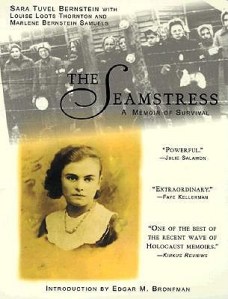
Book Review: The Seamstress

SeamstressI don’t recall where I saw The Seamstress: A Memoir of Survival by Sara Tuvel Bernstein recommended: I think it was probably through some of the What’s On Your Nightstand participants. But when I saw it on sale as an audiobook, I decided to try it. It was very wonderfully read by Wanda McCaddon.

Audiobooks don’t always include prefaces and introductions, but I am glad this one did as the co-author, Louise Loots Thornton, explained how the book came to be. Sara had attended a lecture on the Holocaust where the professor said that, although there were camps during WWII, the Jewish people embellished their experiences and made them sound worse than they were so people would “feel sorry for them and buy things in their stores.” Sara was so angry she decided she must write of her experiences. Louise had an MA in Creative Writing and Sara’s son had married into her family, so Sara asked her to help write her book.

The book begins with Sara’s birth (as Seren, which she is called throughout) and early childhood in Romania, where she was one of the youngest children of a Jewish mill owner. Persecution started early, as schoolchildren called her and her siblings “stinking Jews” or “dirty Jews” (after coming home from her first day of school, she smelled her clothes to see if they were indeed stinky. When her mother asked what she was doing and heard her answer, she waved it off with an “Oh that. Don’t even listen to it. It’s nothing.”) The priests presiding over the classroom and school would continually make disparaging remarks about Jews as “Christ-killers” and would respond negatively to the rabbi’s pleas for them to be let out for Jewish holidays. Periodically roving mobs would vandalize Jewish homes and businesses.

When Sara was in the fourth grade, she entered a contest where she was chosen to represent their school as a student in a more prestigious boarding school in another town. She was its first Jewish student. Things were not terribly different in this school, and when one teacher warned students to keep their distance from Jews during Passover because they used Gentile blood in their rituals, Sara threw an inkwell at him, marched to her room, packed up her things, and left.

She did not go home, however. She decided to try to apprentice as a dressmaking salon and found one salon owner who seemed to size up the situation and take her in. Sara did not tell her parents for a long while, as in the village she came from, young ladies did not work outside the home. When her father finally found out, he was furious: he had not wanted her to go to school there in the first place. But he finally came around.

When Sara completed her apprenticeship, she worked at the salon for many years and enjoyed outings with a group of friends. Many of them began sharing rumors they had heard about strange things happening to Jews in other areas, and then, suddenly, some of their number began disappearing one by one. As persecution escalated, Sara made it back home with the help of her supervisor’s son. There Jewish businesses were being closed down, and Sara and her father were arrested and accused of being spies. They were sent to a labor crew and then to prison. Sara was released, but her father was not. She then had to scramble to find work to support her mother and sisters. Eventually she moved to a different town with better prospects. Because she did not look like a Jew, with her blond hair and blue eyes, she got more work than she would have otherwise. Eventually two sisters  joined her. When she was out with one sister, they were picked up and forced to work with a labor crew for months. When it was discovered her sister was pregnant, she was shot. Sara was released and went back to her other sister, but eventually all the Jews were rounded up and sent to prison camps. Sara, her sister, and two friends were taken to Ravensbruck, a concentration camp for women north of Berlin. I had not known that this camp was only for women and that not many survived: I did know that Corrie Ten Boom and her sister were there, but unfortunately there was not much chance of their meeting as the Jewish prisoners were kept in a separate barracks.

Sara tells of the beatings, starvation, and inhumanity of the camps. She and her sister and friends became a foursome who managed to stay together, although Sara was careful never to stand next to her sister in line-ups for counting (some of which lasted four hours long) so it would be less likely that anyone noticed their resemblance and used their relationship to torture either of them. Sara was the oldest and helped the others know what to do (like choosing a top bunk for the four of them, since the bottom bunks were by windows which caused some of those in them to freeze to death), sought for (and stole, sometimes) food for them.

As the war wound down and Germany was losing, they tried to evacuate the prisoners for seemingly endless days of being packed together in cars with little food and less water. I believe she said they started out with 10,000 women, but by the time they finally stopped they were down to a few hundred because so many died on the way. At every stop the soldiers removed all the corpses.

After the war Sara ended up in a hospital for several months, where she weighed 44 lbs. on arrival, and later found work in Germany. Even at that time, if Jews boarded a bus, the Gentiles would vacate the bus: if Sara stood in line at different stores for provisions, the butcher or grocer would just happen to run out as she finally got to the counter.

Sara married, and eventually she and her husband received permission to emigrate to Canada, and later on to the US. Her daughter fills in details from the rest of her life in the epilogue.

I found this account riveting. Man’s inhumanity to man just astounds me, but Sara faced all of the events in her life with pluck, courage, and wit. She had an independent spirit early on which stood her in good stead through her trials.

Though she was a Jew in ethnicity, unfortunately she was not in her faith. Her daughter shares in the epilogue that her mother continued with many of the Jewish rituals because they were comfortable and familiar, but she didn’t understand why her friend through the horrors of labor camp became devoutly religious. She couldn’t believe in a God who let such things happen, and she felt that if there was a hell, it couldn’t be worse than what she had already experienced. She would be sadly mistaken on that point, and I can only hope she found that out before it was too late. That’s the down side of an independent spirit: one doesn’t recognize or acknowledge that God sends His rain on the just and the unjust, that He was the one who led her to food in unexpected places or to a coat with money sewn in the hem or gave her the will and drive to survive and to help her friends as well. Unfortunately, her experiences with so-called Christians early on caused her to see “the cross was used as a backdrop for persecution of the Jews.” I hope somewhere along the way someone was able to share its true meaning with her.

I’ve skimmed through a number of reviews, and some of them mention that she describes some of the horrors as well as the deaths of friends and family seemingly unemotionally. I didn’t get that impression, perhaps due to the narrator’s sympathetic inflections, but I would guess that was perhaps the only way she could write about such gruesome, wrenching details was to distance herself from them a bit in the telling. It is also possible she would not have wanted to seem as if she was embellishing the facts or pulling on readers’ heartstrings with her own emotions: she wanted to details to speak for themselves.

This will probably be one of my top ten books of the year.

(This will also be linked to Semicolon‘s Saturday Review of Books.)