Friday’s Fave Five

Here we are at the last Friday of June already. It’s good to slow down for a moment with Susanne and friends at Living to Tell the Story to think about the blessings of the week before their memory is gone forever. Please feel free to join in!

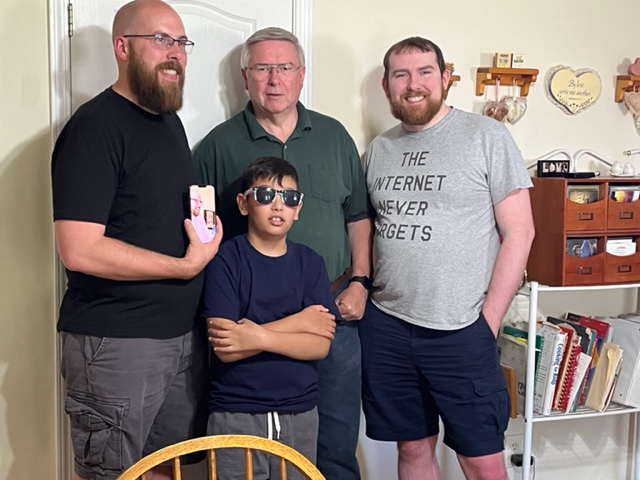
1. Father’s Day. We enjoyed remembering our fathers and honoring my husband and son. I am so thankful for my husband’s showing his love and care and faithfulness every day.

We got to FaceTime with Jeremy (He’s in the picture, on the phone. 🙂 ).

Jason offered to grill burgers, so the rest of us made various sides. I made a Boston Cream Pie and Mittu made Maple Bacon Cupcakes—so good!

2. A fixed washer. Our washer’s spin cycle was so slow, it left clothes soppy. Jim ordered a part and got it working again just before I thought we might need to borrow my son and daughter-in-law’s washer. I’m sure they wouldn’t have minded, but I am glad not to have to haul laundry to their house. The washer is on its last legs, but I am glad it’s hanging in there for a while longer.

3. Consolidated errands. If I am out much of the morning, I like to be home in the afternoon, and vice versa. I ended up being out for both on Wednesday, but it was good to get my errands done all on one day so I could spend the rest of the week at home. Plus Jim acquiesced to my request for Subway sandwiches for dinner, so I had a break for the late afternoon and evening.

4. Getting past summer solstice. I do like having more daylight in the summertime. The lack of light is one of the things I least like about winter. But when the days are longest, it doesn’t feel like there is enough wind-down time in the evenings. It’s nice knowing we’re past the longest day of the year.

5. Getting a haircut has been on my agenda for a couple of weeks, and I finally made it out this week.

Bonus: I mentioned a potential shake-up last week. But it looks like everything will remain the same for now.

Happy Friday! Have you been blessed this week?

Be Distinct (2 Kings and 2 Chronicles)

Be Distinct (2 Kings and 2 Chronicles): Standing Firmly Against the World’s Tides is Warren Wiesrbe’s short commentary on those two books of the Bible.

I read this book while reading 2 Kings 2, so it was nice to have the parallel material from 2 Chronicles, Isaiah, and Jeremiah to fill in the rest of the details.

2 Kings covers a sad time in Israel’s history. The northern kingdom was conquered by the Assyrians, and the southern kingdom of Judah continued its descent from what it had been during the reigns of David and Solomon. A few of Judah’s kings were godly and enacted various reforms away from idolatry and back to the worship of the one true God as He had laid out in His Word. But the next generation would fall away even further than they had before. Finally, Babylon conquered Judah, destroyed the temple, burned Jerusalem, and took most of the Israelites back to Babylon. Different prophets were sent with God’s warnings, but were largely ignored.

It’s not hard to see history repeating itself in our day. America is not Israel, of course. But any people who have had God’s light and turn away from it are going on a similar collision course. As Dr. Wiersbe says:

When society around us is in moral and spiritual darkness, God’s people need to be lights; and when society is decaying because of sin, we need to be salt. We must be distinctive! Paul calls us to be “children of God without fault in the midst of a crooked and perverse generation” (Phil. 2: 15 NKJV). . . .The hour has come for God’s people to be alert to the voice of God and obedient to the will of God—to be distinctive. God is seeking transformers, not conformers (p. 11, Kindle version).

Throughout the book, we also see the grace of God in keeping His promises to David and offering help multiple times.

Some quotes that stood out to me:

The gospel isn’t only a message to believe; it’s also a mandate to obey (p. 19).

During the years that I was privileged to instruct seminary students, I occasionally heard some of them say, ‘Why should we attend school? Charles Spurgeon never went to seminary, and neither did Campbell Morgan or D. L. Moody!’ I would usually reply, ‘If any of you are Spurgeons, Morgans, or Moodys, we’ll no doubt discover it and give you permission to stop your education. But let me remind you that both Spurgeon and Moody founded schools for training preachers, and Campbell Morgan was once president of a training college and also taught at a number of schools. Meanwhile, back to our studies.’ God has different ways of training His servants, but He still expects the older generation to pass along to the younger generation the treasures of truth that were given to them by those who went before, ‘the faith … once for all delivered to the saints’” (Jude 3 NKJV) (p. 21).

Never underestimate the power of a simple witness, for God can take words from the lips of a child and carry them to the ears of a king (p. 53).

To the humble heart that’s open to God, the Word generates faith, but to the proud, self-centered heart, the Word makes the heart even harder. The same sun that melts the ice will harden the clay (p. 74).

[Uzziah] had a wonderful beginning but a tragic ending, and this is a warning to us that we be on guard and pray that the Lord will help us to end well. A good beginning is no guarantee of a successful ending, and the sin of unholy ambition has ruined more than one servant of the Lord (p. 140).

Even though 2 Kings ends on a bleak note, God has not entirely forsaken His people. After 70 years in captivity, they would be allowed to return. And several hundred years later, the rightful ruler of the throne of David would come to earth. He would not to establish His physical kingdom at that time. But He would provide for their salvation.

My God, My Father

I grew up with a mental image of God as a somewhat stern, authoritarian father, looking down from heaven just waiting for me to mess up so He could zap me.

Some people think of God as a kindly and indulgent father, one who never says no, never scolds, slips them money, and always bails them out of trouble.

Some people view God’s fatherhood as that of a dear old man, well-meaning but hopelessly out of touch.

Some feel God is like a father who is capricious and impossible to please.

Others feel that God is a distant Father, either absent or uninvolved and uncaring.

But our Father God is not like any of those.

Our earthly fathers help inform our view of God for better or worse. A faulty father might imprint on our minds a skewed perception of God. A good father will give a positive but still shadowy picture of our heavenly Father.

But it’s good to learn of our Father for who He is.

He loved us enough, even when we were His enemies and totally uncaring about Him, to rescue us from our rebellion and darkness.

Giving thanks to the Father, who has qualified you to share in the inheritance of the saints in light. He has delivered us from the domain of darkness and transferred us to the kingdom of his beloved Son, in whom we have redemption, the forgiveness of sins (Colossians 1:12-14).

See what kind of love the Father has given to us, that we should be called children of God; and so we are. (1 John 3:1a).

He makes us heirs with Christ:

For you did not receive the spirit of slavery to fall back into fear, but you have received the Spirit of adoption as sons, by whom we cry, “Abba! Father!” The Spirit himself bears witness with our spirit that we are children of God, and if children, then heirs—heirs of God and fellow heirs with Christ, provided we suffer with him in order that we may also be glorified with him (Romans 8:15-17).

He keeps us secure.

I give them eternal life, and they will never perish, and no one will snatch them out of my hand. My Father, who has given them to me, is greater than all, and no one is able to snatch them out of the Father’s hand. I and the Father are one. (John 10:28-30).

He wants us to come to Him with our needs.

Your Father knows what you need before you ask him. Pray then like this: “Our Father in heaven . . . ” (Matthew 6:8-9).

But when you pray, go into your room and shut the door and pray to your Father who is in secret. And your Father who sees in secret will reward you (Matthew 6:6).

He provides for us.

And do not seek what you are to eat and what you are to drink, nor be worried. For all the nations of the world seek after these things, and your Father knows that you need them. Instead, seek his kingdom, and these things will be added to you (Luke 12:29-31).

He has compassion on us:

As a father shows compassion to his children, so the Lord shows compassion to those who fear him. Psalm 103:13.

He cares enough for us to discipline us when we need it.

My son, do not despise the Lord’s discipline or be weary of his reproof, for the Lord reproves him whom he loves, as a father the son in whom he delights (Proverbs 3: 11-12).

It is for discipline that you have to endure. God is treating you as sons. For what son is there whom his father does not discipline? If you are left without discipline, in which all have participated, then you are illegitimate children and not sons. Besides this, we have had earthly fathers who disciplined us and we respected them. Shall we not much more be subject to the Father of spirits and live? For they disciplined us for a short time as it seemed best to them, but he disciplines us for our good, that we may share his holiness. For the moment all discipline seems painful rather than pleasant, but later it yields the peaceful fruit of righteousness to those who have been trained by it (Hebrews 12:7-11).

He reassures us:

Fear not, little flock, for it is your Father’s good pleasure to give you the kingdom (Luke 12:32).

He shapes us, surrounding us with care and concern and interest like a potter bending over his creation:

But now, O Lord, you are our Father; we are the clay, and you are our potter; we are all the work of your hand (Isaiah 64:6).

He gives good gifts and doesn’t change moods or character:

Every good gift and every perfect gift is from above, coming down from the Father of lights, with whom there is no variation or shadow due to change (James 1:17).

He comforts us:

Blessed be the God and Father of our Lord Jesus Christ, the Father of mercies and God of all comfort, who comforts us in all our affliction, so that we may be able to comfort those who are in any affliction, with the comfort with which we ourselves are comforted by God (2 Corinthians 1:3-4).

He leads and guides us:

For all who are led by the Spirit of God are sons of God (Romans 8:14).

He blesses us:

Blessed be the God and Father of our Lord Jesus Christ, who has blessed us in Christ with every spiritual blessing in the heavenly places (Ephesians 1:3).

He’s preparing a place for us to live with Him eternally.

In my Father’s house are many rooms. If it were not so, would I have told you that I go to prepare a place for you? (John 14:2).

There was a popular song years ago that said God is watching us from a distance. But no. He is close and personal, caring and concerned.

Is He your father? “But to all who did receive him, who believed in his name, he gave the right to become children of God” (John 1:12).

(I often link up with some of these bloggers.)

Laudable Linkage

Here are a few of the good reads found this week:

First Love. “As I watched all of this unfold, I also watched what being around this young man did for the members of our church and me. There is something contagious about being around someone with that first love. There were several things I noticed in this man’s life that gave me pause to consider my own spiritual life.”

Why You Should Name and Even Feel Negative Emotions, HT to Challies. “I rarely dealt with or named my emotions—at least not the “negative” ones. They had to be killed, banished, ignored, and stuffed. I learned this from both Christian circles (like the counselor above) and my own fears. I didn’t want others to see my emotions. Negative emotions always equaled sin and weakness in my mind, a reason for people to look down their noses at me. So I tried to kill my negative feelings with kindness—or gratitude. But what if there’s goodness in every emotion—even in the ones we don’t like so much?”

When the Story Doesn’t Have a Happy Ending, HT to Challies. “The ‘successful’ missionaries always have lots of numbers. They fill their newsletters with compelling stories and photographs of large groups of believers. But nobody gives presentations about evangelistic events where no one showed up, or posts a picture of the local pastor who abused his daughter, or writes a newsletter about the exciting convert who just slowly disappears.”

Tyranny Follows Where Truth Fades, HT to Challies. “Having escaped the tyrannical regime of North Korea, where criticism of ‘Dear Leader’ can land you (and your family) in a concentration camp, she never anticipated the thought control she’d find at this elite American university.”

Speaking Truth in Marital Conflict, HT to Challies. “We know that when couples use words like alwaysnever, and only to describe each other’s behavior or to express a complaint, it will not help to resolve their conflict. These words exaggerate and overgeneralize in a way that provokes a spouse to defensiveness. Instead of considering and talking about their spouse’s concern, an accused spouse will be tempted to prove that they are not always guilty of this or that behavior.”

What “Leah’s Eyes Were Weak” Means—and What It Says About Bible Interpretation, HT to Challies. Admittedly, the state of Leah’s eyes doesn’t affect any major doctrine. Our opinions about what the statement about her eyes in Scripture means is not a hill to die on. But I appreciate the process Mark Ward takes us through when a passage of Scripture isn’t clear and even commentators disagree.

How Can I Be a Good Father When Mine Walked Out?

How Making an If/Then List Can help Your Mental Health, HT to Linda. “Recently, while going through the grief of a loss and all the emotional turmoil that can entail, I made myself an ‘if/then list.’ I thought through what helps—really helps—me in any given mood or symptom, and then made myself a list with easy, actionable steps to take if I found myself in any of those situations.”

This is as good a time as any for my occasional reminder that linking to a post does not mean full endorsement of everything about that site. If a friend’s link sends me to a site I’ve never visited before, and I consider sharing the post, I’ll look at the “about” section to have some idea where the person is coming from. I wouldn’t share something I have strong reservations about without some caveats, but obviously I don’t know everything about a site when I’ve just read one post there. And we often have some disagreements even with our dearest friends. We need to be discerning in all we read.

I watched a program last night in which what I would consider to be normal father-son love and support brought a couple of people to tears. I wondered if seeing such interaction was so rare in the world that it brought forth such an emotion. Maybe these folks didn’t have that fatherly support–or maybe they did, and the memory brought tears. At any rate, I very much agree with the statement below. Happy Father’s Day tomorrow to the dads out there. Keep up the good work. It’s vital.

Friday’s Fave Five

It’s time to slow down for a moment with Susanne and friends at Living to Tell the Story to think about the blessings of the week before their memory is gone forever. Please feel free to join in!

1. Outside time. I’m very much an indoorsy person. But last Friday night, Jason and Mittu brought take-out barbecue over. Then we all sat on the patio and drew with sidewalk chalk, blew bubbles, and threw Pop-its on the concrete. It was before this week’s heat wave set in, and the sun was on the other side of the house. It was a pleasant evening.

2. Peace and security. There have been some shake-ups behind the scenes here which I can’t discuss just yet. But whatever else happens in life, we know God loves us and will take care of us.

3. Anticipation. We learned for sure this week that my step-father, nephew, and two of my sisters will be coming to visit us this fall. I can hardly wait.

4. Mini candies. I don’t usually make desserts much any more unless it’s a special occasion or we’re having someone over. With just two of us here, we don’t need extra sugar. But we keep Hershey’s miniatures and Reese’s mini peanut butter cups in the pantry when we want a little sweetness.

5. Flowers. My flowers are all doing well, thanks to my husband’s diligent watering. But my petunias, in particular, are flourishing more than they ever have before.

Bonus: Fathers. I am thankful for the fathers, father-figures, and grandfathers in my life and for the fathers my husband and son are. Happy Father’s Day to the dads out there!

The Confessions of St. Augustine

Augustine of Hippo wrote his Confessions partly as an autobiography, partly to express his views on doctrine.

Augustine was born in 354 and grew up in northern Africa. His mother, Monica, was a Christian, but his father was a pagan until close to his death. Augustine was sent to school to study rhetoric and eventually taught grammar and later rhetoric in Carthage, Milan, and Rome.

In the school he was sent to, boys bragged about their sexual exploits, even making up encounters so as to have something to tell. He began a relationship with a mistress that produced one son. He later agreed to forsake his mistress and marry, but the girl he was engaged to was too young. In the meantime, he took another mistress.

He was involved for many years in Manichaeism and astrology.

When Augustine first began to study the claims of Christianity, he was plagued by what the nature of God was, the origin of evil, and the seeming unconquerable hold his lust had on him.

Through reading, study, and conversations with others, he eventually he turned away from Manichaeism, disproved astrology, and came a satisfactory understanding of the nature of God and evil. It took a very long time, however, for him to be willing to give up his lust. He once famously prayed, “Grant me chastity and continence, but not yet.” He tells how this last stronghold was broken and how he came to believe in Christ for salvation and was baptized.

Confessions is written in thirteen books, the first nine autobiographical and the last four philosophical. He was only in his forties when he wrote it and lived until 76, so the book only covers the first half of his life. Wikipedia says Confessions is the “first Western Christian autobiography.” It’s written somewhat like the psalms, with Augustine’s history or thoughts on a subject followed by bursts of penitence or praise. In his introduction, the translator of this edition says:

One does not read far in the Confessions before he recognizes that the term “confess” has a double range of meaning. On the one hand, it obviously refers to the free acknowledgment, before God, of the truth one knows about oneself—and this obviously meant, for Augustine, the “confession of sins.” But, at the same time, and more importantly, confiteri means to acknowledge, to God, the truth one knows about God. To confess, then, is to praise and glorify God; it is an exercise in self-knowledge and true humility in the atmosphere of grace and reconciliation.

Augustine is considered one of the early church fathers. Though a Catholic, he is also claimed by many Protestants as well. Of course, the Reformation wouldn’t happen until the 1500s. But some of the seeds of Protestant thought are in Augustine’s writings, one being the doctrine of original sin.

Confessions was one of those “I probably ought to read that sometime” books. I put it off several times, thinking it would be hard to understand.

The words themselves weren’t hard to understand. The copy I read and listened to was originally translated by Albert C. Outler in 1955 and then included in this version in 2002, so perhaps the archaic language was modernized. But as Outler said in his introduction, “A succinct characterization of Augustine is impossible, not only because his thought is so extraordinarily complex and his expository method so incurably digressive, but also because throughout his entire career there were lively tensions and massive prejudices in his heart and head.” “Incurably digressive” was a good way to put it.

The dialogue and narrative testimony wasn’t hard to understand, either.

But what I found hard to follow were Augustine’s lengthy trains of thought: for example, over 16 Kindle pages pondering what was meant by “The earth was without form and void” in Genesis 1:2, 20 pages on what time is and how it is measured, similar long discourses on memory and many other subjects.

Also, I am not familiar with many of the schools of thought or warring doctrines and philosophies of the times. In fact, I am sorry to say that I know very little about the first millennium AD after the first century or so.

Augustine’s famous quote, “Thou hast made us for thyself and restless is our heart until it comes to rest in thee,” comes from the first page of his confessions. Some of my other favorite quotes:

Thou wast always by me, mercifully angry and flavoring all my unlawful pleasures with bitter discontent, in order that I might seek pleasures free from discontent. But where could I find such pleasure save in thee, O Lord—save in thee, who dost teach us by sorrow, who woundest us to heal us, and dost kill us that we may not die apart from thee.

I especially liked “mercifully angry” and “woundst us to heal us.”

I got a lot from his discussion of the will and struggles with food, especially that “What is sufficient for health is not enough for pleasure.”

He had a section on people with differing interpretations and Scripture and said, “In this discord of true opinions let Truth itself bring concord, and may our God have mercy on us all, that we may use the law rightly to the end of the commandment which is pure love.”

I enjoyed finding an incident I had heard, but did not know came from this book. Augustine’s mother, Monica, had prayed for him for years. She talked to a bishop who had had some of the same struggles as Augustine with the Manicheans. She wanted the bishop to speak to Augustine, but he felt Augustine was unteachable at the moment, and they should just pray for him for now. She cried and begged him, until he said, “It cannot be that the son of these tears should perish.”

There was another illustration I had heard but didn’t realize came from Augustine until I read it here. He tells of a friend, Alypius, who had “a passion for the gladiatorial shows,” but determined they were bad for him and he wouldn’t attend any more. One night he ran into some friends who, with “friendly violence . . . drew him, resisting and objecting vehemently, into the amphitheater” to watch. He determined to keep his eyes closed. But a cry from the audience caused him to open his eyes, and, “as soon as he saw the blood, he drank it in with a savage temper.” He became enamored once again with the violence of the games, receiving “a deeper wound in his soul than the victim.”

There was one famous illustration that I was looking forward to reading that was not in the book. The story is told that, after Augustine’s conversion, he ran into one of his mistresses on the street. He tried to avoid her, but she kept following and calling to him, “Augustine, it is I.” He was said to have answered, “Yes, but it is no longer I.” This article indicates this incident may not have ever happened. On the other hand, it may have come from some of Augustine’s writings that are not searchable online. At any rate, it’s not in his Confessions.

I am not Catholic and therefore couldn’t agree with his distinctly Catholic views. Probably my biggest disagreement is that, though he expressed faith and his life changed before his baptism, he equated salvation with baptism several times in the book. Also, he spends a lot of time near the end of the book interpreting creation allegorically–the firmament is supposed to mean the Bible, the spiritual gifts are supposedly meant by the sun, moon, and stars. etc. He goes into a great deal of explanation as to how he came to these conclusions. But personally, I think we have to be careful not to make something in the Bible symbolic that the Bible doesn’t convey as symbolic. He and his mother also put a lot of stock in visions and dreams, which I don’t.

So, I have mixed views about Augustine. But I am glad to finally have read this book.

I started out listening to the audiobook read by one of my favorite narrators, Simon Vance. I read parts in this 99-cent Kindle version, but didn’t find Augustine’s arguments any easier to follow. The last few pages, I read along while listening to the audiobook. That seemed to be the clearest way for me to gain the most from the book. If I ever read it again—which won’t be for a very long time to come—I’ll have to try it that way from the beginning.

I am counting this book for the Pre-1800 Classic for the Back to the Classics Challenge hosted by Karen at Books and Chocolate.

Have you ever read Augustine’s Confessions? What did you think?

Walking Through the Flames

When we were taking care of my mother-in-law in our home, our caregiver would stay with her on Sunday mornings while we went to church. I offered to trade off with my husband for Sunday evening services, but he always chose to stay home with her. I think he wanted to give me a break since I was with her so much while he was at work.

Jesse, our youngest son, was still home at that time. So he and I had about a twenty minute drive to church. I usually plugged my phone into the car speakers with the music on shuffle. Sometimes I turned the music down and we talked. Sometimes he’d fall asleep or play a game on one of his devices. Sometimes one or both of us would sing along softly.

But when “Walking Through the Flames” came on, we sang along together at full voice.

I’m not sure what about this song inspired our outburst. It’s based on Shadrach, Meshach, and Abednego in Daniel 3 who would not bow down to the king’s idol, even when their lives were threatened. Their faith and their words have inspired believers for centuries:

“Our God whom we serve is able to deliver us from the burning fiery furnace, and he will deliver us out of your hand, O king. But if not, be it known to you, O king, that we will not serve your gods or worship the golden image that you have set up” (Daniel 3:17-18).

If you know the story, “Nebuchadnezzar was filled with fury” (verse 19), ordered the furnace to be heated seven times hotter than normal, and had the three Hebrew men tied up and thrown in.

The furnace was so hot, the men who threw Shadrach, Meshach, and Abednego in died. But the three Hebrew men, instead of immediately succumbing to flames, were walking around untied. And what was more, someone else was with them, and “the appearance of the fourth is like a son of the gods” (verse 25).

Nebuchadnezzar called them out and saw that they were not only unhurt, but they were not even singed. They didn’t even smell like smoke. Then “Nebuchadnezzar answered and said, ‘Blessed be the God of Shadrach, Meshach, and Abednego, who has sent his angel and delivered his servants, who trusted in him, and set aside the king’s command, and yielded up their bodies rather than serve and worship any god except their own God'” (verse 28). He decreed that no one in the land could speak against the God of the God of Shadrach, Meshach, and Abednego without dire consequences. Although Nebuchadnezzar was not a believer yet, the next chapter in Daniel tells how he became one. No doubt this incident had a part in establishing his faith in the one true God.

In “Walking Through the Flames” (words are here), Jeanine Drylie retells the story in song and then applies it to us.

But when the hour of trial comes and fire is all around
We’ll find the place we’re walking on is really holy ground.

And praise be to God that the flames will set us free
And praise be to God, we shall gain the victory.

The version in my playlist is sung by Mac Lynch on a CD by the Wilds Christian Camp titled Praise the Everlasting King. Unfortunately, I can’t find that CD or that version of the song online anywhere. But here’s the song by the Northland Baptist Bible College:

I wrote a couple of posts based on truths from this passage of Scripture: “But If Not,” when our pastor was diagnosed with pancreatic cancer, and From “What If” to “Even If.”

These truths and this song will always minister to me. But my heart will also be warmed by the memory of singing this song along with my son in the car on Sunday evenings.

(I often link up with some of these bloggers.)


When You’re Afraid to Take Communion

I am embarrassed to admit this, but for many years I was hesitant and sometimes outright afraid to take communion. But I thought sharing my experience might help some who have wrestled with the same thing. If you’ve never had troubles with this issue yourself, you might know someone who does.

I became a Christian as a teenager, and most of the churches I’ve attended since then have taken a serious view of communion. We had communion about once a month. Usually the whole church service was built around celebrating communion rather than just tacking it on at the end. By contrast, one church we visited had communion every Sunday, and it was just another part of the service, like passing the offering plates. I much preferred the special emphasis placed on it.

Often, the second half of 1 Corinthians 11 is read before communion (or the Lord’s Table or the Lord’s Supper, as it has also been called). In that passage, Paul recounts how Jesus instituted communion with the disciples the night before He was betrayed. Then Paul issues this solemn warning:

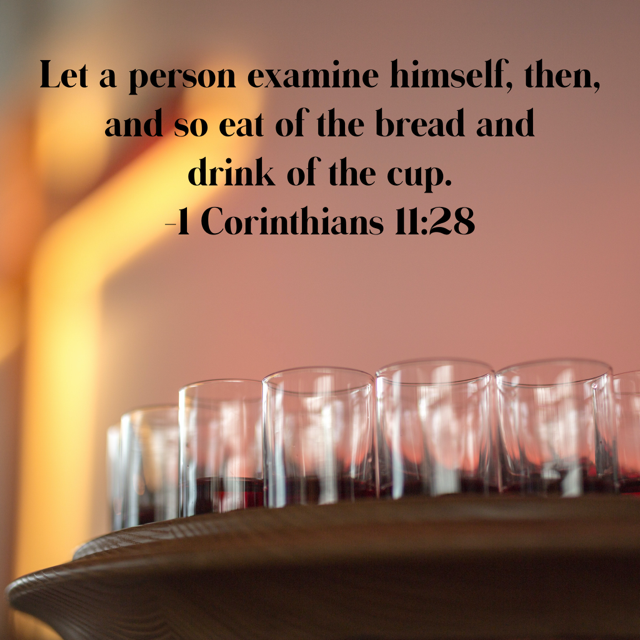
 Whoever, therefore, eats the bread or drinks the cup of the Lord in an unworthy manner will be guilty concerning the body and blood of the Lord. Let a person examine himself, then, and so eat of the bread and drink of the cup. For anyone who eats and drinks without discerning the body eats and drinks judgment on himself. That is why many of you are weak and ill, and some have died. But if we judged ourselves truly, we would not be judged. But when we are judged by the Lord, we are disciplined so that we may not be condemned along with the world (verses 27-32).

The pastor preparing for communion would echo the same warning. Anyone who was saved was welcome to join in, but we were encouraged to examine ourselves beforehand. It would be incongruous to partake of the symbols representing Christ’s body broken and blood shed for us while harboring known sin in our hearts.

In the church we attended after we were married, time was provided during the communion service for self-examination. That was the largest church we attended, and it took time to pass the elements to everyone. Piano music would be playing softly while we waited, and there was plenty of time to pray.

My pastor there compared confession of sin to opening a series of boxes. You open a box only to find another box within. You open that box and find another one, and keep going til there are no more boxes.

As you pray and ask the Lord to search your heart, you confess to Him whatever sin comes to mind. Then you wait and see if anything else comes to mind, and confess that. And so on until nothing else comes to mind. This particular church allowed time for this.

At subsequent churches we attended, there was not much quiet time to pray. Some pastors would have people stand up and share a testimony or a passage of Scripture while we waited for the elements to be passed. Nothing wrong with that, but without that time to pray, I often felt unready to participate unless I went through this self-examination process at home beforehand.

Even with time to pray, though, I often felt unready. What if I missed confessing something? The part of the passage about eating and drinking judgment on ourselves to the point of becoming sick or dying scared me. Ending up in the ER a few days after one communion service fed that fear.

So, often I would refrain from taking the elements as they were passed, just to be safe.

Then our pastor began to address those who refrained from communion. (Had an usher told on me? Was I the only one?) I don’t remember what the pastor said except to encourage people to participate.

Over the years, God graciously helped me overcome this fear. I thought I’d share what helped in case I’m not the only one who has dealt with this.

Unworthily, not unworthy

The KJV that I grew up with translates 1 Corinthians 11:27 as “Wherefore whosoever shall eat this bread, and drink this cup of the Lord, unworthily, shall be guilty of the body and blood of the Lord.” Unworthily is an adverb describing how we partake. Newer translations are clearer in saying “in an unworthy manner.” But for years I struggled with this. Of course, none of us is worthy in ourselves. We’re only made worthy to commune with God because Jesus died for us and has saved and cleansed us—the very thing communion portrays.

The paragraph above this text in 1 Corinthians 11 (verses 17-22) addresses the way the Corinthians partook unworthily. They were making a feast out of communion in a way that showed up who had more vs. who had little. The remembrance of the Lord’s table was dividing people instead of unifying them. Plus some were drinking to the point of getting drunk while others went hungry. The rest of the passage was instruction and reminders of what communion represented and how it was to be partaken of, with reverence and remembrance of the Lord’s death.

So that’s what Paul meant by partaking in an unworthy manner–flippantly, self-indulgently, forgetfully. He didn’t mean that no one who was unworthy of God’s love and forgiveness could partake, because that would include all of us.

I’m not off the hook even if I don’t partake.

If I am examining my heart, asking God to search me, and confessing my sin to Him, and I come across something I am not willing to give up, I’m not off the hook by just not partaking of communion that day. God still wants me to deal with whatever it is and will eventually chastise me if I refuse to submit to Him.

I couldn”t remember every sin anyway.

I’ve always been thankful for the way 1 John 1:9 is phrased: “If we confess our sins, he is faithful and just to forgive us our sins and to cleanse us from all unrighteousness.” When we confess our sins, we’re not likely to remember every little sin. And as we grow in the Lord, we become aware of thoughts and actions that are sinful that we didn’t realize before. But when we confess our sins, God cleanses us from all unrighteousness.

Self-examination doesn’t need to be a long process.

Self-examination is a good thing. But we don’t need to save everything up until communion time. We need to confess sin to God as soon as we’re aware of it and convicted by it. I have become more and more aware that we all have blind spots. Jesus warned people about looking for specks in other people’s eyes when they had big logs in their own. God told people in Malachi what they were doing wrong, but they denied there was a problem. He told the church in Laodicea, “For you say, I am rich, I have prospered, and I need nothing, not realizing that you are wretched, pitiable, poor, blind, and naked” (Revelation 3:17). I’ve been regularly asking the Lord to show me my own blinds spots. When we’re seeking to walk closely with Him every day, asking Him to show us where we fall short, confessing sin to Him as we become aware of it, we won’t need extremely long periods of self-examination before we’re right with God.

Consciences need training.

I’ve discovered about myself that I have an oversensitive conscience. It would make a long post even longer to go into why I say this. The solution to that isn’t to ignore my conscience: conscience is a tool in the hands of God. Ignoring it can lead to the opposite problem of not being sensitive enough. The more I read God’s Word, the more my conscience is trained according to His will so I don’t lapse into legalism on one side or license on the other. (A good book on this subject is Conscience: What It Is, How To Train It, and Loving Those Who Differ by Andrew David Naselli and J. D. Crowley.)

Now, instead of dreading communion, I appreciate the time to remember what Jesus did for me. We get so caught up in the daily cares of life, and we’re such forgetful people, it’s good to get back to basics. I’m thankful that most of the churches I have been in have taken communion seriously. I’m thankful for God’s tender patience as I worked through some of these issues. And I am thankful that most times of communion end with joy and renewed appreciation for God’s grace.

(I often link up with some of these bloggers.)

Laudable Linkage

I have just a few links to share this week:

Prayers That God Will Not Answer. “There are times when it seems like God does not hear us. There are times when it seems like God has become deaf to our prayers and unresponsive to our cries. There are times when we seek but do not find, knock but do not find the door opened. Why is it that God sometimes does not answer our prayers?”

Embodied Discernment: Learning to Discern With Our Hearts. Minds, and Actions, HT to Challies. “Where I went wrong is that my discernment only engaged my mind—and if you’re like me, maybe you’ve gone wrong in this way too. Why is this a problem? Doesn’t discernment only require logic and study?”

5 Steps to Deal with a Distressing Situation. “Based on 1 Samuel chapter 30, I want to share with you these five biblical steps when we face adverse situations which cause great distress and bitterness.”

Patsy at InstaEncouragements is hosting a summer book club reading and sharing insights on Aging With Grace: Flourishing In an Anti-Aging Cultureby Sharon W. Betters and Susan Hunt. Discussion on the first chapter is here. It’s not too late to join in!

Friday’s Fave Five

It’s time to slow down for a moment with Susanne and friends at Living to Tell the Story to think about the blessings of the week before their memory is gone forever. Please feel free to join in!

1. End of school celebration. We had a little party with pizza and confetti cake after Timothy finished his school year.

2. A long talk with an old friend. We had touched base on Facebook, but it was good to have an extended conversation and catch up on all the family.

3. Timothy’s help. Jim bought a big pile of dirt to fill in several paces in our yard. Timothy wanted to bring his shovel over to help. 🙂

4. Not cooking. Jason and Mittu brought dinner the night Timothy helped with the shoveling. Jim was out of town one night, and I splurged with a takeout meal. With dinner for Timothy’s party and takeout Sunday, I’ve had a light week in the kitchen.

5. Humor. One evening when the sky was overcast, I asked Alexa if it was going to rain. It gave me a weather report, but said nothing about rain. Then Jim asked it, “Is it raining?” It said, “It will start raining in half an hour.” I sighed and shook my head and said, “We’re a long way from making a Commander Data,” the human-looking android in Star Trek. Then we began to come up with ways Data might answer like Alexa does:

Captain: Data, fire phasers!
Data: Would you like me to put phasers in your shopping cart?

Captain: Data, are the Borg nearby?
Data: Here’s what I found on the web. . .

Captain: Data, plot a course to Deep Space Nine.
Data: Setting a course for Deep Space Nine. By the way, I can also track meteors.
Captain: Okay, do that.
Data: Go to the Data app on your phone . . .

We shared these on the family group text, and my oldest son added this one:

Captain: Data, slow the ship to one-quarter impulse.
Data: I don’t know any devices named “Ship.”

This reminds me of a quote by Henry Ward Beecher: “A man without mirth is like a wagon without springs, in which everyone is caused disagreeably to jolt by every pebble over which is runs.” I’m thankful for the way humor can turn irritations into a fun exchange.