Laudable Linkage

Here’s another round-up of thoughtful reads.

God Sees the Whole Picture, HT to Challies. “Sometimes our dots line up, and we connect one to the other and the picture is clear. We see what God was trying to do and we say, ‘Oh, I get it. That’s why that had to happen that way.’ That’s why the tire was flat. That’s why I got sick. That’s why I lost my job. ‘Now I understand.’ But other times none of it makes sense. We wait for God to tie up the ends and put a bow on it so we can look at a completed package with spiritual satisfaction, admire the intricate workings of God and justify His actions. But He doesn’t and it doesn’t.”

Wise People Don’t Believe the Best About Everyone. “Heart-broken parents have told me, ‘I didn’t think my parents would hurt their own grandchildren.’ Yet those same parents abused the adults that sat before me when they were children. If they harmed their own child, why would they be different with their grandchild? Discernment feels mean to some people. They don’t want to hurt someone’s feelings. They think good people believe the best. Yet, that is not what Christ practiced.”

Her Weakness Is Her Strength. “Regardless of the cause or degree of the weakness, these are the ones who are to be the special objects of our love, protection, and affection. These are the ones we must accept as a special gift of God to the church. It is to the weakest that we owe the greatest honor, to the frailest that we owe the greatest allegiance, to the ones most likely to be overlooked that we owe the greatest attention.”

You Can Obey, HT to Challies. “We thank Jesus that he came, died for us and transferred his perfect life to our account. And then we can think that we won’t be perfect until glory so we kind of give up trying. Sinners gonna sin, innit.”

6 Truths to Cling to While You’re Praying for Your Prodigal. “God knows exactly where your child is. He has the power to engineer circumstances large and small to pursue your child and draw him or her to Himself. Sometimes the goodness of God leads men to repentance (Rom. 2:4), and sometimes His judgment breaks their stony wills. We can trust God to know which is most effective.”

Why You Still Need the Church Even If You Have Been Hurt by It, HT to Challies. “Yes, we’re imperfect, but imagine how much Jesus must love his people to continue to meet with them despite their blemishes. It’s that same love that Jesus offers you, wounds and all.”

No, I’m Not a Pro: How to Parent Our Children’s Souls, HT to Challies. “My children are immortal beings with eternal souls. I would say this takes my breath away, but I don’t want to give the wrong impression. It feels less like witnessing a pretty sunset at the beach and more like standing at the precipice of a mountain. The view is incredible but my sense of helplessness at the top of sheer rock is almost overwhelming. To be entrusted with the care of souls is beautiful and terrifying at the same time. It is a holy task.”

All of Our Opinions All of the Time, HT to Challies. “I’m not offering an opinion on whether or not Will Smith smacking Chris Rock was okay, I’m offering an opinion on why we should hesitate hopping in on the controversy of the day. . . ‘Is it necessary that every single person on this planet um, expresses every single opinion that they have on every single thing that occurs all at the same time?'”

When Motherhood Goes Unnoticed, HT to The Story Warren. “Our motherhood often goes unnoticed, and we can easily believe the lie that the work of it all isn’t worthy. There are seasons where our faithfulness seems fruitless, our efforts never enough. There is no actual ‘mom-of-the-year’ award, but we all long for it and constantly feel like we fall short. Our hearts are weary, and no one seems to care. But Scripture offers a different perspective and a greater hope than any outward praise and recognition can offer.”

Finally, this is an amazing piece of film work about an amazing phenomenon: time lapse of a spring garden blooming.

Happy Saturday!

Friday’s Fave Five

Yay for the first week of April! Winter is not letting go just yet, but each day is one more step away from it and toward consistently warmer, sunnier days.

We join up with Susanne and others at Living to Tell the Story to recount some of the good things of the week. We’re grieving with Susanne today in the recent loss of her father. She has kindly left the FFF link up for us.

1. Routine medical visits. I can’t say I enjoy any medical visits, but it’s nice when they are done and revealed no new problems to be concerned about. I had my annual eye exam this week and a visit with the dentist not long ago.

2. An unexpected package. I helped a friend with her book launch a few weeks ago, and she sent me some bookmarks and a cute little magnet this week.

3. Food Truck Parks. A new one sprang up between our place and Jason and Mittu’s. They’ve been several times already, and I met them there for dinner one night this week. It’s a nice set-up. I especially appreciate that they have real bathrooms rather than portable ones.

4. Lunch with the family. Jim and Jesse went over to Jason and Mittu’s to set up a trampoline, and I joined them there later for lunch. Mittu made brownies afterward, but Jim and I needed to leave before they were done. So Jason and Mittu brought me a brownie Sunday afternoon. It was big enough to split over two days. (Jim is trying to cut back on sugar, so he declined the brownie offer.)

5. Time alone. I’ve sometimes felt guilty wishing for or enjoying having some time to myself. And then when I am alone for very long, I miss my family. But then I thought, you know what, I don’t have any control over my husband’s travels for work. Of course, I love him and love when he is here. But there are things to enjoy about being together and things to enjoy about solitude. So I decided to just enjoy whichever I was experiencing instead of pining for one or the other. Being by myself most of this week made for light cooking and the opportunity to watch some of the programs I mentioned yesterday that he would not have been interested in. But I am looking forward to having him home tonight (it’s Thursday afternoon as I write this). (Update: he made it home safely.)

And that wraps up another week! How was yours?

March Reflections

March has been springy one day and wintery the next. But I am glad spring is officially here, and soon the weather will settle in to consistently warmer days. We’re enjoying the blooms and buds appearing in the yard and around the neighborhood. Both the warmth and new life are welcome after the cold, drab palette of winter.

We celebrated my husband’s birthday this moth as well as “Pi Day” on 3.14 (really an excuse to eat pie). We didn’t do anything for St. Patrick’s Day this year. In the past I’ve made corned beef and cabbage or at the very least played some of my Irish Tenors CDs.

Otherwise, it’s been a fairly quiet month. Except for car situations. Jason had one tire blow, then had to place an order for new tires, then found the place he orders from had been hacked and closed down. It took a while, but he finally got his tires. Then Jeremy’s car was sideswiped by a hit-and-run driver, thankfully not while he was in it. His car is in the shop now. Then when Jim got out his lawn mowers, both the riding and push lawn mowers didn’t work. After ordering some parts, changing spark plug, etc., he got both of them going.

Timothyisms

While energetically pretending that a cardboard box was a boat in a storm, Timothy said, “My abs are popping out.”

Creating

I just made one card this month for Jim’s birthday. He has taken Timothy fishing once and would like to again soon. So I decided to base his card on fishing.

masculine birthday card about fishing

This Cricut silhouette reminded me of this photo from the former fishing venture:

Watching and Listening

We had some hits and misses in the viewing department. One of the not-so-good ones was The Angel of Auschwitz. The premise was good and based on a true story: Stanislawa Leszczynka was a Polish Catholic midwife who was sent to Auschwitz after being arrested for helping Jews. There she delivered over 3,000 babies. Unfortunately, one of the nurses (?) in the camp was tasked by Mengele with drowning newborns. I didn’t remember until after the film that Mengele was called the “angel of death,” and then realized this film meant to contrast his activities with Leszczynka’s. But I think the film’s makers tried to be too artsy about it. There were a lot of scenes where we didn’t know what was going on, like the agonizingly slow opening.

One that would have made a good candidate for Mystery Science Theater mocking was Flight World War II about a modern-day overseas flight that passes through a weather anomaly and ends up over Europe during WWII. Even suspending disbelief over the premise, there were so many improbable situations and plot holes, we ended up laughing through the last half, even though it wasn’t meant to be a comedy (warning: 3 or 4 bad words).

The only one I recall that we did like was Casablanca. Somehow, even though I was familiar with some of the iconic lines and scenes, I had never seen the whole film. I enjoyed it.

Jim also watched This Beautiful Fantastic with me–not his usual style, but I wanted to see it again, and he tolerated it. 🙂

One night while Jim was away, I watched Finding You, which I had seen recommended by a few people. The film is based on a book by Jenny B. Jones (which I haven’t read), who usually writes Christian YA novels. There is no Christian content in the film except a verse on a tombstone and a vague mention about prayer and not being alone. But the film was sweet and cute. A violinist, failing to get into the conservatory she wanted, takes a course in Ireland. There she meets a teen heartthrob actor doing his latest film with his supposedly girlfriend/costar. The violinist immediately doesn’t like or trust the actor, but circumstances throw them together. She finds there is another side to him–but which is the real man?

I also enjoyed watching Letters to Juliet one night when Jim was away. The premise is based on a place called Juliet’s Balcony in Verona where people leave letters asking advice about their love lives, and “Juliet’s secretaries” answer them. In the movie, an American girl, Sophie, flies with her boyfriend to Verona. He’s a chef and busy looking for supplies, touring vineyards, etc. She goes by herself to Juliet’s balcony, meets the secretaries, and joins them for a while. She finds a 50-year-old letter in a crevice and answers it, leading to the recipient traveling to Italy to search for her long lost love, and she asks Sophie to accompany her. My favorite part is that Vanessa Redgrave plays the older woman, and her long lost love is played by Franco Nero, her real-life husband. They were Guinevere and Lancelot in Camelot in 1967.

Also while Jim was away, I watched the new remake of West Side Story (some great parts and music, but a little vulgar in places) and the 2016 Anne of Green Gables (with Martin Sheen as Matthew). I don’t think any version of AoGG will ever beat the 1985 Megan Follows series. This one was ok in the first half, but changed the “puffed sleeve dress” scenario and the way that Matthew and Marilla decided to keep Anne, plus added in some scenes not original to the book.

Reading

Since last time I finished (titles link back to my reviews):

  • 100 Best Bible Verses to Overcome Worry and Anxiety, a devotional book by various authors. Good.
  • Be Successful (1 Samuel): Attaining Wealth That Money Can’t Buy by Warren W. Wiersbe
  • The Enchanted Places: A Childhood Memoir and The Path Through the Trees, both by Christopher Milne, A. A. Milne’s real-life son, reviewed together here. The first book tells of Christopher’s childhood; the second tells of his adult life. He enjoyed the fame of being “Christopher Robin” at first, but resented it later on.
  • Just 18 Summers by Michelle Cox and Rene Gutteridge, a novel about several families in different stages of child-rearing, realizing the time is short to have an influence on their kids.
  • The Small House at Allington by Anthony Trollope (audiobook), the fifth in his Barsetshire Chronicles, had numerous threads, but the main plot focuses on a widow and her two daughters who live in a small house on the property of her brother-in-law, who owns the manor house and never liked his sister-in-law.

I’m Currently Reading:

  • IBS for Dummies by Carolyn Dean and L. Christine Wheeler. Just picking this one up here and there. I need to get done with it.
  • Another Gospel?: A Lifelong Christian Seeks Truth in Response to Progressive Christianity by Alisa Childers. Excellent so far.
  • Be Restored (2 Samuel & 1 Chronicles): Trusting God to See Us Through by Warren W. Wiersbe
  • I Must Decrease: Biblical Inspiration and Encouragement for Dieters by Janice Thompson
  • Ten Time Management Choices That Can Change Your Life by Sandra Felton and Marsha Sims
  • The Last Chronicle of Barset by Anthony Trollope (audiobook)

Blogging:

Besides book reviews, Friday Fave Fives, and Saturday Laudable Linkage, I’ve posted these since last time:

  • How Well Do We Know Him? We like to be known for who we truly are. But do we know God as He truly is, or our preferred version of Him?
  • We Don’t Know What to Do. When we don’t know how to pray, we can borrow Jehoshaphat’s prayer: “We do not know what to do, but our eyes are on you.”
  • The Dangers of Success. “There are scores of books, articles, blog posts, podcasts, and sermons about dealing with trials and suffering. And that’s good, because we need them. But I don’t know that I have ever seen any material about the dangers of success. What danger can there be in success? Especially success that we’ve prayed and trusted God for?”
  • How Do We Adorn the Doctrine of God? I explored this question after coming across the phrase “adorn the doctrine of God our Savior” in Titus.
  • Comforted by the Ways God Uses Us. I felt out of my element much of my time caring for my mother-in-law. God taught me much through my weakness and inability, but recently I saw ways He used the skill set and personality He gave me.
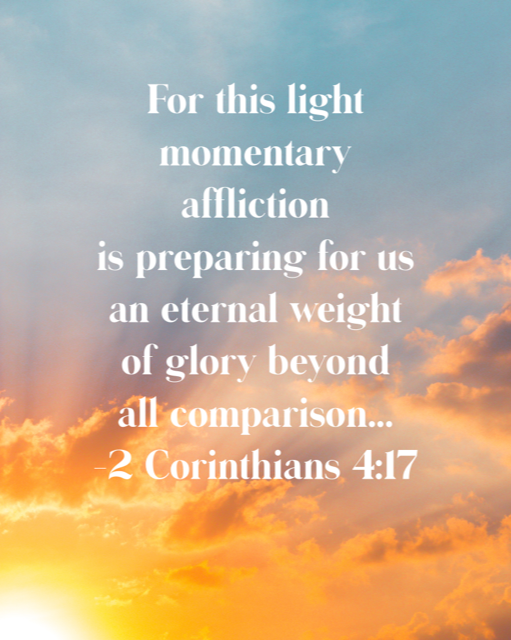
  • From a Weight of Care to a Weight of Glory. When Paul says “this light momentary affliction is preparing for us an eternal weight of glory beyond all comparison” (2 Corinthians 4:17-18), he’s not minimizing our affliction. He’s saying the glory will be that much greater.

Writing

I actually have gotten back into the book I am working on! I’m wrestling with the hardest chapter: it has so much information, I am trying to figure out the best way to present it without having readers’ eyes glaze over (or worse yet, causing them to skip the chapter).

As April comes to a close, we look forward next month to more warmth and growth as well as Easter and Timothy’s birthday.

How was your March?

(I often link up with some of these bloggers.)

From a Weight of Care to a Weight of Glory.

In the midst of Job’s suffering, he remarked, “Man who is born of a woman is few of days and full of trouble” (Job 14:1).

We might sometimes lament, “Why does life have to be so hard?”

God didn’t originally create life to be so troublesome in Eden. But sin affected everything, from the people God created to the earth they lived in (Genesis 3). Humans had work to do before sin entered the world (Genesis 2:15). But it would have been something like working at your favorite hobby with nothing going wrong. However, after sin entered the world, part of God’s curse was that thorns and thistles would spring up and labor would cost sweat and pain (Genesis 3:16-19).

Besides daily work becoming hard, personal relationships would suffer because now everyone would have a sin nature. Misunderstandings, anger, selfishness, pride, and more would war in hearts and against others. The very first person born to Adam and Eve murdered his brother.

And human history went downhill from there.

Each of us has experienced the fallenness of the world.

From early childhood we fall and get scraped up, hear taunts, teasing, and put-downs from other children, get into trouble when we do wrong, feel misunderstood and mistreated.

As teenagers we either strive to get into the popular crowd and then not lose our place, or we lament that we’ll always be on the outside. Then there’s acne, puberty, hormones, questions about the future.

As adults we struggle to make a living against increasing prices. Workplace feuds and misunderstandings crowd out enjoyment in our jobs. Someone else gets the promotion we were due. Someone takes the credit for our idea.

We struggle against our own sin nature and lament the continual pull of selfishness.

As we get older, aches and pains take over our bodies. Sight dims, and we can’t do the things we used to.

Along the way, friends and loved ones get sick and die. Innocent little children get cancer. Car crashes maim or kill loved ones. Murders and wars increase.

We try to share our faith, but people mostly don’t want to hear it. Some will actively persecute us. There are countries where sharing Christianity and handing out Bibles is a crime and conversion is punishable by death.

We have needs. Our families have needs. Friends have needs. Our country has needs and opposite opinions about how to deal with them. Our church has needs. The world at large has needs. Orphans, widows, victims, medical research, so many needs that are more than we can even begin to manage.

When we feel the weight of a fallen world, we’re tempted to just crawl into a corner and wait for it to be over.

But thinking of that weight, Paul says, “ For I consider that the sufferings of this present time are not worth comparing with the glory that is to be revealed to us” (Romans 8:18). In another place he says:

For this light momentary affliction is preparing for us an eternal weight of glory beyond all comparison, as we look not to the things that are seen but to the things that are unseen. For the things that are seen are transient, but the things that are unseen are eternal (2 Corinthians 4:17-18).

Once when we came across this passage in a ladies’ Bible study, one of the women had been going through a terrible physical battle. She was a little hurt and angry that the Bible seemed to brush off her heavy affliction as light.

But Paul isn’t minimizing the affliction. He’s saying our glory will be greater than our affliction. Sin, tears, pain, mourning, loss, problems, as weighty as they are, will seem lightweight and short-lived compared to what we’ll experience when Jesus comes for His own. Speaking of that time, Paul tells the Thessalonians, “Therefore encourage [some translations say ‘comfort’] one another with these words” (1 Thessalonians 4:8).

‘Well,” we might be thinking, “that will be great when we get to heaven. But is there no hope and help til then?”

There is.

Just before that section in 2 Corinthians, Paul says, “So we do not lose heart. Though our outer self is wasting away, our inner self is being renewed day by day” (4:16).

God gives grace and strength to meet every trial. “God is our refuge and strength, a very present help in trouble” (Psalm 46:1).

God invites us to cast our care on Him (1 Peter 5:7).

God gives strength in our weakness. “But he said to me, ‘My grace is sufficient for you, for my power is made perfect in weakness.’ Therefore I will boast all the more gladly of my weaknesses, so that the power of Christ may rest upon me. For the sake of Christ, then, I am content with weaknesses, insults, hardships, persecutions, and calamities. For when I am weak, then I am strong” (2 Corinthians 12:9-10).

Jesus sympathizes with our weakness and promises grace to help in time of need. “Since then we have a great high priest who has passed through the heavens, Jesus, the Son of God, let us hold fast our confession. For we do not have a high priest who is unable to sympathize with our weaknesses, but one who in every respect has been tempted as we are, yet without sin. Let us then with confidence draw near to the throne of grace, that we may receive mercy and find grace to help in time of need” (Hebrews 4:14-16).

Okay, it’s a relief to know we have God’s help to get through this life. But what about joy? Do we just bear with life til it’s over?

No, God gives joy as well. He gives physical blessings: “You cause the grass to grow for the livestock and plants for man to cultivate, that he may bring forth food from the earth and wine to gladden the heart of man, oil to make his face shine and bread to strengthen man’s heart” (Psalm 104:14-15).

He gives comfort in sorrow. “Weeping may tarry for the night, but joy comes with the morning” (Psalm 30:5b).

Joy is one aspect of the fruit of God’s Holy Spirit in believers (Galatians 5:22-23).

He gives us the joy of His presence: “You make known to me the path of life; in your presence there is fullness of joy; at your right hand are pleasures forevermore” (Psalm 16:11). “Then I will go to the altar of God, to God my exceeding joy, and I will praise you with the lyre, O God, my God” (Psalm 43:4).

When the world is too much, we can’t hide our head in the sand. But neither can we solve the world’s problems. We’re not meant to. We only need to walk in fellowship with “God our exceeding joy,” take everything to Him in prayer, and do what He calls us to within our sphere of influence.

As the hymn says:

Pardon for sin and a peace that endureth,
Thine own dear presence to cheer and to guide,
Strength for today and bright hope for tomorrow,
Blessings all mine with ten thousand beside.

Great is Thy faithfulness!
Morning by morning new mercies I see;
All I have needed Thy hand hath provided.
Great is Thy faithfulness, Lord, unto me.

From “Great Is Thy Faithfulness” by Thomas Obediah Chisholm

(I often link up with some of these bloggers.)

Laudable Linkage

Happy Saturday! Here are some good reads I have discovered online recently.

Don’t Waste Your Experience, HT to Story Warren. “In the forums of The Habit Membership, Carey Christian recently posted an essay she had written about her experience as a survivor of the Columbine High School shooting . . . She survived by hiding with classmates in a locked and darkened office for three hours. (You can read the whole essay here.) The heart of the essay, however, is not those three hours of immediate peril, but the fifteen years after.” “It takes time to know what things mean. Writing and reflecting greatly improves your chances of learning what there is to learn from your life.”

Bible Reading Blues? Study Your Stop. “One of the most important questions a Bible reader can ask is what made her stop and walk away midway through. Think back to the last time you abandoned your Bible reading plan—it may have been as recently as this morning. Find your Bible and open to the page where you stopped reading; let’s figure out what went wrong.”

Should Parents Talk to Their Kids About Scary World Events? HT to Story Warren. “Since this digital age has made it virtually impossible to shield our children from disturbing news, parents have no choice but to address the issues head-on. With God’s help, we can provide balance and truth that will empower kids to walk in freedom from fear. Here are some tips to use when talking to children about scary world events.”

The Indispensable, Enduring, and Intervening Work of the Spirit, also from the Story Warren. “Much like the disciples, our heartaches can readily consume our perspective, hijack our story, and overshadow the truth of who God is. When we’re in the midst of hard circumstances, relinquishing our expectations of how things ought be feels frightening and vulnerable. We choose instead, to numb pain, worry obsessively our way through uncertainty, and manipulate people and our environment for a desired outcome. However, what if our insistence on control and holding tightly to our misplaced securities—such as health, finances, work, successes, giftedness, and relationships—hinder us from hearing Jesus? And what if we miss his tender care and reassuring comfort for us?”

Back to the Hospital: A Story of God’s Faithfulness, HT to Challies. A wonderful story of a young woman finding a way to minister as a patient in a mental health hospital.

How Heroes of the Bible Build Faith and Courage in Your Son. “A right understanding of biblical heroes provides a model for many desirable traits that we long for and pray for in our sons. But the Bible is a book about God, not a self-help manual. Scripture provides the faithful reader with a blueprint not just for good behavior, but for godliness.”

Are You Principled or Just a Contentious Jerk? HT to Challies. “The apostle Paul says ‘an overseer must be . . . not quarrelsome’ (1 Tim. 3:2–3). Yet in my experience, quarrelsome people often hide behind the excuse, ‘I’m just principled’ or ‘I’m standing up for the truth when no one else will.’”

When He Loves Someone Else. I don’t know if I have ever seen this topic addressed, but this is a good treatment of it. I don’t remember this incident from Corrie ten Boom’s life—it’s been way too long since I’ve read The Hiding Place.

Busyness . . . God’s Way. “In our hustle culture, the term ‘busy’ often gets a bad rap (and understandably so – sometimes we just flat out are too busy with misplaced priorities!). But just because we aren’t called to hustle and strive and be workaholics doesn’t mean it’s automatically wrong to ‘be busy’. It all comes down to what we are busy doing.”

Finally, this is a cute little film:

Friday’s Fave Five

Last week was overflowing with favorites. This week has been a little more ordinary—not a bad week, but nothing stood out as a favorite at first. But sometimes those weeks that require a little more scrutiny are more rewarding when we find the blessings in them. We join up with Susanne and others at Living to Tell the Story to recount some of those good things.

1. Lack of a long checkout line. When I shop in a certain big store that starts with a W, I dislike that they only have one or two checkout lanes open, usually with very long lines. They have tons of self-checkouts, which I don’t mind using for a few items—but not for a whole cartful. I usually order online and schedule a pickup time. But I needed to look for some non-grocery items, so I decided to shop for my whole list inside. Surprisingly, I got into a line with only one person on front of me, who was nearly done, and my cashier was very efficient. That may have set a record for my shortest time checking out there.

2. A kind driver let me into a very long lane of traffic as I left the store mentioned above.

3. A successful camping trip. Jason and Timothy went on a father-son camping trip last weekend. They did well and had a good time, and Mittu did well by herself.

4. Insurance can be a pain to pay for and deal with. And when my oldest son’s car got sideswiped by a hit-and-run driver, he wasn’t looking forward to everything involved with taking care of the damage. But thankfully insurance does help. And, most thankfully, he wasn’t in the car when it got hit.

5. Fellowship. We had not had our monthly ladies’ Bible study for a few months due to the holidays and our leader’s having a baby in January. But we met this last Saturday. I have to confess that I am not fond of getting up early on a Saturday, which we do so that everyone is free to spend the rest of the day with their families. But once I get there, I really enjoy the time. And then, our church had a fellowship meal Sunday after the morning service. We had missed the last one due to a family gathering, and I think we may have missed one in December for the same reason. We really enjoyed the time of fellowship.

Bonus: Drop-in visits. I am so thankful most of our kids live close enough that they can text and ask if they can drop by for a little while. I don’t take that for granted—we didn’t live close enough to either of our parents to do that.

Have you found any blessings in your week?

Comforted by the Ways God Uses Us

We took care of my mother-in-law in our home for five years. Many of you were reading here at that time and offered much prayer, love, and encouragement.

I had a sudden realization about that period of our lives this week. It was such a jolt, and then a comfort, that I thought I’d share it with you.

We had moved my mother-in-law, Colleen, from Idaho, where she lived for 30+ years, to SC, where we then lived, to an assisted living facility. She had to move again when we moved to TN. Then she had to be moved twice when her physical state declined to the point that the facilities could no longer care for her. She ended up in a nursing home, where she declined rapidly. She was 90 lbs. and in a constant fog. We felt she was being neglected, so we brought her home, thinking we were bringing her home to die. But with one-on-one care, she gained weight and became clearer and lived for another five years. I wrote about our experiences, things I learned, challenges we faced, etc., and filed them under Adventures in Eldercare.

My biggest regret from our caregiving experience was that I chafed under most of it. I wanted her to be well cared-for. But I didn’t want to be the one to do it. Of all the things I wanted to be when I grew up, a nurse was never one of them.

Plus, our “nest” was emptying, and though I missed our kids, I had big plans for my free schedule. I was going to write a book and all sorts of things (in the three years since she passed, I still haven’t finished the book, so obviously caregiving wasn’t the main roadblock).

I had to remind myself many times over those years that if caregiving was God’s will for me at that time, that He would give grace to do it; that He doesn’t always place us in positions that use our strengths, but often He puts us where we feel totally weak, that we might find our strength in Him; that caring for one person, even a mostly unresponsive person, in a back room is as much a ministry as preaching to thousands or writing a best-selling book or whatever.

But I can’t say I ever “got” those lessons in a way that stayed with me. I had to repeat them often, sometimes daily.

For some reason, one morning this week my mind wandered to some of the caregivers both in facilities and in our home who . . . let’s say, did not do a good job. I could tell you stories . . . At first I put several of those stories here, but then decided to delete them.

You think, when you’ve researched facilities and placed a loved one in one, that they’ll get the best care possible, that everyone knows what they are doing. But that’s not the case. There are a lot of kind, caring caregivers who do their best. Our dear Jessica, who was Colleen’s main caregiver for 3 1/2 or so years, was a treasure worth her weight in gold. But there were others who were just punching the clock. There were some about whom we wondered what ever brought them into health care in the first place. Did they think it would be an easy job to prepare for or to do? Did they used to be good but then got burned out?

Some of them did a good job as far as the physical things they were responsible for. But they seemed to forget that they were dealing with a person, especially when that person didn’t speak. They’d talk over her to each other instead of to her.

So this particular morning, as my thoughts ran through some of the caregiving situations we encountered, I began to realize that maybe what Colleen had needed most from me was not my nursing care. Maybe what she needed most from me was someone to watch out for her, to advocate for her, to insist that she be cared for in not only the best physical ways, but the most humane ways.

It’s not that we griped to caregiver managers or corrected all the time. We didn’t want to come across as know-it-alls or can’t-ever-be-pleased nitpicky types. We didn’t bring up every single little thing we felt was wrong. We only chose the most vital issues to discuss with the staff at her facilities or at the home health care agency. Still, there seemed to be way too much that we needed to speak to them about.

Years ago, before there were so many personality tests and ways of classifying them as they are now, the main way of sorting personalities was the four spiritual temperaments. I remember poring over Beverly LaHaye’s The Spirit-Controlled Woman. Though no personality classification is perfect, this one made sense to me and seemed a lot simpler than many of the personality classifications today.

My personality, according to that system, was melancholic—an unfortunate name since it sounds like I’m depressed or sad or morose, which I am not. One aspect of melancholics is perfectionism, which, like most personality traits, can be good or bad. Perfectionism can drive one to do the best possible job rather than leaving things done half-hardheartedly. You’d want your brain surgeon to be a perfectionist. But perfectionism can also lead to hyper-criticism and misery when you and everyone else can’t live up to your ideals. This trait “clicked” for me when a guest preacher in our church several years ago, Jim Binney, said that melancholics see things that are wrong and want to set them right.

I felt like much of the care I provided for my mother-in-law felt outside my natural gifts. As I mentioned before, that situation cast me on the Lord like nothing else.

But this particular morning, I realized God had used me in the ways He made me by helping me see the things that were wrong in her care, helping to right them, and eventually bringing her home. It’s not just that this area was one thing I did right in the midst of so much I felt I did wrong or struggled with. But I just felt particularly known and loved and useful in God’s hands. I hope that makes sense.

Whether God uses us as we feel gifted or totally outside our gifts and personality, our sufficiency is from Him.

(I often link up with some of these bloggers.)

How Do We Adorn the Doctrine of God?

Have you ever come across a passage of Scripture that you’ve read for years, even for decades, and then found yourself questioning what a word or phrase meant that you’ve just glossed over before?

I had that experience recently with the last part of Titus 2:10, which says, “in everything they may adorn the doctrine of God our Savior.”

I puzzled over that word “adorn.” My initial thoughts ran something like this: we think of adornments as something we add on, like jewelry or hair ornaments, to make us prettier or more attractive.

But the gospel of God is perfect as it is—we can’t add anything to it to make it better. So what does the Bible mean that we’re to adorn it?

Does “adorning the doctrine of God our Savior” mean making a beautifully stitched or lettered plaque with the gospel message on it? There’s nothing wrong with that, but Paul has a deeper meaning in mind.

I looked up the Greek word for adorn here. In the KJV, it’s translated as “adorn, trim, or garnish.” Other translations say “make attractive.” According to BibleStudyTools.com, the Greek word can mean:

  1. to put in order, arrange, make ready, prepare
  2. to ornament, adore
  3. metaph. to embellish with honour, gain honour

That didn’t help a whole lot. So I looked up the definition of the English word adorn, since translators felt that was a good rendering of the Greek word. According to Dictionary.com, the first definition is the one we usually think of first: “to decorate or add beauty to, as by ornaments.” The second definition shed a little more light: “to make more pleasing, attractive, impressive, etc.; enhance.”

I went back to Titus to look at the verse in context. Titus is a letter from the apostle Paul to one of his helpers, Titus, who was then pastoring in Crete. In chapter 1, Paul stresses the importance of ordaining elders who are men of godly character. He laments those who are “insubordinate, empty talkers and deceivers” (1:10). “They must be silenced, since they are upsetting whole families by teaching for shameful gain what they ought not to teach. . . . Therefore rebuke them sharply, that they may be sound in the faith” (1:11, 13).

By contrast, Titus was to teach “what accords with sound doctrine” (2:1). Paul then goes into instructions for older men and women, younger women and men, so that their works and character lines up with sound doctrine.

Then Paul addresses bondservants. That term makes us bristle these days. I’ve written before about slavery in the Bible, so I won’t repeat all of that here. In an example of God’s timing, I was pondering this passage Wednesday night, and on Thursday morning while making breakfast I heard part of Stephen Davey’s message on Surprising Submission from 1 Peter 2. He explains that slavery in Biblical times was not like slavery as we think of it from the 1800s and before in this country. The Old Testament condemns the type of slavery we usually think of: Deuteronomy 24:7: “If a man is found stealing one of his brothers of the people of Israel, and if he treats him as a slave or sells him, then that thief shall die. So you shall purge the evil from your midst.” So does the New Testament: 1 Timothy 1:8-11 lists enslavers (in the ESV; “menstealers” in the KJV) among those not in accord with sound doctrine. In OT times, often slavery was a way of working off a debt, like an indentured servant. In Rome, Dr. Davey explained, most of the people who weren’t Roman citizens were considered servants. These would be the everyday “worker bees” who made society run smoothly. A relatively small number of Christians was not going to be able to overthrow the Roman economy. God’s instruction was to transform people from the inside out with the truth that everyone is created in the image of God, and in the kingdom of heaven, these distinctions didn’t make any difference.

So, Paul’s instruction to bondservants here doesn’t mean he was condoning the system. His instructions for everyone had to do with how to live within their circumstances in a way that honored and glorified God.

That said, in context this passage says:

Bondservants are to be submissive to their own masters in everything; they are to be well-pleasing, not argumentative, not pilfering, but showing all good faith, so that in everything they may adorn the doctrine of God our Savior.

For the grace of God has appeared, bringing salvation for all people, training us to renounce ungodliness and worldly passions, and to live self-controlled, upright, and godly lives in the present age, waiting for our blessed hope, the appearing of the glory of our great God and Savior Jesus Christ, who gave himself for us to redeem us from all lawlessness and to purify for himself a people for his own possession who are zealous for good works. (Titus 2:9-14).

Even though the word “adorn” is used towards servants, I think it applies to everyone in this passage (and within the church), because Paul’s theme to each group is the same: live lives that are in keeping with God’s truth.

So, then, how do we adorn the doctrine of God our Savior? The whole rest of the letter to Titus tells us how. Here are a few ways:

First of all, we have to believe God’s truth. “And without faith it is impossible to please him, for whoever would draw near to God must believe that he exists and that he rewards those who seek him” (Hebrews 11:6).

Then Philippians 2:12 says, “work out your own salvation with fear and trembling.” That doesn’t mean work for your salvation: salvation is a free gift of God’s grace. Later in Titus Paul writes:

But when the goodness and loving kindness of God our Savior appeared, he saved us, not because of works done by us in righteousness, but according to his own mercy, by the washing of regeneration and renewal of the Holy Spirit, whom he poured out on us richly through Jesus Christ our Savior, so that being justified by his grace we might become heirs according to the hope of eternal life (Titus 3:4-7).

But we work out our salvation. One of our former pastors used to say it’s like working out a math problem to its logical conclusion. We take those high and lofty ideals and work them out into our everyday lives. God is a God of truth, so we live by truth and tell the truth. God is a God of love, so we show love to Him and others.

The word “self-controlled” comes up a lot in this book, and self-control is one facet of the fruit of the Spirit in Galatians 5:16-26. We don’t blast people with angry words when we feel like it. We don’t steal other people’s goods or steal from our employers by not giving them a good day’s work.

We obey the authorities God has placed over us. That’s not always fun, especially when their faults and foibles are obvious. But we work as unto God.

Paul mentions being “well-pleasing.” Does that mean we’re obsequious sycophants? No, but we make a deliberate effort to get along with others. 

Not argumentative,” Paul says. Later in Titus, Paul writes, “But avoid foolish controversies, genealogies, dissensions, and quarrels about the law, for they are unprofitable and worthless. As for a person who stirs up division, after warning him once and then twice, have nothing more to do with him, knowing that such a person is warped and sinful; he is self-condemned” (Titus 3:9-11).  Elsewhere he writes, “Do all things without grumbling or disputing, that you may be blameless and innocent, children of God without blemish in the midst of a crooked and twisted generation, among whom you shine as lights in the world” (Philippians 2:14-15). Ouch. Probably half of social media involves grumbling and disputing. Yet even there we should “shine as lights in the world.”

After exploring the passage in context, I looked up other sources on this verse. Spurgeon has a good sermon on this passage here. I liked what Warren Wiersbe said in his Be Faithful commentary on 1 and 2 Timothy and Titus:

This will “embellish with honor” the Word of God (WUEST). When we serve faithfully, we “beautify the Bible” and make the Christian message attractive to unbelievers. When Paul addressed the slaves in Timothy’s church (1 Tim. 6: 1), he used a negative motive: “that the name of God and his doctrine be not blasphemed.” But the positive motive, to make God’s message attractive, and the negative motive, to keep God’s teaching from being slandered, ought to control our lives.”

I don’t think making the gospel attractive to unbelievers means telling them all their problems will be solved when they believe. That would be a lie. Every believer in the Bible had problems. But the gospel is attractive because in Christ we find forgiveness, peace, righteousness, help, guidance, and so much more.

When I started this study, I leaned toward a definition of adornment as making attractive or honoring. While I think those do apply, I can also see the “put in order, arrange, make ready” aspect of the Greek word for “adorn.” We’re to order and arrange our lives to reflect accurately our Savior and the gospel.

Normally my blog posts aren’t so Bible-study-ish. I’ve thought about trying to rework this into something that might look a little more inspirational to read. But I decided to leave it as is. I don’t find such study dry. Each step opened my understanding a bit more. Now I can not only approach this word with more depth next time I read this passage, but I have an overarching principle to keep in mind as I go about daily life: are my thoughts and actions adorning the gospel or marring it?

How about you? Has a word or phrase or concept in your Bible reading ever sent you off on a study? Had you encountered before what it means to adorn the gospel?

(I often link up with some of these bloggers.)

Laudable Linkage

Here’s my latest collection of good reads found online.

A Better Love Song: Suffering and God’s Great Love For Us, HT to the Story Warren. “Do you pluck from the circumstances sent by our heavenly Father to determine whether he loves you? Some circumstances feel loving, others don’t. When he makes you lie down in green pastures and leads you beside still waters (Ps. 23:2), do you sing, ‘he loves me!’? When he calls you to walk through the valley of the shadow of death (Ps. 23:4), does your heart whisper, ‘he loves me not’?”

How Do I Know I’m Really Repentant? HT to Challies. “What does a repentant heart look like? Does it just look sad? Timid? Is it simply agreeable? How would we discern the difference in ourselves between a heart turning from sin and one seeking simply to manage or alleviate the consequences of it?”

Bible Interpretation Is More Than Stacking Verses, HT to Knowable Word. “We cannot merely stack up Bible verses, making biblical claims based on a handful of verses that are isolated from their immediate and broader biblical contexts. We must interpret the Bible rightly. . . Satan shows us that quoting out-of-context phrases and sentences that seem handy in the moment can be a dangerous game.”

Context Matters: The Heart Is Deceitful Above All Things. “This is no inspirational teaching, so you won’t spot it on posters or mugs. But I see this verse dashed into arguments like salt in soup. Are we using using this verse properly? When we learn to read the Bible like a book and not as isolated bullet points, we’ll see that some familiar phrases don’t mean all that we’ve always assumed.”

Your Suffering Is Valid Even When Others Have It Worse, HT to Maree. “I understand what we are trying to do when we play down our troubles because they are small in comparison to what others are experiencing. We’re trying to put things in perspective so we can be grateful, avoid feeling sorry for ourselves, and be compassionate to others. However, I think minimizing our troubles can sometimes be harmful. It leads us to ignore our feelings, which can increase our stress, cause feelings of self-doubt, harm our self-esteem, and heighten our anxiety.”

Did We Kiss Purity Good-Bye? HT to Challies. “Calls for sexual purity were (and are) biblical and needed. Even in the midst of the good that was done through lots of preaching and discipleship during those years, several lies seemed to spread in the renewed emphasis on purity — each laced with enough truth to be taken seriously and yet with enough deceit to lead some astray.”

4 Traits of an Emotionally Healthy Ministry Worker, HT to Challies. “If you’re serving in ministry, you have likely been encouraged to prioritize your spiritual health. You may have been exhorted to pay attention to spiritual disciplines that will shape you into the best possible leader, teacher, or minister. All of this is good. The Bible implores us to pay careful attention to ourselves (1 Tim. 4:12–16). But spiritual vitality is not the only area of health ministry workers need to pursue. Your emotional health is also essential.”

Can Christians “Do Business” With the World? HT to Challies. “People on both sides of this issue believe that we may not compromise the holy standards of God. We all agree that we must not capitulate to our culture’s definition of right and wrong, and that we must resist calls for Christians to redefine biblical ethics. However, it is one thing to stand strong on what God defines as sin, but it is another to say this requires us to boycott any business that is involved tangentially with sin.”

How to Avoid Misinformation and Disinformation Online, HT to Proclaim and Defend. “God’s ninth commandment—do not bear false witness—is being obliterated by social media (Ex. 20:16). Where untruth takes root, social trust declines. Friends begin doubting friends because we increasingly agree, ‘I can’t tell what’s true anymore.’”

The Surprising Value of Reading Fewer Books, HT to the Story Warren. “Reading more books doesn’t make us (or our kids) a more well-read person. You’re not more well-read than someone who read three books carefully and well if you speed-read ten in the same amount of time. You’re not getting more out of your books simply because you’ve read a taller stack of them. The number of books that our kids read and that we read matters a lot less than the quality of our reading.”

Finally, this adorable kitten reminds me that even though we might not reach a goal on the first effort, each try strengthens us, and one day we’ll get there.

Happy Saturday!

Friday’s Fave Five

Though there’s so much serious trouble in the world right now, it helps to look for the good in our lives. Susanne at Living to Tell the Story invites us to do just that each Friday.

1. Family dinner. Jason and Mittu had us over Friday night for tilapia, potatoes, mixed vegetables, homemade gluten-free rolls, and these cute and tasty gluten-free apple turnovers and blueberry cobbler. I had just been craving apple turnovers! We enjoyed a couple of games as well.

2. A quiet weekend. We had six inches of snow late Friday night to Saturday morning. Because we had been warned ahead of time, we ran all our errands Friday. On Saturday, Jim experimented with the 3D printer he had received on his birthday, and I caught up on some computer stuff and then did some “puttering” around the house—a little mending, tidying the craft/sewing room, figuring out how to set the clock I had in there.

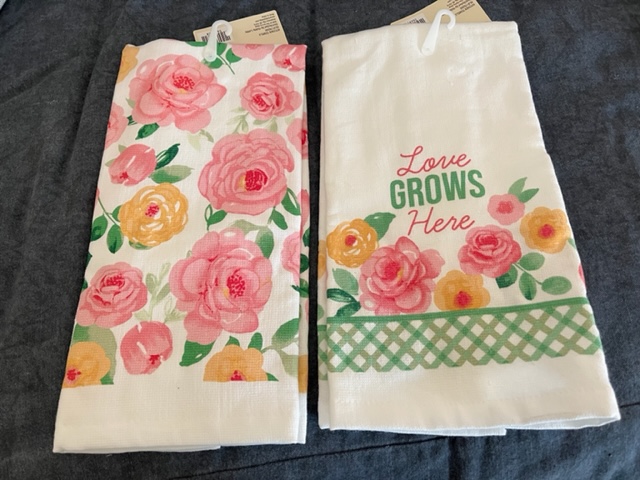
While setting things right in the sewing room, I came across these two dish towels I had bought at Hobby Lobby a few weeks ago, still in the shopping bag. I love shopping for home things from Valentine’s Day through spring, because then I can find them in colors I like—light, pastels, especially pinks that aren’t too orangey or reddish.

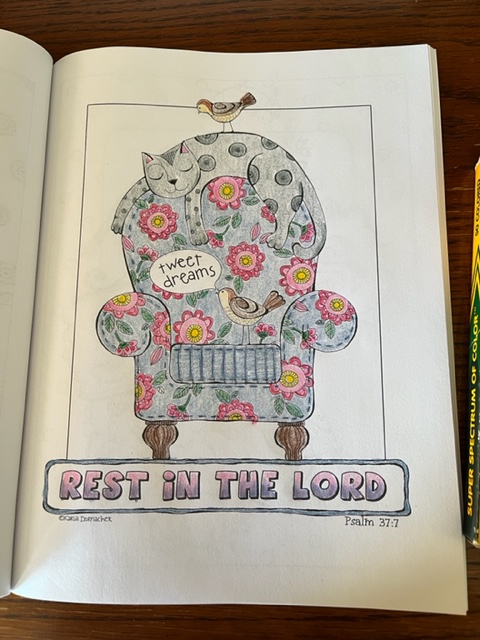
3. A cozy Sunday. Usually after church and lunch, we’ll take a nap, then I’ll read blogs on the computer. Since I had caught up my computer reading Saturday and not much new had come in, I got out my Karla Dornacher coloring books and colored pencils while watching some of her videos about how she does shading. I don’t color often, but I strongly wanted to that day. It was very relaxing. Plus I had fun experimenting with what she calls gradient lettering.

4. Pi Day. Since 3.14 is the number of pi, we use that date as an excuse to eat pie. 🙂 I made hamburger pie for dinner and Mittu made a delicious Mississippi Mud Pie for dessert.

5. A surprise visit. Jesse called Wednesday afternoon to say the power had gone out at his apartment complex (the whole complex, not just his building). He asked if he could come over for dinner and then borrow our cooler in case he needed to transfer items from his refrigerator. We enjoyed having him for dinner and offered him the use of our guest room if he needed it. He decided to go back to his place, and the power was back on by the time he got there. I haven’t heard what caused the outage.

Bonus: Maybe the end of time changes. The Senate passed a bill to make Daylight Savings Time permanent rather than changing our clocks twice a year. The bad thing about DST year-round is that sunrise will occur later in the morning, which is a problem for children waiting for school buses. But a lot of businesses like having more daylight in the evenings. A lot of employees do as well, so they have a little light after work rather than driving home in the dark. I’ll just be glad not to have to adjust both physical clocks and my body clock twice a year.

Have you found blessings in your week? Feel free to share in the comments here or at Susanne’s.